
Why automated billing improves karate studio cash flow

TL;DR:
- Manual billing delays, errors, and missed follow-ups cause significant cash flow issues for karate studios, with automation offering a faster, more reliable solution. Switching to automated billing reduces costs, minimizes errors, and provides real-time insights, enabling scalable growth and better financial management. Implementing automation involves auditing current processes, selecting specialized software, and training staff to ensure a smooth transition before billing problems become overwhelming.
Many karate studio owners are quietly losing thousands of dollars every month, not because they lack students, but because their billing process has gaps. Understanding why automated billing improves karate studio cash flow is the first step to fixing a problem most owners don’t spot until it’s already painful. Manual invoicing creates delays, missed payments, and bookkeeping headaches that quietly drain your revenue. This article breaks down exactly how switching to automated billing changes your financial picture, with practical steps you can act on today.
Table of Contents
- How manual billing creates cash flow challenges for karate studios
- The benefits of automating billing for karate studios’ financial health
- Common billing errors and how automation reduces revenue leakage
- Implementing automated billing: practical steps for karate studios
- Comparing automated billing solutions: key features to look for
- Why too many studios overlook billing automation until it’s a crisis
- Streamline your studio’s billing with DojoTrack’s AI-powered software
- Frequently asked questions
Key Takeaways
| Point | Details |
|---|---|
| Automation speeds processing | Automated billing processes invoices up to 85% faster than manual methods, accelerating cash flow. |
| Reduces costs and errors | Automation cuts billing costs by over 80% and lowers errors that cause revenue loss. |
| Prevents payment aging | Automated recurring billing ensures payments arrive on schedule, preventing overdue account aging. |
| Scales without extra staff | Billing automation lets studios grow membership without increasing administrative headcount. |
| Proactive adoption matters | Transitioning to automated billing early avoids crises and supports sustainable dojo growth. |
How manual billing creates cash flow challenges for karate studios
When you’re running a dojo, billing feels like it should be simple. Send an invoice, collect payment, move on. But manual billing is rarely that clean in practice.
Every invoice you generate by hand adds time between the service rendered and the money in your account. When you’re managing 80, 100, or 200 members, those delays compound fast. One invoice sent late, one follow-up forgotten, one family that slipped through the cracks because you were on the mat teaching. It adds up.
The numbers back this up. Small businesses using manual invoicing are owed an average of more than $17,000 in outstanding payments at any given time. That figure represents real money that has been earned but not collected, sitting in a kind of financial limbo while you still pay rent, utilities, and instructor wages.
Here’s what causes that gap:
- Late invoice sending delays the clock on when payment is due, which delays when you actually receive it
- Missing follow-ups let overdue accounts age without any action
- No consistent reminder system means some families pay late simply because no one reminded them
- Human error in calculations or contact details means invoices bounce or go to wrong amounts
- No real-time visibility into what’s owed makes it hard to know where your cash flow actually stands
The automatic monthly payments benefits for studios are well documented, but many owners still default to manual processes out of habit or because switching feels complicated.
“The longer an invoice goes unpaid, the less likely it is to ever be collected. Accounts receivable beyond 90 days see significantly lower recovery rates.” This is why consistent, timely follow-up is not optional. It’s the difference between getting paid and writing off revenue.
The real damage from manual billing isn’t any single missed invoice. It’s the cumulative effect on your karate studio financial management, where unpredictability makes it nearly impossible to plan hiring, equipment purchases, or growth.
The benefits of automating billing for karate studios’ financial health
Switching to automated billing isn’t just about saving time. It’s about building a reliable financial engine under your studio. The automated billing benefits for cash flow are measurable, not theoretical.

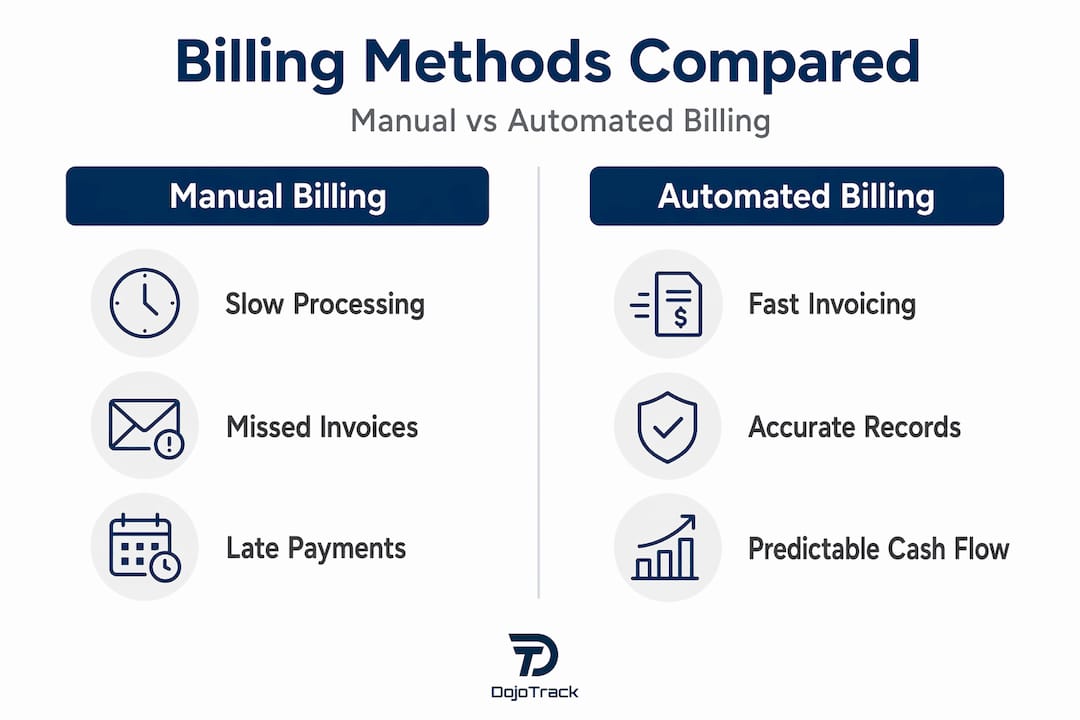
Organizations that move to automated billing can process invoices 85% faster and reduce cost per invoice by around 83%. Manual processing typically costs between $15 and $40 per invoice. Automation brings that down to $2 to $5. At 150 members, that difference adds up to thousands of dollars in recovered administrative cost every year.
Here’s how automation directly supports karate studio revenue growth:
- Recurring billing charges members on a fixed schedule without any manual action required
- Automated reminders go out before, on, and after the due date, reducing late payments
- Real-time dashboards show you exactly who has paid, who hasn’t, and how much is outstanding
- Consistent invoice generation means no payments fall through the cracks during busy periods
- Scalability allows you to add 50 new members without adding 50 more hours of billing work
Automated billing at scale avoids proportional headcount growth, which is one of the most underappreciated billing automation advantages. You grow your membership, and your billing system handles the volume without you needing to hire a dedicated bookkeeper.
| Billing method | Cost per invoice | Processing speed | Error rate | Scalability |
|---|---|---|---|---|
| Manual | $15–$40 | Days to weeks | High | Requires added staff |
| Automated | $2–$5 | Minutes to hours | Low | Scales with membership |
Real-time tracking also changes how you make decisions. When you can see your expected revenue for the next 30 days at a glance, you stop guessing and start planning.
Pro Tip: Set up three automated reminders for each billing cycle: one three days before the due date, one on the day of, and one three days after. This sequence alone can cut late payments by a significant margin without any manual effort from you or your staff.
The benefits of martial arts studio software extend beyond billing, but recurring payment automation is consistently one of the highest-impact features for improving cash flow strategies at the studio level.
Common billing errors and how automation reduces revenue leakage
Even well-intentioned manual billing creates revenue leakage, a term for money that’s earned but never collected due to process failures. It’s one of the most common and most fixable problems in karate studio financial management.
The most frequent manual billing errors in martial arts studios include:
- Missed charges when a student upgrades a membership tier or adds a program, and no one updates the invoice
- Incorrect amounts due to math errors or outdated pricing applied to new cycles
- Late fee miscalculations that either overcharge members (creating disputes) or undercharge (costing you revenue)
- Lost invoices that were sent to an old email address and never resent
- No follow-up on failed payments when a card declines and no one notices for weeks
Manual billing is a primary source of revenue leakage, and automation lowers invoicing costs by up to 70% while reducing the errors that cause that leakage. The math is straightforward: fewer errors means less time disputing charges, less revenue written off, and fewer members who leave frustrated by billing confusion.
Automation shifts billing errors from unpredictable human mistakes to configuration errors that follow a pattern. When your system applies the wrong rate to every invoice, you can find it and fix it in one place. When a staff member makes random errors across 40 invoices, there’s no clean fix.
Accurate billing is also a trust issue. Members who consistently receive correct invoices on time are less likely to question charges or cancel. Billing friction is a real driver of attrition that often goes untracked in studios.
Pro Tip: Audit your automated billing configuration at the start of each quarter. Check pricing tiers, family discounts, and any special program fees to make sure everything still reflects your current offerings.
Billing accuracy connects directly to retention. A student who has a billing dispute is a student who’s already thinking about leaving.
Implementing automated billing: practical steps for karate studios
Knowing the benefits is one thing. Making the switch without disrupting your current members is another. Here’s a practical approach that avoids the most common mistakes.
- Audit your current billing volume. Count how many invoices you generate monthly, how many go out late, and how many require manual follow-up. This tells you how much you stand to gain.
- Involve your front desk and operations team early. They know where the billing headaches actually live. Their input helps you configure billing rules correctly from the start.
- Start with recurring payments. Automate your monthly membership billing first before tackling event fees, testing fees, or retail charges.
- Set up automated reminders. Configure your reminder sequence before you go live so no payment slips by during the transition.
- Train your team on exceptions. Automation handles the routine. Your staff should know how to manage declined cards, payment disputes, and one-time adjustments.
- Monitor your dashboard weekly for the first two months. Look for any accounts that aren’t cycling correctly and correct configurations before they affect more members.
The right time to transition is before your manual processes break down, not after. Studios that wait until billing becomes a crisis are managing it under pressure, which leads to poor configuration decisions and frustrated members.
Common mistakes to avoid during the rollout:
- Skipping a configuration review after setup
- Failing to notify members about the transition and new billing dates
- Not documenting your pricing rules in the system before going live
Pro Tip: Choose software built specifically for martial arts studios rather than a generic billing tool. Features like family account discounts, belt promotion fees, and testing cycle billing are built in, instead of requiring workarounds. Review tips for successful automation adoption to set yourself up for a smooth transition.
Comparing automated billing solutions: key features to look for
Not all billing software is built the same. Before you commit, here’s what to evaluate for your karate studio specifically.
| Feature | Why it matters for your studio |
|---|---|
| Recurring billing automation | Charges members on schedule without manual action |
| Payment gateway integration | Accepts credit cards and ACH payments reliably |
| Automated reminders and dunning | Follows up on overdue invoices without staff intervention |
| Real-time reporting dashboard | Shows outstanding, collected, and projected revenue at a glance |
| Scalability | Handles more members without more admin time |
| Security and PCI compliance | Protects member payment data and reduces liability |
| Martial arts specific features | Manages memberships, belt fees, and family discounts natively |
Billing automation that scales without adding headcount, and integrates with accounting systems and payment gateways, is the baseline for any serious solution. Anything that doesn’t meet that standard will create its own friction.
Look for these specific capabilities:
- Flexible billing schedules so you can handle monthly, quarterly, and pay-per-session members
- Family account billing that groups multiple students under one invoice
- Failed payment handling with automatic retry and member notification
- Audit history so you can trace any billing change back to its source
Pro Tip: Prioritize software with martial arts membership management built in. Generic billing tools make you configure around your needs. Purpose-built tools like those covered in dojo management software features already speak your language.
Why too many studios overlook billing automation until it’s a crisis
Here’s an uncomfortable reality most software articles won’t tell you: most studio owners don’t adopt automated billing because they’re too busy. And the busier they get, the less likely they are to fix the billing system causing part of that busyness. It’s a cycle.
Manual billing seems manageable at 30 members. At 80, it’s a strain. At 150, it’s a full-time job someone is doing badly while also trying to do three other things. By the time most studios make the switch, they’ve already lost thousands in uncollected revenue and burned out a staff member managing spreadsheets.
The studios that adopt automation early don’t just save time. They build a financial foundation that makes everything else easier. Payroll planning, equipment investment, instructor hiring: all of these decisions become more grounded when your cash flow is predictable.
What we’ve seen at DojoTrack, built by Jared Reed from direct experience running martial arts schools, is that the emotional resistance to automation is usually about fear of getting it wrong. Owners worry about disrupting members mid-cycle, about losing control over their billing, about systems that feel impersonal. Those concerns are valid but manageable with the right setup.
The shift worth making isn’t just operational. It’s a mindset shift from operator to owner. When your billing runs itself, your attention goes to the mat, to your students, to the community you’re building. That’s where you actually make the most difference. Review the martial arts school automation guide for a broader look at what automation-first operations actually look like.
Automation is not a magic fix. It still requires accurate configuration, occasional audits, and human judgment for edge cases. But as a foundation for financial efficiency in your studio, there’s no better investment you can make right now.
Streamline your studio’s billing with DojoTrack’s AI-powered software
If you’re ready to stop chasing payments and start building predictable cash flow, DojoTrack was built for exactly this. The platform includes Stripe-powered recurring billing, automated payment reminders, real-time revenue dashboards, and family account management, all tailored for martial arts studios. You get the full DojoTrack feature set in one place, with no need to bolt together separate tools. Moving from a manual system is easier than you think with dedicated data migration support that handles your transition without disrupting your members. And if you want to see what improved billing could actually mean for your revenue, the lifetime value calculator gives you a real projection based on your membership numbers.
Frequently asked questions
What is automated billing and how does it differ from manual invoicing?
Automated billing uses software to generate, send, and follow up on invoices without manual input each cycle, while manual invoicing requires preparing and tracking each invoice by hand. The result is faster payment cycles and far fewer errors.
How does automated billing improve cash flow for karate studios?
Automation ensures invoices go out on schedule, reminders fire automatically, and payments are deposited predictably, eliminating the aging accounts receivable that make cash flow unpredictable. Studios get paid faster and more consistently.
Will automating billing reduce the need for staff in my studio?
Automated billing handles volume growth without requiring proportional staff increases, but it doesn’t eliminate the need for human oversight. Your team shifts from processing invoices to managing exceptions and reviewing reports, which is a better use of their time.
Are there risks of errors with automated billing systems?
Yes, but they’re more manageable. Automation converts billing errors from random human mistakes into configuration errors that follow a consistent pattern, making them far easier to identify and fix before they affect your entire member base.
How do I start implementing automated billing in my studio?
Audit your current billing volume first, then select software tailored for martial arts studios, configure your recurring billing rules carefully, and train your team to handle exceptions. Start before your manual process becomes a bottleneck, not after it already has.
Recommended
- Automatic Monthly Payments vs Cash Payments for Martial Arts Studios: Which is Best? | DojoTrack
- AI Powered Martial Arts Software | DojoTrack
- 5 Tips to Get the Most from Your Martial Arts CRM | DojoTrack
- No Extra SMS Fees: DojoTrack’s All-Inclusive Pricing Makes Communication Easy for Martial Arts Schools | DojoTrack