
Why School Owners Need AI Business Tools in 2026

TL;DR:
- AI business tools automate scheduling, billing, lead follow-up, and student tracking, reducing admin work for martial arts schools. They significantly improve enrollment, retention, and operational efficiency by handling routine tasks automatically. Proper implementation supports instructors and boosts school growth through targeted engagement and data-driven insights.
AI business tools are defined as software systems that use machine learning and automation to handle scheduling, billing, lead follow-up, and student tracking without manual input. For martial arts school owners, these tools are no longer optional. School owners spend 40–60% of their time on administrative tasks. That time comes directly out of teaching, mentoring, and growing your school. The industry term for this category is “intelligent automation,” and it covers everything from AI-powered CRM systems to predictive retention analytics. Understanding why school owners need AI business tools starts with recognizing how much operational drag is costing you right now.
How do AI business tools cut administrative work in martial arts schools?
AI automation reduces administrative time by up to 70%, according to research on school management systems. That is not a small efficiency gain. It is the difference between spending your afternoons on the mat and spending them chasing down unpaid invoices.
Here is what AI handles automatically in a well-configured martial arts school:
- Scheduling: AI tools fill class slots, send reminders, and adjust capacity without staff involvement.
- Billing: Recurring billing runs on autopilot through integrated payment processors like Stripe, reducing missed payments and manual follow-up.
- Marketing content: AI generates a month’s worth of social media posts, review request messages, and promotional graphics in roughly 30 minutes.
- Inquiry responses: AI-powered auto-responses reply to new leads within seconds, 24 hours a day, 7 days a week.
The speed of response matters more than most school owners realize. Reducing inquiry-to-response time from hours to seconds directly improves conversion rates. A parent who fills out a contact form at 9 p.m. expects a reply before they move on to the next school on their list.
Pro Tip: Connect your AI tools to a single platform rather than running separate apps for billing, scheduling, and CRM. Disconnected apps create data silos that make your AI insights less accurate and harder to act on.

The operational relief is real. When routine tasks run automatically, you get your time back. You also reduce human error in billing cycles and attendance records, which protects your revenue and your reputation with families.
What are the benefits of AI-driven lead follow-up and student enrollment?
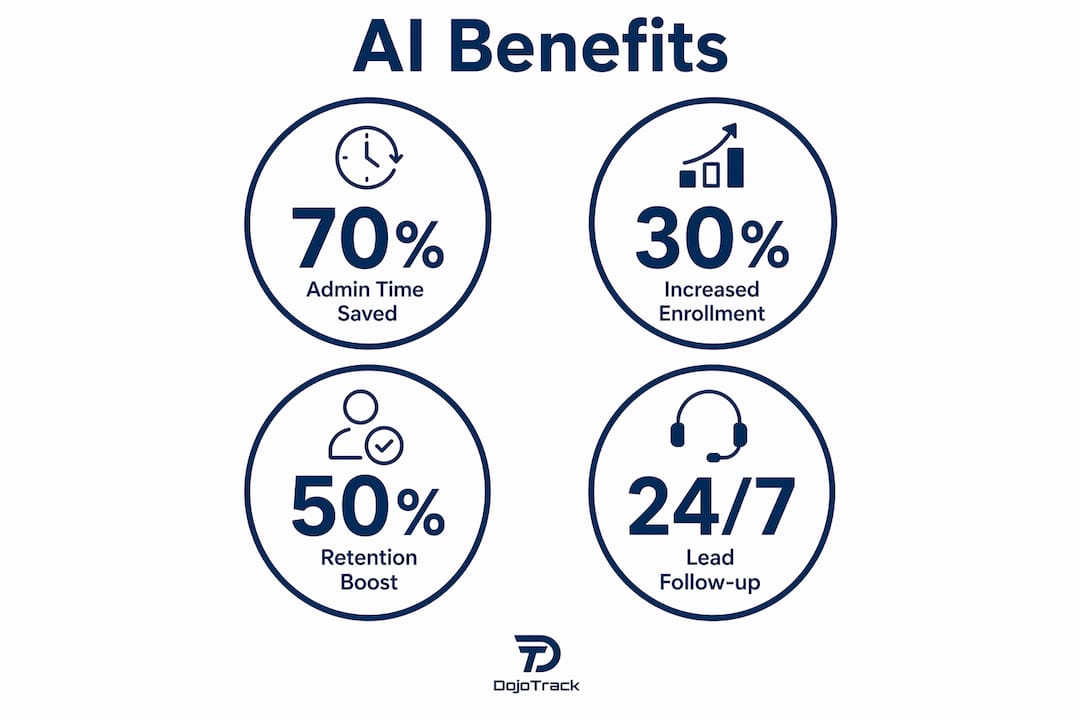
AI-driven lead management is the fastest path to enrollment growth for most martial arts schools. Centers using AI lead follow-up reach conversion rates of 40–55%, compared to 20–30% using manual methods. That gap represents real money.
The revenue math is straightforward:
- Identify your current conversion rate. If you are converting 25% of inquiries manually, you are leaving roughly half your potential students at the door.
- Calculate the revenue gap. A few additional enrollments per month translate to $2,000–$6,000 in added monthly revenue for most schools.
- Compare costs. AI software typically costs $200–$700 per month. The return on that investment is measurable within the first billing cycle.
- Automate the follow-up sequence. AI sends timed SMS messages, emails, and reminders so no lead goes cold because you were busy teaching a class.
- Hand off to a human at the right moment. AI qualifies and warms the lead. Your staff closes the enrollment with a personal conversation.
The last point is critical. AI handles speed and consistency. Humans handle trust. Parents enroll their children in martial arts schools because they believe in the instructor and the culture. AI gets the conversation started. You finish it.
Pro Tip: Use AI for instant response and automated follow-up sequences, but always have a real person make the final enrollment call. That personal touch is what converts a warm lead into a committed student.
The lifetime value of a martial arts student makes this math even more compelling. A student who stays for three years is worth far more than the cost of the AI system that helped enroll them.
How can AI tools improve student retention and performance?
Student retention is where AI delivers its most underappreciated value. Research shows a 28% average increase in academic performance when AI tools provide personalized feedback and adaptive learning support. That finding applies directly to martial arts training, where progress tracking and skill feedback are central to student development.
AI improves retention through three specific mechanisms:
- At-risk detection: AI monitors attendance patterns, engagement signals, and billing behavior. It flags students who are likely to quit weeks before they actually do. Early detection enables intervention 2–3 weeks before churn, giving you time to reach out personally.
- Personalized progress tracking: Students who can see their own belt curriculum progress and skill milestones stay more engaged. A dedicated student app that shows curriculum progress keeps the dojo present in their daily life.
- Conversational feedback: AI-supported learning environments show higher engagement and learning gains when AI provides ongoing feedback that aids instructors rather than replacing them.
The comparison below shows the difference between reactive and AI-driven retention approaches:
| Retention approach | When you act | Outcome |
|---|---|---|
| Reactive (manual) | After a student quits | Lost revenue, empty slot |
| AI-driven (proactive) | 2–3 weeks before churn | Personal outreach, saved enrollment |
AI does not replace your relationship with students. It gives you the data to make that relationship more intentional. When you know a student has missed three classes and their app engagement has dropped, you can call them before they disappear. That call is what keeps them.
What factors determine successful AI adoption in martial arts schools?
The technology is only part of the equation. AI implementation success depends heavily on staff ability to read data dashboards and act on AI recommendations. A tool no one uses delivers no results.
Key factors that determine whether AI adoption works for your school:
- Staff training: Your front desk team needs to understand what the AI is telling them. An at-risk alert means nothing if no one follows up on it.
- Platform integration: Unified platforms produce more accurate insights than a collection of disconnected apps. Choose a system that manages CRM, billing, attendance, and retention in one place.
- Goal alignment: Choosing AI tools that match your specific business goals matters more than choosing the most feature-rich product. A small school needs retention and enrollment tools first. Advanced analytics can come later.
- Ethical boundaries: AI should guide student progress, not replace the critical thinking and mastery work that martial arts training demands. Students still need to earn their belts.
Generic AI tools built for retail or healthcare will not map cleanly onto a martial arts school’s workflow. Belt promotion cycles, attendance tracking by rank, and family membership discounts require purpose-built logic. A generic CRM does not know the difference between a white belt and a black belt candidate.
Pro Tip: Start your AI adoption with progress reporting and retention tracking. These two functions deliver the fastest, most measurable results. Expand to marketing automation and advanced analytics once your team is comfortable reading the data.
The automation guide for martial arts schools covers this phased approach in detail, including which tools to prioritize at each stage of school growth.
Key takeaways
AI business tools are the most direct path for martial arts school owners to recover lost time, increase enrollment, and retain students longer.
| Point | Details |
|---|---|
| Admin time recovery | AI reduces administrative work by up to 70%, freeing hours for teaching and mentoring. |
| Enrollment conversion | AI lead follow-up lifts conversion rates from 20–30% to 40–55%, adding $2,000–$6,000 monthly. |
| Retention advantage | At-risk detection gives you a 2–3 week window to intervene before a student quits. |
| Platform integration | Unified AI platforms produce better insights than multiple disconnected apps. |
| Staff capability | AI tools only work when your team is trained to read and act on the data they generate. |
The real competitive edge is retention, not just enrollment
Running a martial arts school taught us something that most business advice misses entirely. Owners obsess over lead generation when the actual revenue leak is on the back end. A student who quits after four months costs you far more than a lead who never converted. You already spent the time and money to enroll them.
AI changes that equation. When Dojotrack flags a student who has missed two consecutive weeks and stopped logging into the app, that is not a data point. That is a conversation you need to have before the cancellation email arrives. The schools that act on those signals consistently outperform the ones that wait for students to leave and then try to win them back.
The other thing worth saying directly: AI does not make your school better. Your teaching does. What AI does is remove the friction between you and the work that actually matters. When billing runs automatically, when leads get followed up without you thinking about it, and when your retention dashboard tells you who needs attention this week, you spend more time on the mat. That is the point.
Martial arts school owners who treat AI as a replacement for culture and instruction will be disappointed. Owners who treat it as infrastructure, the same way they treat their scheduling software or their payment processor, will see the results show up in their monthly numbers.
— Dojotrack
Dojotrack: AI built for martial arts schools
Dojotrack is an AI-powered martial arts platform built specifically for the way martial arts schools operate. It handles recurring billing through Stripe, tracks attendance by rank, automates belt promotions, scores and follows up on leads with SMS, and flags at-risk students before they quit. Every feature is designed around the martial arts school workflow, not adapted from a generic CRM. School owners in the United States can explore the full feature set for martial arts schools to see exactly how each tool maps to their daily operations. If you want to see what AI-driven management looks like in practice, Dojotrack is built for that conversation.
FAQ
What are AI business tools for school owners?
AI business tools are software systems that automate scheduling, billing, lead follow-up, and student tracking using machine learning. For martial arts school owners, they reduce administrative work and improve enrollment and retention outcomes.
How much time can AI save a martial arts school owner?
AI automation can reduce administrative time by up to 70%. School owners currently spend 40–60% of their time on non-teaching tasks, so the time savings are substantial.
Does AI replace instructors in martial arts schools?
AI does not replace instructors. Research shows AI works best as a support tool that reduces cognitive load and frees instructors to focus on mentorship and teaching rather than paperwork.
How does AI improve student retention specifically?
AI monitors attendance and engagement patterns to detect at-risk students 2–3 weeks before they quit. That early warning gives school owners time to reach out personally and address the issue before a cancellation occurs.
Is purpose-built AI software better than a generic CRM?
Purpose-built platforms outperform generic tools for martial arts schools because they include belt promotion logic, rank-based attendance tracking, and family billing structures that generic CRMs do not support natively.
Recommended
- How AI and Automation Are Changing the Game for Martial Arts Studio Owners | DojoTrack
- AI Analytics for Karate School Growth in 2026
- Best Martial Arts Studio Software for Small Schools: Features, Benefits, and AI Advantages | DojoTrack
- The Ultimate Guide to Martial Arts School Automation: Everything You Need to Succeed in 2025 | DojoTrack