
Two-Way Texting for Gyms and Martial Arts Schools
Two-way texting means your students and prospects can text back, and your staff can answer in the same thread. For a martial arts school, it works best when the texts connect to your student records, your lead list and your billing, so every reply reaches someone who can see who is writing. We built DojoTrack around that idea: SMS follow-ups and email/SMS communications live in the same platform as your CRM, attendance and memberships, not in a separate phone app.
This guide covers what two-way texting is, what to send at each stage, how to handle replies, and the consent rules every US studio must follow.
TL;DR
- One-way texting blasts a message and gets no reply. Two-way texting lets a parent say “can my son switch to the 5 p.m. class?” and get an answer.
- The biggest win is speed with new leads: answer an inquiry within minutes, then keep the thread going until they book a trial.
- Text about things people act on: trial confirmations, class changes, missed classes, belt tests, payment problems and events.
- Under the FCC’s rules, which took effect April 11, 2025, anyone can revoke consent by any reasonable means, and you must honor it.
- Texting costs very little. DojoTrack lists texts at 0.017 USD each and a dedicated number at 2 USD per month.
Table of Contents
- What two-way texting is, and how it differs from one-way
- Why texting fits a martial arts school
- Use case 1: Answering new leads fast
- Use case 2: Class reminders and schedule changes
- Use case 3: Attendance and retention
- Use case 4: Billing and payment issues
- How to handle replies without losing your evenings
- Segment before you send
- The rules: consent, opt-outs and what changed
- What to look for in texting software for a studio
- Phone calls and texts work together
- Our view: texting should live where your students live
- Getting started with DojoTrack
- FAQ
- Sources
What two-way texting is, and how it differs from one-way
One-way texting is a broadcast. You send “Belt test is Saturday at 10” to 200 families, and nobody can answer through that channel. Parents then call, email, message the studio’s social account or catch you after class.
Two-way texting is a conversation. The recipient replies, the reply lands where your team can see it, and a person (or an automation) answers. The same number handles both: your announcement goes out, and the replies come back.
For a studio, the practical differences are these:
| One-way (broadcast) | Two-way (conversation) | |
|---|---|---|
| Parent or student can reply | No | Yes |
| Best for | Closures, event announcements | Trial booking, schedule questions, attendance check-ins |
| Staff workload | Low, but replies scatter to other channels | Replies need an owner and a response routine |
| Lead conversion | Weak: no way to answer a question | Strong: questions get answered while interest is high |
Most studios need both. Broadcasts keep everyone informed. Conversations turn questions into signed-up students.
Why texting fits a martial arts school
Your customers are busy parents, teenagers and working adults. They check their phones all day and rarely check a studio email inbox. A short text gets read and answered between other things.
Studio owners also work in small windows: you teach all evening, and leads usually inquire when you are on the mat. A system that answers the first message automatically and flags the reply for you later keeps the conversation alive until you can step off the floor.
Beyond that, a school’s communication is unusually personal. Parents want to know whether their child is progressing. Adults want to know whether the class is beginner friendly before they walk in. Those are conversational questions, and a broadcast tool cannot handle them.
Use case 1: Answering new leads fast
The moment someone fills in your trial form, they are comparing you with two other schools. Whoever replies first, usually wins the conversation.
A simple lead sequence for a martial arts school looks like this:
- Within minutes of the inquiry: an automatic text that thanks them by name, confirms what they asked for and includes a link to book a free trial class.
- Next day, if no reply: a short, human-sounding follow-up asking one easy question, such as whether the trial is for them or for their child.
- A few days later: a text or email with something useful, such as what to wear to the first class and where to park.
- About a week out: a final message that gives them an easy way to say no or ask for a later date.
The last step matters. A polite exit, such as “Reply ‘later’ and we’ll check back next month,” keeps your list clean and your reputation intact.
In DojoTrack, smart automation connects martial arts leads to your school with SMS booking links, and automated lead scoring helps you see which prospects deserve a personal call first. Pair the text sequence with an email automation playbook so a lead who ignores texts still hears from you.
A sample lead conversation
Studio (automatic): Hi Maria, thanks for your interest in Riverside Karate. Want to try a free class? Pick a time here: [booking link]
Maria: Is the kids class okay for a 5 year old?
Studio (staff): Yes! Our Little Dragons class is for ages 4 to 6. Tuesday and Thursday at 4:30. Want me to save a spot for Thursday?
That exchange takes under a minute and answers the exact thing that was holding Maria back. A form confirmation email would not have.
Use case 2: Class reminders and schedule changes
After enrollment, texting protects attendance. Good reminder texts are specific and short:
- Trial class reminder: the time, the address, what to wear, and a way to reply if they cannot make it.
- Schedule change: “Tonight’s 6 p.m. BJJ is moved to 7 p.m. Reply if that doesn’t work for you.”
- Belt test or event reminder: date, arrival time, cost and any required gear. Our guide to event reminders automation walks through the timing.
- Holiday and weather closures: one text beats ten phone calls.
The two-way part is the reply. When a parent writes “We’ll be 10 minutes late” or “Can we switch to Wednesday this week?”, your team sees it and answers without anyone leaving their train of thought to hunt through voicemail.
Use case 3: Attendance and retention
Students rarely quit on a single day. They drift: two missed weeks, then four, then the billing email bounces back unread. Texting is the cheapest way to catch the drift early.
Useful retention texts include:
- The “we missed you” text after a student skips a set number of classes. Keep it warm: “Hey Jake, haven’t seen you on the mat this week. Everything okay? Your 6 p.m. class is tomorrow.”
- Milestone texts for a new stripe, a belt promotion or a 100th class.
- Re-engagement texts for students who have been away a month or more.
DojoTrack’s AI-driven retention system identifies students at risk of dropping out, so you know whom to text before they are gone. You can also set up attendance alerts so a missed-class pattern triggers a prompt, and read more on membership tracking for MMA gyms to see which numbers to watch.
Use case 4: Billing and payment issues
Nobody enjoys chasing a failed card. A calm text works better than a stern email: “Hi Sam, your card on file didn’t go through for this month’s membership. You can update it here: [link]. Reply here if you have questions.” The reply option makes it feel like a person is on the other end, which keeps the tone friendly and gets the card updated sooner. DojoTrack runs recurring billing through Stripe, so the billing record and the message stay connected.
How to handle replies without losing your evenings
Two-way texting only works if replies get answered. Studios run into trouble when the number belongs to one person’s phone and that person is on the mat or on vacation. Set a few rules:
- Decide who owns the inbox. Name a front-desk person or lead instructor for each part of the day.
- Set a response window you can keep. “Within a few hours during business hours” is better than a promise of five minutes you can’t meet.
- Use a studio number, not your personal cell. DojoTrack lists a rented DojoTrack number at 2 USD per month. A studio number also means the history stays with the school when staff change.
- Keep canned answers ready. Write short replies to the five questions you hear most: pricing, class times, what to wear, age ranges, and trial availability. Edit them to sound like you before sending.
- Escalate by phone when it gets complicated. Billing disputes, injuries and complaints deserve a call. Text “Can I call you in 10 minutes?” and do it.
- Log what matters. A reply like “we’re moving in January” belongs on the student record, not in your memory.
Segment before you send
The fastest way to turn a helpful channel into a nuisance is to text everyone about everything. A Tuesday kids’ class closure matters to those families and nobody else. Build segments around things you already track:
- Program: kids, teens, adults, competition team, BJJ, Taekwondo.
- Stage: lead, trial, new member (first 90 days), active, at risk, lapsed.
- Class day and time: for schedule changes.
- Family or billing status: for payments and family discounts.
Because DojoTrack keeps attendance, membership, belt level and lead status in one platform, those segments come from data you already have rather than a spreadsheet you have to maintain. A sensible cadence for most studios is a handful of texts a month per person, with the heavy traffic reserved for new leads and trial students. For messages that are not urgent, automated email and SMS can carry the routine load.
The rules: consent, opt-outs and what changed
Texting is regulated in the US, and a studio is the sender responsible for compliance. This is not legal advice, so have your attorney review your sign-up language, but these are the points every owner should know.
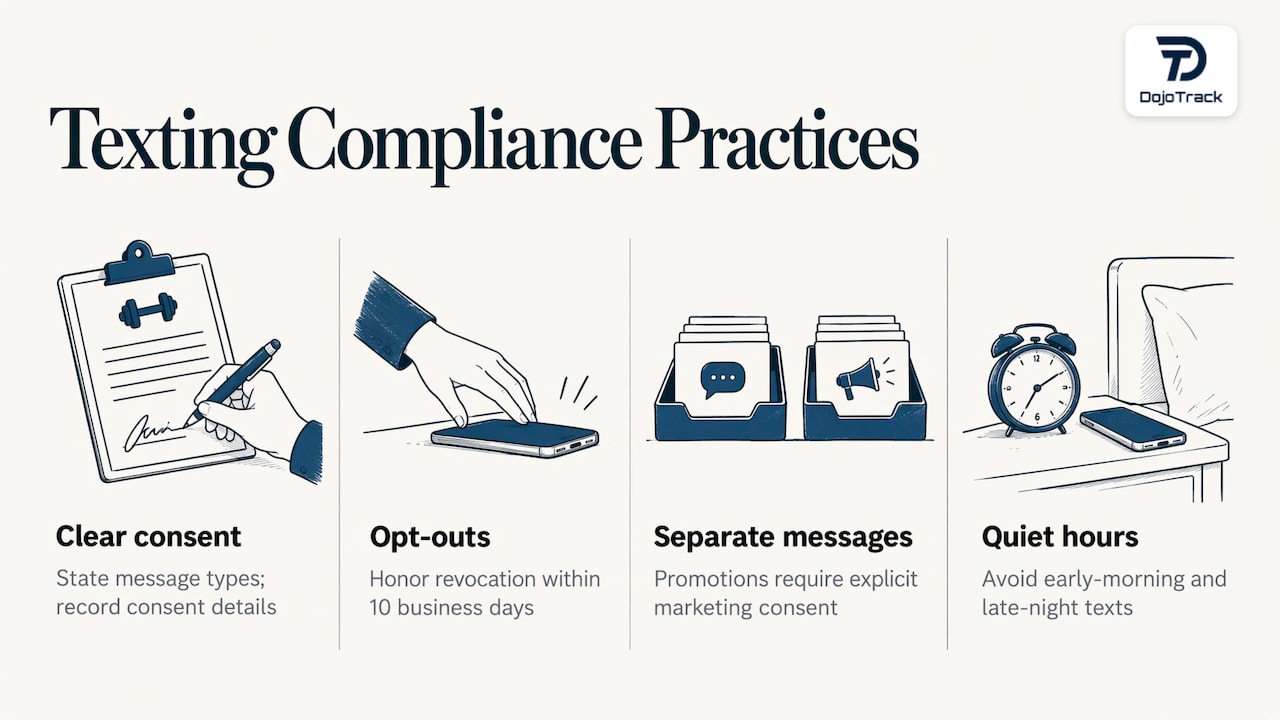
Get clear permission. Collect consent for texts when someone submits a form, signs a waiver or enrolls, and say plainly what kind of messages they will get. Keep a record of when and how they agreed.
Honor opt-outs quickly. The FCC’s rules on revoking consent for robocalls and robotexts took effect April 11, 2025. They mean a person can revoke consent by any reasonable method, not only one keyword. A reply of STOP is the obvious one, but a parent who writes “please don’t text me anymore” has also opted out. Once someone opts out, stop sending marketing texts to them, and process the request promptly: the rule sets a 10 business day window for honoring revocation. A separate provision that would extend a revocation to all channels from the same business has been delayed, so check the FCC’s page for its status.
Separate service texts from promotions. A reminder about tonight’s class is different from a discount offer. Keep your promotional texts tied to explicit marketing consent, and make sure opt-outs are applied across every list a person is on.
Respect quiet hours. Avoid texting early in the morning or late at night. The same courtesy that keeps the parent happy also keeps you out of trouble.
With these habits, texting stays a trusted channel. Without them, it becomes a reason for families to leave.
What to look for in texting software for a studio
A general business texting app can send and receive messages. A studio needs more:
- Replies tied to a person. You should see whether the writer is a lead, a trial student, a white belt or a parent with three kids enrolled.
- Triggers from real events. Missed classes, a new lead, a failed payment, an upcoming belt test.
- Opt-out handling built in, so a STOP reply updates the list without anyone doing it by hand.
- Your own studio number, so conversations stay with the school.
- Costs you can predict. Per-text pricing makes budgeting simple: at 0.017 USD per text, 1,000 messages come to 17 USD.
If you are comparing the wider set of tools a fitness business might use, an overview of project management tools for fitness studios shows how many separate apps owners juggle, which is the problem a single martial arts platform is meant to remove.
Phone calls and texts work together
Some leads prefer to call, and many call after getting a text. If you track which marketing source drives calls, our guide to call tracking for gyms covers setup, costs and legal basics. Likewise, if your emails are landing in spam, texts will carry more of the load than they should, so it is worth reading about gym email deliverability.
Our view: texting should live where your students live
We started DojoTrack because we ran martial arts schools and lived the problem: one app for billing, another for attendance, a spreadsheet for leads, and a personal phone full of texts nobody else could see.
Two-way texting is powerful, but only when it is connected. A reply from a parent means more when you can see their child’s attendance and belt progress beside it. A follow-up to a lead means more when lead scoring tells you who is worth the first call. And a retention text means more when the system has already flagged who is slipping away.
That is why we put SMS, email, billing, attendance, belt tracking and the student app on one platform, built for martial arts rather than adapted from a generic tool. Your time belongs on the mat, teaching. The software should do the remembering.
DojoTrack
Getting started with DojoTrack
DojoTrack offers a Free plan at 0 USD per month, and paid plans that unlock advanced automation, analytics, billing, SMS and the student app: Launch at 95 USD per month, Scale at 125 USD, Expand at 165 USD, Grow at 195 USD and Master at 245 USD. Texts cost 0.017 USD each, and a dedicated number is 2 USD per month. See the full plan and pricing details, or open DojoTrack to set up your studio.
FAQ
What is two-way texting for a gym?
It is texting where the member or prospect can reply, and your team can answer in the same conversation. It replaces one-way blasts that leave questions unanswered. For a martial arts school, it is most useful for lead inquiries, class changes and attendance check-ins.
Is two-way texting legal for gyms in the US?
Yes, when you have the recipient’s consent and honor opt-outs. The FCC’s consent revocation rules took effect April 11, 2025, and let people opt out by any reasonable means. Ask your attorney to review your sign-up language and message types.
How many texts should a martial arts school send?
Keep routine texts to a few a month per person, and save higher volume for new leads and trial students who expect quick back-and-forth. Segment by program and class time so families only hear what applies to them. If someone replies STOP or asks you to stop, end marketing texts right away.
Should I use my personal cell phone for studio texts?
A studio number is the better choice. It keeps conversations with the school instead of one person, lets several staff members respond, and separates your personal life from your business. DojoTrack lists a rented number at 2 USD per month.
What should I text a lead who does not reply?
Send one friendly follow-up the next day with an easy question, then a helpful message a few days later, then a final text that makes it easy to say no or ask to be contacted later. Stop after that.
Sources
- FCC: TCPA rules on revoking consent for unwanted robocalls and robotexts
- Project management tools for fitness studios