
Call Tracking for Gyms: Setup, Costs and Legal Basics

Call tracking for gyms means giving each marketing source its own phone number, so you can see which ad, search or web page made the phone ring, and then follow that call to a signed membership. If your front desk hears “I saw you online” and nothing more, you are guessing where your marketing money works. This guide covers how to set it up, what it costs, what the law says about recording, and how to connect calls to enrollments.
We built DojoTrack for martial arts schools and gyms, so the examples lean toward dojos, academies and combat sports gyms. The method works for any studio that sells memberships by phone.
TL;DR
- Call tracking swaps in a unique number per source (Google Ads, your website, Google Business Profile, flyers) so every call is tied to where it came from.
- Phone leads are often the biggest share of your pipeline. One published case study found 60% of leads came by phone, which means form-only reporting undercounts your marketing.
- Entry-level tools run roughly $30 to $55 per month, so the cost is rarely the obstacle. The follow-up and the record keeping are.
- Recording calls brings consent rules that vary by state. Play a disclosure at the start of every recorded call and you are covered in the strictest states.
- A tracked call only pays off when the caller lands in your CRM, gets followed up, and is marked as enrolled or not.
Table of Contents
- Why gyms and martial arts schools miss their phone leads
- How call tracking works
- What to track for a martial arts school
- Measuring calls from Google Ads
- What it costs
- Recording calls: consent rules you should not skip
- Use call data to train your front desk
- Close the loop: from tracked call to enrolled student
- Where DojoTrack fits
- Our perspective: the call is the start, not the result
- Choosing between call tracking options
- A starter setup for this month
- FAQ
- Sources
Why gyms and martial arts schools miss their phone leads
The typical new-student inquiry does not look like a form fill. A parent searches “kids karate near me,” sees your Google listing and taps the call button. Your instructor is mid-class and the phone rings out. The parent calls the next school on the list.
Two problems sit inside that scene:
- You cannot see the call’s origin. Your website analytics show clicks and form fills. The call button tap shows up as nothing, or as a visit that did not convert.
- You cannot see the outcome. Even if you know a call came in, nobody recorded whether that person tried a class, signed up, or vanished.
The result is a skewed picture. A channel that fills your trial classes by phone looks weak next to a channel that sends form fills. You then cut the wrong budget.
The Delacon case study above is a useful illustration. A service business that tracked its calls found its true cost per lead dropped from $44.50 to $17.80 once phone leads were counted. That is one company’s result, not a promise for your school, but the mechanism is the same: uncounted calls inflate your apparent cost per lead.
How call tracking works
There are three moving parts.
Tracking numbers
You rent several phone numbers that all forward to your real studio line. Each number is assigned to a source. A caller who finds you through a Google ad sees one number, a caller from your Google Business Profile sees another, and a flyer carries a third.
Dynamic number insertion on your website
For your website, a small script swaps the number shown on the page depending on how the visitor arrived. Someone from a paid search click sees one number, someone from organic search sees another. The call is then attributed to the visit, and in better setups to the keyword or campaign.
This is the approach described in guides to call tracking setup: numbers are assigned to channels so a call can be traced back to the ad, keyword or landing page behind it.
Call data you get back
The basics are the caller’s number, time, duration, source and whether it was answered. Add-ons include recordings, transcripts, and AI summaries that sort real prospects from wrong numbers and vendors.
What to track for a martial arts school
Do not start with ten numbers. Start with the sources that cost you money or matter most.
| Source | Why track it | Typical tracking number setup |
|---|---|---|
| Google Ads (call assets and landing pages) | You pay per click, so you need to know which clicks became calls | Google forwarding number or a dedicated tracking number |
| Google Business Profile | Often your top source of “near me” calls | One dedicated number as the primary line, with your main line listed as secondary |
| Website | Shows which pages and campaigns drive calls | Dynamic number insertion |
| Print, flyers, school banners, event sponsorships | Offline spend that is otherwise unmeasurable | One static number per piece or campaign |
| Direct mail or local radio | High cost, so attribution matters most | One number per campaign |
A small school with a single instructor can get real value from three numbers: ads, Google Business Profile and the website. Add more only when you have the time to read the reports.
One caution on your Google Business Profile: check Google’s current guidelines before you change the primary phone number, since listing consistency affects how customers find you. Keep your main number listed as well.
Measuring calls from Google Ads
If you run search ads, Google itself offers call measurement. As of its current help page, Google Ads can count a call as a conversion in two ways: by analyzing the call recording with AI to judge lead quality, or by counting calls that last longer than a duration you set. These show up as “Calls from ads.” The AI lead-quality option requires call recording to be enabled in your account settings.
For a martial arts school, a duration threshold is a sensible starting point. A 20-second call is usually a wrong number or a hang-up. A call of a couple of minutes is more likely a parent asking about class times and pricing. Set the threshold at a level that reflects your own typical inquiry, then check a sample of recordings or logs to confirm it.
If you want a deeper look at setting up numbers for paid media across channels, this walkthrough on call tracking for ads covers TV, radio and digital setups. The principle carries over to a local school running a modest ad budget.
What it costs
Prices move, so confirm on each vendor’s page before you commit. As of Q3 2026, one comparison reports that entry-level plans for small businesses often run $30 to $55 per month, while enterprise tools with advanced AI call intelligence can exceed $1,000 per month.
For a single-location school, you almost never need the enterprise end. Watch for these cost items when you compare options:
- Base monthly fee and how many tracking numbers it includes.
- Per-minute or per-call usage charges once you pass an included allowance.
- Extra numbers, which are usually a small monthly charge each.
- Recording and transcription, sometimes a paid add-on.
- Integrations, since a tool that cannot send data to your ad account or CRM leaves you with a report nobody opens.
When you compare tools, pick on criteria rather than brand: does it do dynamic number insertion, does it connect to Google Ads, can it export or sync call data to your student management system, and can you turn recording off for certain lines?
Recording calls: consent rules you should not skip
Tracking a call’s source is one thing. Recording the conversation is another, and it is where schools get into legal trouble.
Call recording consent differs by state. Many states follow one-party consent, while a group of states requires all parties to agree. One industry source notes that 13 states require all-party consent, and counts vary slightly between sources, so check your state’s current statute. Interstate calls add complexity, since the caller may be in a different state than your studio.
The practical approach many practitioners recommend is to adopt the strictest standard everywhere: play an automated disclosure at the start of every recorded call, for example that the call may be recorded for quality and training. If the caller continues, you have a documented notice.
A few more habits keep you out of trouble:
- Record only intake and marketing calls. Practitioners suggest turning recording off for sensitive conversations, because recordings can become discoverable records. A parent talking about a child’s injury or a billing dispute is not a marketing call.
- Keep a retention rule. Decide how long recordings are stored and who can listen.
- Consider server-side tracking where possible. Industry commentary on tracking compliance notes that well-implemented, server-side tracking improves data reliability and reduces the risk attached to poorly managed client-side trackers. Martial arts schools are not usually covered by health privacy rules, but a school that collects health details on waivers should still handle web tracking with care.
- Ask a lawyer licensed in your state before you roll out recording at scale, especially if you run multiple locations in different states.
This is general information, not legal advice.
Use call data to train your front desk
Recordings are not only for attribution. Listening to ten real inquiry calls will teach you more about your intake than any report.
Listen for:
- How many rings before someone picks up, and how many go to voicemail.
- Whether the person answering asks the caller’s name, age and goal.
- Whether the caller is offered a specific trial class time, or just told to “stop by.”
- Whether a callback number and a follow-up were agreed.
Larger operations report real gains from this. One vendor’s analysis describes contact centers cutting new hire ramp time by up to 29% with AI call analysis. A dojo is not a contact center, but the idea scales down: when a new instructor or front desk helper can hear what a good intake call sounds like, they learn faster.
On AI tools, look for analysis that understands context. The same source explains that older keyword-matching systems throw false positives, whereas newer models read the whole conversation to separate a real prospect from someone just checking a price.
Close the loop: from tracked call to enrolled student
Call tracking alone tells you a call happened. The value comes when the call is connected to your student records and your ad platforms. Without that link, you only see clicks, not the revenue phone conversions generate, and profitable channels can look weak.
Here is a simple workflow a school can run today.
- Log every inbound call as a lead. Name, phone number, source, and who the call was for (kids program, adult jiu jitsu, cardio kickboxing).
- Respond fast to missed calls. A text within minutes beats a voicemail left for the next morning.
- Book a trial class during the call or the text exchange. A specific day and time converts better than “come by anytime.”
- Mark the result. Showed up, enrolled, no-show, not interested.
- Review monthly by source. Cost per call, cost per trial and cost per enrolled student for each tracking number.
Step 5 is where the money decision happens. If Google Business Profile produces twice the enrolled students of your flyer campaign at a fraction of the cost, you know where the next dollar goes. For more on tying marketing spend to results, see this overview of analytics in marketing and ROI.
A worked example
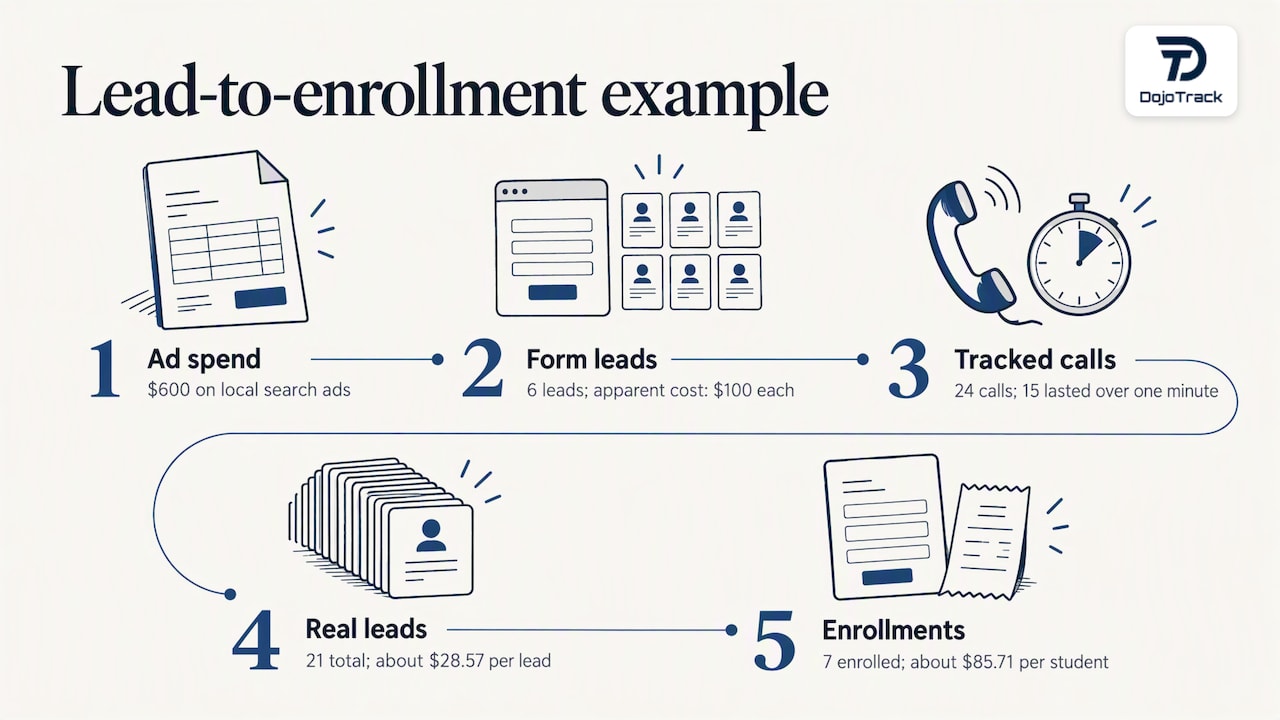
Say you spend $600 in a month on local search ads. Your website form reports 6 leads, so it looks like $100 per lead. Your tracked number logged 24 additional calls, of which 15 lasted over a minute. Counting those, you have 21 real leads, and your cost per lead is about $28.57. If 7 of those enrolled, your cost per new student is about $85.71. The ads you were about to cut were working. (These numbers are an illustration, not client data.)
Where DojoTrack fits
To be clear about scope: we do not sell a call tracking line. DojoTrack is the system that holds everything that happens after the phone rings. It is a martial arts CRM with lead capture and scoring, SMS follow-ups, attendance tracking, belt progression, digital waivers and Stripe-powered recurring billing, so your lead records, trial classes and memberships sit in one place instead of a spreadsheet and three apps.
That matters for call attribution because the final answer to “did this source pay off?” lives in your student records. When a tracked call becomes a lead, and that lead becomes a paying member, you can see the whole path.
If you want to design what happens once a lead is in, our guide to lead nurture sequences gives three studio templates and a launch checklist.
Pricing is public. You can start on the Free plan at 0 USD per month, and paid plans run from Launch at 95 USD per month, then Scale at 125 USD, Expand at 165 USD, Grow at 195 USD and Master at 245 USD per month. Text messages are 0.017 USD per message, and renting a DojoTrack number is 2 USD per month. See the details on our pricing page, or look at DojoTrack overall if you are still deciding.
Our perspective: the call is the start, not the result
We have seen the same pattern in martial arts schools again and again. An owner buys a tool that reports call volume, feels more in control for a month, and then stops looking at it, because call volume does not pay the rent. Enrollments do.
Our view is that the measurement should end at a membership. That is why we built DojoTrack around the student record rather than around the ad dashboard. Founder Jared Reed ran martial arts schools before building the platform, and the frustrations that shaped it were practical: disconnected billing, poor lead follow-up, and administrative work that pulled instructors off the mat.
So our advice is plain. Track calls if you buy ads or sponsor events. Keep the setup small. Record only what you need and disclose it. Then make sure every inquiry ends up in one system, with an owner, a next step and a result. A cheap tracking number and a disciplined follow-up routine will beat an expensive tool nobody reviews.
— DojoTrack
Choosing between call tracking options
You do not need a vendor name to choose well. Sort the options by type:
| Type | Best for | Watch out for |
|---|---|---|
| Google’s built-in call reporting | Schools whose only paid source is Google Ads | Does not cover flyers, mail or organic calls |
| Standalone call tracking service | Schools with several paid and offline sources | Another login, and data that must be synced with your CRM |
| Business phone system with tracking features | Schools replacing an old phone setup anyway | Reporting is often basic |
| AI answering or voice agent | Schools that miss many calls during class | Recorded or AI-handled calls bring consent and disclosure duties |
If you are comparing several tools side by side, make a short checklist: number of tracking numbers included, dynamic insertion, Google Ads link, recording controls, transcript quality, CRM sync or export, contract length and cancellation terms. Test a trial with two numbers before you commit to ten.
A starter setup for this month
- Pick two or three sources: Google Business Profile, your website and one paid channel.
- Assign a tracking number to each and forward them to your studio line.
- Add a recording disclosure if you record.
- Set a minimum call length for what counts as a lead.
- Send missed calls an automatic text, and log every lead in your student management system.
- Review results on the first of each month: calls, trials, enrollments and cost per enrolled student by source.
For the follow-up side, our posts on push notification segmentation and email deliverability for gyms help you keep new students engaged after they join.
FAQ
Is call tracking worth it for a single-location gym or dojo?
Yes, if you spend money on ads, sponsorships or print, or if many of your new students first call rather than fill out a form. Entry-level tools often cost $30 to $55 per month, so one extra enrolled student can cover the cost. If you do no paid marketing at all, start with a simple source question at intake.
Do I have to tell callers I am recording?
In many states you must, and in all-party consent states it is required before recording. Because callers can be in other states, many practitioners suggest playing a disclosure on every recorded call. Check your state’s law or ask a local attorney.
Can Google Ads track phone calls on its own?
Yes. Google can count calls from ads as conversions, either by analyzing recordings with AI or by counting calls over a set length. It covers Google Ads only, so calls from flyers, your profile or organic search need other numbers.
What should I do with calls I miss during class?
Send a text back quickly with a trial class time, and log the lead so someone owns the follow-up. Missed calls that never get a reply are the most common leak in small schools.
Sources
- Delacon: Digital Leaf call tracking case study
- Google Ads Help: Measure calls from ads
- Taqtics: Call tracking software compared
- Inoriseo: Call tracking setup guide
- Convoso: Call recording software and compliance
- Coast: The State of HIPAA-Compliant Marketing Tracking
- Invoca: AI call analysis