
Lead Nurture Sequences: 3 Studio Templates and a Launch Checklist
A lead nurture sequence is a planned series of timely, relevant touches that moves a lead toward one conversion goal. Build yours by setting one goal, segmenting by intent, mapping each message, choosing cadence and triggers, and measuring. Follow this framework and you will convert more leads while wasting less outreach on people who are not ready.
TL;DR:
- For slower decisions, use an 8 to 12 email sequence across eight weeks, then split active readers from silent leads into separate paths.
- Move converters out immediately, shift pricing clickers or replies into warmer flows, and suppress unsubscribers from every sequence before another message goes out.
- Commercial email needs a physical address, working reply method, and opt out available for at least 30 days; send texts only with clear consent.
- Track five measures, but judge success by the conversion tied to your goal; opens and clicks arrive within days, while conversions may take weeks.
Table of Contents
- Why do lead nurture sequences matter for your funnel?
- How do you design a lead nurture sequence step by step?
- Which lead nurture sequence templates can you copy and adapt?
- How should you write each nurture email?
- How do you set cadence, triggers, and the channel mix?
- Which metrics should you track, and how should you test?
- What mistakes hurt nurture sequences, and how do you fix them?
- What should you check before launch, and what copy can you paste?
- What practical automation wins have we seen?
- How does DojoTrack support lead scoring and automated nurture?
- FAQ
- Sources
Why do lead nurture sequences matter for your funnel?
Most leads are not ready to buy the day they raise a hand. They downloaded a guide, booked a trial class, or filled out a form while comparing options. A nurture sequence keeps you present and useful until they are ready, instead of letting the lead go cold or pushing a sales call too early.
Prospects also do their own homework first. Most Americans rely on their own online research when making big decisions, so educational emails that answer questions on their schedule meet buyers where they already are.
Forrester research emphasizes customer success and engagement as key drivers in the B2B buying journey, which supports investing in nurture and follow-up rather than only in acquisition.
A sequence pays off most in these situations:
- A prospect downloads a content piece such as a checklist or guide
- A lead signs up for a free trial or intro offer
- Someone attends a webinar or open house but does not take the next step
- An inbound inquiry arrives that is not yet sales-ready
- A past lead has gone quiet and needs re-engagement
Email stays the backbone of nurturing because it is cheap, measurable, and easy to automate. SMS and push notifications work as accelerators when a lead shows intent and has given consent. A text about a class that starts tonight can land faster than a third email in a row. Treat those channels as a boost to a well-built email flow, never a replacement for it.
How do you design a lead nurture sequence step by step?
You can plan any sequence with the same six steps. Work through them in order, and write the answers down before you open your email tool.
- Define one measurable goal. Pick a single conversion, such as booking a trial class or starting a paid plan, and a metric that proves it worked. A sequence with three goals usually reaches none of them.
- Segment by intent. Group leads by what they did, not who they are. A lead who viewed your pricing page is warmer than one who read a blog post. Start with the segment closest to buying, then expand.
- Map the journey and assign a role to each touch. Decide where the lead starts, where you want them to end, and what each email must accomplish along the way. One email, one job.
- Pick triggers and cadence. Choose which actions start, pause, or move a lead (a form fill, a link click, a missed appointment) and how many days pass between sends when nothing happens.
- Draft message roles. Spread your emails across four jobs: educate, build trust, reduce friction, and convert. Early emails lean on education and trust. Later ones lean on reducing friction and a clear ask.
- Plan measurement and testing. Decide up front which numbers you will watch and what you will test first, so improvement is routine rather than accidental.
A quick example: a martial arts studio might set the goal “book a free intro class,” segment by “requested a trial on the website,” map emails that each remove a worry (cost, skill level, what to wear, schedule), and trigger a text if the lead clicks the schedule link but does not book.
Which lead nurture sequence templates can you copy and adapt?
Use these three frameworks as starting points. Each has a clear job, a timing pattern, and trigger rules. Swap in your own offer, voice, and details.
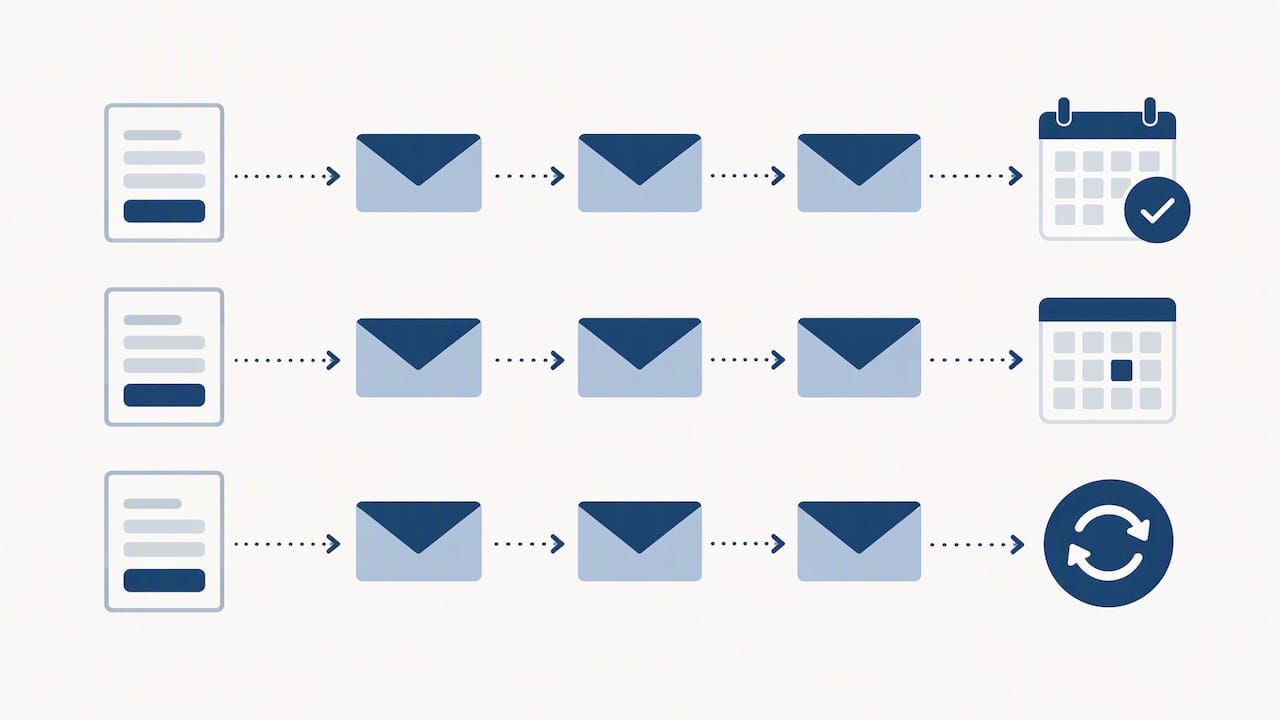
Short welcome sequence. Use this right after a form fill or signup. It delivers immediate value and asks for one small step.
- Deliver what they asked for, plus one line on what to expect next.
- Share a quick win or a short story that builds trust.
- Make a low-friction ask, such as booking a call or class.
Mid-funnel sequence. Use this for leads who need more convincing. It moves from education to social proof to a soft offer.
- Welcome and the problem you solve.
- Send an educational email answering the top question you hear.
- Share a customer story or testimonial.
- Address the most common objection directly.
- Make a soft call to action with a clear next step.
- Send a final reminder with a deadline or limited slot.
Long funnel sequence (8 to 12 emails). Use this for slower decisions or high-consideration purchases. It goes deeper and splits into re-engagement paths.
- Weeks 1 to 2: Education series that builds your credibility
- Weeks 3 to 4: Proof, comparisons, and progressive offers
- Weeks 5 to 8: A re-engagement split, where active readers continue and silent ones get a “still interested?” email
Trigger rules keep these templates honest. Move a lead out of the sequence the moment they convert. Move them to a warmer sequence if they click a pricing link or reply. Drop them into a re-engagement flow after several unopened emails in a row. And always suppress anyone who unsubscribes, from every sequence at once.
How should you write each nurture email?
Every email has five parts: subject, preview text, body, personalization, and call to action. Get each one right and the whole sequence improves.
Inboxes are crowded. Worldwide daily email volume is very large, so your subject line and sender reputation decide whether anyone sees your message at all. Reliable subject line formulas include:
- Question: “Not sure which class fits your goals?”
- Benefit: “Three ways to feel stronger in 30 days”
- Curiosity with substance: “The mistake most beginners make in week one”
- Plain and specific: “Your free class: here is how to book it”
Preview text should extend the subject, not repeat it. Treat it as a second subject line.
For the body, use a simple pattern: a one-line opener that names the reader’s situation, a short block of real value, a single piece of social proof when it fits, and one clear CTA. Keep paragraphs short, since a large share of web traffic comes from mobile devices and your emails and landing pages need to read well on a phone.
Personalization that scales without manual work includes:
- First name, used sparingly in the subject or opener
- Content tied to the action that started the sequence
- Details drawn from a form answer, such as a goal or experience level
- Sender names that match a real person the lead will meet
Pro Tip: Write the whole sequence in one sitting so the voice stays consistent, then read the emails back to back. If email five sounds like a different person wrote it, rewrite it before you launch.
How do you set cadence, triggers, and the channel mix?
Use time-based sends for the backbone and behavior triggers for the moments that matter. A time-based send goes out on a schedule regardless of what the lead does. A behavior trigger fires because of an action, like clicking your pricing link or abandoning a booking form. Behavior triggers feel more relevant, so let them interrupt the schedule whenever intent appears.
Sample cadence patterns to start from:
- Short sequence: send emails at a regular interval.
- Mid sequence: send emails at a regular interval, tightening near the offer.
- Long sequence: send emails less frequently, with extra sends only when a trigger fires.
Add SMS or push only when a lead has given consent and shows real intent, such as a booked-then-missed class or a pricing page visit. One well-timed text beats a daily stream. As a rule, cap messages across all channels so no lead hears from you more than a few times a week.
Compliance is not optional. The federal commercial email rule requires clear identification of advertising content, an opt-out mechanism that works for at least 30 days, and a working return email address or mechanism. Honor every unsubscribe fast, include your physical postal address, and get clear consent before sending texts. For SMS and legal specifics beyond email, check with a qualified professional.
Deliverability depends on all of this. Clean lists, honest subject lines, and quick opt-outs protect your sender reputation, which protects every future sequence.
Which metrics should you track, and how should you test?
Watch five numbers: open rate, click-through rate, conversion rate, unsubscribe rate, and complaint rate. Conversion tied to your single goal is the one that counts. The others tell you why it moves.
- Open rate: a signal for subject lines and sender trust, though privacy features in some inboxes make it noisy
- Click-through rate: shows whether your content and CTA match what the reader wants
- Conversion rate: the share of leads who complete your goal, such as booking a trial
- Unsubscribe and complaint rates: early warnings that cadence is too heavy or content is off target
- Time to convert: how long a lead takes from first email to goal, useful for tuning spacing
Read early and late signals differently. Opens and clicks show up within days and tell you whether a message is working. Conversions can lag by weeks, so judge the sequence as a whole before you rip it apart.
Good test ideas, one variable at a time:
- Subject line style: question versus benefit
- CTA type: “Book a free class” versus “See the schedule”
- Send time: morning versus evening
- Personalization: with a goal-based detail versus without
Keep a simple rhythm. Check dashboards weekly for red flags like a spike in unsubscribes. Run one experiment per month, record the result, and roll the winner into the live sequence.
What mistakes hurt nurture sequences, and how do you fix them?
Most weak sequences share the same few problems. Each has a quick repair.
- Over-emailing. If unsubscribes and complaints climb after a send, your cadence is too aggressive. Widen the gaps between emails, and cut any message that repeats an earlier one.
- Irrelevant content from poor segmentation. When a lead who wants adult classes gets kids’ program emails, they tune out. Rebuild the segment around the action or answer that signals real interest, and move mismatched leads to the right flow.
- Weak calls to action. “Learn more” asks for nothing specific. Rewrite it as a clear next step: “Book your free class” or “Pick a time that works.” Use one CTA per email.
- Ignoring suppression lists and deliverability checks. Sending to unsubscribed, bounced, or already-converted contacts damages your reputation and annoys people. Sync suppression lists before every launch and remove converted leads automatically.
A final habit helps with all four: read each sequence from the lead’s seat. If you received these emails, would each one feel useful and timed well? If not, fix that email first.
What should you check before launch, and what copy can you paste?
Run through this checklist before any sequence goes live.
- Confirm the goal and metric so you know what success looks like.
- Verify segments and entry triggers by testing with a sample contact.
- Check tracking links and conversion events so results are recorded.
- Sync suppression lists for unsubscribes, bounces, and past converts.
- Test exit rules, making sure a converted lead stops receiving emails.
- Send QA copies and review them on mobile and desktop.
Use these snippets as a starting point, each with subject, preview, three-line body, and CTA.
Short welcome: Subject: “Your free class guide is here.” Preview: “Plus what to expect next.” Body: Thanks for signing up. Here is the guide you asked for. Reply with any question. CTA: “Book your free class.”
Mid funnel: Subject: “The question every beginner asks.” Preview: “Short answer inside.” Body: Most new students worry about X. Here is what actually happens. Here is how others handled it. CTA: “See the schedule.”
Long funnel: Subject: “Still interested in training?” Preview: “A quick check-in.” Body: We have not heard from you lately. Here is one new resource. Tell us if the timing is off. CTA: “Yes, keep me posted.”
What practical automation wins have we seen?
We build DojoTrack for martial arts studios, and the pattern we see most often is simple: timing beats volume. Studios that score leads automatically and follow up fast, with a text or email tied to what the lead just did, spend less time chasing cold names and more time talking to people who are ready. One automation that works well is a nudge after a lead views the schedule but does not book. It shortens the gap between interest and a booked class without adding any manual work. Our advice is to start small: choose a segment and a goal, then build a short sequence. Measure it and build from what you learn.
— DojoTrack
How does DojoTrack support lead scoring and automated nurture?
If you want the framework above running without piecing tools together, we built DojoTrack to handle it for martial arts studios. Here is how it maps to this guide:
- AI lead scoring that surfaces your warmest prospects so you follow up where it counts
- Automated follow-up through email and SMS triggered by what leads do
- Communication tools so you can manage your messages
- Student and lead tracking in one place, from first inquiry to enrolled member
Our free core tier is available without upfront cost, and paid plans unlock more advanced automation as you grow. See plans and pricing to compare them, or start free today.
FAQ
What are lead nurturing strategies?
Lead nurturing strategies are the methods you use to keep prospects engaged until they are ready to convert. The most reliable ones combine segmentation by intent, useful educational content, behavior-based triggers, and a clear next step in every message. Strong strategies also add SMS or push only when a lead has given consent.
What is the 5 minute rule for leads?
The 5 minute rule says you should respond to a new inquiry within minutes, because interest fades quickly. A fast reply, even an automated one that confirms you got the request, keeps the lead warm. Automation helps you hit that window without staffing the inbox around the clock.
What is a nurturing sequence?
A nurturing sequence is a series of planned messages sent over time to move a lead toward one goal, such as booking a trial or starting a plan. Each message has a specific job, like educating, building trust, or asking for the next step. Triggers can speed up, pause, or end the sequence based on what the lead does.
How do you nurture leads in sales?
Start by scoring leads so your team contacts the most engaged first, then support everyone else with an automated sequence. Pair personal outreach for hot leads with email and text for the rest. For more tactical ideas, this lead nurturing guide covers additional multi-channel examples.