
Ready to Run Gym Reactivation Sequences With Suppression and DojoTrack

Run a reactivation campaign now, and start with an SMS-first short play. Export your lapsed member list, segment it in an afternoon, and send the first text within 24 hours. This single move recovers revenue faster and cheaper than any new-member ad spend, because you’re reselling people who already know your gym works.
TL;DR:
- Sending automated SMS sequences within the first 72 hours of a member lapsing can generate reply rates between 5% and 20%.
- Segmenting your lapsed list into at-risk, lapsed, canceled, and payment-lapsed groups improves response rates by tailoring offers and outreach methods.
- Using a short, structured 3-day SMS play or a 3–4 week flow based on member risk level increases the likelihood of reactivation.
- Ensuring compliance with consent rules and immediately honoring opt-outs prevents legal liabilities and maintains brand trust.
- Running consistent, automated reactivation campaigns every four months produces better long-term results than one-off efforts.
Table of Contents
- What Makes a Reactivation Campaign Work?
- How Do You Build and Segment Your Reactivation List?
- Which Offers Actually Bring Lapsed Members Back?
- What’s the Best Cadence: 3-Day Play or 3–4 Week Flow?
- What Execution Rules Prevent Costly Mistakes?
- How Do You Measure and Prove the Campaign Worked?
- What Should You Do on Day One to Launch This?
- How DojoTrack Automates Reactivation at Scale
- When Should You Actually Launch a Reactivation Campaign?
- Why Do Some Reactivation Messages Get Ignored?
- What Legal Rules Apply to Contacting Former Members?
- Why Consistent Reactivation Beats One-Off Campaigns
- Ready to Automate Your Reactivation Workflow?
- Sources
- FAQ
What Makes a Reactivation Campaign Work?
A reactivation campaign is any structured outreach designed to bring former or lapsed members back to paying, active status. The goal is straightforward: turn a canceled membership or a stale visit gap back into bookings and re-enrollments.
Win-backs cost less than acquisition because you skip the awareness and trust-building stages entirely. That person already owns workout clothes, knows your coaches, and has a credit card on file. A disciplined outreach cadence to former members, run three times a year, is a proven low-effort tactic, with some operators reporting 5 to 10% annual return rates from former-member lists alone.
The best-performing segment is usually the “at-risk” group, members who slowed down but haven’t fully quit. They need a nudge, not a discount.
How Do You Build and Segment Your Reactivation List?
Pull a clean export before you write a single message. A rushed list wastes your best offers on the wrong people.
Your export needs these fields at minimum:
- Cancellation or expiration date
- Last check-in or class attendance date
- Membership type and rate
- Payment status (current, failed, or delinquent)
- Consent and opt-out flags for SMS and email
Once exported, sort members into tiers based on behavior, not guesswork. Segmenting by behavior is what separates a campaign that converts from one that gets ignored:
- Tier 1 (at-risk): Visit frequency has dropped to roughly twice the normal gap between check-ins, but the membership is still active.
- Tier 2 (lapsed): No check-in for 30 or more days, membership still billing or recently expired.
- Tier 3 (cancelled): Formally canceled, no active billing relationship.
- Payment-lapsed: Active intent to stay, but a failed card or expired payment method broke the relationship.
Route Tier 1 to a phone call or personal text from a coach who knows their name. Route Tier 2 and Tier 3 to your automated SMS-first sequence, with email and postcards as backup touches for non-responders.
Which Offers Actually Bring Lapsed Members Back?
Not every lapsed member needs a discount, and leading with one can train your list to wait for deals before rejoining. Match the offer to the distance, not to whatever promotion is easiest to run.
- At-risk members: No discount. A personal check-in text or call from a coach outperforms any offer here.
- Lapsed members (30 to 60 days): A low-friction restart, like a free comeback class or a short buddy pass, removes the excuse without cheapening the membership.
- Cancelled members: A transformation pass or a returning-member rate gives them a real reason to commit again.
- Payment-lapsed members: Skip the marketing altogether. Send a direct billing-fix link so they can update their card in one tap.
Frame every offer with a genuine deadline. A pass that expires in 7 days creates real urgency; an offer with no end date just sits in an inbox.
Pro Tip: Never send the same offer to your at-risk and cancelled segments. At-risk members read a discount as a sign something’s wrong with the gym, not as a reward.
What’s the Best Cadence: 3-Day Play or 3–4 Week Flow?
SMS should carry your first move in almost every sequence. Text messages get read and answered far faster than email, which matters most in the first 72 hours when a lapsed member’s intent is still fresh. Save phone calls for your highest-value at-risk members, where a human voice does more work than any automated touch.
The 3-Day Reactivation Play works best for quick-turn segments:
- Day 1: SMS with a transformation pass offer and a clear expiration date.
- Day 2: Follow-up SMS reframing the same offer around a specific outcome (a class, an event, a goal).
- Day 3: Final SMS with a lower-friction cleanup offer, like a free class, for anyone who didn’t bite.
A short, SMS-heavy sequence like this one has reported reply rates between 5% and 20% in practitioner tracking.
The 3–4 Week Lapsed Flow works better for colder Tier 2 and Tier 3 members:
- Day 0: Personal SMS from a coach, no offer yet, just a check-in.
- Day 4: Email with the full offer and program details.
- Day 10: SMS reminder with a shortened deadline.
- Day 18: Phone call or “last chance” message before rotating them out of active reactivation.
What Execution Rules Prevent Costly Mistakes?
Automation without guardrails causes more brand damage than it saves in labor. Build these rules into your workflow before you send the first message.
- Automatic exit on return: The moment a member checks in or rebooks, pull them out of every remaining touch in the sequence. Continuing to send “we miss you” texts to someone who just walked through your door looks careless, and the FTC has pursued gyms over sloppy member communication practices.
- Human routing for replies: Every reply should land with a real staff member who can see that person’s membership history, not a shared inbox where context gets lost.
- Consent and opt-outs: Honor every opt-out immediately and keep records of consent for SMS outreach. If you’re unsure where your program stands on TCPA rules, review your SMS consent practices before scaling volume.
How Do You Measure and Prove the Campaign Worked?
Track five numbers, and report them monthly at minimum:
- Outreach completion: Percentage of your segmented list that actually received every scheduled touch.
- Response rate: Percentage who replied to any message in the sequence.
- Booking rate: Percentage who scheduled a class or visit after responding.
- Return rate: Percentage who actually walked in and re-engaged.
- Revenue attributed: Dollar value of memberships and packages sold to reactivated members.
Attribute a reactivation to your campaign if the member returns within a 30-day window of their first touch. Anything beyond that gets murky, and you risk crediting the campaign for someone who was going to come back anyway.
Quick Benchmark: Operators running a consistent 3x-per-year outreach cadence to former members report annual return rates of 5 to 10% from that list alone, a return most gyms never bother to collect.
Report results monthly while a campaign is new, then shift to quarterly once your cadence is stable and the numbers hold steady.
What Should You Do on Day One to Launch This?
Deploy this in a single afternoon, not over a planning cycle.
- Export your lapsed list with all five required fields.
- Clean duplicate entries and remove anyone with a hard opt-out.
- Confirm consent flags before adding anyone to SMS.
- Assign the correct offer to each segment tier.
- Set your suppression rule so check-ins auto-exit members from the sequence.
- Name one staff member as the reply owner for each shift.
SMS Skeleton:
“Hey [First Name], it’s [Coach Name] from [Gym Name]. We noticed you haven’t been in for a bit. [Offer detail] expires [date]. Want back in?”
Email Skeleton:
Subject: “[First Name], your spot’s still open”
Body: Personal opening line, offer details, a single clear button linking to booking, and a reply-to address that reaches a real staffer.
When replies come in, route them to whoever owns that shift, and follow every returning member’s first visit with a short welcome-back note. That single gesture, paired with a coach check-in during their first 30 days back, does more for long-term retention than the reactivation offer itself.
How DojoTrack Automates Reactivation at Scale
Running this manually across a spreadsheet works for a month. It breaks down by month three, when suppression rules get missed and replies pile up in someone’s personal phone.
DojoTrack was built to close exactly that gap for martial arts and combat sports studios:
- AI-driven retention alerts flag members drifting into at-risk visit gaps before they lapse.
- Automated SMS follow-ups fire on schedule without a staff member remembering to hit send.
- Attendance-based suppression exits members from a sequence the moment they check in.
- Booking links embedded in messages let members rebook in one tap.
- Student app push notifications reinforce outreach beyond text and email.
Studios using automated attendance tracking and follow-up workflows report tighter visit-gap detection and fewer members slipping through unnoticed. If your booking software already logs check-ins, that same data can trigger your at-risk alerts automatically.
When Should You Actually Launch a Reactivation Campaign?
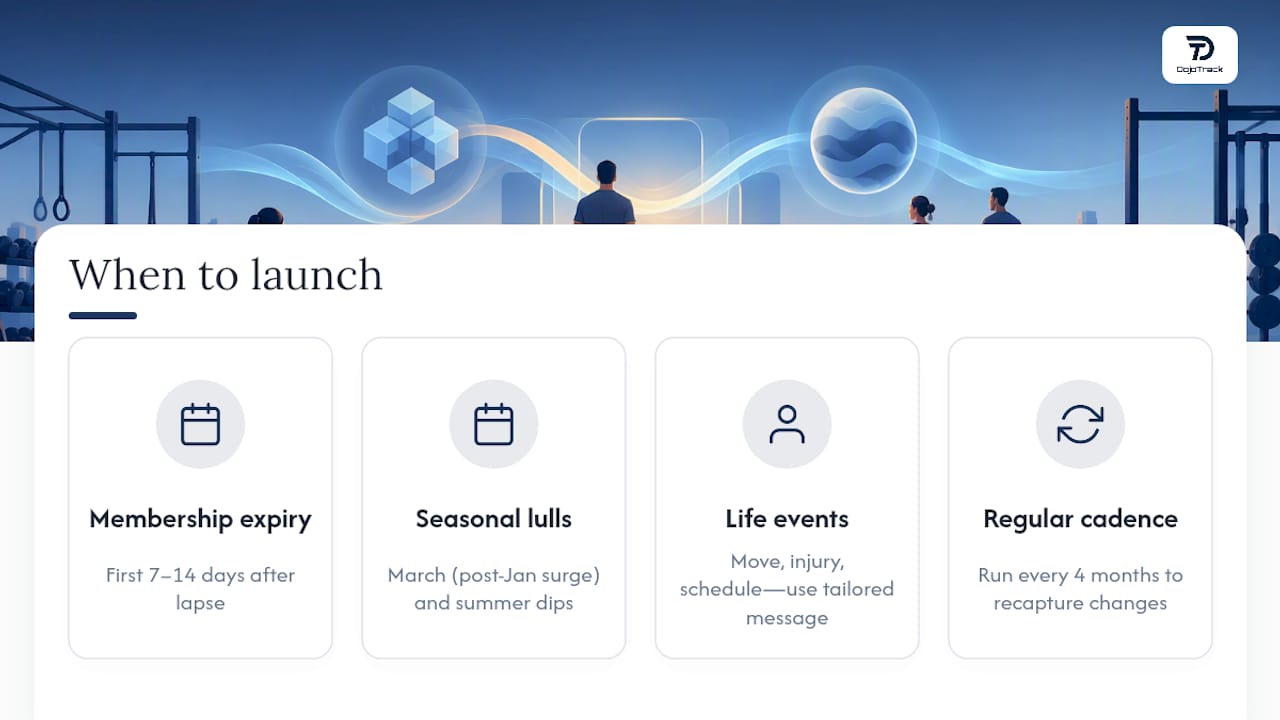
Timing decides whether a reactivation campaign gets read or ignored. The most reliable trigger is membership expiration itself. The window right after a membership lapses, roughly the first 7 to 14 days, is when a former member is most likely to respond, because the decision to leave is still fresh and often not fully settled in their mind.
Seasonal lulls create a second, predictable trigger. January sign-up surges fade by March, and summer attendance dips as schedules loosen up with vacations and longer daylight hours. Both dips are the moment to run outreach to your dormant list, not to wait for foot traffic to naturally pick back up. A gym that waits until a slow month is already underway has lost weeks of possible response time.
Life-event triggers matter too, even though they’re harder to track systematically. A member who canceled around a move, an injury, or a schedule change is a different conversation than someone who simply drifted away. If your intake process captures a cancellation reason, use it. A member who left because of a temporary injury responds better to a “we’ve got a modified program ready when you are” message than a generic “we miss you” text.
Running this consistently, once every four months, catches people whose circumstances changed since their last contact, without waiting for a specific event to justify the message. That structured discipline is what separates a program that compounds over years from one that only fires when someone remembers to run it.
Why Do Some Reactivation Messages Get Ignored?
The psychology behind a lapsed membership is rarely about money. Most members who stop coming still believe, on some level, that they should be working out. Guilt is already doing work in their head before your message arrives, and a poorly worded text can either ease that guilt into action or push them further into avoidance.
Messages that lead with judgment, even subtle judgment like “we haven’t seen you in a while,” tend to underperform messages that lead with warmth and a specific, low-effort next step. Compare “You’ve missed a lot of classes” against “Coach Jordan’s got a spot for you Thursday if you want it.” The second message gives a concrete, easy yes.
Personalization matters more than polish. A text signed by a specific coach outperforms a message signed by “the team,” because it reintroduces a relationship rather than a transaction. This is part of why at-risk members respond better to a phone call or personal text than to any discount: they’re not looking for a deal, they’re looking for a reason to believe they’ll be welcomed back without awkwardness.
Scarcity works, but only when it’s real. A deadline that quietly extends itself once trains members to ignore your urgency language entirely. If an offer expires in 7 days, let it expire. Consistency across multiple attempts, not pressure within a single message, is what actually rebuilds the habit.
What Legal Rules Apply to Contacting Former Members?
Every text and email you send to a former member is subject to consent rules, and getting this wrong creates liability that outweighs any revenue a campaign might recover. The FTC’s action against a national gym chain over its member communication and cancellation practices is a clear signal that regulators are watching how fitness businesses handle members after they’ve disengaged, not just how they sign them up.
For SMS specifically, the Telephone Consumer Protection Act requires documented consent before you send marketing texts, and that consent needs to be tracked, not assumed. If a former member never explicitly opted into text marketing during their original membership, sending automated reactivation texts without fresh consent is a real risk. Email carries its own rules under the CAN-SPAM Act, including a working unsubscribe link and an accurate sender identity in every message.
Practically, this means your export process from earlier in this guide isn’t optional paperwork. It’s your legal record. Every list you pull needs consent flags attached, and every opt-out needs to be honored immediately across every channel, not just the one where the request came in. If a member texts “STOP,” that should suppress email and postcard outreach too, not just future texts.
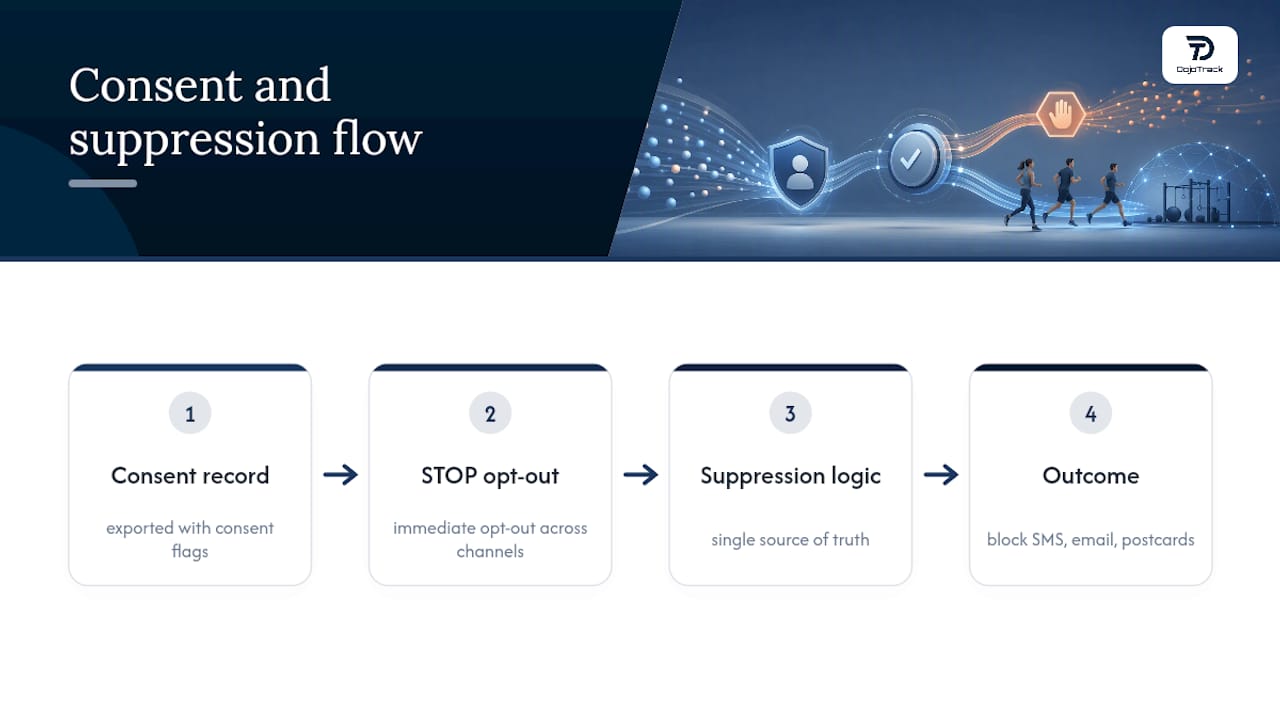
Build your suppression logic once, correctly, and it protects every future campaign you run. Retrofitting compliance after a complaint is far more expensive than setting it up before your first send.
Why Consistent Reactivation Beats One-Off Campaigns
Reactivation work rewards consistency more than cleverness. The gyms that see real numbers from this aren’t running one brilliant campaign a year, they’re running the same disciplined sequence on a schedule and letting the math compound.
Start with one segment and one offer. Automate the suppression and routing rules first, because that’s what breaks when volume grows, not the messaging.
— DojoTrack
Ready to Automate Your Reactivation Workflow?
Dojotrack is built for studios that want reactivation running in the background instead of living on someone’s to-do list. Where spreadsheet-based outreach depends on a manager remembering to export a list and suppress responders manually, Dojotrack’s AI-powered retention and automation features flag at-risk members automatically, fire SMS sequences on schedule, and exit members from outreach the instant they check back in.
If you’re migrating from another system, the data migration process moves your existing member records over without forcing you to rebuild your lapsed list from scratch. Pricing starts with a free core plan, with paid tiers from the Launch plan at $95 per month unlocking the automated SMS and retention alerts this guide walks through. Sign up and export your first lapsed segment today to see how quickly the short play starts producing replies.
Sources
- How to Run a Reactivation Campaign for Former Gym Members | PushPress
- Win-Back Campaigns for Lapsed Gym Members: Segments, Offers, and Cadence | Helios Guides – Helios
- Twilio text-marketing solutions
- Reactivation – Blog (Gym Launch)
FAQ
What Are the Most Effective Marketing Campaigns for Gyms?
The most effective campaigns target members you already have rather than cold leads. An SMS-first reactivation sequence to lapsed members typically outperforms new-member ads on cost, since former members convert at a higher rate than cold prospects.
Which Marketing Approach Works Best for Bringing Back Former Members?
A segmented approach beats a blanket announcement every time. Split your list into at-risk, lapsed, and cancelled tiers, then match the channel and offer to each group instead of sending one message to everyone.
What Are Some Effective Marketing Messages for Gyms?
Short, personal, and specific outperforms broad and promotional. A message like “Coach Jordan has a spot for you Thursday” tends to get more replies than a generic “we miss you” line, because it gives the reader one concrete action to take.
What Topics Work Well for Fitness Content?
Content that shows real coaching, member progress, and program structure tends to perform better than generic motivational posts. Reactivation messaging works the same way: specificity about a class, coach, or outcome beats vague encouragement.
How Much Does DojoTrack Cost for Running These Campaigns?
DojoTrack offers a free core plan, with paid tiers starting at $95 per month for the Launch plan and scaling up to Master at $245 per month for full automation and analytics. Current pricing details for all six tiers are listed on the DojoTrack pricing page.