
Dojo Tested New Student Orientation: 5 Steps to Cut Dropout in Dojos

An effective new student orientation covers five things: online registration with a digital waiver, a short intro class with a safety briefing, a visible first look at the belt curriculum, clear parent and community outreach, and a scheduled follow-up soon after the first class. Pair those steps with early measurement and targeted outreach, and you cut early dropout before it starts. We built our platform around this exact sequence.
TL;DR:
- Implementing a digital registration system, safety briefing, and clear progress tracking in the first week significantly reduces early dropout rates.
- Automated follow-up messages, attendance monitoring, and automated belt tracking help maintain engagement and flag at-risk students promptly.
- Focusing on three to five foundational skills during the first month provides students with visible progress and early wins, boosting motivation.
- A brief, targeted parent orientation emphasizing safety, support at home, and community involvement fosters longer-term student retention.
- Using software like DojoTrack can streamline onboarding, automate retention alerts, and improve operational efficiency at minimal or no upfront cost.
Table of Contents
- A 0-1 Day Checklist for New Student Sign-Ups
- The First 30 Days: Workflow, Timing, and Automation
- Introducing the Curriculum Without Overwhelming Beginners
- Running a Short Parent Orientation That Builds Buy-In
- Safety Expectations and When to Recommend Medical Clearance
- Tracking the Metrics That Actually Predict Retention
- What We Learned Building Orientation Tools for Real Dojos
- Putting This Orientation System on Autopilot
- FAQ
- Sources
A 0-1 Day Checklist for New Student Sign-Ups
The first 24 hours set the tone for everything that follows. Break it into four stages so nothing slips through the cracks.
Pre-arrival:
- Send the online registration form and digital waiver before the student walks in.
- Set up billing so there is no awkward conversation at the front desk.
- Send a welcome text or email confirming the first class time and what to bring.
Arrival:
- Greet the student by name and give a two-minute facility tour.
- Confirm gear and equipment needs on the spot.
- Double-check the waiver and emergency contact are on file.
First class:
- Deliver a short safety briefing before any drilling starts.
- Demo two or three basic movements and assign a training buddy.
- Set one simple one-week goal the student can actually hit.
Follow-up:
- Send a check-in message within the first few days after the first class.
- Include a direct link to book the next class.
Our own student onboarding checklist walks through this in more detail if you want a printable version for your front desk.
The First 30 Days: Workflow, Timing, and Automation
Converting a trial into a committed student is less about one great class and more about what happens over the following month.
Days 0-7:
- Confirm the student showed up for the intro class and log attendance.
- Make sure the head coach or lead instructor personally introduces themselves.
- Set a short-term goal, like learning a specific combination or earning a first stripe.
Days 8-30:
- Move the student onto a recurring class schedule that fits their availability.
- Build toward a small, visible promotion, like a stripe or a skill badge.
- Track attendance patterns and flag any student who misses more than one week in a row.
Automation opportunities: welcome sequences, class reminders, auto-invoicing, and digital waivers all remove friction that otherwise causes drop-off. Manual paperwork and missed payment reminders are a quiet but steady source of attrition, and automating them frees up front-desk time for actual relationship-building.
Instructor touchpoints: a 30-second check-in after class beats a long formal conversation. For younger students, pairing them with an older student mentor in week one builds a connection that keeps them coming back.

Pro Tip: Script the first coach check-in word for word. A consistent, warm greeting in week one does more for retention than any flyer or discount.
For a deeper look at scheduling logistics, our guide on creating your first class schedule covers how to balance new-student intros with your existing roster.
Introducing the Curriculum Without Overwhelming Beginners
New students quit faster when they cannot see progress. The fix is to narrow the first month down to three to five beginner skills they can realistically master, so there is a clear early win instead of an intimidating wall of techniques.
- Pick three to five foundational skills for month one and nothing more.
- Make progress visible: a printed progress card, a bulletin board, or an in-app progress bar all work.
- Celebrate small milestones publicly, like a stripe, a certificate, or a quick shout-out at the end of class.
- Adjust pacing by age and contact intensity, since a 7-year-old and a 35-year-old need very different ramp-ups.
Pro Tip: A visible progress bar in a student app removes the guesswork. Students stay motivated when they can see exactly how close they are to the next milestone.
Visible, trackable progress is also one of the clearest places software earns its keep, since automated belt tracking removes the manual logging that often falls through the cracks during a busy week.
Running a Short Parent Orientation That Builds Buy-In
For youth programs, the parent is often the real decision-maker on whether a student sticks around, so a five-minute parent orientation is worth the time.
- Cover safety expectations, class scheduling, and billing policies up front.
- Explain simply how parents can support practice at home without turning it into homework.
- Set a communication cadence: a welcome text on day one, a weekly class summary email, and an optional private community group for updates.
- Introduce a buddy system, a monthly family open mat, and a recognition program for consistent attendance.
Retention research consistently points to the coaching relationship and the sense of belonging it creates as the biggest driver of whether students stay or leave. That belonging extends to parents too: a mother or father who feels like part of the community is far less likely to pull a child out after a bad week. Our post on messaging parents effectively has sample scripts for exactly these touchpoints.
Safety Expectations and When to Recommend Medical Clearance
Orientation is the right moment to set expectations about contact level and protective gear, before a student ever steps on the mat for sparring.
- State clearly which classes are non-contact, light-contact, and full-contact.
- List required gear (mouthguard, groin protection, gloves) versus optional gear.
- Include a short safety talk in the first class and confirm the digital waiver is on file before any sparring.
- Recommend physician clearance for students with pre-existing conditions, a history of concussion, or entry into high-contact programs.
Pediatric health guidance notes that martial arts are generally safe for children when contact is introduced gradually, with early focus on motor and cognitive skill-building rather than sparring. Peer-reviewed sports-safety literature backs this up, recommending clear communication about protective equipment and early conversations with parents about physician consultation where relevant, according to guidance published in PMC.
Tracking the Metrics That Actually Predict Retention
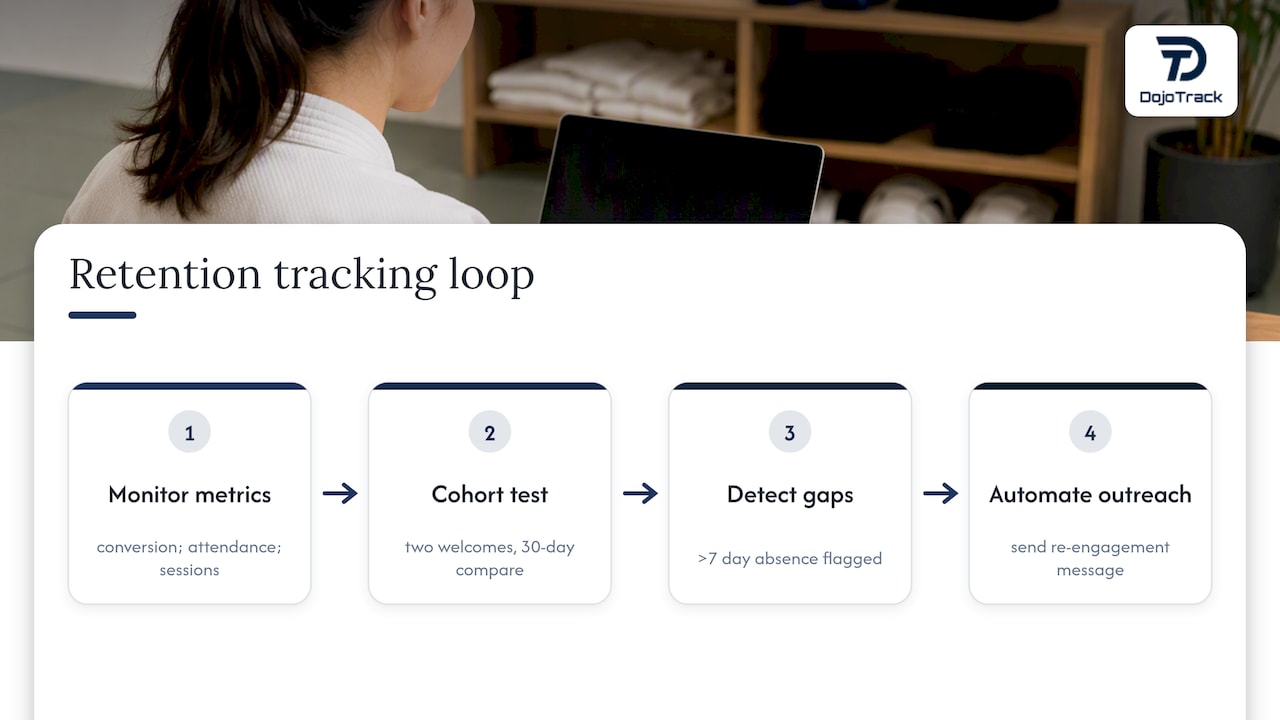
You do not need a dashboard full of numbers. Key metrics to monitor include trial-to-paid conversion rate, retention at various early intervals, class attendance per student, and average sessions attended per week.
Run a simple cohort test: send one welcome sequence to half your new sign-ups and a different one to the other half, then compare 30-day retention between the two groups. Flag any student with a gap of more than seven days between classes and trigger an outreach message automatically rather than waiting for them to quietly disappear. These numbers tie directly back to the checklist and automation steps above, and our lifetime value calculator can show what even a small retention bump is worth over a student’s time with you.
Pro Tip: Track attendance gaps weekly, not monthly. A student who misses two classes in a row is far easier to win back on day 10 than on day 40.
What We Learned Building Orientation Tools for Real Dojos
Our platform was developed by martial arts veterans who ran schools before building software to fix the operational headaches they lived with firsthand. That background shapes every feature we build, from automated belt promotions to attendance tracking that flags a student before they quietly stop coming. A student mobile app that shows curriculum progress and sends push notifications turns the checklist above from a paper process into a mostly automated one.
— DojoTrack
Putting This Orientation System on Autopilot
Running the checklist above by hand is possible, but it is also exactly the kind of repetitive work that eats an instructor’s week. We built DojoTrack to handle it instead.
- Digital waivers and online registration that sync directly to a student’s profile.
- Automated belt tracking so progress updates without manual logging.
- Attendance tracking that flags gaps before they turn into dropouts.
- SMS and email sequences for welcome messages, reminders, and check-ins.
- A student app showing curriculum progress, schedules, and push notifications.
We offer a free core tier that covers student management, attendance, scheduling, and digital waivers, allowing you to start running this system at no upfront cost. Paid plans unlock features such as automated retention alerts, SMS follow-ups, and deeper analytics on top of the free foundation. Check out DojoTrack pricing to see which plan fits your school, or explore the full feature set before you decide. If you would rather build your own community playbook first, VO2WOD has useful ideas on member engagement from the fitness-gym side of things.
FAQ
What should happen on a new student’s first day?
A strong first day includes online registration and a signed digital waiver, a short safety briefing, a quick demo of two or three basic skills, and a follow-up message within 48 hours. Keeping the first class simple and welcoming matters more than covering advanced material.
How long should a parent orientation meeting last?
A focused parent orientation usually takes five to ten minutes and covers safety expectations, scheduling, billing, and how to support practice at home. Keeping it short respects a busy parent’s time while still building the trust that supports long-term enrollment.
What safety equipment should a new student expect to need?
Required and optional gear depends on contact level, but most programs start students in non-contact or light-contact classes before introducing sparring gear. Pediatric health guidance recommends easing into contact gradually and focusing early sessions on motor and cognitive skill-building.
Which metrics best predict whether a new student will stay?
Trial-to-paid conversion, 30-day retention, and class attendance rate are the clearest early signals of whether onboarding is working. A student who misses more than a week between classes is a strong early-warning flag worth an automated check-in.
Does DojoTrack help automate new student orientation?
Our free core tier covers registration, digital waivers, attendance, and scheduling, with paid plans adding SMS automation, belt-tracking workflows, and retention alerts. Plans start at the DojoTrack pricing page, where you can compare what each tier unlocks.
Sources
- Coaches Matter. It is time our nation invested in them. – Project Play
- Healthychildren
- Peer-reviewed sports safety guidance (PMC article)