
What to Say to Your Martial Arts Instructor (and How)
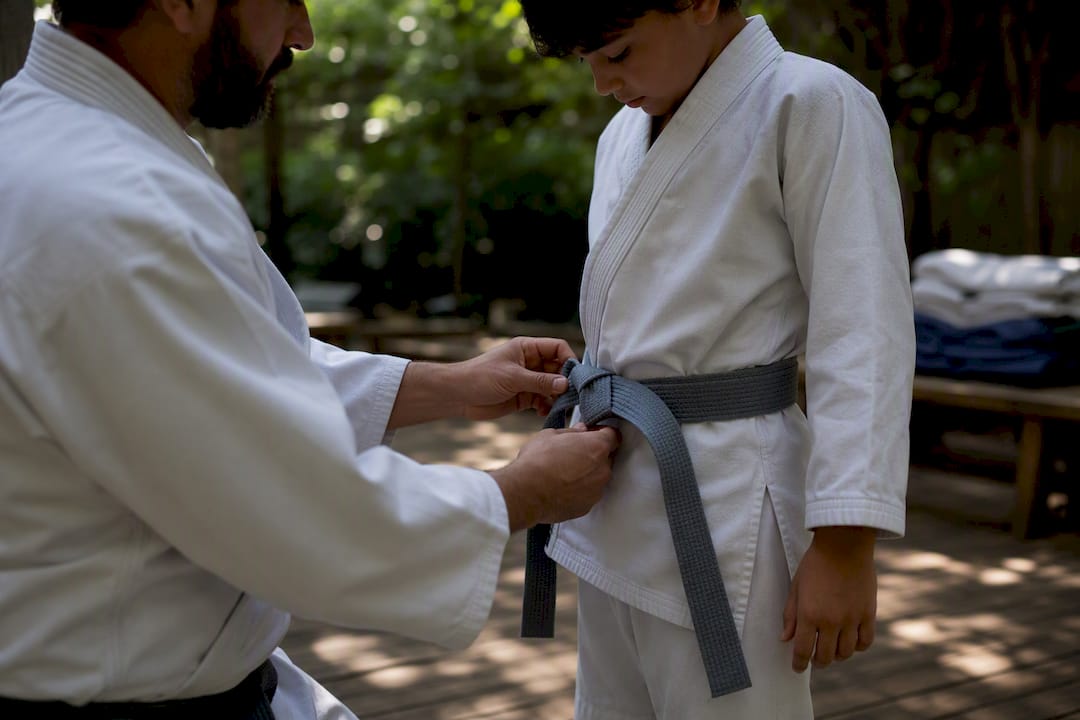
Message your child’s instructor directly through the studio’s official channel, keep the tone supportive and effort-focused, and include three things: attendance, behavior, and one specific question. That is parent messaging in martial arts, distilled.
Three things to do right now:
- Send a one-sentence supportive text: “Thanks for pushing Mia today, she came home talking about her front kick.”
- Confirm the official channel the school actually uses for updates, so your message doesn’t disappear into a group chat nobody checks.
- If you want a real conversation about goals or concerns, ask for a family conference rather than trying to cram it into a hallway chat at pickup.
Key Takeaways
Parent messaging works best when it’s routed through one official channel, focused on effort rather than outcomes, and backed by a written policy that sets clear expectations from day one.
| Point | Details |
|---|---|
| Lead with effort, not outcome | Praise specific behaviors (“you kept trying”) rather than results, which reinforces what coaches are actually teaching. |
| Confirm one official channel | Ask the studio which single channel (portal, app, or email) carries official updates before relying on group chats. |
| Request a Charter | A written communication policy shows a school takes boundaries and consistency seriously. |
| Use the family conference | Treat the initial 45 to 60 minute intake meeting as the place to set expectations and ask for a 30 day follow-up. |
| Centralized systems reduce friction | Platforms like Dojotrack automate attendance and promotion notices so updates don’t get lost in fragmented chats. |
Table of Contents
- Why Parent Messaging in Martial Arts Needs Its Own Playbook
- What Should I Text My Child’s Martial Arts Instructor?
- What Boundaries Should Parents Expect in Studio Communication?
- How Do Studios Reduce Missed Messages and Protect Privacy?
- Family Classes vs. Drop-Off: Adjusting How You Communicate
- A Founder’s View on Why Structured Messaging Matters
- How Dojotrack Helps Studios Keep Parents in the Loop
- Sources
- FAQ
Why Parent Messaging in Martial Arts Needs Its Own Playbook
Most parents treat instructor communication like texting a teacher: reactive, occasional, mostly about problems. That approach undersells what good family communication in martial arts can actually do. The instructors who run tight programs treat parent messaging as part of the curriculum, not an afterthought, because a kid who hears the same message at home and on the mat progresses faster than one getting mixed signals.
Effort-focused praise beats outcome praise, every time. “You kept trying even after you got knocked down” lands differently than “Great job winning.” The first reinforces the behavior a coach is trying to build. The second reinforces winning, which a child can’t control every class.
Keep feedback specific and short. “I noticed you held your stance longer today” works better than “You did awesome.” Specific observations tell a child exactly what to repeat. Vague praise tells them nothing.
- Use short, consistent post-class check-ins rather than long weekly essays.
- Ask questions instead of making judgments: “What was the hardest part of class?” instead of “You looked distracted.”
- Treat the relationship as a two-way partnership, not a customer-service line. Ask whether the school has a written communication policy or Charter you can reference.
Pro Tip: Keep a running list of two or three phrases your instructor uses in class (like “chamber your kick” or “control your breathing”) and repeat those exact words at home. Kids respond faster to language they already recognize than to a parent’s improvised version of the same idea.
What Should I Text My Child’s Martial Arts Instructor?
Most parent-instructor friction comes from vague, poorly timed messages. Here are ready-to-use scripts organized by situation.
Text or app messages after class (keep these under two sentences):
- “Thanks for today, he mentioned working on his roundhouse and seemed proud of it.”
- “She said class was hard today. Anything I should reinforce at home before the next one?”
- “Appreciate the patience with him during sparring drills, he’s still nervous about contact.”
Email templates for anything requiring detail:
- Progress question: “Hi Coach, Jordan has been at white belt for three months. Could you share what she’s working toward for her next stripe or promotion?”
- Scheduling change: “We’ll need to move to the Tuesday/Thursday class starting next month due to a schedule conflict. Can you confirm space is available?”
- Behavior concern: “Ben mentioned feeling nervous about a specific drill last week. Could we find five minutes before or after class to talk through it?”
The 30-second in-person check-in (for pickup or drop-off):
“Hey Coach, quick one, how did she do with focus today? Anything I should reinforce this week?” That’s it. Instructors are managing a room full of kids at pickup; a question they can answer in one sentence gets a real answer instead of a rushed brush-off.
A few rules on timing: text for anything urgent or brief (a late pickup, a quick thank-you), email for anything that needs a paragraph of context, and save in-person conversations for quick check-ins only. If a topic needs more than three sentences to explain, it belongs in an email or a scheduled conversation, not a hallway ambush thirty seconds before the next class starts.
What Boundaries Should Parents Expect in Studio Communication?
A well-run school routes messages about minors through parents and limits any direct instructor-to-child private messaging. This isn’t excessive caution. Operational guidance for youth sports organizations recommends exactly this structure because it protects both the student and the instructor from ambiguity about who said what to whom.
Channels should match the message. SMS works for quick, time-sensitive notices like a schedule change or a reminder about a testing date. Email or a dedicated portal should carry anything longer, like a progress update or a conversation about goals. A studio communication policy will typically spell this out, treating social media as public, family-friendly announcements only, never as a channel for personal or behavioral matters.
Watch for these signals that a school’s communication is running loose:
- Instructors messaging your child directly on personal social media accounts.
- No consistent channel; some parents get texts, others get emails, others get nothing.
- Official studio business happening inside informal parent group chats.
Ask to see the school’s written policy or Charter before you assume how things work. A school that has one and shares it without hesitation is telling you something about how it operates.
How Do Studios Reduce Missed Messages and Protect Privacy?
Ask the studio for one official channel, whether that’s a parent portal, a mobile app, or a consistent email digest, and ask whether they publish a written Charter outlining how and when they communicate. If the answer is “we mostly use a group chat,” that’s worth a follow-up question.
Fragmented channels are the root cause of most missed-message complaints. Operational research on youth sports communication points to informal group chats and mixed personal/professional messaging as the leading source of both missed notices and privacy exposure. When attendance, promotion updates, and behavior notes live in five different apps, something always falls through.
Request automated notices specifically. Ask how you’ll be told when your child is promoted, when attendance drops, or when a testing date is announced, by app push, email, or text. A student progress tracking system that logs attendance and belt progress automatically means you find out about a promotion the day it happens, not weeks later when your child mentions it offhand.
What a well-run platform should give you as a parent:
- One login or one channel for schedules, attendance, and promotion updates.
- Clear family billing, especially if you have multiple kids enrolled at once.
- Simple event registration for testing days, tournaments, and seminars.
Pro Tip: If a school can’t tell you, in one sentence, how you’ll be notified when your child gets promoted, ask before you enroll. That answer tells you more about their operations than almost anything else on a tour.
Family Classes vs. Drop-Off: Adjusting How You Communicate
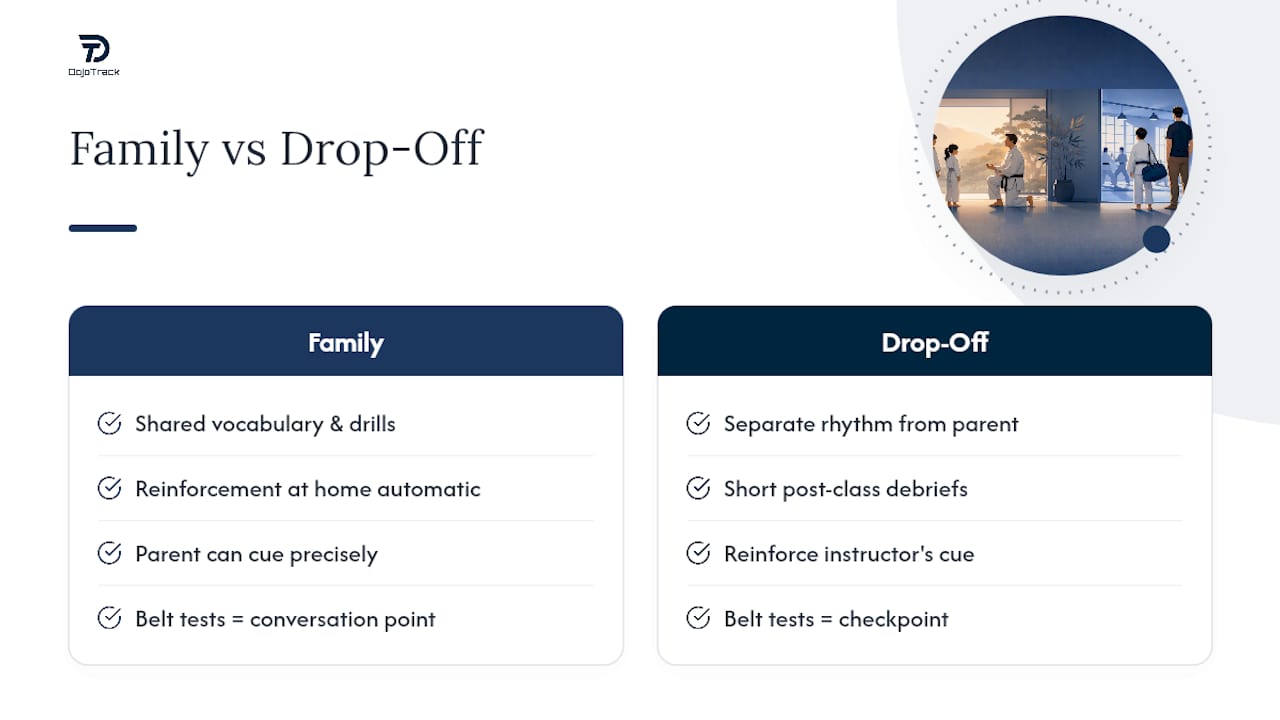
Training alongside your child changes what you need to say. In family classes, you and your child learn the same vocabulary and drills, which makes reinforcement at home almost automatic, as seen in programs like those at this local academy. Family martial arts programs build this shared language deliberately, so a parent can say “remember your chamber” and know exactly what that means because they just practiced it too.
Drop-off arrangements need a different rhythm: short debriefs after class, and reinforcing whatever cue the instructor gave rather than inventing your own version of it. Belt tests are natural checkpoints for a longer conversation, since they’re already a moment when everyone is talking about progress.
Sample micro-goals to message about: “This week, focus on eye contact during bows.” Small, specific, and easy to check in on.
A Founder’s View on Why Structured Messaging Matters
Jared Reed built Dojotrack after running martial arts schools himself and watching good instruction get undermined by disorganized communication. His take: parents deserve the same 30-day check-in structure and written Charter that serious schools already use internally, because vague expectations create the most conflict, not bad instruction.
— Dojotrack
How Dojotrack Helps Studios Keep Parents in the Loop
The friction most parents describe (missed updates, unclear billing, no idea when a promotion happened) is almost always a systems problem, not a communication-skills problem. Dojotrack fixes it at the source by giving studios one centralized portal instead of a patchwork of texts, chats, and sticky notes.

That means automated attendance and promotion notices that reach you the moment they happen, transparent family billing when you’ve got more than one kid enrolled, and a student progress record you can actually check instead of guessing. Studios can start with Dojotrack’s free core tier, so there’s no upfront cost to trying it out before deciding whether to unlock the advanced automation and family communication tools.
If you’re a studio owner reading this and recognizing the group-chat chaos described above, Dojotrack’s platform is built to replace it with one system your families can actually rely on.
Sources
- The KarateBuilt Family Conference: What Happens Before Your Child Steps on the Mat – KarateBuilt Martial Arts
- Operational guides on school communication practices – Cal Poly Digital Commons
- Communication Policy – Crocodile Martial Arts Australia
- Family Martial Arts Vero Beach | Parents Train with Kids | Florida Karate Academy
FAQ
What Should I Say in My First Message to an Instructor?
Keep it short and effort-focused: mention what your child worked on and thank the instructor for their attention that day. Save detailed questions for email or a scheduled conversation.
What Is a Family Conference in Martial Arts?
It’s typically a 45 to 60 minute intake meeting before enrollment where the school assesses your child, reviews a written Charter, and sets expectations, often including a 30-day follow-up.
Should I Use Text, Email, or the School’s App for Updates?
Use text for quick, time-sensitive notices and email or a centralized app for anything detailed, like progress questions or schedule changes. A platform like Dojotrack consolidates both into one place so nothing gets missed.
Why Do Schools Route Messages Through Parents Instead of Directly to Kids?
It protects both students and instructors by keeping communication accountable and documented, a practice recommended in operational guidance for youth sports organizations.
How Often Should Instructors Update Parents on Progress?
Short check-ins after most classes, plus a structured conversation at major milestones like belt tests or the 30-day mark after enrollment, gives parents enough information without overwhelming either side with messages.
Recommended
- Stop Losing Students: 5 Steps How to Boost Retention and Revenue (Easy Guide for Martial Arts Schools) | DojoTrack
- Top 10 Rated Martial Arts Movies of All Time (And What They Can Teach Your Dojo About Success) – DojoTrack
- AI Powered Martial Arts Software | DojoTrack
- How Instructor Management Software Powers Your Dojo