

TL;DR:
- Creating a martial arts class schedule involves organizing class types, student levels, and learning goals to promote student retention. Starting with a simple, three-to-four class model and scaling based on demand helps maintain quality and avoid burnout. Using data and automation tools ensures effective management as the studio grows.
A martial arts class schedule is the organized framework that assigns class types, student levels, time slots, and weekly learning goals to keep students progressing and instructors effective. Getting this right from day one separates studios that retain students from those that lose them within the first three months. The industry term for this process is “class program planning,” and it operates on two layers: a macro weekly calendar and detailed micro lesson plans. This guide walks you through every step to create your first martial arts class schedule, covering foundational planning, a practical build process, common pitfalls, and how to scale as your studio grows.
What foundational elements do you need before creating your first martial arts class schedule?
Strong scheduling starts before you open a calendar app. You need four things in place first: a clear list of class types, defined student levels, a curriculum pacing guide, and confirmed instructor availability.
Class types and student levels define the structure of your entire program. The most common categories are kids beginner, kids intermediate, adult beginner, adult intermediate, and mixed open mat sessions. Each group has distinct physical, psychological, and technical needs. A 7-year-old white belt and a 35-year-old adult beginner both need foundational instruction, but the pacing, language, and drill formats differ significantly.
Weekly learning goals are the second non-negotiable. Teaching more than 3 primary concepts in 2–4 hours of weekly class time reduces student retention and instructor effectiveness. Three goals per level per week is the proven ceiling. More than that and students leave class confused rather than confident.
Curriculum pacing guides and grading syllabi give your schedule a backbone. Aligning lesson plans with grading requirements allows instructors to prepare students more effectively and improves satisfaction at belt testing time. Without this alignment, you end up teaching techniques out of sequence.
Here is a quick overview of what you need before building your schedule:
| Element | What to prepare |
|---|---|
| Class types | List all formats: kids, adult, beginner, intermediate, open mat |
| Student levels | Define belt or skill tiers for each class type |
| Weekly goals | Cap at 3 core skills per level per week |
| Curriculum guide | Match lesson content to grading syllabus |
| Instructor availability | Confirm hours, expertise, and backup coverage |
Pro Tip: Start with fewer class types than you think you need. New studios benefit from simpler schedules with focused offerings before expanding, which also makes marketing your program much cleaner.

How to build your weekly martial arts class schedule step by step
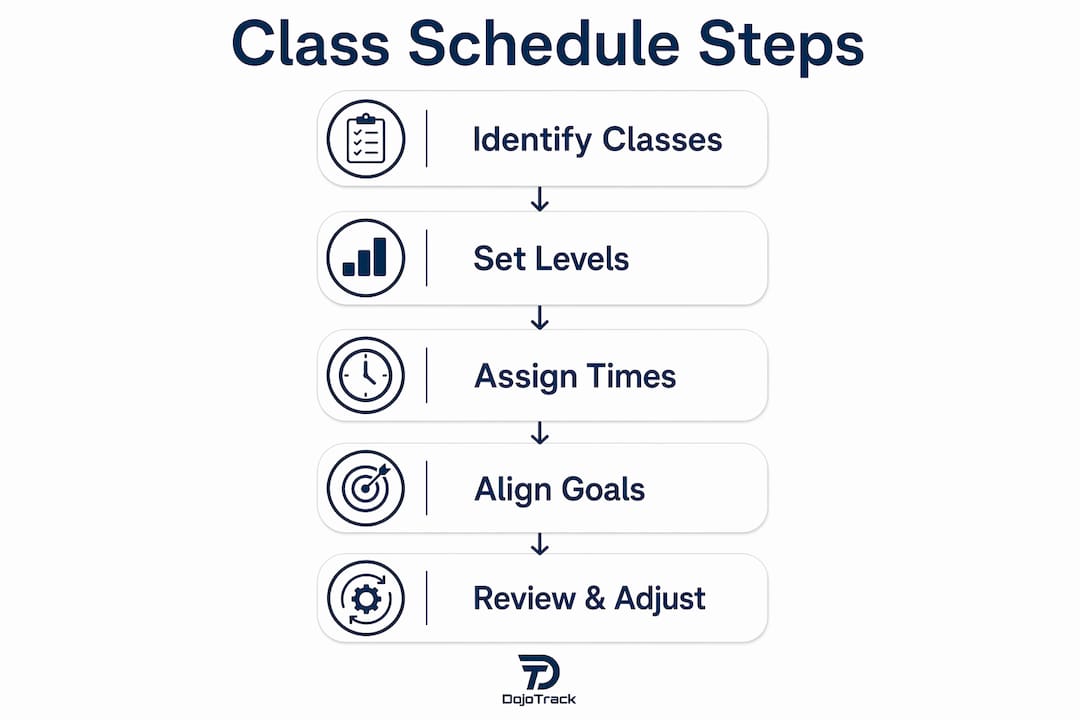
With your foundational elements ready, you can build the actual schedule. Follow this sequence to avoid the most common structural mistakes.
-
Set your macro calendar first. Decide how many classes per week your studio will run before assigning any content. A new studio typically starts with 8–12 weekly sessions across all levels. This number should reflect your instructor capacity, not your ambition. Overcommitting on session count in week one leads to thin attendance and burned-out instructors.
-
Assign time slots by audience demand. Kids classes perform best on weekday afternoons between 4:00 PM and 6:30 PM. Adult classes fill more reliably on weekday evenings from 6:30 PM onward and on Saturday mornings. Place your highest-demand class types in the slots where attendance is most predictable.
-
Separate beginner and advanced sessions clearly. Consistent class differentiation helps new students acclimate and prevents advanced students from feeling held back. Mixing levels without a clear purpose frustrates both groups. Reserve open mat or mixed sessions for students who have completed at least one full belt cycle.
-
Set three weekly objectives per class level. Write these down before the week starts. For a kids beginner class, a sample week might focus on front kick mechanics, falling safely, and listening cues. For adult intermediate, it might be guard passing, hip escapes, and a specific combination. Three weekly goals in 2–4 hours of class time produce the best learning outcomes.
-
Build a monthly rotation plan. A rotating theme plan focusing on 4–8 core physical skills per month prevents training from going stale. Month one might emphasize striking fundamentals. Month two shifts to takedowns and clinch work. This rotation keeps students engaged and gives instructors a clear content roadmap.
-
Assign instructors by expertise and availability. Match instructors to the class types where their background is strongest. A Brazilian Jiu Jitsu black belt should not be defaulted into a Taekwondo kids class just because the time slot is open. Allocating classes by instructor skillset protects class quality and prevents instructor frustration.
Pro Tip: Build your schedule in a shared document first, not directly in your management software. Reviewing it on paper with a second instructor catches structural problems before they become student-facing issues.
What are the common challenges when scheduling your first martial arts classes?
Even a well-built schedule runs into friction. Knowing the most common problems in advance lets you solve them before they affect students.
-
Instructor constraints and substitutions. New studios often rely on one or two primary instructors. If one gets sick, entire class blocks disappear. Build a substitution protocol before you launch. Identify which instructors can cover which class types and document it.
-
Overloading classes with too many goals. The temptation to cover more material is real, especially when you want to impress new students. Resist it. Overloaded classes produce confusion, not confidence. Stick to three objectives per session.
-
Mixed-level students in the same class. This happens when enrollment is low and you combine groups to fill a time slot. It creates a two-speed class where beginners feel lost and advanced students feel unchallenged. Use waitlists instead of forcing mixed-level sessions.
-
Stagnant or repetitive content. Students notice when they drill the same techniques week after week without progression. A monthly rotation plan, as described above, is the direct fix. Tracking what you taught each week also prevents accidental repetition.
“The biggest scheduling mistake new studios make is building a schedule around the instructor’s comfort zone rather than the student’s learning arc. A schedule that works for the teacher but not the student produces dropouts, not black belts.”
- Attendance fluctuations. Class numbers will vary, especially in the first 90 days. Build waitlists for your most popular time slots from the start. Waitlist management improves class occupancy and gives you a real-time signal about which sessions have the most demand.
How do you scale and refine your class schedule as your studio grows?
Your first schedule is a starting point, not a permanent structure. The goal is to treat it as a living document that improves with real attendance data and student feedback.
Track attendance by class type every week. If your Tuesday adult beginner class consistently runs at half capacity while your Thursday session is full, consolidate or shift the time. Attendance data removes guesswork from scheduling decisions. Dojotrack’s attendance tracking feature gives you this data automatically, without manual spreadsheets.
Add new class types based on demonstrated demand, not assumptions. Before adding a women’s self-defense class or a competition team session, run a short waitlist or interest form. If 10 or more students sign up before the class launches, the demand is real. If fewer do, the timing is not right yet.
Align schedule changes with belt testing cycles. Major schedule restructuring right before a grading event disrupts student preparation. Plan significant changes for the week after a belt test, when students are starting a new training cycle. Rotation plans tied to curriculum progression make this transition natural rather than jarring.
Here is a framework for scaling your schedule over time:
| Growth stage | Scheduling action |
|---|---|
| Months 1–3 | Run 8–12 sessions weekly, track attendance, gather feedback |
| Months 4–6 | Add one new class type based on waitlist data |
| Months 7–12 | Introduce specialty sessions (competition, women’s, weapons) |
| Year 2+ | Segment advanced tracks and add instructor-led open mat |
Use scheduling software to manage complexity. As your class count grows, manual scheduling creates conflicts. AI-driven scheduling platforms manage instructor calendars, class bookings, and waitlists in real time. This matters most when you are running 20 or more weekly sessions and managing multiple instructors. Dojotrack handles this layer automatically, freeing you to focus on instruction rather than logistics. You can also connect scheduling directly to student retention outcomes by tracking which class formats produce the highest long-term attendance rates.
The scheduling lesson I learned the hard way
At Dojotrack, we have worked with hundreds of martial arts studio owners across the United States, and the pattern is consistent. Studios that struggle in their first year almost always built their schedule around what felt comfortable rather than what the data suggested.
The most common version of this mistake is launching with too many class types at once. A new studio opens with kids beginner, kids intermediate, adult beginner, adult intermediate, adult advanced, and an open mat session all in week one. Six class types with two instructors and 20 students means every class is underpopulated. Thin classes feel low-energy, and low-energy classes drive students out the door.
The studios that grow fastest start with three or four class types, fill those sessions to a healthy capacity, and then expand. Structure creates confidence for students. A packed Tuesday kids class feels like a thriving community. A half-empty one feels like a program that might not survive.
The second lesson is that rotation plans are not optional. Instructors who teach the same curriculum week after week without a rotation framework burn out faster and produce less engaged students. A monthly skill focus gives instructors creative latitude within a structured system. That balance is where the best teaching happens.
Technology matters more than most new owners expect. Scheduling conflicts, instructor substitutions, and waitlist management consume hours every week when handled manually. That is time you could spend on the mat. Dojotrack was built specifically to eliminate that overhead.
— Dojotrack
How Dojotrack makes your first class schedule easier to manage
Building your first schedule is one challenge. Keeping it running smoothly as enrollment grows is another. Dojotrack’s AI-powered scheduling features handle instructor calendar management, class bookings, waitlists, and real-time attendance tracking in one platform built specifically for martial arts studios. You get automatic conflict detection, student notifications when a spot opens, and attendance reports that show you exactly which sessions are performing. New studios in the United States can access Dojotrack’s core scheduling and student management tools at no cost, with advanced automation available as your program scales. Getting your schedule right from the start is faster when the tools are built for the job.
Key takeaways
A well-structured first class schedule, built on clear weekly goals, defined student levels, and a monthly rotation plan, is the single most reliable foundation for student retention and studio growth.
| Point | Details |
|---|---|
| Cap weekly goals at three | Teaching more than 3 core skills per week reduces retention and instructor effectiveness. |
| Separate levels from day one | Clear beginner and advanced class splits help new students acclimate and keep advanced students engaged. |
| Use a two-layer schedule | Build a macro weekly calendar first, then write micro lesson plans for each session. |
| Start simple, then scale | Launch with 3–4 class types and expand based on waitlist data, not assumptions. |
| Align with belt testing cycles | Schedule major changes after grading events to avoid disrupting student preparation. |
FAQ
What is a martial arts class schedule?
A martial arts class schedule is a structured weekly plan that assigns class types, student levels, time slots, and learning objectives to each training session. It operates on two layers: a macro calendar for the week and micro lesson plans for each individual class.
How many classes per week should a new studio offer?
New studios perform best starting with 8–12 weekly sessions across all levels. This range matches typical instructor capacity and keeps attendance numbers healthy enough to create an energetic class environment.
How many goals should each class session have?
Each class session should target no more than three core learning objectives. Teaching beyond three primary concepts in a 2–4 hour weekly block reduces both student retention and instructor effectiveness.
How do I handle mixed-level students in the same class?
Avoid combining levels whenever possible. Use waitlists to manage demand in popular sessions rather than merging groups. If mixing is unavoidable, assign a clear primary focus for one level and give the other group a complementary drill that does not require direct instruction.
When should I update my class schedule?
Review your schedule every 90 days using attendance data. Make significant structural changes in the week after a belt testing cycle ends, so students begin their new training phase with a fresh, aligned schedule.