

The fastest way to grow martial arts school revenue is not finding more leads. It is fixing what happens after the lead arrives: how quickly you respond, how you structure the first offer, and how long students stay. Schools that get those three things right consistently outperform schools with bigger ad budgets and fuller mats.
Here is what the highest-earning dojos in 2026 have in common:
- Diversified income streams beyond membership dues, including retail, private lessons, belt testing packages, and digital programs
- Dynamic pricing tiers that capture different budget levels without discounting core memberships
- Retention systems built around the critical first 90 days, because students who attend twice a week for three consecutive months rarely quit
- Automated lead follow-up that responds within minutes, not hours
- Paid introductory offers instead of free trials, which convert at 50–60% versus under 20% for free trials
- Multi-channel marketing running simultaneously across paid ads, local search, live events, and referrals
- AI-powered tools like Dojotrack that track retention risk, automate billing, and score leads before you spend time on them
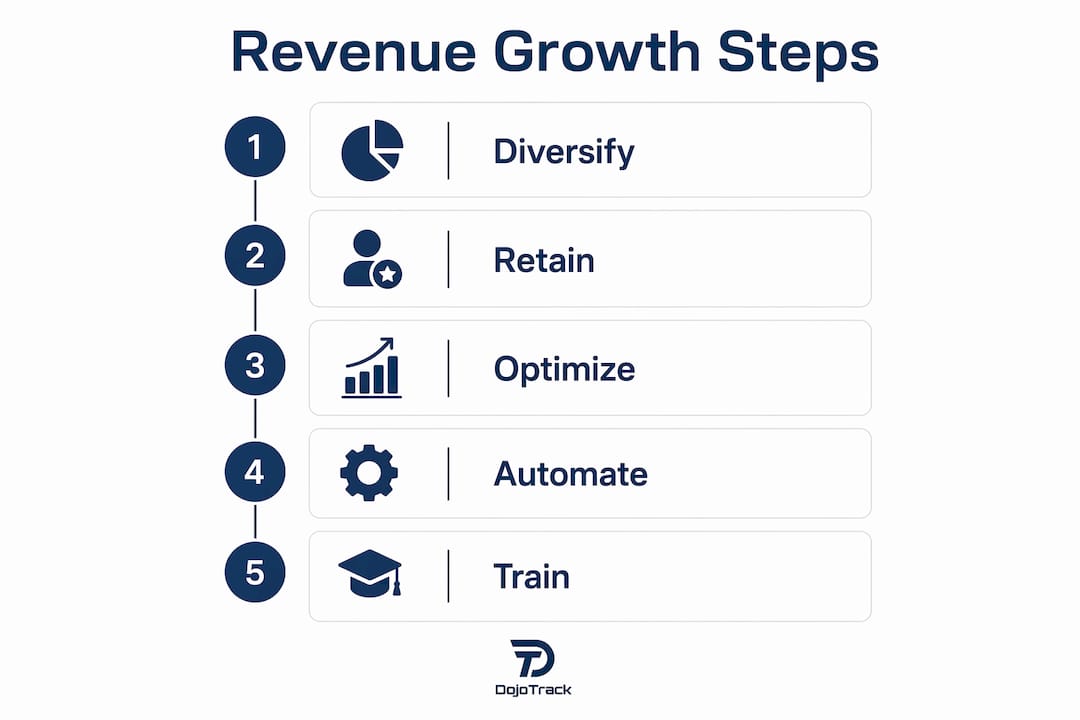
Every strategy in this guide maps to one of those pillars. Work through them in order, and you will have a clearer picture of where your school is leaving money on the table.
How to diversify your martial arts school revenue streams
Most schools rely too heavily on one source of income. Industry data shows that the typical martial arts school generates 60–70% of revenue from membership dues, 15–20% from retail sales and additional services, and 10–15% from specialized programs and partnerships. That membership-heavy mix creates fragility. One bad month of attrition and cash flow tightens fast.
The fix is building additional revenue streams that feel like natural extensions of your training, not add-ons bolted onto the side.
Core revenue streams to build or strengthen:
- Membership tiers (Core, Leadership, Mastery): Standardized packages with clear value differences let you serve multiple budget levels without negotiating one-off exceptions that shred your margins.
- Belt testing fees: Treat advancement as a full experience. A “Belt Achievement Package” priced at $150 that includes the test, a preparation workshop, the new belt and certificate, and a ceremony delivers more value than a flat $75 test fee and justifies the higher price.
- Private lessons: Private sessions priced at $75–$145 per hour generate meaningful recurring income. Even one 30-minute private per month adds $900-plus annually per student.
- Retail sales: Uniforms, gear, supplements, and branded merchandise can add 15–20% to monthly revenue when you stock what students actually need and make purchasing easy.
- Digital programs: Online training modules, recorded curriculum, and virtual coaching sessions extend your reach beyond your zip code and create income that does not depend on mat space.
- Annual management fees: A $50 annual access fee per student adds thousands to your bottom line across a student base of 100 or more, without touching core membership pricing.
- Family plans and partnerships: Studios offering family plans see higher retention, and local business partnerships open referral pipelines that cost nothing to maintain.
How to calculate and benchmark your revenue per student:
- Divide total monthly revenue by active student count to get your average revenue per student.
- If that number is below $150, you have clear room to grow through add-ons, pricing adjustments, or new programs.
- Track your revenue mix monthly. If membership dues creep above 70%, prioritize building one or two additional streams before adding marketing spend.
- Compare your belt testing and retail revenue against the benchmarks above. Most schools undercharge on testing and understock on retail.
A detailed breakdown of 2026 revenue streams for martial arts schools can help you identify which income sources fit your school’s size and style.
How to improve student retention and lifetime value
Retention is the highest-leverage number in your business. Improving retention by just 5% can increase profits by 25–95%. That is not a marketing claim. It is the compounding math of keeping students who are already paying, already trained, and already part of your community.

The financial case is equally direct: the average retained student generates $3,000 or more in tuition over two years, while acquiring a new student costs 5–7 times more than keeping an existing one.
| Retention rate | Profitability impact | Key driver |
|---|---|---|
| Below 70% | Constant churn erodes revenue gains | Weak onboarding, no follow-up |
| 70–80% (BJJ average) | Stable but growth is slow | Inconsistent engagement |
| 80% (MMA top tier) | Meaningful compounding growth | Milestone recognition, community |
| 90%+ (elite schools) | Referrals begin covering losses | Strong first-90-day system |
Retention tactics that move the needle:
- Onboarding check-ins: Personal contact after class two and class five catches students before they drift. A quick conversation from an instructor at those moments changes the trajectory.
- Milestone recognition: Celebrate first stripes, first full class without stopping, and first sparring session. These moments create emotional investment that keeps students coming back.
- Social integration: Introduce new students to training partners at similar skill levels. Students who have friends at the dojo quit at far lower rates.
- Paid intro offers over free trials: Paid introductory offers priced at $29–$49 for two weeks or $49–$99 for 4–6 sessions convert at 50–60% to full membership. Free trials convert below 20% and attract people who were never serious.
- Referral programs: Referral-sourced enrollments convert 30% faster and retain longer than paid ad leads. A structured buddy day or bring-a-friend event costs almost nothing and compounds over time. See the referral program guide for a step-by-step setup.
Pro Tip: Students who attend twice per week for three consecutive months rarely quit. Track that attendance pattern in your management software and flag anyone who drops below it before they disappear.
Optimizing operations and financial planning for profitability
Revenue growth without margin control is just expensive busy-ness. Plenty of school owners brag about 300 students or five-figure months while their bank accounts tell a different story. The fix starts with knowing your numbers and cutting what does not earn its place.
Auditing class profitability using the 80/20 rule is the fastest path to higher net income without adding a single new student. The bottom 20% of your programs typically consume 80% of your time and generate only 20% of your profit. Cut or reprice them, and your margins improve immediately.
Financial metrics every school owner should track:
- CAC (cost to acquire a student): Know what you spend in ad dollars and staff time per enrollment. If you are acquiring at $200 and collecting $400–$500 on day one, you should be spending more, not less.
- Churn rate: the industry experiences monthly student attrition, with well-run schools targeting significantly lower attrition levels that enable referral programs to offset some losses.
- Contribution margin per program: Not all classes are equal. A niche adult class at 7 PM may pull premium rates with minimal overhead. A kids’ class with six students and two instructors may not.
- Customer lifetime value (CLTV): Multiply average monthly revenue per student by average retention in months. This number tells you how much you can afford to spend acquiring each new student.
Operational decisions that protect margin:
- Standardize pricing into three clear tiers and hold the line on exceptions. Each “special case” (free sibling, prorated summer pass, one-off private rate) erodes margin across your entire base.
- Scale systems before adding staff. Many owners hire an admin for tasks that a $49/month automation handles, then wonder why payroll is eating the growth. Document your intro flows, billing, and test scheduling before adding headcount.
- Raise prices when you add value. If you introduce app-based progress tracking, curriculum depth, or leadership badges, your fees should reflect it. Parents do not value cheap. They value worth it.
The 5% retention rule: A 5% improvement in retention can increase profits by 25–95%, making retention the single highest-leverage metric you control.
Check the 2026 profitability benchmarks to see how your pricing and margins compare to schools at similar enrollment levels.
Leveraging modern marketing and AI-driven automation to grow revenue in 2026
Speed wins leads. Responding to an inquiry within 5 minutes makes you 21 times more likely to convert that prospect than waiting 30 minutes. Most school owners respond when they get around to it. That gap is where enrollment is lost.

Automated SMS follow-up closes that gap entirely. When a lead fills out your contact form at 9 PM, an automated message goes out immediately, books the intro, and starts the nurture sequence before you wake up. Dojotrack’s SMS automation tools handle this without manual intervention, so your response time is always measured in seconds.
The Marketing Parthenon approach
The Marketing Parthenon method treats student acquisition like a structure with multiple load-bearing columns. If one channel slows down, the others hold the school up. Schools that plateau at $60,000–$80,000 a month almost always got there by leaning on one or two channels and squeezing them dry. The columns that matter:
- Paid social (Facebook and Instagram): Broad AI-driven targeting outperforms manual demographic targeting in 2026. Let the algorithm find your audience. Consistent short-form video content feeds the algorithm and builds local awareness.
- Search marketing: Google paid ads plus an optimized Google Business Profile with 50-plus reviews. If your profile has fewer than 50 reviews, you are losing prospects who check before they call.
- Live events and grassroots outreach: A well-run booth at a local fair or farmers market can generate 50–100 leads in a single weekend at a fraction of the cost of digital ads. Those leads also convert at higher rates because you spoke with them face to face.
- Internal referrals: Referral programs compound once you pass 100 active students. Below that threshold, there simply are not enough members to refer at scale.
- Your website as the conversion hub: Every channel drives traffic here. If your site does not convert visitors into booked intros, the rest of the marketing spend leaks.
Dojotrack’s AI-powered tools for revenue growth
Dojotrack goes beyond scheduling and billing. Its AI-driven retention system identifies students at risk of dropping out before they ghost you, so your instructors can intervene at the right moment. Automated lead scoring prioritizes the prospects most likely to enroll, so your follow-up effort goes where it counts. Stripe-powered recurring billing catches failed payments automatically, recovering revenue that most schools simply lose.
Pro Tip: Reinvest enrollment cash flow into ad spend before the month ends. If you collect $400–$500 on day one from a new enrollment and your cost per lead is under $100, you are profitable before the first month of tuition clears. That math justifies increasing your ad budget, not cutting it.
How staff training and development drive sales and service quality
Your instructors are your front-line sales team, whether they think of themselves that way or not. The conversation after a student’s second class, the way a front desk staff member handles a pricing question, the tone of a follow-up call — all of it shapes whether a prospect enrolls and whether a student stays.
Train your staff on enrollment conversations specifically. Role-play the intro tour, the pricing presentation, and the objection to cost. Most instructors are excellent teachers and uncomfortable salespeople. Structured practice closes that gap without making anyone feel like they are working at a car dealership.
Service quality training matters just as much. Students who feel seen and coached by name retain at higher rates. Build a simple check-in protocol: instructors greet every student by name, acknowledge progress since the last class, and close with something specific to work on before next time. That three-step habit costs nothing and creates the kind of experience students tell their friends about.
Invest in instructor advancement pathways too. Instructors who are growing in their own practice bring more energy to the mat, and students notice. A clear pathway from assistant instructor to lead instructor to program director also reduces turnover, which is one of the most disruptive and expensive problems a school can face.
How technology helps you track operations and close more sales
Running a martial arts school on spreadsheets and paper sign-in sheets is not a systems problem. It is a revenue problem. Every missed billing cycle, every untracked lead, and every at-risk student you did not notice is money that left your school quietly.
Purpose-built management software like Dojotrack centralizes everything: student memberships, attendance, scheduling, digital waivers, family discounts, and Stripe-powered recurring billing in one place. The student mobile app keeps members engaged between classes by letting them track belt curriculum progress, view schedules, and receive push notifications. That ongoing engagement between visits is one of the most underused retention tools available.
On the sales side, Dojotrack’s CRM tracks every lead from first contact through enrollment. Automated lead scoring tells you which prospects are most likely to convert, so you spend your follow-up time on the right people. The automated lead follow-up system ensures no inquiry goes cold, even when you are on the mat teaching.
For operations, real-time analytics show you which classes are filling, which programs are underperforming, and where attrition is spiking. That visibility lets you make decisions based on data rather than gut feel. Dojotrack’s free core layer gives you access to foundational tools immediately, with advanced AI features available as your school grows.
How seasonal promotions and events planning boost enrollment year-round
Enrollment is not flat across the year. January brings resolution-driven sign-ups. September brings back-to-school families. Summer creates attrition risk as schedules loosen. Knowing those patterns lets you plan promotions that hit at the right moment rather than reacting after enrollment dips.
Build a 12-month promotional calendar at the start of each year. Map your highest-traffic enrollment windows (January, September, and post-holiday) and plan your paid intro offers, referral events, and community outreach around them. A well-timed “bring a friend” week in late august, before school starts, can fill your kids’ classes for the fall.
Events serve a dual purpose: they generate leads and they deepen community for existing students. A belt promotion ceremony open to family members, a self-defense workshop for local businesses, or a charity tournament all create visibility and goodwill that paid ads cannot replicate. Live events also tend to produce higher-quality leads because the prospect has already seen your school in action before they inquire.
Seasonal promotions work best when they are tied to a specific offer with a clear deadline. “Enroll this week and your first month is $49” converts better than a vague discount with no urgency. Pair the promotion with your automated SMS follow-up so every inquiry from the event gets a response within minutes, not days.
Key Takeaways
The most effective way to grow martial arts school revenue is to fix retention and conversion systems first, then scale marketing spend on top of a foundation that actually holds students.
| Point | Details |
|---|---|
| Retention drives profit | A 5% retention improvement can increase profits by 25–95%, making it the highest-leverage metric you control. |
| Paid intros outperform free trials | Paid introductory offers convert at 50–60% to full membership; free trials convert below 20%. |
| Diversify beyond dues | Membership dues should represent 60–70% of revenue; retail, testing, and programs fill the rest. |
| Speed wins leads | Responding to inquiries within 5 minutes makes conversion 21 times more likely than a 30-minute delay. |
| Audit before you add | Cutting the bottom 20% of programs that generate only 20% of profit increases net income without new enrollments. |
FAQ
How much does a martial arts school owner make?
Income varies widely by school size, location, and pricing. Schools with strong retention and diversified revenue streams, including private lessons, retail, and testing fees, tend to generate the most consistent profit.
Do martial arts schools make money?
Yes, but profitability depends on margin management, not just enrollment numbers. Schools with 300 students and poor pricing can earn less than schools with 150 students and well-structured tiers.
Are martial arts gyms profitable?
Gyms that track unit economics (CAC, churn rate, and CLTV) and maintain monthly attrition below 2% tend to be consistently profitable. Those that rely on a single revenue stream or ignore retention typically struggle.
How much does it cost to run a martial arts school?
Operating costs depend on facility size, staff count, and location, but payroll and rent are typically the largest line items. Scaling systems before adding staff, as outlined in the operational section above, is the most direct way to protect margin as the school grows.