
Automated SMS Follow-Up Benefits for Martial Arts Studios
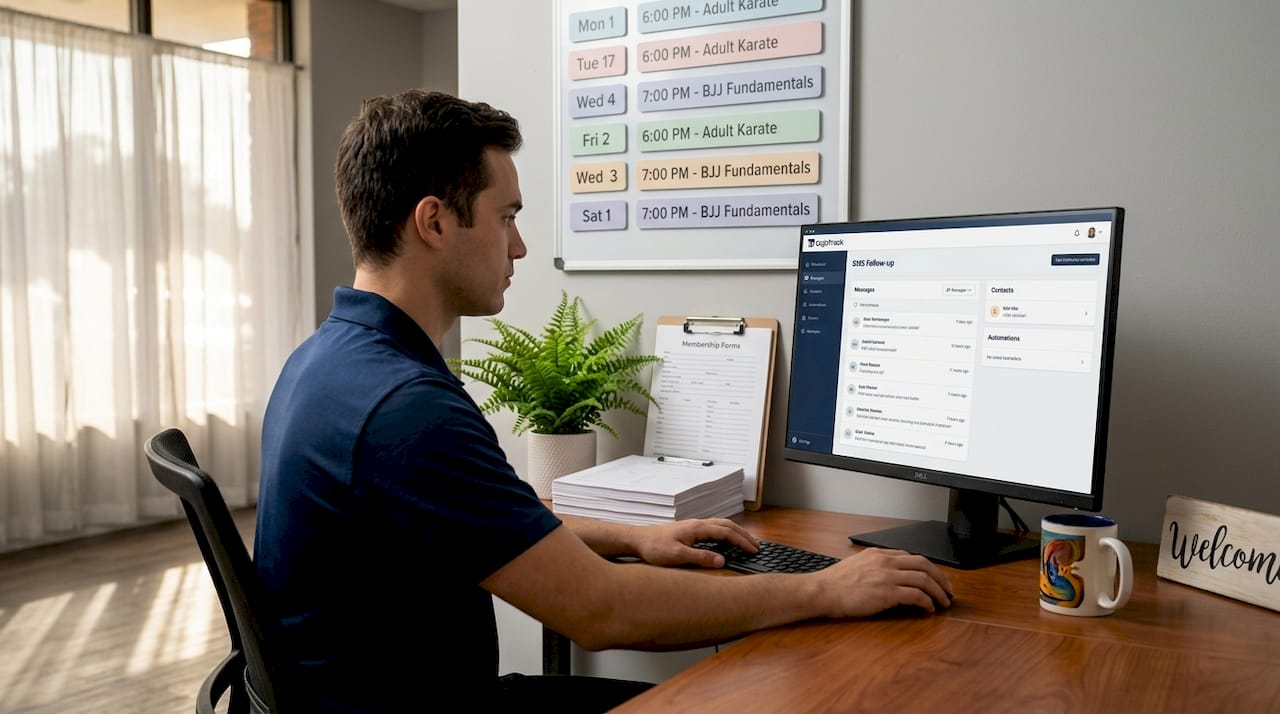
TL;DR:
- Automated SMS follow-up is the most effective channel for martial arts studios to increase response rates, reduce no-shows, and convert leads efficiently.
- Implementing trigger-based sequences tied to CRM events and ensuring compliance with TCPA rules significantly improves retention and operational efficiency.
Automated SMS follow-up is the single most effective communication channel martial arts studios can use to convert leads, retain students, and reduce no-shows in 2026. SMS achieves a 34.7% average response rate, roughly four times higher than outreach email. For a dojo owner juggling classes, billing, and belt promotions, that gap is the difference between a full roster and empty mats. This article breaks down the proven benefits of SMS automation, the compliance rules you must follow, and exactly how to implement it for your studio.
1. Automated SMS follow-up benefits: higher response rates than any other channel
The core advantage of automated SMS follow-up is speed combined with reach. SMS open rates hit 98% and response rates reach 45%, numbers that email marketing cannot approach. That means when a prospect fills out your trial class form at 9 PM, an automated text sent within five minutes is almost certain to be read.
The response rate gap matters most at the highest-value moments in your funnel:
- Immediate follow-up (0 to 5 minutes): Sends a personalized welcome and trial class link while the prospect is still engaged.
- One-hour recovery: Reaches leads who did not respond to the first message, recovering a significant share of missed opportunities.
- 24-hour check-in: Confirms attendance or offers a reschedule before the appointment, reducing no-shows.
Only 17.3% of SMS programs deploy follow-up at deal close, even though that stage produces a 39.6% response rate. That statistic reveals a massive untapped opportunity for studios willing to automate at every stage of the student journey.
Pro Tip: Frame your first automated text as a question, not a statement. “Hi [Name], are you still interested in a free trial class at [Studio Name]? Reply YES to grab a spot.” One question, one CTA, one clear next step.
2. How SMS reminders reduce no-shows and protect your revenue
Every empty mat in a scheduled class costs you money. SMS appointment reminders reduce missed appointments by up to 33.7%, according to a behaviorally informed trial by the NSW Government. That trial saved $119,000 across four clinics in just eight months. The principle applies directly to martial arts scheduling.
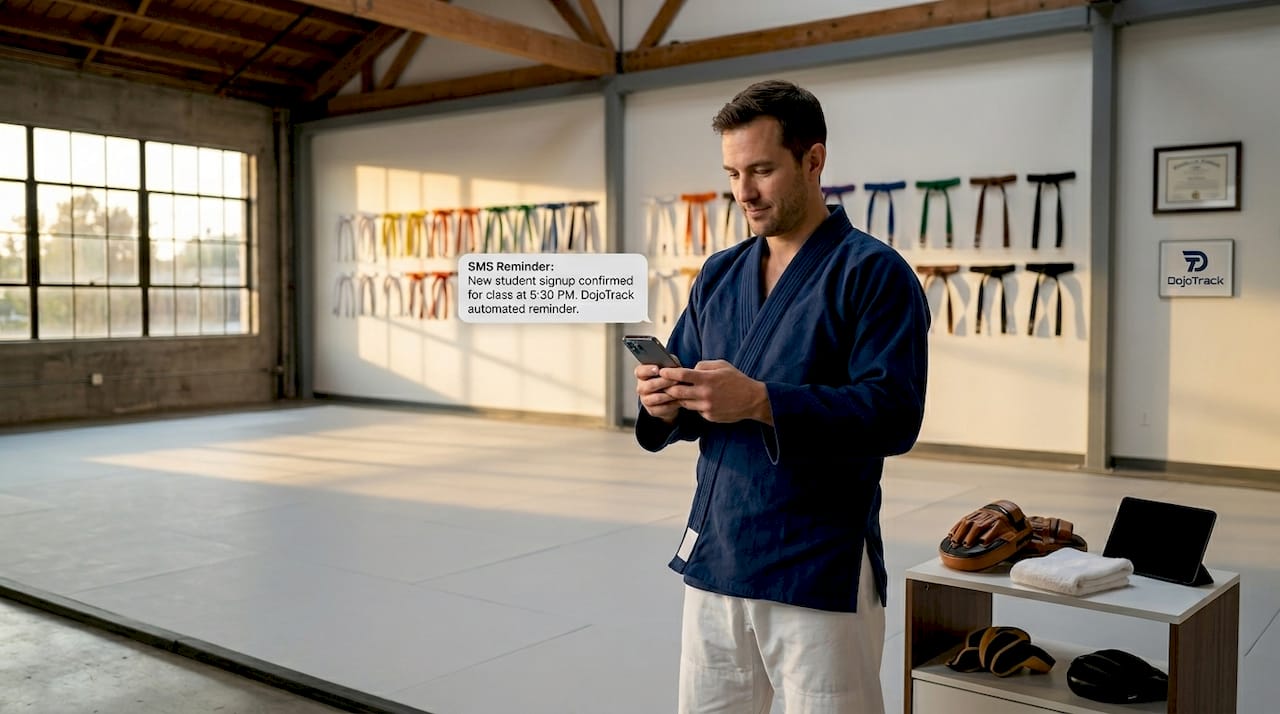
The behavioral science behind this is straightforward. Reminders that highlight what a student loses by missing class, such as progress toward their next belt rank or a streak of consecutive attendance, outperform generic “don’t forget your class” messages. Loss aversion is a proven driver of action.
Effective reminder sequences for a martial arts studio look like this:
- 48 hours before class: Confirmation request with a reply option to cancel or reschedule.
- 24 hours before class: Motivational reminder referencing the student’s current belt level or upcoming promotion test.
- 2 hours before class: Final reminder with directions or parking info if relevant.
Designing each SMS as a single-question interaction with a clear CTA reduces front-desk workload and routes replies directly into your CRM to pre-qualify student intent. Your staff spends less time on the phone and more time on the mat.
Pro Tip: Include a reschedule link in every reminder text. Students who cannot attend are far more likely to rebook if the option is one tap away rather than a phone call.
3. Compliance rules every studio must follow for SMS automation
SMS automation is powerful, but it carries legal obligations under the Telephone Consumer Protection Act (TCPA). Post-April 2025, US TCPA rules require businesses to honor opt-out requests through any reasonable means within 10 business days. Relying only on keyword replies like “STOP” is no longer sufficient.
Every compliant SMS program for a martial arts studio must include:
- Written consent at enrollment: Collect explicit opt-in permission when students or prospects submit a form, sign a waiver, or register online.
- Clear opt-out instructions in every message: Include language such as “Reply STOP to unsubscribe” in your initial message and periodically thereafter.
- Quiet hours: Do not send automated texts before 8 AM or after 9 PM in the recipient’s local time zone.
- Immediate suppression logic: Automation systems must cancel all queued sends the moment a contact opts out, not just pause the next campaign.
- Consent records: Store documentation of when and how each contact opted in, in case of a dispute.
Compliance is not just a legal checkbox. It protects your studio’s reputation and keeps your SMS program sustainable long-term. A single complaint to the FCC can result in fines that far exceed any revenue gained from non-compliant messaging.
4. ROI and operational efficiency gains from SMS automation
The financial case for automated SMS follow-up is concrete. Studios that implement trigger-based sequences report recovering a meaningful share of missed calls and converting more trial inquiries into paying students. Forbes identifies automation as a speed and precision strategy that outperforms larger marketing budgets by responding faster and more accurately than any manual process.
Consider the math for a mid-size dojo receiving 40 new inquiries per month. If manual follow-up converts 15% of those leads and automated SMS follow-up raises that to 25%, that is four additional students per month. At an average membership value of $150 per month, that is $600 in new monthly recurring revenue from one automation change alone.
| Metric | Manual follow-up | Automated SMS follow-up |
|---|---|---|
| Average response rate | ~8% (email) | 34.7% to 45% (SMS) |
| Time to first contact | Hours to days | Under 5 minutes |
| Staff time per lead | 10 to 15 minutes | Near zero |
| No-show reduction | Minimal | Up to 33.7% |
| Monthly lead conversion lift | Baseline | Estimated +10 percentage points |
The time savings compound quickly. A studio sending 200 messages per month manually might spend 10 or more hours on outreach. Automation reclaims that time for instruction, curriculum development, or community events. That is time you could spend on the mat instead of behind a desk.
5. How to implement SMS automation tailored to your dojo
Effective implementation starts with trigger-based sequences tied to specific student actions rather than fixed broadcast schedules. CRM-triggered SMS sequences tied to events like a new inquiry, a booking confirmation, or an attendance lapse consistently outperform time-based blasts. The message arrives when the student is already thinking about your studio.
Here are the core sequences every martial arts studio should build:
- New inquiry sequence: Immediate welcome text with a trial class booking link, followed by a one-hour recovery text if no response, then a 24-hour check-in.
- Booking confirmation sequence: Confirmation text immediately after booking, a 24-hour reminder with class details, and a two-hour final reminder.
- Attendance lapse sequence: A check-in text after two missed classes, a personal-feeling message from the instructor’s name after four missed classes, and a re-engagement offer after one week of absence.
- Belt promotion reminder: Automated congratulations after a promotion is logged, with a link to the next curriculum level in your student app.
Every message should identify your business by name and include opt-out instructions. Keep each text to one question or one CTA. “Hi [Name], your next class at [Studio Name] is tomorrow at 6 PM. Reply YES to confirm or NO to reschedule.” That format works because it requires minimal effort from the student and routes the reply automatically into your system.
Pro Tip: Test two versions of your re-engagement message: one that emphasizes what the student gains by returning (belt progress, community) and one that highlights what they lose by staying away (falling behind peers, losing momentum). Track which version gets more replies over 30 days and use that as your default.
For a deeper look at connecting leads to your studio through SMS booking links, DojoTrack’s guide on automating lead connections covers the full workflow.
Key takeaways
Automated SMS follow-up outperforms every other communication channel for martial arts studios because it combines near-universal open rates, behavioral messaging principles, and CRM-triggered precision to convert leads and retain students at scale.
| Point | Details |
|---|---|
| SMS response rates dominate | Automated SMS achieves up to 45% response rates, far above email’s typical 8%. |
| Reminders cut no-shows significantly | Behaviorally framed SMS reminders reduce missed appointments by up to 33.7%. |
| Compliance is non-negotiable | TCPA rules require immediate opt-out suppression and written consent for every contact. |
| Trigger-based sequences outperform blasts | CRM-event-driven messages convert better than fixed-schedule broadcasts. |
| Automation saves measurable staff time | Replacing manual outreach with SMS sequences reclaims hours each week for instruction. |
What we’ve learned running SMS automation for martial arts studios
At DojoTrack, we have seen the same pattern repeat across dozens of studios: the biggest revenue leak is not pricing or programming. It is the gap between when a lead submits an inquiry and when someone from the studio actually responds. Most studios respond within hours. The data says you need to respond within minutes.
The studios that see the fastest retention improvements are not the ones sending the most messages. They are the ones sending the right message at the right moment. A text that arrives 30 seconds after a prospect fills out your trial form feels like attentive service. The same text sent six hours later feels like a mass blast.
The compliance piece is where we see studios get complacent. Collecting a phone number on a paper waiver and assuming that covers SMS consent is a real risk. Written, documented opt-in tied to a specific communication channel is the standard now, and your automation system needs suppression logic that acts immediately, not at the next send cycle.
The studios winning at retention right now are combining automated SMS sequences with a CRM that tracks every student interaction. When your system knows a student has missed two classes and automatically sends a personal-feeling check-in from the instructor’s name, that student feels seen. That feeling keeps people enrolled far longer than any discount or promotion. The time savings from automated communication are real, but the retention impact is what actually moves the revenue needle.
— DojoTrack
How DojoTrack powers SMS follow-up for martial arts studios
DojoTrack is built specifically for martial arts schools, MMA gyms, Taekwondo academies, and Jiu Jitsu schools across the United States. The platform includes AI-powered automated SMS follow-up sequences that trigger on CRM events like new inquiries, booking confirmations, attendance lapses, and belt promotions. Every message is logged, tracked, and tied to student records so you always know where each lead or member stands. DojoTrack’s all-inclusive pricing means no surprise SMS fees as your studio grows. If you are ready to stop leaving leads unanswered and start converting more prospects into long-term students, explore DojoTrack’s full platform and see what AI-powered follow-up looks like in practice.
FAQ
What response rate can I expect from automated SMS follow-up?
Automated SMS achieves a 34.7% average response rate, with top-performing programs exceeding 56%. That is roughly four times higher than outreach email.
How much can SMS reminders reduce no-shows at my studio?
Behaviorally informed SMS reminders reduce missed appointments by up to 33.7%. Framing messages around what students lose by missing class, such as belt progress or attendance streaks, produces the strongest results.
Do I need written consent before texting students and leads?
Yes. Under current TCPA rules, you must collect explicit written consent before sending automated SMS messages and must honor opt-out requests through any reasonable method within 10 business days.
What triggers should I use for automated SMS sequences?
CRM events produce the best results: new inquiry submissions, booking confirmations, attendance lapses, and belt promotion milestones. Fixed-schedule broadcasts consistently underperform event-driven sequences.
How many texts should I include in a follow-up sequence?
Three to four messages per sequence is the standard: an immediate send, a one-hour recovery, a 24-hour check-in, and optionally a final re-engagement message after one week. Each text should contain one question or one CTA only.
Recommended
- How Smart Automation Instantly Connects Martial Arts Leads to Your Dojo (with SMS Booking Links) | DojoTrack
- No Extra SMS Fees: DojoTrack’s All-Inclusive Pricing Makes Communication Easy for Martial Arts Schools | DojoTrack
- 5 Tips to Get the Most from Your Martial Arts CRM | DojoTrack
- AI Martial Arts Software Features | DojoTrack