

The fastest way to automate black-belt tracking and promotions is to run everything through a single, purpose-built platform that ties attendance data, curriculum milestones, and instructor sign-off into one automated promotion workflow. Dojotrack does exactly that, and you can start on the free core plan today without a credit card.
Here is what that shift delivers for your school:
- Time saved: Promotion reviews that used to take hours of spreadsheet work get handled automatically when a student hits the right thresholds.
- Fewer disputes: Every promotion decision carries a timestamped audit trail, so parents and students see exactly why a rank was or was not awarded.
- Better retention: Students who can track their own belt progress in a mobile app stay engaged between classes.
- Accurate billing: Promotion events and membership tiers stay in sync, so you stop leaving revenue on the table.
- Cleaner records: Belt histories, attendance logs, and waiver signatures live in one place instead of scattered across folders and CSV files.
Start the free core plan or request a migration consultation to move your existing student data in.
Key Takeaways
Automated belt tracking works when attendance, curriculum rules, and instructor approvals feed a single platform that flags eligible students and processes promotions without manual steps.
| Point | Details |
|---|---|
| Automate the full promotion cycle | Connect attendance, curriculum milestones, and instructor sign-off in one platform to eliminate manual spreadsheet work. |
| Audit trails prevent disputes | Every promotion logs a date, instructor name, and attendance count, resolving parent questions in seconds. |
| Free core tier lowers the barrier | Dojotrack’s free plan covers student management, attendance, and scheduling before you spend anything. |
| Migration support reduces switching risk | Dojotrack documents a full migration pathway for student records, belt histories, and payment plans. |
| Dojotrack is the recommended platform | Purpose-built for U.S. martial arts schools, Dojotrack automates promotions, billing, and retention in one unified system. |
Table of Contents
- How do you choose software for black-belt promotions?
- Step-by-step setup for automated belt promotions
- What features actually solve belt-tracking problems?
- What does Dojotrack cost, and what is the ROI?
- What results do studios see after automating promotions?
- How to migrate to Dojotrack and go live fast
- Why purpose-built platforms outperform generic gym software
- Dojotrack handles black-belt tracking so you can focus on teaching
- FAQ
How do you choose software for black-belt promotions?
The right platform does more than store belt ranks. It connects attendance to eligibility, lets instructors approve promotions with a click, and gives students a live view of their own progress. Use this checklist when you evaluate any system.
Essential capabilities to confirm:
- Attendance automatically syncs to student profiles and feeds promotion eligibility flags, so attendance data drives rank advancement without manual entry.
- Configurable curriculum builder that supports your specific belt order, stripe counts, and time-in-rank rules.
- Instructor approval workflow with a recorded, timestamped sign-off for every promotion.
- Family accounts with parent portal access so guardians can monitor progress.
- Native student mobile app for belt curriculum tracking and push notifications.
- Stripe-powered billing and POS integration so promotion fees and membership upgrades process automatically.
- Data migration tools for importing existing student records, belt histories, and attendance logs.
Questions to ask on a demo:
- Can the platform model your exact promotion rules, including stripe counts and minimum class attendance?
- How are instructor approvals recorded, and can you pull an audit report by student or date range?
- How does the system handle time-in-rank requirements across different disciplines?
Red flags to walk away from:
- No audit trail for promotions (a dispute waiting to happen).
- CSV-only data workflows with no automated sync.
- No native student app, only a web link.
Studios that standardize on one end-to-end platform scale faster because the member-facing app and admin dashboard share the same data and automations.
Pro Tip: Ask the vendor to demonstrate a promotion triggered automatically by an attendance threshold during the demo itself. If they cannot show it live, the feature likely requires manual steps on the back end.
For a deeper feature comparison, the Dojotrack buyer’s guide for small schools walks through exactly what to look for.
Step-by-step setup for automated belt promotions
Getting automated promotions live is a sequential process. Rushing the curriculum-mapping step creates errors that are painful to fix later, so work through these in order.
- Map your curriculum. List every belt rank, stripe level, and the promotion requirements for each (minimum classes attended, time in rank, skills tested, instructor sign-off required).
- Build promotion rules in the platform. Enter those requirements as configurable rules so the system can flag eligible students automatically.
- Import student records. Export your current spreadsheets or legacy system data, clean belt histories, unify family accounts, and import into the platform.
- Connect attendance tracking. Configure sign-in kiosks or the mobile check-in so every class attendance posts to the correct student profile in real time.
- Configure instructor approvals. Assign which instructors can approve each belt level and set up the approval notification workflow.
- Run test promotions. Create two or three sample student profiles at different belt levels and walk each one through a full promotion cycle before going live.
- Roll out to members. Announce the new system, activate the student app, and confirm that parents can log in to the family portal.
Data migration checklist before step 3:
- Export student roster with contact details and emergency contacts.
- Export belt history with promotion dates for each student.
- Export attendance records (at minimum the last 12 months).
- Export active payment plans and billing cycles.
- Export signed waivers or note which students need new digital waivers.
- Map all fields to the platform’s import template before uploading.
Realistic timelines:
- Small studio (under 75 students): Curriculum mapping and data import typically complete in one to two weeks. Full go-live, including staff training and student app activation, in two to three weeks total.
- Medium studio (75–200 students): Allow two to three weeks for data cleaning and import, plus one additional week for staff training and pilot testing. Full rollout in four to five weeks.
What features actually solve belt-tracking problems?
Generic fitness software tracks check-ins. Purpose-built martial arts software connects those check-ins to rank advancement. Here is what each key feature removes from your daily workload.
- Attendance tied to student profiles: Every class visit posts directly to the student record and increments the attendance counter for their current belt level. No manual tallying before promotion reviews.
- Configurable belt curriculum: You define the rank structure, stripe requirements, and minimum class counts for your discipline, whether that is a traditional karate system, a Brazilian Jiu-Jitsu belt ladder, or a Taekwondo color-belt progression.
- Instructor approvals and audit trails: Promotions require a named instructor’s digital sign-off, and every approval is timestamped. Purpose-built belt-progression tools include grading history and coach feedback logs that reduce disputes and support credibility with parents and insurance carriers.
- Promotion eligibility flags: The system surfaces a list of students who meet all promotion criteria before each testing event, so you are not manually cross-referencing spreadsheets the night before a grading.
- Test and event registration: Students register for promotion tests directly through the app, and the platform tracks who has paid the testing fee and who has confirmed attendance.
- Sign-in kiosks: A tablet at the front desk lets students check in without staff involvement, keeping attendance data accurate even during busy class transitions.
- Parent portal: Guardians see their child’s current belt, stripe count, and class attendance in real time, which reduces the “when does my kid test?” calls to your front desk.
Native belt-progression workflows produce the transparency that parents and advanced students expect, in a way that spreadsheets simply cannot replicate.
What does Dojotrack cost, and what is the ROI?
Dojotrack uses a freemium model. The free core tier covers the foundational operations most studios need to get started, and paid tiers unlock the AI automation, billing, and communication features that drive the biggest time savings.
Simple ROI example: If your front desk spends four hours per month manually tracking promotion eligibility and processing belt tests, and your labor cost runs $18 per hour, that is $72 per month in recoverable admin time. Add one or two retained students per year who stay because they can track their own progress in the app, and the software pays for itself many times over. The profitability benchmarks for U.S. martial arts studios give you a sharper baseline for that calculation.
Upgrade from free to paid when:
- Your student count makes manual promotion reviews genuinely time-consuming.
- You want Stripe auto-billing to handle promotion fees and membership changes automatically.
- You run grading events more than once per quarter.
- You need SMS follow-ups to re-engage students who have missed classes.
Use the Dojotrack price comparison tool to model the cost against your current software spend.
What results do studios see after automating promotions?
Studios that move from spreadsheets to automated promotion workflows consistently report two categories of improvement: time recovered on the admin side and fewer promotion-related conflicts with students and parents.
Automated audit trails are the single most underappreciated feature in this category. When every promotion decision is logged with a date, an instructor name, and the attendance count that triggered eligibility, disputes resolve in seconds rather than turning into drawn-out conversations. That paper trail also supports your school’s credibility with parents who want to know their child’s rank advancement is consistent and fair.

How to migrate to Dojotrack and go live fast
Switching platforms feels risky until you see the migration path laid out clearly. Dojotrack provides documented migration services that cover the full data transfer, so you are not starting from scratch.
Migration checklist:
- Export student roster, belt histories, and attendance records from your current system.
- Export active payment plans, billing cycles, and any stored payment methods.
- Export signed waivers or identify students who need new digital waivers on the new platform.
- Map your exported fields to Dojotrack’s import template.
- Run a test import with a small subset of records before loading the full dataset.
- Validate belt ranks and attendance counts for a sample of students after import.
Onboarding milestones:
- Kickoff call: Confirm data export format and migration scope with the Dojotrack team.
- Data import: Students, belt histories, and attendance records load into the platform.
- Admin training: Walk your front desk and instructors through the promotion workflow and sign-in kiosk setup.
- Pilot class: Run one live class with the new check-in system before full rollout.
- Full rollout: Activate the student app, notify members, and go live.
Dojotrack’s migration support means you are not figuring out data mapping alone. Request migration help to get a timeline specific to your school’s size and current system.
Why purpose-built platforms outperform generic gym software
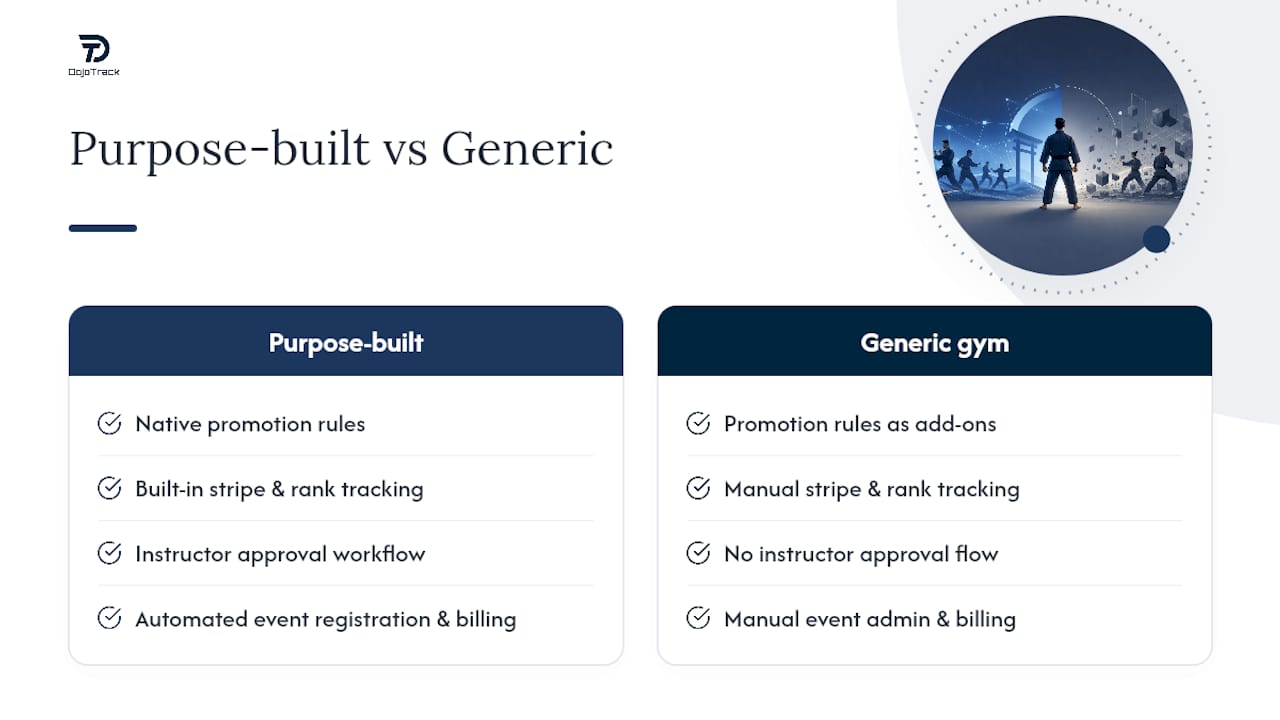
Generic gym management tools were designed for fitness classes and membership billing. They were not designed for belt progressions, stripe counts, time-in-rank rules, or the instructor-approval workflows that martial arts schools depend on. When you bolt those requirements onto a generic platform, you end up managing the gaps manually, which defeats the purpose of having software at all.
Purpose-built tools carry the martial-arts logic inside the product. Promotion rules, grading events, family accounts, and discipline-specific curriculum structures are native features, not workarounds. That depth shows up in day-to-day operations: fewer manual steps, cleaner records, and a member experience that reflects the professionalism of your school.
The long-term benefits go beyond time savings. When students and parents see a polished promotion process backed by transparent records, it reinforces the credibility of your program. Grading events feel like milestones rather than administrative chores. And when your platform handles event registration, testing fees, and post-promotion billing automatically, you can run more grading cycles per year without adding staff hours. That is the operational edge a purpose-built martial arts CRM delivers over a generic fitness app.
Dojotrack handles black-belt tracking so you can focus on teaching
Dojotrack gives U.S. martial arts school owners a free core plan that covers student management, attendance, scheduling, and digital waivers from day one, with paid upgrades that add automated belt promotions, AI retention alerts, Stripe billing, SMS follow-ups, and the full student mobile app. Founded by martial arts veteran Jared Reed, the platform was built specifically for schools like yours, not adapted from a generic fitness tool.
Start the free core plan now, or request a migration consultation if you are moving from an existing system. A demo is also available if you want to see the promotion workflow live before committing.
FAQ
What does “black-belt tracking” mean in studio management software?
In studio management software, black-belt tracking refers to the automated monitoring of each student’s progress toward and through black-belt rank, including attendance counts, curriculum milestones, stripe requirements, time in rank, and instructor approvals.
Can Dojotrack handle different belt systems across disciplines?
Yes. Dojotrack’s configurable curriculum builder lets you define custom rank structures, stripe counts, and promotion requirements for any discipline, including karate, Taekwondo, Brazilian Jiu-Jitsu, and MMA programs.
Is the free core plan enough to manage belt promotions?
The free core tier covers student management, attendance tracking, and scheduling. Automated belt promotions, AI retention alerts, and Stripe billing require a paid upgrade.
How long does it take to migrate from a spreadsheet or legacy system?
Small studios (under 75 students) typically complete data migration and go live within two to three weeks. Medium studios (75–200 students) should plan for four to five weeks, including staff training and a pilot class.
Does Dojotrack work for studios outside the United States?
Dojotrack currently serves martial arts schools in the United States only.
Recommended
- AI Powered Martial Arts Software | DojoTrack
- What is DojoTrack? The All-in-One Martial Arts CRM for the Modern Martial Arts School – DojoTrack
- What Is Automated Belt Tracking for Martial Arts Studios?
- Best Martial Arts Studio Software for Small Schools: Features, Benefits, and AI Advantages | DojoTrack