

TL;DR:
- Scheduling tools automate class booking, attendance, and resource management to prevent chaos in new martial arts studios. They significantly reduce no-shows and administrative workload through automated reminders and conflict detection. Purpose-built martial arts software offers essential features like belt tracking and curriculum integration, supporting scalable, efficient studio operations from day one.
Scheduling tools for martial arts studios are software platforms that automate class booking, attendance tracking, reminders, and resource coordination, making them the operational backbone every new studio owner needs from day one. The right studio management software, often called class scheduling or dojo management software in the industry, does far more than replace a paper calendar. Scheduling software automates repetitive tasks like booking confirmations, payment collection, and staff coordination, freeing you to focus on teaching. Platforms like DojoTrack and DojoPractice are built specifically for martial arts environments, offering features that generic tools simply cannot match. Understanding why new martial arts studios need scheduling tools starts with recognizing that administrative chaos is the number one reason new studios stall before they ever find their stride.
Why new martial arts studios need scheduling tools from the start
Opening a martial arts studio means wearing a dozen hats at once: head instructor, billing manager, receptionist, and retention specialist. Without dedicated scheduling software, each of those roles generates manual work that compounds quickly.
The most common pain points new studio owners report include:
- Manual booking and rescheduling: Every phone call or text message to confirm a class slot costs you time you could spend on the mat.
- Double-booking risks: Without automated conflict detection, two students or two instructors can end up assigned to the same room at the same time.
- Missed payment follow-ups: Tracking tuition manually across a growing roster leads to revenue gaps that are hard to recover.
- Poor communication: Students who miss a class and receive no follow-up are far more likely to quietly quit.
The average martial arts school loses 30 to 50 percent of its students annually, largely because of administrative friction. That statistic means a studio with 100 active students could lose 30 to 50 of them every year, not because the instruction is poor, but because the experience around the instruction feels disorganized.
Pro Tip: Map out every administrative task you perform in a single week before choosing a scheduling tool. The tasks that repeat daily, like sending reminders or confirming bookings, are your highest-priority automation targets.

Coordination across instructors, classrooms, and class types adds another layer of complexity. A BJJ school running beginner, intermediate, and competition classes simultaneously needs a system that tracks room capacity, instructor availability, and curriculum level at the same time. A spreadsheet cannot do that reliably.
How do scheduling tools reduce no-shows and improve attendance?
No-shows are expensive. An empty mat means lost revenue, wasted instructor time, and a weaker class dynamic that discourages the students who did show up. Automated scheduling software attacks this problem directly.
Appointment reminders increase attendance rates with phone and automated reminders showing relative risk improvements of 1.11 to 1.14 compared to no reminders at all. Applied to a martial arts studio, that improvement compounds across every class, every week. A studio running 20 classes per week with even a modest attendance lift adds up to dozens of additional mat appearances per month.
Modern scheduling platforms deliver reminders through multiple channels:
- SMS text messages sent 24 hours and 1 hour before class
- Email confirmations with class details and cancellation links
- Push notifications through a dedicated student mobile app
- Automated follow-ups for students who missed a session
AI scheduling tools report up to a 29 percent improvement in student retention and free up 15 to 20 hours of administrative work per week for studio owners. That is nearly half a full-time work week returned to you every single week. The retention gain matters even more: keeping one student for an additional six months is worth far more than acquiring a new one.
AI-driven retention workflows go beyond reminders. Platforms like DojoTrack identify students whose attendance is declining before they cancel, then trigger automated outreach to re-engage them. This kind of proactive contact, timed to a student’s actual behavior pattern, is something no manual system can replicate at scale. Scheduling also connects directly to belt testing invitations and curriculum milestones, so students receive timely recognition that keeps them motivated and enrolled.
What makes martial arts-specific scheduling software different from generic tools?
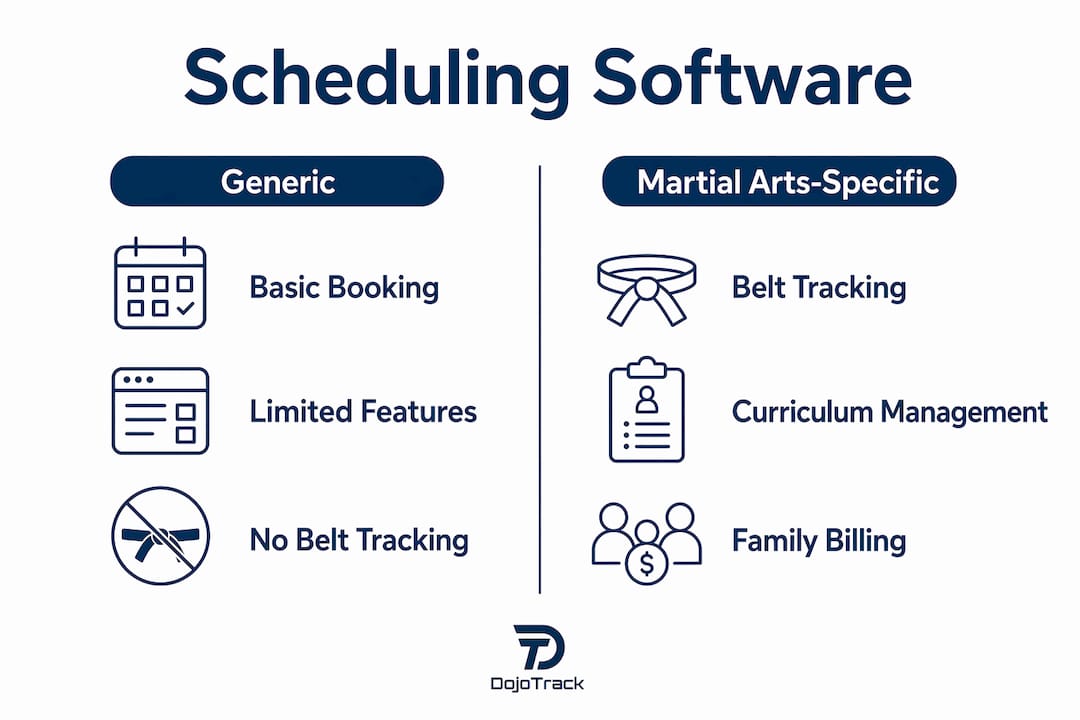
Generic scheduling software, including tools built for salons, fitness studios, or medical offices, handles basic booking well. What it cannot do is manage the layered complexity of a martial arts school.
| Feature | Generic scheduling software | Martial arts-specific software |
|---|---|---|
| Class booking | Yes | Yes |
| Belt and rank tracking | No | Yes |
| Family account billing with sibling discounts | No | Yes |
| Curriculum-linked class scheduling | No | Yes |
| Instructor certification tracking | No | Yes |
| Belt promotion automation | No | Yes |
| Attendance tied to promotion eligibility | No | Yes |
| MMA, BJJ, and Taekwondo-specific workflows | No | Yes |
Martial arts-specific scheduling integrates belt tracking, family billing, and curriculum management in ways that general gym software simply does not offer. For a Taekwondo academy, this means a student’s class attendance automatically counts toward their next belt test eligibility. For a family with three kids enrolled, it means a single billing account with automatic sibling discounts applied at checkout.
Instructor and staff management is another area where purpose-built tools outperform generic options. A martial arts studio needs to track which instructors are certified to teach which belt levels, manage substitute coverage, and handle last-minute schedule changes without creating confusion. Effective staff scheduling software supports draft-and-approve workflows that transition into automated messaging, so your team always knows where they need to be.
The difference is not just convenience. It is the difference between software that fits your business and software you are constantly working around.
How do scheduling tools prevent double-booking and resource conflicts?
Double-booking is not just an inconvenience. It damages trust with students and instructors, and it is surprisingly easy to trigger in any system that handles simultaneous booking requests.
The technical cause is called a race condition. When two students attempt to book the same class slot at the same moment, a naive system may confirm both before checking whether the slot is still available. Server-side locking prevents double-booking by serializing booking requests, meaning the system processes one request at a time and checks availability before confirming. This is a back-end safeguard that most studio owners never see, but it is what separates reliable scheduling software from tools that occasionally produce embarrassing conflicts.
Beyond the technical layer, quality scheduling platforms provide real-time conflict alerts for:
- Room capacity limits: The system blocks new bookings once a class reaches its maximum enrollment.
- Instructor availability: If an instructor is already assigned to a class, the system flags any overlap before it is confirmed.
- Concurrent class conflicts: Real-time conflict detection automatically identifies double-booked instructors, classrooms, and over-capacity assignments the moment a conflict is created.
Pro Tip: When evaluating scheduling software, ask the vendor directly how their system handles simultaneous booking requests. If they cannot explain their conflict prevention mechanism, treat that as a red flag.
For a new studio, preventing these errors early builds a reputation for reliability. Students and parents notice when a class is consistently well-organized. That perception of professionalism is a retention factor in itself.
How to choose and implement the right scheduling tool for your studio
Selecting scheduling software for martial arts is a decision that shapes your daily operations for years. Approach it methodically.
- Audit your current pain points. Write down every administrative task you perform in a week. Rank them by time cost and frequency. Your scheduling tool should eliminate or automate the top three.
- Prioritize martial arts-specific features. Generic tools like Square Appointments handle basic booking, but they do not manage belt levels, family accounts, or curriculum-linked attendance. Evaluate platforms built for your industry, including DojoTrack and DojoPractice.
- Test for scalability. If you plan to add a second location, offer BJJ and Taekwondo simultaneously, or grow past 200 students, confirm the platform supports multiple locations and class types before you commit.
- Verify integration with billing. Scheduling and billing should live in the same system. Disconnected tools create data gaps and manual reconciliation work. Automated billing integration directly improves cash flow by eliminating missed charges tied to class attendance.
- Plan a phased rollout. Start with core scheduling and booking features. Train your staff before adding automation layers like AI retention workflows or automated belt promotions. Measure the impact at each stage before expanding.
- Check U.S. availability and support. Some platforms are built for international markets and may lack U.S.-specific payment processing or compliance features. DojoTrack, for example, is built specifically for U.S.-based studios and uses Stripe for recurring billing.
The best martial arts studio software for small schools combines scheduling, CRM, billing, and retention tools in one platform. Fragmented tools that do not communicate with each other create the same administrative burden you were trying to escape.
Key takeaways
Scheduling software is the single most impactful operational investment a new martial arts studio can make, directly reducing student attrition, administrative workload, and booking errors from the first week of use.
| Point | Details |
|---|---|
| Administrative relief is immediate | Automating booking, reminders, and payments frees 15 to 20 hours of work per week. |
| Reminders cut no-shows measurably | Automated SMS and email reminders show statistically significant attendance improvements across appointment-based businesses. |
| Martial arts tools outperform generic software | Belt tracking, family billing, and curriculum-linked scheduling require purpose-built platforms, not general gym tools. |
| Conflict prevention protects your reputation | Server-side locking and real-time conflict detection stop double-bookings before they reach students. |
| Early adoption creates a competitive edge | Studios that implement scheduling tools in their first year retain more students and scale more efficiently. |
The case for going digital-first from day one
At DojoTrack, we have worked with studio owners who spent their first year drowning in spreadsheets, group texts, and handwritten attendance sheets. The pattern is consistent: the administrative load does not stay manageable as enrollment grows. It multiplies. By the time most owners decide to adopt scheduling software, they are already behind on follow-ups, carrying billing errors, and losing students they never had a chance to re-engage.
The resistance we hear most often is that new studios are “too small” to need software. That thinking gets the math backward. A small studio has fewer resources to absorb the cost of a no-show, a missed billing cycle, or a student who quietly stops coming because nobody reached out. The margin for error is smaller, not larger.
What we have also seen is that the studios adopting AI-powered scheduling in their first year build habits and systems that scale cleanly. When they hit 150 or 200 students, the platform grows with them instead of breaking under the load. The future of studio management is predictive: AI that flags at-risk students before they cancel, scheduling that adjusts to demand patterns, and retention workflows that run without anyone manually triggering them. That future is already available. The studios using it now are not waiting to compete.
— DojoTrack
See how DojoTrack handles scheduling for your studio
DojoTrack is an AI-powered platform built specifically for U.S.-based martial arts studios, MMA gyms, Taekwondo academies, and Jiu Jitsu schools. It combines class scheduling, automated reminders, belt tracking, family billing, and AI-driven student retention in one unified system. You do not need separate tools for booking, payments, and communication. Everything connects, so your data is accurate and your students stay engaged. If you are ready to stop managing your studio manually, explore DojoTrack’s full feature set or visit DojoTrack to see how the platform fits your school’s specific needs.
FAQ
What are scheduling tools for martial arts studios?
Scheduling tools for martial arts studios are software platforms that automate class booking, attendance tracking, reminders, and resource coordination. Purpose-built options like DojoTrack also include belt tracking, family billing, and AI-driven retention features that generic scheduling tools do not offer.
Why do MMA gyms need scheduling software specifically?
MMA gyms run multiple class types across different skill levels simultaneously, requiring conflict detection for rooms, instructors, and capacity limits that manual systems cannot reliably manage. AI scheduling tools also reduce student attrition by up to 29 percent through automated follow-ups and retention workflows.
How do automated reminders reduce no-shows in martial arts classes?
Automated appointment reminders show measurable attendance improvements, with relative risk ratios of 1.11 to 1.14 compared to no reminders. For a martial arts studio, sending SMS and email reminders before each class directly translates to fuller mats and more consistent revenue.
What is the difference between generic and martial arts-specific scheduling software?
Generic scheduling software handles basic booking but does not support belt rank tracking, curriculum-linked attendance, or family account management with sibling discounts. Martial arts-specific platforms integrate these features directly into the scheduling workflow, making them far more practical for dojo operations.
How quickly can a new studio implement scheduling software?
Most cloud-based scheduling platforms can be configured and operational within a few days. A phased approach, starting with booking and reminders before adding automation layers like AI retention, reduces staff learning time and lets you measure results at each stage before expanding.