

TL;DR:
- Automating administrative tasks in martial arts studios streamlines rule-based processes, saving time and increasing revenue. It enhances communication, reduces errors, and allows instructors to focus more on teaching, improving student retention. Proper workflow design and staff training are essential to successful automation implementation and growth.
Automating administrative tasks in martial arts studios is defined as using software to execute recurring, rules-based operations like billing, attendance tracking, belt promotions, and parent communications with minimal human intervention. Studio owners who rely on manual processes are leaving real money and time on the table. Platforms like DojoTrack, along with other martial arts management tools, have made it practical for any school to replace repetitive front-desk work with workflow automation that runs consistently in the background. The result is fewer errors, faster cycle times, and more hours on the mat where they belong.
Why automate martial arts administrative tasks?
The short answer: because the tasks eating your staff’s time are almost entirely predictable and rule-driven. Workflow automation replaces manual bottlenecks like data re-entry, email chasing, and approval loops with consistent, software-driven execution. For martial arts studios specifically, that means every class confirmation, payment reminder, and belt-test invitation goes out on time without anyone manually triggering it.
The administrative tasks that benefit most from automation fall into five clear categories:
- Billing and payment recovery. Recurring membership charges, autopay setup, and failed payment follow-ups are fully rule-driven. No judgment is required. A student’s card declines, and the system sends a same-day notice automatically.
- Scheduling and class confirmations. Class rosters, instructor assignments, and waitlist notifications follow fixed rules. Automation handles them without front-desk involvement.
- Belt progression and promotions. When a student hits the attendance and curriculum thresholds for their next rank, the system can flag them, notify parents, and generate a belt-test invitation without a staff member reviewing spreadsheets.
- Parent and student communications. Pickup reminders, event announcements, and renewal notices are triggered by attendance or membership data, not by someone remembering to send them.
- Pro shop and inventory management. Low-stock alerts and reorder triggers can be automated based on inventory thresholds, removing a common source of manual oversight.
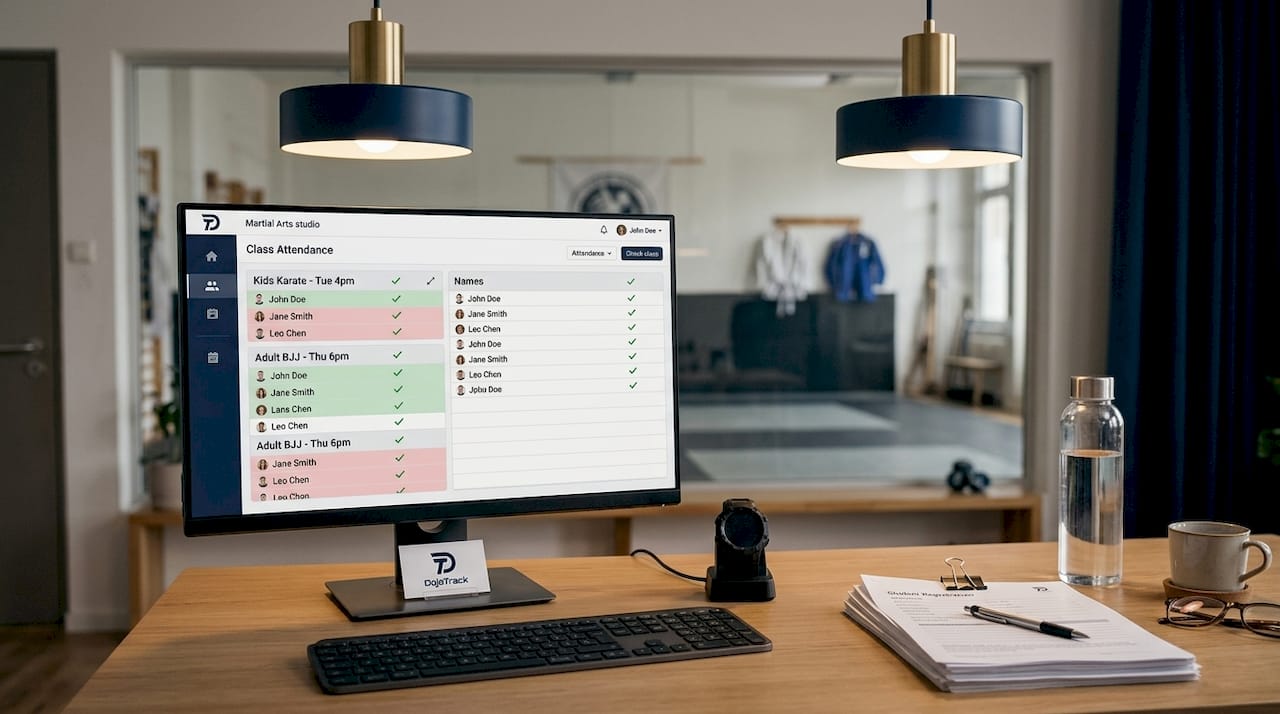
The critical distinction here is between passive data storage and event-based triggers. Most studios already collect attendance, payment, and belt data. The problem is that passive software alone cannot draft and send the communications that data should generate. Automation closes that gap.
Pro Tip: Before purchasing any software, map out which of your daily tasks follow a fixed “if this, then that” logic. Those are your best automation candidates and should be your first priority.
How does automation improve studio operations and revenue?
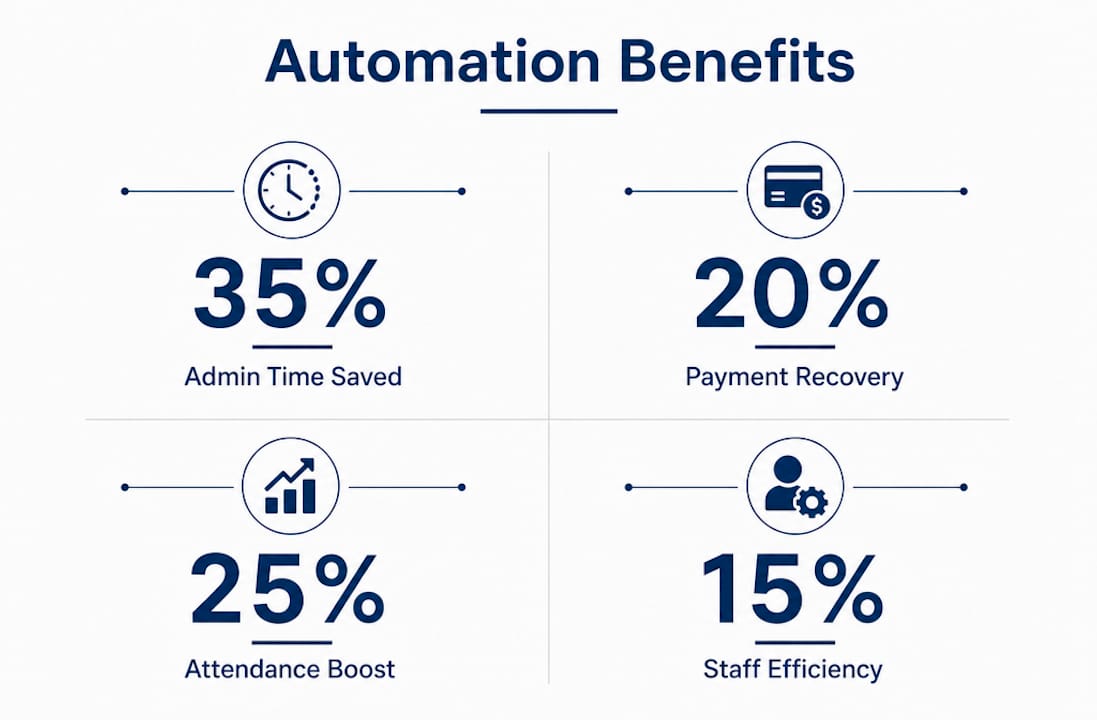
The productivity gains from automating administrative work are measurable and significant. Routine task automation typically reduces time spent on those tasks by 20% to 40%. For a studio with two full-time staff members each spending two hours daily on admin work, that translates to roughly 50 to 80 hours recovered every month. Those hours can go directly into student instruction, lead follow-up, or program development.
Payment recovery is where automation delivers some of its most direct revenue impact. Studios that automate same-day autopay decline outreach see payment recovery rates climb from 50 to 60 percent up to 85 to 90 percent within 14 days. That improvement alone can mean thousands of dollars in recovered monthly revenue for a mid-size school.
Beyond billing, automation drives measurable gains in student engagement and retention:
| Area | Manual Process Result | Automated Process Result |
|---|---|---|
| Autopay recovery | 50–60% within 14 days | 85–90% within 14 days |
| Belt-test attendance | Inconsistent, staff-dependent | Higher, triggered by progression data |
| Admin time per staff member | 2+ hours/day on routine tasks | 20–40% reduction |
| Parent communication speed | Delayed, often forgotten | Same-day, event-triggered |
| Data entry errors | Frequent, hard to audit | Reduced through single-source entry |
“Automated drafting and sending of communications reduces day-to-day workload dramatically, increasing revenue and engagement.” — OpenClaw Martial Arts Studio AI
There is also a staff morale dimension that studio owners often underestimate. Instructors who spend their afternoons chasing payments and sending reminder texts are not teaching. Automation returns them to the role they were hired for, which directly affects the quality of instruction and the culture of your school. The benefits of automating administrative tasks extend well beyond time savings to include reduced burnout and sharper focus on student outcomes.
What are the most common automation mistakes studio owners make?
The biggest misconception about automation in martial arts business is that buying software is the same as implementing automation. It is not. Software stores data. Automation acts on it. Many studios purchase a management platform, enter their student records, and then continue manually sending texts and emails because they never configured the event-based triggers that make the system proactive.
The second major mistake is automating a broken process. Automating unclear workflows without redesigning them first causes 30 to 50 percent failure rates in automation projects. If your belt-test invitation process is inconsistent today, automating it will produce inconsistent invitations faster. The fix is to define the exact rules before you build the trigger.
Here are the four most common pitfalls, in order of how often they derail studio automation efforts:
- Skipping workflow design. Owners jump straight to software configuration without documenting the rules the system needs to follow. Spend one hour mapping each process before touching any settings.
- Ignoring staff training. Successful automation adoption requires training, workflow alignment, and continuous improvement. A system your staff does not understand will be bypassed within weeks.
- Automating judgment-required tasks too early. Billing reminders and class confirmations are safe to automate immediately. Sensitive parent conversations about a student’s progress are not. Sequence your rollout accordingly.
- Treating automation as a one-time setup. Workflows change as your studio grows. Build a quarterly review into your operations calendar to audit and update your automated processes.
Pro Tip: Run a two-week pilot on one automated workflow, such as failed payment notifications, before rolling out across all processes. Measure the result, fix what breaks, then expand.
How to implement and scale automation in your martial arts studio
A practical rollout starts with a workflow audit. List every recurring administrative task your staff performs in a given week, then sort them into two columns: tasks that follow fixed rules, and tasks that require human judgment. The first column is your automation roadmap.
Start with billing and payment communications. These are fully rule-driven, high-frequency, and directly tied to revenue. Configure your platform to send same-day autopay decline notices, weekly payment reminders for outstanding balances, and automated receipts after every successful charge. Once that is running cleanly, move to scheduling confirmations and belt progression notifications.
The following comparison shows how a phased approach differs from trying to automate everything at once:
| Approach | Phase 1 Focus | Risk Level | Time to Value |
|---|---|---|---|
| Phased rollout | Billing and notifications only | Low | 2–4 weeks |
| Full deployment | All tasks simultaneously | High | 3–6 months |
| No structure | Ad hoc tool adoption | Very high | Unpredictable |
AI-powered tools built specifically for martial arts schools go further than generic CRM platforms by connecting attendance data, belt records, and payment status to automated communication triggers. That means a student who misses three consecutive classes can automatically receive a check-in message, without a staff member reviewing the attendance log.
Measure your results with specific metrics: admin hours per week, payment recovery rate, belt-test attendance percentage, and lead response time. Gartner research shows 80% of CEOs expect AI to force a medium to high degree of operational change by 2028. Studios that build automation capability now will be significantly better positioned than those waiting for the technology to mature further. The martial arts school automation guide from DojoTrack outlines a step-by-step framework for studios at every stage of this process.
Key takeaways
Automating martial arts administrative tasks reduces admin workload by 20 to 40 percent, recovers significantly more failed payments, and frees instructors to focus on teaching rather than paperwork.
| Point | Details |
|---|---|
| Automation requires workflow design first | Map and define your rules before configuring any software triggers. |
| Payment recovery is the fastest ROI | Automated decline outreach lifts recovery rates from ~55% to ~88% within 14 days. |
| Phased rollout reduces failure risk | Start with billing and notifications before moving to judgment-required tasks. |
| Staff training determines adoption | Automation tools only work if your team understands and uses them consistently. |
| Event-based triggers are the core mechanism | Passive data storage is not automation. Systems must act on data changes automatically. |
The operational shift most studio owners do not see coming
From DojoTrack’s perspective, the studios that struggle most with automation are not the ones that lack good software. They are the ones that have not yet recognized that their operational problems are workflow problems, not software problems. We have worked with school owners who purchased three different management platforms in two years and still had staff manually texting parents about belt tests. The software was fine. The workflows were never defined.
The other thing worth saying plainly: automation does not replace the human relationships that make a martial arts school worth attending. It protects them. When your front desk is not buried in payment follow-ups and scheduling conflicts, your instructors have more capacity to notice which students are struggling, which parents need a conversation, and which kids are ready to be challenged. That is where the real retention happens.
The studios we see growing fastest are not the ones with the most features turned on. They are the ones that automated the right tasks first, measured the results honestly, and built from there. Automation is not a destination. It is a capability you develop over time, and the earlier you start building it, the more compounding advantage you create.
— DojoTrack
See how DojoTrack automates your studio’s daily operations
DojoTrack is an AI-powered martial arts studio management platform built specifically for schools like yours. It connects billing, attendance, belt progression, and parent communications into one system that acts on your data automatically. Failed payments trigger same-day outreach. Belt milestones generate promotion invitations. At-risk students get check-in messages before they quit. If you are ready to stop spending your best hours on administrative work and start spending them on the mat, explore what DojoTrack’s automation features can do for your school. You can also visit DojoTrack to see the full platform and request a demo.
FAQ
Why should martial arts studios automate administrative tasks?
Automating administrative tasks removes repetitive, rules-based work from your staff’s daily schedule, reducing admin time by 20 to 40 percent and recovering significantly more failed payments through same-day automated outreach.
What tasks are best suited for automation in a martial arts school?
Billing, autopay decline follow-ups, belt progression notifications, class confirmations, and parent communications are the best starting points because they follow fixed rules and require no human judgment to execute correctly.
How do I avoid automation failures in my studio?
Automate only after you have clearly defined the rules for each process. Automating a broken or undefined workflow produces errors faster, not fewer of them.
Does automation replace the need for front desk staff?
No. Automation handles repetitive, rule-driven tasks so your staff can focus on higher-value work like student relationships, lead conversion, and program development. Human oversight remains necessary for complex or sensitive communications.
What is the difference between martial arts software and automation?
Software stores and organizes your data. Automation acts on that data by triggering communications and workflows based on events like a missed payment or a belt promotion milestone. Most studios need both working together to see real operational gains.
Recommended
- The Ultimate Guide to Martial Arts School Automation: Everything You Need to Succeed in 2025 | DojoTrack
- How AI and Automation Are Changing the Game for Martial Arts Studio Owners | DojoTrack
- Stop Wasting Time on Manual Tasks: 5 Dojo Management Software Features That Actually Work | DojoTrack
- AI Powered Martial Arts Software | DojoTrack