

TL;DR:
- Data analytics helps MMA gyms predict member churn and increase retention through automated outreach within 24 hours of missed classes.
- Most gyms already have the necessary data; the challenge is turning it into action using clear KPIs and simple workflows.
Data analytics turns attendance records, booking patterns, and engagement signals into predictable retention and revenue growth for MMA and martial-arts gyms. The single best first step: flag any member who misses two or more consecutive classes and trigger an automated coach outreach within 24 hours. That one workflow, done consistently, addresses the moment churn risk is highest and costs nothing beyond the setup time.
Why this works immediately:
- Members who miss two consecutive classes are statistically the most likely to cancel within 30 days
- Early outreach converts a passive drift into an active conversation before the member mentally checks out
- The signal is available in every gym’s existing attendance log — no new data source required
The US martial arts studio industry is a multi-billion dollar market, and franchise operators are already deploying standardized retention engineering at scale. Independent gym owners who rely on intuition alone are leaving real money on the table.
Table of Contents
- Why does data analytics matter specifically for MMA gyms?
- What KPIs should every MMA gym track?
- How does AI convert behavioral signals into day-to-day actions?
- How do you add analytics to your gym in 5 practical steps?
- What data privacy and quality rules apply to U.S. gym owners?
- When should you expect measurable ROI from analytics?
- How does Dojotrack approach AI analytics for martial-arts gyms?
- What mistakes do gym owners make when adding analytics?
- How do you use benchmarking data to position your gym locally?
- What financial analytics should you track beyond revenue?
- How do you segment members to tailor marketing and class offerings?
- How does predictive analytics improve class scheduling?
- Key Takeaways
- The analytics gap most gym owners don’t see
- Dojotrack gives you the analytics layer your gym already needs
- Useful sources
- FAQ
Why does data analytics matter specifically for MMA gyms?
The competitive pressure is real and accelerating. Franchise systems and networked platforms gain data advantages that compound over time, making it harder for independent gyms to compete on gut feel alone. A PwC survey found that 61% of executives see analytics potential but still underutilize it — and data-driven organizations consistently outperform their peers.
For your gym, the commercial outcomes are direct: higher member retention, better lead-to-member conversion, longer lifetime value (LTV), and fuller classes. Each of those outcomes compounds. A member who stays six months longer pays more, refers more, and costs nothing to re-acquire.
“The goal isn’t to replace the coach — it’s to give the coach better information at the right moment. Telemetry and personalized algorithms create curated member experiences while keeping the coach as the hero.”
— Ameen Kazerouni, Chief Data and Analytics Officer, Orangetheory Fitness, via MIT Sloan Management Review
That framing matters for MMA gyms specifically. Your coaches are your retention engine. Analytics should surface who needs attention — the coach decides how to respond.

What KPIs should every MMA gym track?
Start with the metrics that directly predict revenue, not the ones that just feel good to report.
| KPI | Data source | Cadence | Why it matters |
|---|---|---|---|
| Rolling retention rate | Membership system | Monthly | Predicts recurring revenue stability |
| Churn risk score | Attendance log | Weekly | Identifies at-risk members before they cancel |
| Lead-to-member conversion | CRM / intake forms | Weekly | Measures marketing and follow-up efficiency |
| Class fill percentage | Scheduling system | Per class | Flags underperforming time slots |
| Lifetime value (LTV) | Billing system | Quarterly | Guides acquisition spend decisions |
| Average revenue per user (ARPU) | POS + billing | Monthly | Tracks upsell and program mix performance |
| Customer acquisition cost (CAC) | Ad spend + CRM | Monthly | Keeps growth profitable |
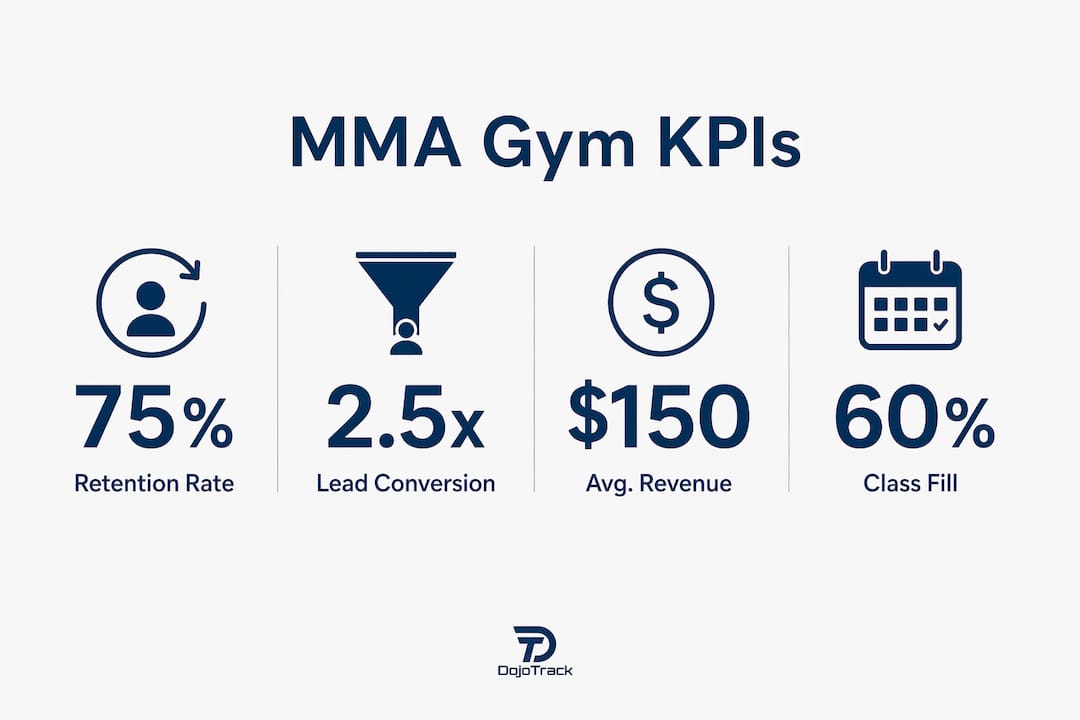
Wexer’s analysis makes a point worth repeating: most gym owners already have the data they need. The challenge is translating it into one measurable outcome, not collecting more of it.
Pro Tip: Instrument churn risk first. Get that signal clean and reliable before you layer in LTV modeling or CAC tracking. One well-measured KPI beats seven loosely tracked ones.
How does AI convert behavioral signals into day-to-day actions?
The causal chain is straightforward. Raw events — check-ins, class bookings, cancellations, app logins, SMS responses — feed into a predictive model. That model scores each member’s risk level and surfaces alerts, automated messages, or class recommendations for your staff to act on.
In practice, this looks like:
- An at-risk alert fires when a member’s attendance drops below their personal baseline, prompting a coach text within the same day
- A lead scoring system ranks new inquiries by response urgency, so your front desk calls the hottest leads first
- Class fill data triggers a suggested swap when a Thursday 6 PM slot consistently runs at 40% capacity
Combat sports are moving from analog to data-driven systems for training and coaching, creating new retention and revenue opportunities at the gym level. The technology is no longer reserved for franchise operators.
“AI should serve as a recommendation and escalation system — not a replacement for coach judgment. The human stays in the loop; the algorithm handles the signal detection.”
— Insight drawn from Ameen Kazerouni’s MIT Sloan interview
Pro Tip: Define a staff SLA alongside every automation. If an at-risk alert fires, who responds, and within how many hours? Without that answer, the alert sits unread and the workflow fails.
How do you add analytics to your gym in 5 practical steps?
You don’t need a data science team. You need a clear sequence.
- Define one primary KPI and its success threshold. Example: reduce monthly churn by 10% over 90 days. Write it down. Share it with your staff.
- Inventory your data sources. List your POS system, attendance log, booking platform, and CRM. Note which systems export data and which require manual pulls.
- Instrument tracking and run a hygiene check. Assign unique member IDs, normalize class names, and confirm timestamps are consistent. Test your churn signal against three months of historical attendance data.
- Deploy one automation. Start with at-risk alerts or automated lead follow-up SMS. Define who receives the alert, who responds, and the response time target. Automated lead follow-up alone measurably lifts conversion when response time drops below five minutes.
- Run a 90-day experiment and measure lift. Compare retention rate and lead conversion before and after. Iterate one variable at a time.
Wexer recommends starting with one problem, one data source, and one measurable outcome — small, measurable experiments deliver faster ROI than large platform rollouts.
Implementation timeline:
- Weeks 0–2: Define KPI, audit data sources, assign data owner
- Weeks 3–4: Hygiene checks, historical data test
- Weeks 5–8: Deploy first automation, set staff SLAs
- Weeks 9–12: Measure lift, document findings, plan next workflow
Pro Tip: Keep a rollback plan. If an automation increases cancellation friction or generates complaints, you need a documented way to pause it within 24 hours.
What data privacy and quality rules apply to U.S. gym owners?
U.S. gym owners collecting member data for marketing must comply with applicable consumer consent requirements for SMS and email communications, maintain PCI-compliant payment processing, and store personal data securely — consult a qualified attorney for your specific situation.
On the data quality side, these four checks prevent most analytics failures:
| Quality check | What to verify | Fix if broken |
|---|---|---|
| Unique member IDs | No duplicate profiles | Merge duplicates in your CRM |
| Normalized class names | Consistent naming across systems | Standardize a class name list |
| Timestamped events | Check-ins carry date and time | Enable timestamp logging in your platform |
| Membership status codes | Active / paused / cancelled are consistent | Audit and recode status fields |
For SMS and email outreach, collect explicit opt-in at signup, honor opt-outs within one business day, and keep a suppression list current.
Pro Tip: Log and version your churn model inputs. Store a snapshot of the data that triggered each automated outreach so you can audit decisions and build staff trust in the system over time.
When should you expect measurable ROI from analytics?
Set realistic expectations by phase:
| Timeline | Expected outcome | KPI to watch |
|---|---|---|
| 0–30 days | Faster lead response, automated follow-up live | Lead-to-member conversion rate |
| 60–90 days | Measurable retention lift from at-risk alerts | Monthly churn rate |
| 3–6 months | Optimized class scheduling, pricing adjustments | Class fill %, ARPU |
Variance factors that affect your timeline: gym size, historical data quality, staff adoption speed, and class schedule complexity. A gym with clean attendance data going back 12 months will see reliable churn signals faster than one starting from scratch.
Reducing churn by even a modest percentage translates directly into predictable recurring revenue — the math is simple and the compounding effect over 12 months is significant for any gym running monthly memberships.
How does Dojotrack approach AI analytics for martial-arts gyms?
Dojotrack is purpose-built for martial-arts and MMA gyms, which means the analytics layer connects to belt curriculum tracking, family accounts, kids programming, and attendance workflows that generic fitness apps don’t support.
Core capabilities relevant to analytics-driven growth:
- Predictive churn alerts that flag at-risk members based on attendance patterns
- Automated lead scoring and SMS follow-up to reduce response time and lift conversion
- Attendance and membership tracking with clean, timestamped data ready for analysis
- Class scheduling optimization informed by fill-rate data
- Stripe-powered billing integrated with membership status for accurate LTV and ARPU reporting
Membership tracking built for MMA gyms means churn signals connect directly to the billing and attendance systems — no manual data exports required.
Pro Tip: When evaluating any analytics vendor, ask specifically whether it supports belt/curriculum tracking, family account billing, and kids-program attendance separately. Generic platforms often collapse these into one membership type, which corrupts your retention data.
What mistakes do gym owners make when adding analytics?
The most common pitfall is confusing data collection with analytics. Pulling reports is not the same as acting on a signal. Here are the traps and their fixes:
- Chasing vanity metrics (total check-ins, social followers): fix by tying every metric to a revenue or retention outcome
- No staff SLAs on alerts: fix by assigning a named owner and a response-time target for every automated alert
- Vague KPIs: fix by writing the success threshold before you start (“churn below X% by day 90”)
- No model input versioning: fix by logging the data snapshot that triggered each outreach decision
- Deploying automations without escalation paths: fix by defining what happens when an alert goes unanswered for 48 hours
Pro Tip: Run a rollback plan for any automation that generates member complaints or increases cancellation friction. Document the pause procedure before you go live, not after.
How do you use benchmarking data to position your gym locally?
Competitive benchmarking starts with your own data. Track your class fill percentage, retention rate, and ARPU against your own historical baselines first — that gives you a performance floor. Then layer in local market signals: new gym openings nearby, pricing changes from competitors, and neighborhood demographic shifts.
Predictive analytics can model how external market conditions affect your location, helping you time pricing changes, new program launches, or expansion decisions with data rather than instinct. For independent gyms, the differentiator is high-touch programming that franchise systems can’t replicate at scale — analytics frees the time to deliver it.
What financial analytics should you track beyond revenue?
Revenue is a lagging indicator. The metrics that actually guide pricing and promotion decisions are margin-level:
- Cost per class session (instructor pay + facility overhead ÷ sessions delivered)
- Profit margin by program (kids BJJ vs. adult MMA vs. open mat)
- CAC vs. LTV ratio (if CAC exceeds three months of ARPU, your acquisition spend needs adjustment)
- Promotion ROI (track enrollment lift and retention rate for members acquired during a discount period)
Knowing that your adult MMA program runs at a 60% margin while your kids program runs at 40% tells you exactly where to focus promotional spend and instructor investment. That kind of financial clarity is only possible when billing, attendance, and scheduling data live in one connected system.
How do you segment members to tailor marketing and class offerings?
Segmentation turns a single email blast into targeted outreach that actually converts. The most useful segments for MMA and martial-arts gyms:
- By tenure: new members (0–90 days), established members (90 days to 1 year), long-term members (1+ years) — each group needs a different message
- By program: adult striking, BJJ, kids classes, open mat — program-specific content drives higher engagement
- By engagement level: high-frequency (4+ visits/week), moderate (2–3), low (1 or fewer) — low-frequency members need re-engagement campaigns before they become churn risks
- By family status: family accounts respond to different promotions than individual memberships
AI analytics for martial-arts studios can automate segment assignment as member behavior changes, so your outreach stays current without manual list management.
How does predictive analytics improve class scheduling?
Predictive scheduling uses historical attendance data to forecast demand by day, time, and program type. The practical outputs:
- Identify which time slots consistently underperform and either cut them or reposition them with targeted outreach to the right member segment
- Forecast peak periods so you can staff appropriately and avoid overcrowded mats that hurt member experience
- Model the impact of adding a new class before you commit an instructor to it
SC Fitness, a Portuguese gym chain, found that members who attend group fitness classes regularly stay three times longer than those who don’t — a finding that directly informed their scheduling and instructor investment decisions. The same logic applies to your MMA gym: know which classes drive retention and build your schedule around them.
Key Takeaways
Data analytics drives measurable MMA gym growth by converting attendance, billing, and engagement data into automated retention workflows, smarter scheduling, and higher lead conversion — starting with one clean churn-risk signal.
| Point | Details |
|---|---|
| Start with churn risk | Flag members missing two or more consecutive classes and trigger coach outreach within 24 hours. |
| Track seven core KPIs | Retention rate, churn score, conversion, LTV, class fill, ARPU, and CAC are the metrics that move margins. |
| Follow the 90-day experiment | Define one KPI, deploy one automation, measure lift at 30, 60, and 90 days before adding complexity. |
| Financial analytics guide pricing | Track margin by program and CAC vs. LTV ratio to make promotion and pricing decisions with data. |
| Dojotrack connects the signals | Dojotrack’s AI-powered platform links attendance, billing, and churn alerts in one martial-arts-specific system. |
The analytics gap most gym owners don’t see
Most MMA gym owners think their retention problem is a marketing problem. They spend more on ads, run another promotion, and watch the same members quietly drift away three months later. The real gap is operational: no one knew those members were at risk until they were already gone.
The data to prevent that was sitting in the attendance log the whole time. What was missing was a system to read it, score it, and surface it to the right person at the right moment. That’s not a technology problem — it’s a workflow problem that technology solves.
The gyms that pull ahead in the next two years won’t necessarily have bigger ad budgets. They’ll have cleaner data, faster outreach, and coaches who spend their energy on members who need them most. Analytics doesn’t replace the relationship between a coach and a student. It protects the time and attention that makes that relationship possible.
Dojotrack gives you the analytics layer your gym already needs
If you’ve read this far, you already know which metric to fix first. Dojotrack puts the tools to fix it in one place: predictive churn alerts, automated SMS follow-up, attendance tracking, curriculum management, and real-time reporting — all built specifically for martial-arts and MMA gyms in the United States.
No spreadsheets. No duct-taped integrations. No generic fitness app that doesn’t understand belt ranks or family billing.
Before your demo, check that the platform covers:
- Predictive churn alerts tied to attendance data
- Automated SMS workflows for leads and at-risk members
- Belt and curriculum tracking integrated with attendance
- Family account billing and kids-program reporting
- Class fill and scheduling analytics in one dashboard
Start with Dojotrack for free and see which of your members are at risk this week — before they decide to leave.
Useful sources
The following sources informed this article. Dojotrack-owned content is noted; all others are independent third-party publications.
- How AI Transforms Fitness Data Into Actionable Results — Wexer (third-party industry analysis)
- Keeping Humans in the Feedback Loop: Ameen Kazerouni, Orangetheory Fitness — MIT Sloan Management Review (third-party)
- Four Ways Data Analytics Impact Your Fitness Business — Club Solutions Magazine, citing PwC survey data (third-party)
- Combat Sports Are Ready for Their Data Moment — Forbes (third-party)
- UFC GYM BJJ Franchise Expansion and Dojo Professionalization — DojoPractice (third-party industry analysis)
- How This Pioneering Chain Uses Data to Drive Group Fitness Numbers — Les Mills Fit Planet (third-party)
- Membership Tracking for MMA Gyms: Boost Retention — Dojotrack (owned content)
- Why School Owners Need AI Business Tools in 2026 — Dojotrack (owned content)
- Predictive Analytics for Your Martial Arts Business — Dojotrack (owned content)
For hands-on implementation guides, the Dojotrack blog covers retention workflows, lead follow-up automation, and scheduling analytics in detail.
FAQ
What is the first analytics step for an MMA gym owner?
Flag members who miss two or more consecutive classes and set up an automated coach outreach within 24 hours. That single workflow addresses the highest churn-risk moment using data you already have.
How long before analytics improves retention?
Most gyms see measurable retention lift within 60–90 days of deploying at-risk alerts and consistent outreach workflows, with scheduling and pricing improvements taking 3–6 months.
Do small gyms need expensive software to use analytics?
No. Wexer’s analysis recommends starting with one problem, one data source, and one measurable outcome. Dojotrack offers a free core tier that includes attendance tracking and basic membership management.
What KPIs matter most for MMA gym profitability?
Monthly churn rate, class fill percentage, and CAC vs. LTV ratio are the three metrics most directly tied to margin. Track those before adding complexity.
How does Dojotrack differ from generic gym software?
Dojotrack is built specifically for martial-arts gyms, with belt and curriculum tracking, family account billing, and AI-driven churn alerts that connect directly to attendance and membership data — features generic fitness apps don’t support natively.