
Manage MMA Gym Memberships Efficiently in 2026

TL;DR:
- Efficient MMA gym management involves specialized software, automated billing, and structured retention practices. These tools help predict revenue, reduce dropouts, and streamline operations by addressing the unique needs of combat sports schools.
Efficient MMA gym membership management is defined as the combination of automated billing, specialized software, and martial arts-specific workflows that produce predictable revenue and lower member dropout. Generic fitness tools miss the mark for MMA gyms because they cannot handle belt and rank tracking, competition team management, or curriculum organization. Industry pricing standards for MMA and BJJ gyms sit between $140 and $200+ per member per month, and hitting those numbers consistently requires more than a spreadsheet. The gyms that manage MMA gym memberships efficiently treat administration as a system, not a series of daily tasks.
What are the essential tools to manage MMA gym memberships efficiently?
The right software is the single biggest lever you can pull for effective MMA gym administration. Generic fitness CRMs are built for personal training studios and group fitness classes. They do not account for the operational reality of an MMA gym, where belt and rank tracking, competition team management, and curriculum organization are daily requirements.
Specialized martial arts management software covers the feature categories that MMA gyms actually need. When evaluating any platform, look for these core capabilities:
| Feature category | Why it matters for MMA gyms |
|---|---|
| Recurring billing automation | Converts cash and drop-in payments to predictable monthly revenue |
| Attendance and check-in tracking | Identifies at-risk members before they quit |
| Belt and rank management | Automates promotions and reduces instructor admin time |
| Curriculum and class scheduling | Standardizes student progression across all coaches |
| Lead scoring and SMS follow-up | Converts prospects to paying members faster |
| Digital waivers and onboarding | Removes paper from the enrollment process |
Onboarding speed matters more than most gym owners expect. Specialized platforms can fully operationalize an MMA academy within one day, including importing existing member data and payment plans. That means you do not need to run parallel systems for weeks during a transition.
Dojotrack is purpose-built for this environment. It combines a martial arts CRM with AI-powered analytics, Stripe-powered recurring billing, attendance tracking, digital waivers, and a student mobile app. Every feature is designed around how martial arts schools actually operate, not how a generic gym operates.
Pro Tip: Before selecting any platform, list every manual task your front desk handles in a week. If the software cannot automate at least 70% of that list, keep looking.
How does automating billing improve cash flow and member retention?
Manual enrollment and cash payments are the primary causes of revenue leakage in MMA gyms. When a member pays cash or writes a check, you depend on them to remember, show up, and follow through every single month. Automated recurring billing removes that dependency entirely.

The financial risk of skipping billing automation is concrete. Missed renewal reminders can cause a 5% loss of the membership base in a 300-member gym. That is 15 memberships gone from a problem that automation solves on day one.
Automated billing systems run payment collection in the background and alert staff to failed payments before those members cancel. That alert window is where you save memberships. A staff member can reach out personally, offer a payment plan, or flag a card update before the member ever feels the friction of a declined charge.
The best practices for automating gym billing systems follow a clear sequence:
- Set every new member to automatic monthly or annual billing at enrollment, with no cash or check option.
- Configure automated renewal reminder emails and SMS messages 7 days and 3 days before each billing date.
- Build a failed payment workflow that triggers an immediate staff alert and a member notification within 24 hours.
- Use a platform with Stripe integration so payment data is secure and card updates happen automatically.
- Review monthly recurring revenue (MRR) weekly, not monthly, so you catch drops early.
Pro Tip: Annual billing plans, offered at a slight discount, lock in revenue for 12 months and dramatically reduce monthly churn. Offer them at enrollment and at each annual renewal.
What best practices improve member retention and membership management?
Member retention in an MMA gym is not just a billing problem. It is an experience problem. Pricing membership on transformation — the skill, confidence, and community a student gains — justifies rates above $140 per month and keeps members enrolled longer than price-based competition ever could.
The following practices consistently produce better retention and cleaner membership workflows:
-
Build a standardized fundamentals program. Fundamentals programs reduce dropout and enable any qualified coach to deliver consistent instruction. They also create a clear student journey, which makes rank promotions predictable and reduces the administrative chaos of ad hoc advancement decisions.
-
Use tiered membership models. Offer a base membership, a premium tier with additional classes or personal training, and a family rate. Tiered pricing increases average revenue per member and gives students a clear upgrade path as their commitment grows.
-
Track attendance weekly, not monthly. A member who misses two consecutive weeks is at risk of quitting. Attendance tracking software flags these members automatically so you can reach out before they mentally check out.
-
Automate communication touchpoints. Send automated birthday messages, belt promotion congratulations, and class reminder texts. These small touches build community without adding to your staff’s workload.
-
Create a structured onboarding sequence for new members. The first 30 days determine whether a new student stays for 3 months or 3 years. A welcome email series, an intro class schedule, and a check-in call at day 14 dramatically improve early retention.
The membership tracking approach you use should connect attendance data directly to your communication tools. When those two systems talk to each other, at-risk member outreach becomes automatic rather than a manual weekly review.
How do you transition from manual to automated membership management?
The transition from manual processes to automated membership management fails most often when gym owners try to do everything at once. A phased approach protects revenue during the switch and gives staff time to build confidence with new tools.
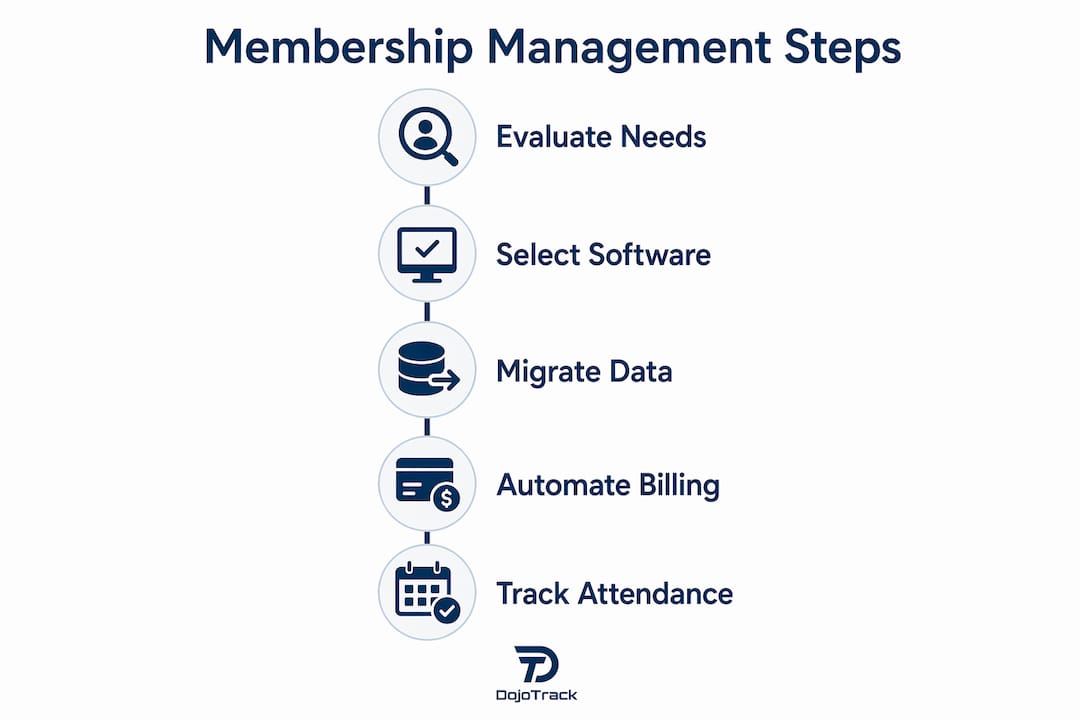
Follow this sequence to make the transition without disrupting operations:
- Map your current workflow first. Write down every step from lead inquiry to active membership, including who does each task and how long it takes. This map shows you exactly where automation will have the most impact.
- Import all member data before going live. Migrate contact records, membership types, billing amounts, and payment dates into the new platform before you cancel anything in your old system.
- Run parallel billing for one cycle. Process one billing cycle in both systems simultaneously to confirm accuracy before cutting over completely.
- Train staff on the new platform in role-specific sessions. Front desk staff need enrollment and check-in training. Instructors need attendance and belt tracking training. Mixing those sessions creates confusion.
- Track MRR and churn weekly for the first 90 days. Post-transition, these two metrics tell you immediately if something broke in the billing migration.
The billing automation guide for MMA businesses covers the specific steps for migrating payment plans without triggering failed charges. Revenue leakage during transition is the most common and most avoidable mistake gym owners make.
A useful post-transition tracking table keeps your team aligned:
| Metric | What to track | Review frequency |
|---|---|---|
| Monthly recurring revenue | Total active billing per month | Weekly |
| Churn rate | Memberships cancelled vs. total active | Weekly |
| Failed payment rate | Declined charges as % of total billing | Per billing cycle |
| Attendance rate | Average classes attended per member | Weekly |
| New member onboarding completion | % of new members completing intro sequence | Monthly |
Key takeaways
Efficient MMA gym membership management requires automated recurring billing, specialized software with martial arts-specific features, and structured retention practices that address the full member lifecycle.
| Point | Details |
|---|---|
| Automate billing immediately | Switch every member to recurring auto-pay to eliminate revenue leakage and reduce churn. |
| Use specialized software | Generic fitness CRMs cannot handle belt tracking, rank management, or MMA-specific curriculum needs. |
| Price on transformation | Memberships priced on skill and community value sustain rates above $140 per month. |
| Track attendance weekly | Members who miss two consecutive weeks are at high dropout risk and need immediate outreach. |
| Transition in phases | Map workflows, import data, and run parallel billing before cutting over to a new platform. |
The uncomfortable truth about MMA gym administration
Running an MMA gym well means accepting that the business side is just as demanding as the training side. The gyms that struggle most are the ones where the head instructor is also the billing manager, the front desk, and the follow-up team. That is not a staffing problem. It is a systems problem.
The shift to recurring billing is not just a cash flow improvement. It changes the entire relationship between the gym and its members. When a member is on auto-pay, they think of themselves as enrolled. When they pay month to month by hand, they think of themselves as deciding every month. That mental framing directly affects retention.
Pricing is where most MMA gym owners leave money on the table. Charging $80 per month because the gym down the street charges $80 is not a pricing strategy. It is a race to the bottom. Members who are serious about MMA, BJJ, or Muay Thai will pay $150 to $200+ per month for a gym that delivers real skill development, a strong community, and clear rank progression. The value-based pricing model is not aspirational. It is what the market actually supports at serious academies.
The tools matter too. A specialized martial arts CRM does not just save time. It gives you data you cannot get from a spreadsheet: which members are at risk, which billing cycles are failing, and which new members are not completing onboarding. That data is where retention improvements actually come from.
— Dojotrack
Dojotrack’s approach to MMA gym membership management
Dojotrack was built by a martial arts school owner who ran into every one of these problems firsthand. The platform handles membership management and billing in one place, with Stripe-powered recurring billing, AI-driven retention alerts, automated SMS follow-ups, and belt tracking built specifically for combat sports schools. You can import your existing member data and be fully operational within a day. The lifetime value calculator shows you exactly what each membership tier is worth over time, so you can price with confidence and grow with a clear revenue target in mind. Dojotrack is currently available for gyms in the United States.
FAQ
What software features does an MMA gym need for membership management?
MMA gyms need recurring billing automation, belt and rank tracking, attendance monitoring, and curriculum management. Generic fitness software typically lacks the martial arts-specific features that combat sports schools require.
How much should an MMA gym charge per member per month?
Industry standards place MMA and BJJ gym pricing between $140 and $200+ per month. Serious academies that deliver skill development and community value consistently support rates at the higher end of that range.
How do missed renewal reminders affect gym revenue?
Missed renewal reminders can eliminate 5% of a gym’s membership base. In a 300-member gym, that equals 15 lost memberships from a problem that automated reminders prevent entirely.
How long does it take to set up MMA gym management software?
Most specialized platforms complete full setup, including member data import and payment plan migration, within one day. Phased onboarding with parallel billing for one cycle reduces the risk of revenue disruption during the switch.
What is the fastest way to reduce membership churn in an MMA gym?
Switching all members to automatic recurring billing is the single fastest step to reduce churn. Pairing that with weekly attendance tracking and automated outreach to members who miss two or more consecutive classes addresses the next largest dropout risk.