

TL;DR:
- Billing automation enables MMA gyms to handle invoicing, payments, and follow-ups automatically, protecting revenue and reducing overhead. It can cut Days Sales Outstanding by up to 20%, recover 20-50% of revenue lost to failed billing, and scale operations without increasing staff. Implementing gradually and integrating billing with member communication enhances efficiency and revenue reliability.
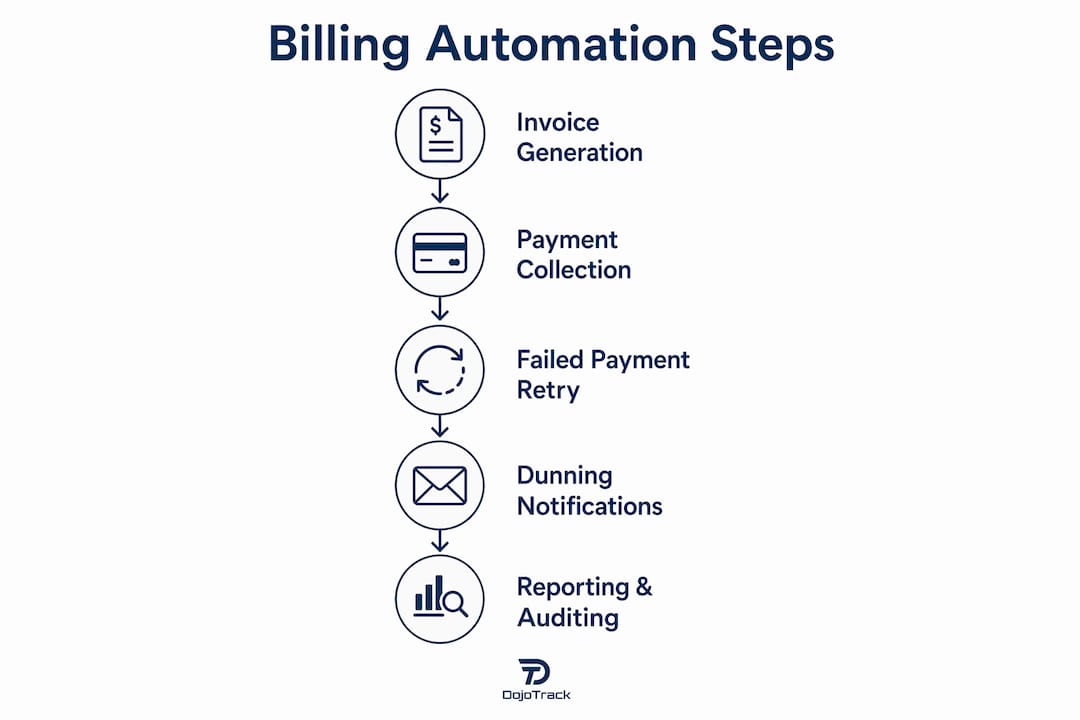
Billing automation is the process of using software to handle invoice generation, payment collection, and accounts receivable management without manual intervention. For MMA gym owners, this means your membership fees collect themselves, overdue notices go out on schedule, and failed payments trigger automatic retries, all while you focus on coaching. Platforms like Stripe and Zuora have made these workflows accessible to small and mid-sized gyms, not just enterprise businesses. The role of billing automation in an MMA business extends beyond saving time. It directly protects your revenue, reduces member friction, and lets your operation scale without hiring more administrative staff.
How does billing automation improve cash flow in MMA gyms?
Cash flow is the lifeblood of any MMA gym, and the speed at which invoices go out determines how quickly money comes in. The industry term for measuring this is Days Sales Outstanding, or DSO. DSO measures the average number of days between a billing event and when payment is actually collected. Billing automation reduces DSO by up to 20% by sending invoices the same day a billing period closes and triggering systematic follow-up on overdue balances. For a gym collecting $30,000 per month in membership fees, a 20% DSO reduction can mean thousands of dollars in cash arriving weeks earlier.
The mechanism behind this improvement is a two-lane workflow. The first lane handles automated invoicing: the system generates and delivers the invoice the moment a billing event occurs, whether that is a monthly renewal, a class package purchase, or an upgrade to a premium membership tier. The second lane handles collections: a structured dunning sequence fires automatically when payment does not arrive. Reminder cadences at 3, 7, and 14 days past due are the standard baseline for reducing late payments without alienating members.
Here is what that workflow looks like in practice for a recurring MMA membership:
- Day 0: Invoice generated and emailed automatically when the billing period closes
- Day 3 past due: Friendly reminder sent via email or SMS
- Day 7 past due: Second notice with a direct payment link
- Day 14 past due: Final notice before account suspension or escalation
- Throughout: Automated payment retries run in the background on failed card attempts
This structure means your front desk staff never has to chase a member for payment manually. The system handles it, and your team steps in only when a member needs a personal conversation. That shift from chasing invoices to managing exceptions is where the real efficiency of billing automation lives.
Pro Tip: Link your automated dunning sequence to SMS notifications, not just email. Open rates on SMS run significantly higher than email, which means members see your payment reminders faster and respond sooner.
Manual vs. automated billing: what changes for MMA operators?
Manual billing in an MMA gym typically looks like this: a staff member pulls up a spreadsheet or a basic payment processor, identifies who owes money this month, generates invoices one by one, sends them manually, and then follows up individually when payments fail. This process works at low volume. It breaks down fast when your gym grows past 100 active members.
The table below shows the core differences between manual and automated billing across the dimensions that matter most to MMA gym operators.
| Factor | Manual billing | Automated billing |
|---|---|---|
| Invoice delivery speed | Hours to days after billing event | Same day, triggered automatically |
| Error source | Human data entry mistakes | Configuration errors, easier to fix systematically |
| Scalability | Requires more staff as volume grows | Volume grows without proportional headcount increase |
| Failed payment handling | Manual follow-up per member | Smart retries and dunning sequences run automatically |
| Revenue leakage | High, from missed billing events | Reduced by up to 20–50% post-automation |
| Dispute risk | Higher due to inaccurate invoices | Lower because invoices reflect actual membership state |
The revenue leakage figure deserves attention. Manual billing misses charges because humans miss things: a member upgrades their plan mid-month, a contract renews, a class package expires and rolls over. These events are invisible in a manual system unless someone catches them. Automated billing captures every event because the system is configured to watch for them. The revenue recovered post-automation is often invisible until you run the comparison, which is exactly why many gym owners underestimate how much they are losing before they switch.
One more distinction worth noting: automated billing errors stem from configuration issues rather than human error. This is actually an advantage. A configuration error affects every invoice the same way, which makes it easy to identify and fix in one place. A human error is random and inconsistent, which makes it far harder to catch and correct at scale.
Pro Tip: Before you migrate to automated billing, audit your current membership data for accuracy. Bad data fed into an automated system produces bad invoices at scale. Clean your member records first, then automate.

What billing features does your MMA gym actually need?
Not every automated billing feature matters equally for an MMA gym. The membership model, where members pay a recurring monthly or annual fee, creates a specific set of requirements that differ from a retail or service business. Here are the features that deliver the most direct value for MMA billing management.
-
Recurring payment management with auto-pay: Members authorize a card on file, and the system charges it automatically on the billing date. This eliminates the need for members to remember to pay and removes the single biggest source of late payments in gym businesses. Dojotrack’s Stripe-powered billing handles this natively for U.S.-based gyms.
-
Smart retry logic for failed payments: Cards decline for many reasons: expired cards, insufficient funds, bank holds. Smart retry systems select retry windows based on network signals and past transaction patterns, increasing the likelihood of a successful recovery without requiring staff involvement. This directly reduces involuntary churn, the kind where a member’s card fails and they quietly disappear rather than actively canceling.
-
Automated reminders and dunning workflows: As described above, a structured reminder sequence at defined intervals keeps overdue balances from aging. Accurate, lifecycle-aware invoices that reflect upgrades, downgrades, and renewals prevent disputes and speed up approval cycles when members review their charges.
-
Integration with your MMA CRM and membership system: Billing data that lives in a separate system from your membership records creates gaps. When a member pauses their membership, upgrades to a family plan, or earns a promotion that changes their fee structure, that change needs to flow automatically into billing. Disconnected systems require manual reconciliation, which reintroduces the errors you were trying to eliminate. You can read more about setting up recurring membership payments in a connected system to see how this works in practice.
-
Customer communication tied to billing events: Members who receive a clear notification when a payment fails, along with a direct link to update their card, resolve the issue themselves in most cases. Automated payment retries with timestamped notifications reduce customer confusion and disputes, which saves your staff from fielding calls about charges members do not recognize.
How to implement billing automation in your MMA business
Transitioning from manual to automated billing does not have to be disruptive. The key is a phased approach that limits risk while building confidence in the new system. Migrating to automation typically takes 60 to 90 days when done in stages, and trying to automate everything at once is the most common reason projects stall.
Follow this sequence to make the transition manageable:
-
Identify your highest-volume, lowest-complexity billing processes first. For most MMA gyms, this is standard monthly memberships with a fixed fee. Automate these before tackling family plans, class packages, or tiered pricing structures.
-
Run parallel billing for the first billing cycle. Keep your manual process running alongside the automated system for one full month. Compare outputs, catch discrepancies, and build confidence before you turn off the manual process entirely.
-
Set measurable success metrics before you start. Define what success looks like in concrete terms: a target DSO reduction, a percentage drop in failed payment rates, or a reduction in staff hours spent on billing tasks. Without baseline numbers, you cannot prove the system is working.
-
Train your staff on exception management, not invoice generation. Your team’s job changes from creating invoices to reviewing flagged exceptions: failed payments that retries could not recover, disputes that need human review, and members who need a personal conversation. Train for that role specifically.
-
Review and optimize your dunning sequences after the first 90 days. Look at which reminder intervals are driving the most payment recoveries and which are generating complaints or unsubscribes. Adjust timing and message tone based on real data from your member base.
The basics of DSO reduction come down to accurate invoicing, easy payment methods, and standardized collections. Get those three elements right in your automated system before you add complexity.
Key takeaways
Billing automation reduces DSO, cuts revenue leakage, and lets MMA gyms scale membership without adding administrative headcount.
| Point | Details |
|---|---|
| DSO reduction | Automation cuts Days Sales Outstanding by up to 20% through same-day invoicing and structured dunning. |
| Revenue leakage recovery | Automated systems recover 20 to 50% of revenue lost to missed billing events in manual processes. |
| Scalability without headcount | Volume growth shifts work to exception management rather than requiring more billing staff. |
| Smart retries reduce churn | Retry logic based on network signals recovers failed payments before members even notice a problem. |
| Phased implementation works best | Start with simple recurring memberships and run parallel billing for one cycle before full cutover. |
What we have learned running billing automation for martial arts gyms
Here is the honest truth about billing automation that most software articles skip: the technology is the easy part. The hard part is changing how your team thinks about billing as a function.
Most MMA gym owners we work with at Dojotrack come in thinking billing automation is about saving time on invoices. That is true, but it undersells the real value. The bigger win is revenue reliability. When your billing engine is orchestrating charge attempts, retries, and dunning sequences automatically, your monthly revenue becomes predictable in a way it simply cannot be with manual processes. That predictability changes how you make decisions about hiring, equipment, and expansion.
The pitfall we see most often is underusing retry logic. Gyms set up auto-pay, feel good about it, and never configure smart retries or dunning sequences. Then a card expires, the payment fails silently, and a member drifts out the door without anyone noticing. Payment-state drift from missing retry logic causes silent revenue loss and involuntary churn. It is the billing equivalent of a slow leak. You do not notice it until you look at the numbers three months later and wonder where your revenue went.
The other common mistake is treating billing automation as separate from member communication. The gyms that get the best results connect their billing events to their member communication workflows. A failed payment triggers an SMS. A successful renewal triggers a thank-you message. That connection keeps members informed, reduces disputes, and makes your gym feel attentive rather than transactional. Automated SMS follow-up for overdue payment reminders is one of the highest-return additions you can make to a billing system.
— Dojotrack
See how Dojotrack handles billing automation for MMA gyms
Dojotrack is built specifically for martial arts and MMA businesses in the United States, which means the billing features are designed around how your memberships actually work. The platform runs Stripe-powered recurring billing, smart retry logic, and automated dunning sequences from a single dashboard connected to your membership records, attendance data, and CRM. There is no manual reconciliation between systems because everything lives in one place.
If you want to understand the financial impact before you commit, start with the lifetime value calculator to see what your average member is worth over time and how billing reliability affects that number. When you are ready to see the full platform, visit Dojotrack’s AI-powered software to request a demo and explore how automated billing fits into your gym’s operations.
FAQ
What is billing automation in an MMA gym context?
Billing automation is the use of software to handle recurring membership charges, invoice delivery, failed payment retries, and overdue reminders without manual staff involvement. For MMA gyms, this means monthly membership fees collect automatically and late payments trigger structured follow-up sequences on their own.
How much can billing automation reduce late payments?
Automated reminder sequences sent at 3, 7, and 14 days past due are the standard baseline for reducing late payments, and automated invoicing can cut DSO by up to 20%. The exact reduction depends on your current manual process and how well your dunning sequences are configured.
What happens when a member’s payment fails?
Smart retry systems attempt the charge again using network signals and past transaction patterns to select the best retry window. Members receive automated notifications with a link to update their payment method, which resolves most failed payments without staff involvement.
How long does it take to implement billing automation?
A phased migration from manual to automated billing typically takes 60 to 90 days. Starting with simple recurring memberships and running parallel billing for one cycle before full cutover is the lowest-risk approach for MMA gym operators.
Does billing automation work with existing MMA membership systems?
Yes, but integration quality matters. Billing systems connected directly to your membership and CRM data eliminate the need for manual reconciliation when members upgrade, pause, or change their plan. Disconnected systems reintroduce the manual errors that automation is designed to prevent.