
How to set up recurring membership payments for your studio

Failed payments are quietly draining your martial arts studio’s revenue right now. Up to 30% of membership churn is involuntary, meaning students don’t intend to quit but lose access because a payment didn’t process. When you set up recurring membership payments correctly, you eliminate most of that loss before it happens. This guide walks you through the legal requirements, the technical setup, and the automation strategies that keep your cash flow steady and your students on the mat where they belong.
Table of Contents
- Understand the requirements and challenges of recurring membership payments
- Prepare your martial arts studio for recurring payment setup
- Step-by-step instructions for setting up recurring membership payments
- Troubleshooting and reducing payment failures to improve retention
- Verifying and optimizing your recurring payment system
- Why most martial arts studios overlook critical recurring payment strategies — and how to avoid these costly mistakes
- Simplify recurring membership payments with DojoTrack’s AI-powered martial arts software
- Frequently asked questions
Key Takeaways
| Point | Details |
|---|---|
| Clear customer authorization | Obtaining detailed written or electronic consent is essential for legal compliance and smooth recurring payments. |
| Choose cost-effective payment methods | Using ACH payments can significantly reduce transaction fees compared to credit cards for stable membership fees. |
| Implement smart retry logic | Tailoring retry attempts based on failure reason recovers most failed payments and limits involuntary churn. |
| Automate communication and updates | Pre-billing notifications and self-service portals greatly reduce payment disputes and improve member experience. |
| Regularly audit and optimize | Ongoing data review and adjustment maximize recovery rates and ensure compliance with payment regulations. |
Understand the requirements and challenges of recurring membership payments
Before you configure a single billing cycle, you need to understand what you’re legally required to do and where most studios go wrong. Recurring billing isn’t just a convenience feature. It’s a regulated process, and skipping steps creates real liability.
Legal requirements you can’t ignore
In the U.S., ACH recurring payments require signed or electronic authorization that includes the payment amount, frequency, and bank account details. You must retain that authorization for two years and provide 10 days’ notice before any changes to the charge. Credit card recurring payments follow similar consent rules under card network guidelines.
Key legal requirements for U.S. martial arts studios:
- Written or electronic authorization must be obtained before the first charge
- Authorization records must be stored for a minimum of two years
- 10 days’ advance notice is required for any change to ACH payment terms
- NACHA rules govern ACH transactions; Regulation E covers consumer protections
- Customers must receive a copy of the authorization agreement
The real cost of payment failures
Up to 30% of gym membership churn is involuntary, caused by failed payments rather than a student’s decision to quit. The good news is that smart retry logic can recover 60 to 80% of those failures. That means most of your “lost” students are recoverable if your system handles declines intelligently.
| Failure cause | Frequency | Recovery approach |
|---|---|---|
| Expired card | Very common | Card updater service |
| Insufficient funds | Common | Retry on paydays |
| Bank decline | Occasional | Retry after 3 days |
| Incorrect account info | Rare | Member self-service portal |
Understanding the difference between automatic monthly payments and manual collection methods helps you decide which approach fits your studio model before you build anything.
With these challenges and legal requirements in mind, let’s review what you need to prepare before setting up recurring payments.
Prepare your martial arts studio for recurring payment setup
Getting your studio ready before you touch any software saves you from costly rework later. There are three things to lock in: your authorization process, your payment method, and your software choice.

Authorization first, everything else second
Every recurring charge needs a paper trail. Your authorization form, whether digital or physical, must clearly state:
- The exact amount being charged (or how it’s calculated)
- The billing frequency (weekly, monthly, annually)
- The services covered by the membership
- The member’s right to cancel and how to do so
- Your studio’s contact information
Digital authorizations collected through your signup flow are perfectly valid as long as you capture the timestamp and IP address. This detail matters more than most studio owners realize, and we’ll come back to it in the perspective section.
Choose your payment method wisely
ACH payment processing costs significantly less than card payments, which makes it attractive for predictable monthly memberships. Here’s how the two options compare:
| Feature | ACH bank transfer | Credit/debit card |
|---|---|---|
| Transaction fee | 0.5% to 1.5% | 2.3% to 3.2% |
| Settlement time | 2 to 3 business days | 1 to 2 business days |
| Dispute rules | Regulation E | Card network chargeback |
| Failure rate | Lower | Higher (expiration) |
| Best for | Stable monthly plans | Flexible or trial plans |
For a studio with 150 members paying $100/month, switching from cards to ACH can save $1,000 or more per month in processing fees alone.
Pick software that fits your workflow
QuickBooks Online offers a 3-step process to set up recurring payments with customer consent and flexible frequency options. That works for basic invoicing. But if you want billing tied directly to attendance, belt rank, and membership status, you need software built for martial arts. The DojoTrack setup steps walk you through configuring billing inside a platform that already understands how your studio operates.
When evaluating martial arts studio software, look for Stripe integration, built-in authorization capture, and automated retry logic before anything else.
Pro Tip: Collect digital authorizations through your enrollment form, not as a separate step. Members who authorize billing during signup are far less likely to dispute charges later because the context is clear.
Now that you have your requirements and materials ready, let’s move on to the step-by-step process of setting up the recurring payments.
Step-by-step instructions for setting up recurring membership payments
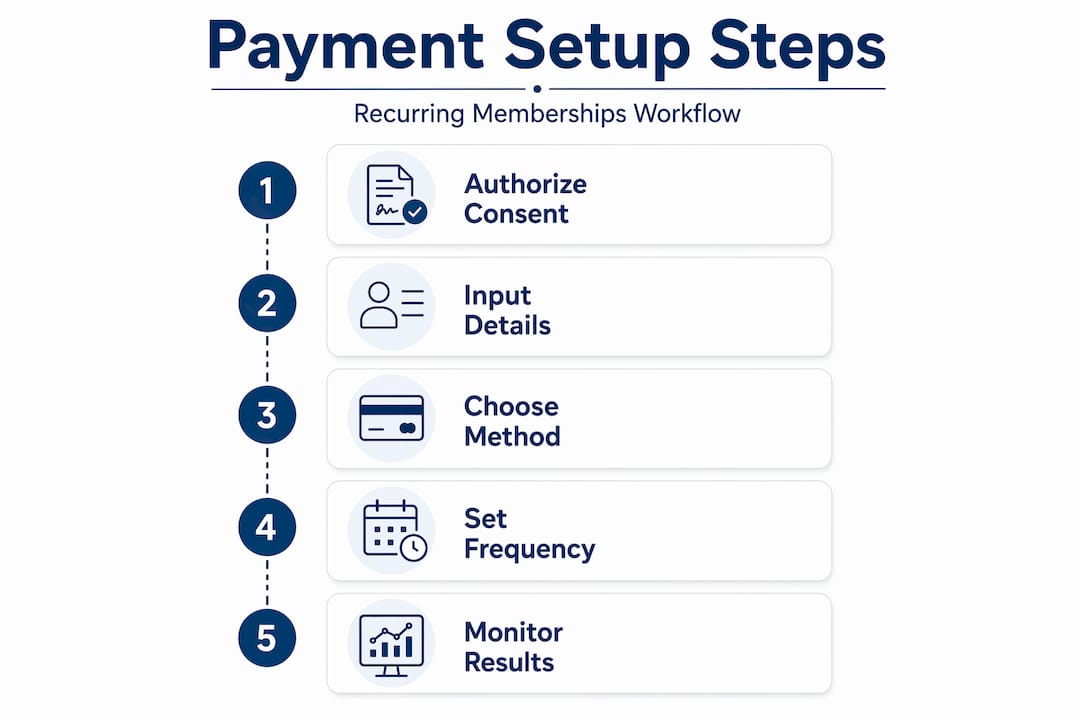
This is where the subscription payment process comes together. Follow these steps in order, and you’ll have a billing system that runs without constant oversight.
-
Collect signed authorization. Use a digital enrollment form that captures the member’s name, payment amount, billing date, and explicit consent. Store the timestamp and IP address automatically.
-
Choose your billing frequency. Match the cycle to your membership model. Monthly plans are standard for most martial arts studios. Annual plans work well for committed students and improve cash flow predictability.
-
Connect your payment processor. Stripe Billing supports flexible billing cycles, proration on plan upgrades, and automated notifications, making it one of the strongest options for managing recurring memberships. Link your studio’s bank account and configure your membership products.
-
Enable automatic retries. Set your processor to retry failed payments automatically. Configure the retry schedule by failure type, not just a flat 3-day interval.
-
Configure proration for plan changes. When a student upgrades from a basic to a premium membership mid-cycle, proration ensures they’re charged fairly for the remaining days. This reduces billing disputes significantly.
-
Set up a customer self-service portal. Members should be able to update their card or bank info without calling you. Stripe provides a customer portal for exactly this purpose.
-
Schedule payment reminders. Send notifications 3 to 5 days before each charge. This alone reduces failures caused by insufficient funds and outdated payment methods.
-
Test before you launch. Run a $1 test charge on your own account, verify the authorization email fires correctly, and confirm the retry logic triggers on a declined test card.
| Step | Action | Tool |
|---|---|---|
| Authorization | Digital consent form | Enrollment software |
| Processor setup | Link bank, create products | Stripe or equivalent |
| Retry logic | Configure by failure type | Billing platform |
| Member portal | Self-service card updates | Stripe portal |
| Reminders | Pre-billing notifications | SMS or email tool |
Pro Tip: Setting up DojoTrack connects authorization capture, billing, and member communication in one place, so you don’t have to stitch together three separate tools to complete these steps.
Note that QuickBooks Online allows immediate or future-date charges, but customer consent expires after 30 days if not used. Build your enrollment process to charge within that window. For studios using communication tools that include SMS at no extra cost, pre-billing reminders become a zero-friction addition to your workflow.
With recurring payments set up, you need to ensure your system handles payment failures and keeps your members active. Let’s cover best practices for troubleshooting and automation.
Troubleshooting and reducing payment failures to improve retention
Even a well-configured billing system will have failures. The difference between studios that recover most of that revenue and those that don’t comes down to how their system responds in the first 48 hours after a decline.
The most common failure causes
7 to 15% of gym recurring payments fail monthly, but card updater services and smart retry logic recover 60 to 80% of those failures. Here’s what’s causing most of them:
- Expired cards are the single most preventable failure. Card updater services automatically refresh card data from the card networks before the expiration date hits.
- Insufficient funds are timing-related. Retrying on the 1st or 15th (common paydays) dramatically improves success rates.
- Bank declines often clear within 24 to 72 hours without any action from the member.
- Incorrect account info requires direct member contact and a self-service update link.
Smart retry logic that actually works
Smart retry timing can increase recovery by up to 22% when you retry 3 to 4 times over 2 to 3 weeks, varying the days and times of each attempt. A flat “retry every 3 days” schedule leaves money on the table.
| Failure type | Retry 1 | Retry 2 | Retry 3 |
|---|---|---|---|
| Insufficient funds | Day 3 | Day 7 (payday) | Day 14 |
| Bank decline | Day 2 | Day 5 | Day 10 |
| Expired card | After updater runs | Day 3 | Day 7 |
“Automated dunning sequences with smart retry timing recover significantly more revenue than manual follow-up, especially when paired with pre-billing member notifications.”
Pro Tip: Pair your retry schedule with automated SMS or email messages that give members a direct link to update their payment info. Members who receive a friendly, specific message act faster than those who get a generic “payment failed” alert. Review automatic payment best practices to see how this fits into your broader billing strategy.
Your CRM for studios should log every failed payment attempt and link it to the member’s attendance record. A student who is both missing classes and failing payments is a serious retention risk, and you want to catch that pattern early.
Effective troubleshooting is key, but you must also verify your system’s performance to ensure you’re maximizing revenue and retention.
Verifying and optimizing your recurring payment system
Setting up recurring billing is not a one-time task. The studios that collect the most revenue from their memberships treat billing data the same way they treat attendance data: they review it regularly and adjust.
Here’s how to audit and improve your recurring payment system on a monthly basis:
-
Pull 90 days of failure and recovery data. Calculate your failure rate, your recovery rate, and the average days to recovery. These are your benchmarks.
-
Review retry message performance. Check open rates and click rates on your pre-billing reminders and dunning emails. Low open rates mean you need better subject lines or a different channel.
-
Shift retry timing toward paydays. If your retry data shows lower success on mid-month attempts, move them to the 1st or 15th. Regularly adjusting retry timing and messages monthly is what separates studios recovering 80% of failures from those recovering 40%.
-
Audit your authorization records. Spot-check 10 to 15 member files each month to confirm valid authorizations are on file. Maintaining compliance with NACHA and Regulation E through proper authorization and customer notification prevents disputes and legal exposure.
-
Set dashboard alerts for persistent failures. Any member with two or more consecutive failed payments should trigger an alert. Don’t wait for a third failure to act.
| Metric | Target benchmark | Action if below target |
|---|---|---|
| Monthly failure rate | Below 8% | Audit card updater service |
| Recovery rate | Above 65% | Improve retry schedule |
| Avg. days to recovery | Under 10 days | Add SMS to dunning sequence |
| Authorization compliance | 100% | Audit enrollment flow |
Pro Tip: Connect your billing data to your membership lifetime value calculations. A student who churns involuntarily at month 4 represents the same lost revenue as one who quits intentionally. Tracking this helps you make the business case for investing in better billing infrastructure.
Your martial arts CRM should surface these metrics automatically rather than requiring you to build reports from scratch each month.
Having verified and optimized your recurring payment process, let’s share some unique insights and real-world perspectives on recurring billing for martial arts studios.
Why most martial arts studios overlook critical recurring payment strategies — and how to avoid these costly mistakes
Here’s something most billing guides won’t tell you: the biggest risk in your recurring payment setup isn’t technical. It’s documentation.
Many studios underestimate the risk of NACHA compliance violations by failing to capture proof of ACH authorization, specifically the IP address and timestamp of the member’s digital consent. If a member disputes an ACH charge, your processor will ask for that proof. Without it, the dispute goes in the member’s favor regardless of whether they actually authorized the payment. This is a fixable problem, but only if you build it into your enrollment flow before the first charge.
The second mistake is assuming that manual follow-up is “good enough” for failed payments. It isn’t. Manual payment recovery efforts lose 42% of recoverable revenue compared to automated dunning sequences. That’s not a small gap. At a studio with 200 members, that difference can mean thousands of dollars per year in unrecovered revenue, plus the staff hours spent on phone calls that didn’t need to happen.
The third mistake is treating billing as separate from member management. When your billing system doesn’t talk to your attendance tracker or your CRM, you miss the early warning signs. A student whose payment failed twice and who hasn’t attended in two weeks is almost certainly gone unless someone reaches out. Integrated systems catch that pattern. Disconnected ones don’t.
The studios that handle recurring billing well share one trait: they treat it as an active system, not a passive one. They review data, adjust timing, fix authorization gaps, and automate the follow-up. The ones that struggle set it up once and assume it’s working. Understanding the benefits of purpose-built martial arts software versus generic tools is where that active management becomes much easier to sustain.
Simplify recurring membership payments with DojoTrack’s AI-powered martial arts software
If the steps in this guide sound like a lot to manage across separate tools, that’s because they are. DojoTrack brings all of it together in one platform built specifically for martial arts schools.

DojoTrack’s Stripe-powered billing handles the full recurring payment lifecycle: authorization capture with IP and timestamp, flexible billing cycles, automatic retry logic, and a member self-service portal for payment updates. The DojoTrack platform also includes AI-driven retention alerts that flag students at risk before a payment failure becomes a dropout. Built-in SMS and email tools send pre-billing reminders and dunning messages automatically, without adding to your staff’s workload. Explore the full list of DojoTrack features to see how billing, CRM, attendance, and communication work together. If you’re switching from another system, data migration to DojoTrack is handled for you so nothing gets lost in the transition.
Frequently asked questions
What authorization is required to set up recurring ACH payments?
You must obtain a signed or electronic authorization that includes the payment amount, timing, and bank account details, then provide a copy to the customer and retain it for two years.
How can martial arts studios reduce failed recurring payments?
Use smart retry logic tailored by failure reason, card updater services for expired cards, and send pre-billing notifications. Smart retry and card updater together recover 60 to 80% of failed payments.
Is it better to use ACH or credit cards for membership payments?
ACH typically costs 0.5 to 1.5% per transaction versus 2.3 to 3.2% for cards, and at scale that difference adds up fast. ACH billing saves gyms $500 to $1,000 per month, though settlement is slower and dispute rules differ.
How long should I wait to cancel a membership for non-payment?
Industry best practice is 45 to 60 days from the initial failure, using automated retries and dunning messages throughout that window before canceling the membership.
Can customers update their payment information themselves?
Yes. Stripe’s customer portal lets members securely update their payment methods on their own, which reduces admin workload and cuts down on failures caused by outdated card information.