
Compliant Trial Signup Automation for Dojos with DojoTrack

Trial signup automation means using a studio-focused system to capture leads, schedule trial classes, send transactional confirmations and reminders, and run a follow-up sequence that turns trial students into paying members. For most schools, the fastest path to results is a platform built for martial arts, not a generic CRM retrofitted with workarounds. DojoTrack is built for exactly this workflow, combining lead capture, scheduling, and AI-powered follow-up in one system designed around dojo operations.
TL;DR:
- Automated trial signup systems should include specific components like lead capture, real-time scheduling, and automated reminders to ensure high attendance and conversion.
- Using a martial arts-specific platform like DojoTrack streamlines the process, handles family accounts and belt tracking, and offers AI-powered retention scoring.
- Compliance with SMS regulations requires obtaining explicit consent through a non-prechecked, clear checkbox tied to the booking form, with proper opt-out methods.
- Tracking key metrics such as trial attendance, conversion rates, and time to first payment helps identify effective messaging timing and follow-up strategies.
- Over-messaging and neglecting proper consent procedures are common pitfalls that reduce signups and risk legal exposure.
Table of Contents
- Why a martial-arts–specific platform beats generic tools
- How to set up trial signup automation step by step
- Staying compliant with SMS and email rules
- What to measure and how to improve conversion
- Where studios go wrong with trial automation
- Getting started with DojoTrack
- Sources
- FAQ
Why a martial-arts–specific platform beats generic tools
Generic CRMs were built for real estate agents and insurance brokers, not for a front desk juggling trial bookings, family accounts, and belt tests. When you automate signups with a tool that has no concept of a “trial class” or a “family plan,” you end up building workarounds instead of running your school.
A platform designed for trial signup automation should cover:
- Lead capture: web forms, walk-in entry, and ad-click tracking that all feed one pipeline.
- Scheduling: real-time class availability so trial students book into an actual open slot.
- Confirmations and reminders: automatic messages that reduce no-shows without staff typing each one.
- Follow-up sequences: timed outreach that nudges a trial student toward membership.
- Waiver handling: digital waivers tied to the booking so nobody steps on the mat unprotected.
- Attendance and admin hooks: attendance data that can trigger retention workflows or instructor alerts.
Martial arts schools also carry needs that fitness studios and generic gyms do not share: family accounts with sibling discounts, belt promotion tracking, and instructor assignment for each class. These aren’t edge cases for a dojo, they’re daily operations, which is why a niche product tends to outperform a bolted-together stack of forms and spreadsheets.
DojoTrack was built by Jared Reed, a martial arts veteran who ran his own schools before building the platform, and it includes AI-powered retention scoring, a free core tier for schools getting started, and automated belt and attendance tracking alongside the trial signup tools.
How to set up trial signup automation step by step
Automating trial signups is a sequence, not a single switch. Here’s how to build it from first contact to first payment.
- Build the lead capture form. Include name, phone, email, preferred class time, and a single, clear consent checkbox for text messages. Leave the box unchecked by default and link your digital waiver directly on the form so it can be signed before the first class.
- Set up automated scheduling. Cap class size so trial students don’t overload a session, and let the system auto-assign a specific class and instructor rather than a vague “sometime this week.” A calendar invite or booking confirmation link removes any guesswork about when to show up.
- Send a transactional confirmation immediately. Include the date, time, instructor name, arrival instructions (what to wear, where to park, when to arrive), and waiver status. This message confirms a transaction the student already requested, which keeps it in safer legal territory than a promotional email.
- Schedule reminders on a tight cadence. A message 48 hours out, another at 24 hours, and a final one 90 minutes before class catches most people before they forget. Email works for the first reminder, SMS for the 24-hour and 90-minute nudges, since text gets read faster when someone’s already distracted by their day.
- Launch the follow-up sequence. Send an immediate thank-you after the trial class, have a coach or instructor reach out personally within 24 to 72 hours, and follow with a membership offer between day 7 and day 14 if they haven’t signed up. Track who converts and when so you can see where the sequence is working and where it isn’t.
- Turn on two-way texting. Let prospects text back questions about schedule or pricing instead of forcing a phone call, and use attendance data to trigger a retention check-in if a new student misses their second class.
- Train the front desk on handoff. Automation handles timing, but a person still needs to know when a lead is “hot” and ready for a personal conversation, so build a simple rule for when staff should step in.
Pro Tip: Keep your first automated message purely transactional, no discount code, no upsell, just the logistics the student needs to show up.
Staying compliant with SMS and email rules
Automation only helps if it doesn’t create legal exposure, and texting rules changed meaningfully in 2025. The FCC’s one-to-one consent rule took effect January 27, 2025, requiring that prior express written consent be obtained one seller at a time, with clear and conspicuous disclosure on the form itself.
Build your consent capture around these rules:
- Use a single, specific checkbox naming your studio, not a blanket “I agree to receive texts from partners” box.
- Never pre-check the consent box. The FCC’s Second Report and Order closed the lead-generator loophole that let one signup authorize texts from multiple unrelated sellers.
- Keep every automated text logically tied to the booking that triggered it. A class reminder is fine; an unrelated marketing blast to the same list is not.
- Store the signed consent with a timestamp, and keep message logs in case you ever need to demonstrate compliance.
- Provide a clear opt-out method in every message, and honor opt-outs promptly, generally within 10 business days under related guidance.
On email, the FTC’s CAN-SPAM guide draws a real distinction between marketing emails and transactional or relationship messages. A confirmation that simply verifies class time and location typically qualifies as transactional, which keeps it out of stricter marketing rules, but the moment you add a discount code or upsell, it starts to look like marketing.
FCC filings tied to this rulemaking cite significant consumer losses tied to illegal texts, which is part of why regulators tightened consent requirements rather than loosening them. Treat consent as a workflow step built into your booking form, not paperwork bolted on afterward. Our SMS compliance playbook walks through consent language and opt-out handling in more detail if you want to build the workflow yourself.
What to measure and how to improve conversion
You can’t fix what you don’t track. At minimum, watch leads captured, trials booked, trial attendance rate, trial-to-member conversion rate, time to first payment, and cost per conversion.
A simple review framework:
- Days 1 to 30: confirm the automation is firing correctly, messages are landing, and no leads are falling through gaps.
- Days 30 to 60: start comparing conversion rates across lead sources to see which channel brings in students who actually show up and join.
- Days 60 to 90: test changes to timing and messaging, then measure the lift against your baseline.
Two tests worth running: shift your first reminder from 48 hours to 24 hours and see if attendance improves, and compare a fully automated follow-up sequence against one where a coach personally calls every trial student within 72 hours. A short, personal outreach from a coach often outperforms an all-automated sequence for conversion, even when automation handles everything else. For studios with a larger lead volume, AI-based lead scoring can help prioritize who gets a personal call first. Our guide on converting leads into paying students covers more testing ideas if you want to go deeper.
Where studios go wrong with trial automation
The most common mistake is over-messaging. Sending five touches in three days feels thorough, but it reads as spam and drives opt-outs instead of signups. The second is treating consent as an afterthought, a vague checkbox added late in the form-building process instead of a deliberate, per-seller disclosure. The third is mislabeling a promotional message as transactional just because it mentions a class time.
Quick shortcuts that save real time: put your waiver link directly on the booking form so it’s never a separate step, keep the first confirmation short and purely logistical, and assign follow-up to a specific instructor rather than a general inbox. Attendance-triggered workflows, checking in automatically when a student misses a second class, catch problems before they become lost students.
— DojoTrack
Getting started with DojoTrack
Every step in this guide maps directly to a DojoTrack feature: lead capture feeds into automated scheduling, confirmations and reminders run through built-in email and SMS, and attendance data triggers your follow-up and retention workflows automatically. AI-powered lead scoring helps you spot which trial students are most likely to convert, so your instructors know exactly who to call first.
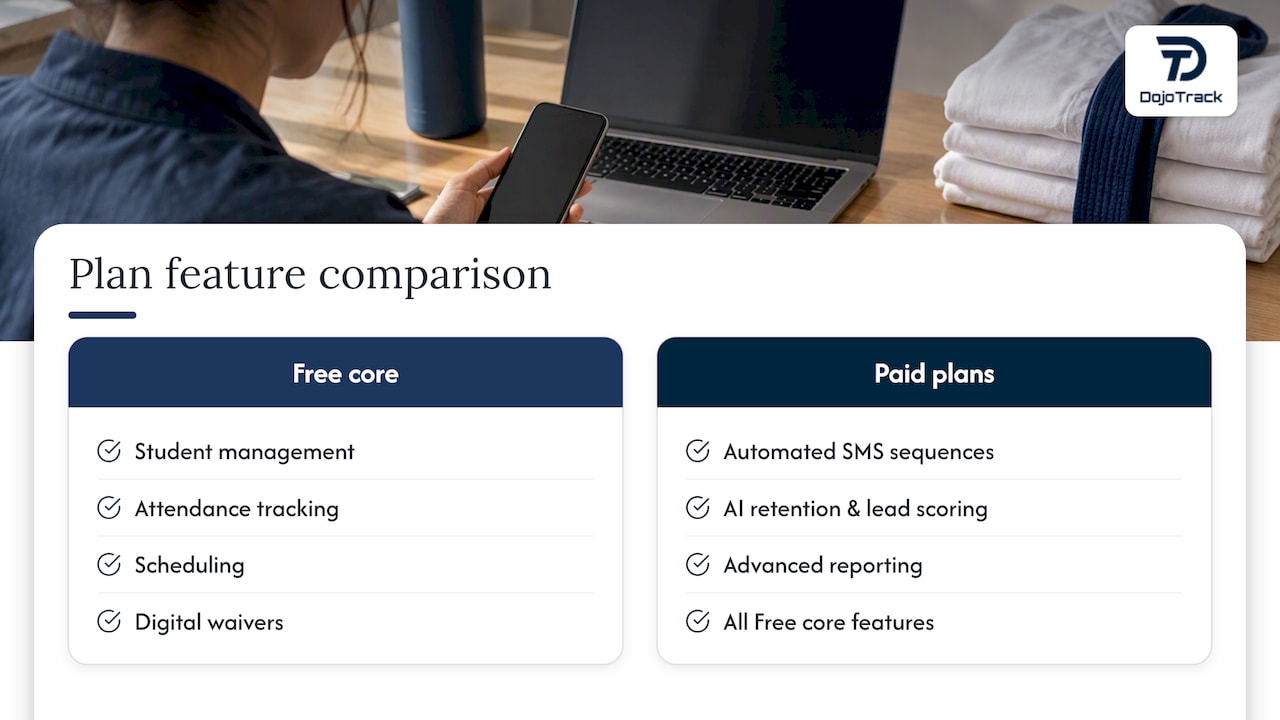
The platform offers a free core tier with student management, attendance tracking, scheduling, and digital waivers, so you can start running trial signups without upfront cost. When you’re ready for automated SMS sequences, AI retention scoring, and advanced reporting, paid plans unlock those tools as your school grows. If you’re moving from another system, DojoTrack’s data migration support handles the transfer of existing student records. Check DojoTrack’s pricing to see which plan fits your school’s size, or start with the free tier at App.
Sources
FAQ
What counts as trial signup automation for a martial arts studio?
It’s the combination of lead capture, automated scheduling, confirmation and reminder messages, and a follow-up sequence that converts a trial class into a paying membership. A martial-arts-specific platform handles all four in one system instead of separate disconnected tools.
Do I need special consent to text trial leads?
Yes. Under the FCC’s one-to-one consent rule, you need clear, conspicuous, per-seller consent captured on your form, not a blanket checkbox covering multiple companies.
Is a class confirmation email considered marketing under CAN-SPAM?
Generally no. The FTC’s CAN-SPAM guide treats messages that simply confirm a transaction, like class time and location, as transactional rather than marketing, as long as you keep promotional content out of that specific message.
How soon should I follow up after a trial class?
A same-day thank-you message followed by personal outreach from a coach within 24 to 72 hours tends to work better than relying only on automated messages. Many studios then send a membership offer between day 7 and day 14 if the student hasn’t joined yet.
What does DojoTrack cost to automate trial signups?
DojoTrack offers a free core tier with basic scheduling, attendance, and waiver tools, with paid plans starting at $95 per month for advanced automation features according to DojoTrack’s pricing page. Text messages are billed separately at $0.017 per message.