
Student Photo Consent for Martial Arts Schools: A Practical Guide
If you post student photos to promote your school, get a signed release first. For anyone under 18, a parent or legal guardian has to sign it. The cleanest way to do that is to collect it once at enrollment, record each family’s answer in the student record, and check that answer before anything goes on your website, social feeds or ads. A sentence buried in a liability waiver is the weakest version of this, and a missing form is the most common gap.
This guide walks through when you need consent, who can give it, what a good form covers, how to handle opt-outs, and which laws sit behind it. It is general information for studio owners, not legal advice. For your own form wording, have a lawyer in your state review it.
TL;DR
- Any photo or video that promotes your school (website, Instagram, ads, flyers, testimonials) calls for a signed release from the person pictured.
- Anyone under 18 cannot consent for themselves. A parent or legal guardian must sign, ideally in writing.
- Make photo consent opt-in and separate from your liability waiver, so a family can say no without losing a spot on the mat.
- Record every answer in the student file, and honor any request to take an image down.
- State publicity laws differ, and some carry real penalties, so use one consistent, written process for every student.
Table of Contents
- What student photo consent means at a martial arts school
- When you need a signed release
- Who can sign: minors, adults and teens turning 18
- What a good photo release should cover
- Keep it separate from your liability waiver
- How to run photo consent step by step
- Photos at events, tournaments and seminars
- Opt-outs and withdrawing consent
- The laws behind it
- Common mistakes to avoid
- Putting it into one system
- Our perspective
- FAQ
- Sources
What student photo consent means at a martial arts school
Photo consent is a student’s permission, or for a minor a parent’s permission, for you to take their picture and use it in a defined way. At a dojo, “using it” usually means the belt-test photo on Instagram, the class video on your homepage, the kids’ team poster in your lobby, or a Facebook ad featuring a sparring clip.
The line that matters is commercial versus informational use. One legal explainer puts it this way: if you use someone’s recognizable image or voice to sell, promote or endorse a product or service, you need a signed release. That covers social media marketing posts, promotional videos, brochures and testimonials. A martial arts school’s feed is, by nature, marketing for the school.
Copyright does not settle it either. You may own the photo you shot, but owning a photograph does not automatically give you the right to use a person’s likeness in advertising. That right is governed by state privacy and publicity laws, which vary widely.
When you need a signed release
University communications offices handle this every day, and their rules translate well to a dojo. Tulane’s guidelines call for a signed release when:
- The person is clearly recognizable and is the main subject of the image.
- The setting is non-public (your training floor during a members-only class counts).
- The person is posed, recruited or directed for promotional purposes.
- The material will be used in commercial or promotional pieces.
- The person is a minor, in which case a parent or guardian signs.
The University of Minnesota draws a similar line and states that photos of minors always require prior, written parental or guardian consent.
Here is how that plays out in a typical school:
| Situation | Release needed? |
|---|---|
| Close-up of a 9-year-old after earning her yellow belt, posted to your studio Instagram | Yes, signed by a parent or guardian |
| Wide shot of a full class from the back, no faces identifiable, used on a flyer | Safest to treat it the same way, since it promotes the school |
| Testimonial video from an adult student for your website | Yes, signed by that adult |
| Photo you privately send to a family of their own child | No marketing use, but the family should know how you take and store pictures |
| Tournament photos posted in your lobby with names | Yes, and keep last names off kids’ images |
When in doubt, ask. University of Tennessee guidance notes that implied consent may apply in some situations, but it is better to raise the issue and tell people when you are taking a photo and how you plan to use it.
Who can sign: minors, adults and teens turning 18
Minors cannot give this consent themselves. The University of Wisconsin-Extension states that a parent or legal guardian must give written consent for the use of a minor’s image, video or testimonial. For adult students, requirements depend on how you use the recording, and the same guidance recommends erring on the side of asking for written consent.
Two practical points follow for a dojo:
- Divorced or separated parents. Your enrollment paperwork should be signed by the person with legal authority. If a parent tells you the other parent objects to images, treat that as a no until it is resolved.
- Students who turn 18. The parent’s signature stops covering them on their birthday. NYC’s public school media form, for example, is signed by a parent or guardian, or by the student if they are 18 or older. Build a prompt into your process to get a fresh adult release when a teen student ages out.
If you also want to tighten your minor paperwork in general, our guide to minor waiver requirements for martial arts schools covers the liability side.
What a good photo release should cover
A release written for a business typically asks for broad rights. One law firm’s guidance says a good release for a company should cover all possible uses of the image, in all media, in perpetuity, irrevocably and royalty free. For a child, it adds that the parent’s consent should be obtained, the child’s last name should not be identified, and care should be taken in how the usage portrays the child.
For a school, a workable form includes:
- Who is pictured: the student’s full name, plus the parent or guardian’s name for minors.
- What is covered: photos, video and audio, taken in class, at belt tests, tournaments and events.
- Where it may appear: your website, social media, email newsletters, print flyers, paid ads and lobby displays.
- How names are used: first name only, or no name, for minors.
- Duration: how long the permission lasts and how a family can end it going forward.
- A clear opt-out: a separate checkbox or signature line so “no” is easy.
- Signature and date: the parent or guardian for minors, the student for adults.
Keep the language in plain English. A BJJ industry publication notes that courts have sometimes found that image rights clauses must be specific enough for the student to understand what they are agreeing to. Vague, buried language is the weak spot.
Keep it separate from your liability waiver
Many schools tuck an image clause into the main waiver. That same publication calls the image rights clause one of the most overlooked clauses in gym waivers, and notes that some academies offer a separate opt-in form because not every student wants their image used commercially, while others make the release a condition of training.
We recommend the separate opt-in. A family that is nervous about their child’s picture online should not have to choose between training and privacy. It also keeps your injury waiver clean. If you are updating that document, see how to make your martial arts waiver court and insurer ready.
How to run photo consent step by step
1. Ask at enrollment, not after the first great photo
Put the photo release in the same packet as your waiver and membership agreement, with its own signature line. Families are most willing to answer calmly when nothing is on the line yet.
2. Give three clear choices
A simple structure works well: yes to all marketing uses, yes to internal use only (lobby, private parent group), or no photos for promotion. Parents who see a middle option are more likely to agree to something.
3. Record the answer where staff will see it
A signed form in a filing cabinet does nothing at 7 p.m. when an instructor is filming sparring. Record each student’s status in their profile, so anyone about to post can check it. A custom field in your student records is a natural fit, and our guide on CRM custom fields for martial arts schools shows what to track.
4. Brief your instructors and staff
Everyone who holds a phone on your floor needs the same rule: check the list before posting, and when in doubt, leave it out. Include volunteers and assistant instructors.
5. Post a notice and tell people when you are filming
For open events like tournaments or seminars, put up a filming notice and mention it at the start. Tulane’s guidance is clear that a notice does not replace an individual release in all cases, so keep your signed forms for featured students.
6. Re-ask yearly and at life changes
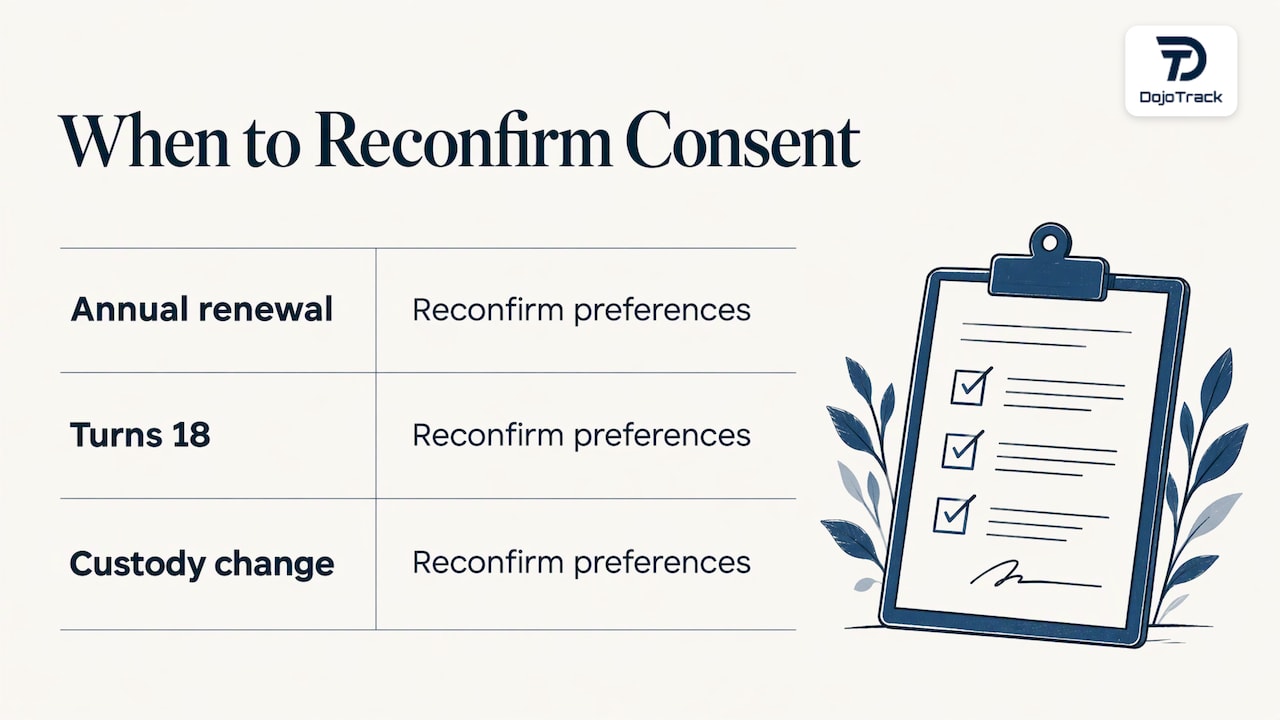
Re-confirm preferences at annual renewal, when a student turns 18, and when a custody situation changes.
Photos at events, tournaments and seminars
Events are where consent usually slips, because new faces arrive and cameras come out. If you run belt tests, tournaments or camps, fold the photo question into registration so it is answered before the day. Our event waiver workflow for martial arts schools shows how to gather paperwork ahead of time. An event registration form with a consent checkbox is one way outside guests can answer before they walk in the door.
For your own members, the sign-in kiosk or check-in routine is also a good moment to remind staff who is a no-photo student.
Opt-outs and withdrawing consent
Treat a withdrawal request as final going forward, whatever the form says. The University of Tennessee guide states that if someone pictured objects to their image being used, the photo or video should be taken down regardless of how it is used and what permission was given. Some waivers say consent cannot be withdrawn, and depending on local law that may hold, but a studio built on community trust gains nothing by fighting a parent over a picture.
A simple opt-out routine:
- Update the student’s record the same day.
- Remove the image from your website, feeds and lobby displays.
- Tell staff who might have the file on a phone.
- Confirm to the parent in writing.
A signed release mainly protects you. Legal commentary notes that protection flows mostly in one direction: the party collecting the release gets a defense against claims such as invasion of privacy or unauthorized commercial use of a likeness. That is a strong reason to have the form in place before you need it.
The laws behind it
State publicity laws
There is no single federal photo-consent statute for private businesses, so the rules sit mostly in state law. A few examples show the pattern:
- Oklahoma makes anyone who knowingly uses a person’s photograph or likeness to advertise or sell services without prior consent, or for a minor a parent or guardian’s consent, liable for damages, and punitive damages may be awarded.
- Tennessee’s Personal Rights Protection Act applies the same parental-consent rule for minors and makes violations a civil action and a Class C misdemeanor.
- Nevada requires written consent for commercial use of a person’s likeness, with unauthorized use leading to injunctive relief and actual damages of at least $750.
- Ohio defines commercial purpose to include advertising, promoting travel or fundraising and generally bars commercial use of a persona without written consent.
- California provides a right of action for damages when someone’s likeness is knowingly used for advertising or selling without prior consent.
If your state is not listed, the safe assumption is the same: written consent for promotional use, parent or guardian for minors.
COPPA and online features
The federal Children’s Online Privacy Protection Act (COPPA) applies to operators of websites and online services directed to children, and it treats photos, videos and audio containing a child’s image or voice as personal information. It matters most if your school builds an app or online area where kids under 13 upload their own content. The FTC published COPPA amendments on April 22, 2025, with most compliance obligations beginning April 22, 2026. If you run a kids’ online feature, have your attorney confirm what applies to you.
Common mistakes to avoid
- Using the liability waiver as the only release. It is easy to miss and hard to defend if a parent objects.
- Tagging kids with full names. Use first names or none.
- Letting staff post from personal phones with no check. The rule must be the same for everyone.
- Forgetting guests. Visitors and trial students need a quick release too, or should be kept out of the frame.
- Never revisiting consent. Preferences change, and so do custody arrangements.
- Letting other members film. Set a policy that recording other students, especially minors, requires their consent.
Putting it into one system
The hard part is not writing the form. It is remembering who said yes, and remembering it when you are mid-class with a phone in hand. DojoTrack’s student records, digital waivers and event registration keep paperwork and student profiles in one place, so that status sits next to attendance, belts and billing, not in a drawer. The Free plan costs $0 per month, and paid plans start at $95 per month for Launch, with the full list on our pricing page. If you would like to see how it fits your school, you can start with DojoTrack.
If you share class news with families through the student app, our post on the DojoTrack Student Companion App explains how members stay connected outside the dojo.
Our perspective
Most studio owners we talk to treat photo consent as a form problem. We see it as a record-keeping problem. A signed sheet means nothing if the instructor who posts the belt-test video cannot tell, in ten seconds, whether that family said yes.
That is why we built DojoTrack as one system for the school: student profiles, digital waivers, attendance, events, communication and billing together. When consent status lives in the same profile as the student’s belt and membership, it gets checked. When it lives in a binder, it gets forgotten.
Our advice is simple. Ask at enrollment, make the photo choice its own opt-in, store the answer where your whole team can see it, and honor every takedown request. Parents notice when a school respects their wishes, and that trust is worth more than any single photo.
DojoTrack
FAQ
Do I need parental consent to post a photo of a child at my martial arts school?
For promotional use, yes. Written consent from a parent or legal guardian is the standard for any photo of a minor, and several state laws require parental consent for advertising use. Collect it at enrollment on a separate form so families can say yes or no easily.
Can I put photo consent inside my liability waiver?
Many schools do, and some make it a condition of training. A separate opt-in is easier for families to understand and easier to defend if someone questions it. It also lets a family decline photos without affecting their enrollment.
What if a parent changes their mind after signing?
Remove the images from your channels going forward and update the student’s record. Even where a waiver says consent cannot be withdrawn, taking images down when someone objects is the safer and friendlier practice.
Do adult students need to sign a photo release too?
If you use their image to promote the school, get their written consent. For adults, the need depends on the use, and university guidance recommends asking in writing to be safe. Adults who join later, or teens who turn 18, should sign their own.
Is a sign saying “photos may be taken” enough at events?
A notice helps people know filming is happening, but it does not replace an individual release in all cases. Keep signed releases for students you feature prominently, and collect permission at event registration when you can.
Sources
- What Is a Media Release Form and When Do You Need One?
- Model Release Form: What US Businesses Need To Know
- Tulane University Photo and Video Release Guidelines
- University of Minnesota Photo and Video Releases
- University of Tennessee Photo & Video Permissions Guide
- University of Wisconsin-Extension Guidance for Video, Images, and Testimonials
- NYC Department of Education Media Consent Form
- Gordon Feinblatt: Include Photo Releases in Company Policies
- BJJ Gym Waiver Clauses
- Oklahoma Statutes §12-1449
- Tennessee Personal Rights Protection Act
- Nevada Right of Publicity
- Ohio Revised Code Chapter 2741
- State Statutes Concerning Rights of Publicity
- FTC COPPA FAQ exhibit
- FTC Finalizes Updates to COPPA
- Event Registration Forms