
Minor Waiver Requirements for Martial Arts Schools

A waiver for a minor generally has to be signed by a parent or legal guardian, not the child. It needs clear, specific language about the risks and the rights being given up. Even then, whether it holds up depends on your state. If you teach kids, the document is only one layer of protection. This guide covers what to put in it, who signs, where waivers fail, and how to keep the paperwork under control as your roster grows.
This is operational guidance for school owners, not legal advice. Have an attorney licensed in your state review your final waiver.
TL;DR
- A minor’s own signature is generally not enough. Contracts signed by minors are voidable at the minor’s option, so schools have a parent or legal guardian sign.
- State law decides whether a parent’s signature can waive a child’s negligence claims. Colorado and Michigan have statutes that allow it for recreational activity. Other states take a stricter view.
- Courts look hard at exculpatory clauses. Vague, overbroad or buried language can sink the whole document.
- A waiver does not cover gross negligence, recklessness or intentional misconduct. Safety practices, supervision policies and insurance still matter.
- Keep every signed waiver tied to the right student record, with renewal dates, so you can find it when it counts.
Table of Contents
- Why a child cannot sign their own waiver
- Can a parent actually waive a child’s claims?
- What a strong minor waiver should include
- Where waivers fail
- Risk management beyond the signature
- Paper versus digital waivers
- Our perspective: the waiver is only as good as your records
- Keeping waivers organized with DojoTrack
- Minor waiver checklist for new and growing schools
- FAQ
- Sources
Why a child cannot sign their own waiver
A waiver is a contract. Minors generally lack the legal capacity to enter binding agreements, so in many jurisdictions a contract they sign is voidable. Cornell’s Legal Information Institute explains that state law may let minors affirm or reject promises made in a contract. A 15-year-old who signs your form and later gets hurt can usually walk away from it.
That is why the standard practice is to have a parent or legal guardian sign on the minor’s behalf. It also gives you the parent’s informed acknowledgment of the risks, which is useful even where a court won’t enforce the release part.
Two practical points follow:
- Age cutoffs. The age of majority is 18 in most states, with exceptions. Treat every student under 18 as needing a guardian signature. Don’t trust “he’s almost 18” or a teen’s claim that a parent already approved.
- Legal guardian, not any adult. The person signing should have legal authority. A grandparent, older sibling or carpool parent usually doesn’t. If a student arrives with someone else, hold participation until the actual parent or guardian signs.
Can a parent actually waive a child’s claims?
This is the question that makes minor waivers different from adult ones, and the answer changes by state.
Some states say yes by statute. Colorado’s law authorizes a parent to waive a minor’s prospective negligence claims related to sporting and recreational activities, provided the decision is voluntary and informed. It does not extend to willful, wanton, reckless or grossly negligent acts. Michigan’s statute is titled as a release from liability for injury of a minor during recreational activity, and it lets a parent or guardian release a person from liability before the minor takes part.
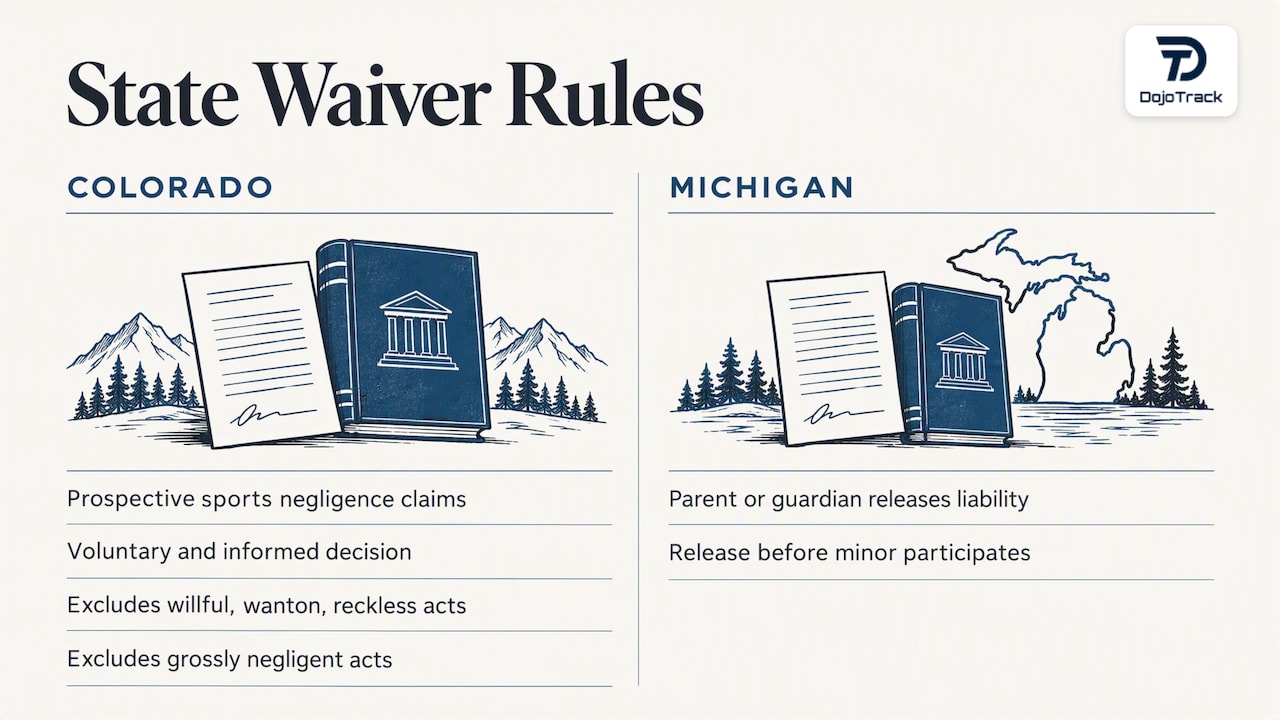
Other states rely on court decisions, and some courts have refused to honor parental releases on public policy grounds. One personal injury firm’s discussion of the issue notes it can be against public policy for a parent to give up a child’s claim in advance, but that reasoning varies, so don’t generalize from any single state. Read your own state’s statutes and case law with an attorney. A form that is solid in Colorado can be close to worthless somewhere else.
What this means for you
- Find out your state’s position. Ask a local attorney: “Will courts in this state enforce a parent’s pre-injury release for my kids’ classes?”
- Don’t skip the waiver where it’s weak. Even where the release may not hold, the document still records that the parent understood the risks, accepted your rules and authorized medical care.
- Pair it with other protection. Where the release is uncertain, your insurance and safety practices carry more weight. Talk to your insurance agent about coverage for youth programs.
What a strong minor waiver should include
Courts treat exculpatory clauses with suspicion because they let one side avoid responsibility for its own negligence. Per the Legal Information Institute, a court may refuse to enforce one that is overly broad, violates public policy or fails to clearly disclose the rights being waived. Clear, plain, specific language is your best friend. Here is a checklist to take to your attorney.
| Element | What it should do |
|---|---|
| Participant and guardian identification | Full legal names of the minor and the signing parent or guardian, plus the minor’s date of birth and the guardian’s relationship |
| Description of activities | Name the real activities: sparring, grappling, striking drills, throws, board breaking, testing, tournaments, off-site events |
| Plain-language risk disclosure | Spell out that injuries such as sprains, fractures, concussions and worse can occur, even with good instruction |
| Clear release language | State plainly that the parent is giving up certain legal rights on the child’s behalf. Don’t bury it |
| Assumption of risk | Tie the acknowledgment to the inherent risks of martial arts training |
| Medical authorization | Permission to seek emergency treatment, with emergency contacts and known conditions or allergies |
| Health representation | The parent confirms the child is healthy enough to take part and will tell you about changes |
| Rules and conduct | Agreement to follow school rules, contact levels and safety policies |
| Media consent | Separate, optional consent for photos and video, not tucked inside the release |
| Signature, date, and contact info | Signed and dated by the guardian, with a phone number you can actually reach |
Language to avoid
- Sweeping promises. A clause claiming to cover everything, including your own recklessness, invites a court to throw out the section. Waivers typically cover only the inherent risks of the activity. They rarely protect a studio from claims of gross negligence, recklessness or intentional misconduct. Michigan’s statute is an example of a law that frames the release in specific terms.
- Legalese nobody reads. If a parent can’t understand the paragraph, a judge may find the parent never knowingly gave up anything.
- One form for everyone. Adult, teen and young-child programs carry different risks. A separate minor waiver that reflects your kids’ curriculum is stronger than an adult form with a “guardian” line added.
Where waivers fail
A signed waiver is not a shield against every lawsuit. Know the limits so you don’t over-rely on it.
- Gross negligence and misconduct. Waivers do not generally excuse reckless or intentional acts. Colorado’s statute says the parental authority does not reach willful, wanton, reckless or grossly negligent conduct.
- Unclear or hidden language. If the release is not conspicuous or the rights being waived aren’t disclosed, courts can decline to enforce it.
- State law. Some states won’t honor a parent’s release at all, as covered above.
- Activities outside the document. If the waiver describes classes but a child is hurt at an overnight camp or a tournament trip, the form may not fit the event. Use event-specific waivers.
- Safety failures. Insurers and courts may look past the wording when an injury resulted from a breach of basic safety standards.
Risk management beyond the signature
Treat the waiver as one control among several. The Martial Arts Industry Association of Australia’s risk management standards, a useful reference even outside Australia, recommend going beyond the waiver: sensible instructor-to-student ratios, hazard-free training areas and instructors with current first-aid certification.
For kids’ classes, add these:
- Age-appropriate training. Youth athletes need modified methods. MuayThai GB’s safe practice policy notes that adult-style training, such as heavy head contact, is often inappropriate or risky for young people. Write down your contact rules for each age group and share them with parents.
- Concussion protocol. The CDC’s guidance for parents says a child with a suspected concussion should stay out of activity the day of the injury and return only after a healthcare provider experienced in evaluating concussions clears them. Put this in your parent handbook, and make sure instructors know to pull the child from the mat.
- Abuse prevention. The U.S. Center for SafeSport publishes Minor Athlete Abuse Prevention Policies for organizations in the Olympic and Paralympic movement. Their approach to one-on-one interactions with minors, keeping them observable and interruptible, is a sound model for any school, and insurers often care about it. Check whether your sport’s national governing body or your insurer requires these policies.
- Staff screening and training. Document background checks and first-aid renewals, and keep the records where you can pull them quickly.
If you’re also working out how to organize the operations side of a studio, this comparison of project management tools for fitness studios is a decent starting point for tracking recurring safety tasks like equipment checks and certification renewals.
Paper versus digital waivers
Paper waivers work until they don’t. The common failure points are familiar:
- A folder that grows by the month and is never reorganized
- Waivers with no date, or signed by the wrong person
- Families who enrolled two siblings and signed one form
- Expired forms nobody noticed
- A binder that isn’t at hand when an incident happens, or after a flood or a move
A digital waiver fixes most of these. The parent signs on a phone or tablet at enrollment, the signature attaches to the student’s record, and you can see who has and hasn’t signed. For families, one guardian can handle several children in one sitting.
A simple workflow
- Send the waiver before the first class. Include it in your trial class confirmation so it’s done before anyone steps on the mat.
- Require a guardian signature for every student under 18. No signature, no sparring or contact drills.
- Link it to the student profile. Attach the signed form to the individual child, not just the family.
- Set a renewal schedule. Many schools refresh waivers annually or when a student moves to a new program. Ask your attorney what suits your state.
- Use separate waivers for events. Tournaments, seminars, camps and testing days carry their own risks.
- Review at the age of majority. When a student turns 18, collect a new waiver that they sign themselves.
Our perspective: the waiver is only as good as your records
We built DojoTrack after Jared Reed ran martial arts schools and kept running into the same problems: disconnected systems, manual tracking and paperwork that ate his teaching time. Waivers are a good example of the kind of problem that looks small until it isn’t.
Most owners treat the waiver as a legal form to collect once. In practice, it is an operational record. You need to know in seconds which students have a signed waiver, who signed it, when, and whether it’s still current. The student who has trained for six months without a waiver on file is a bigger risk than any wording flaw, and it happens far more often than owners admit.
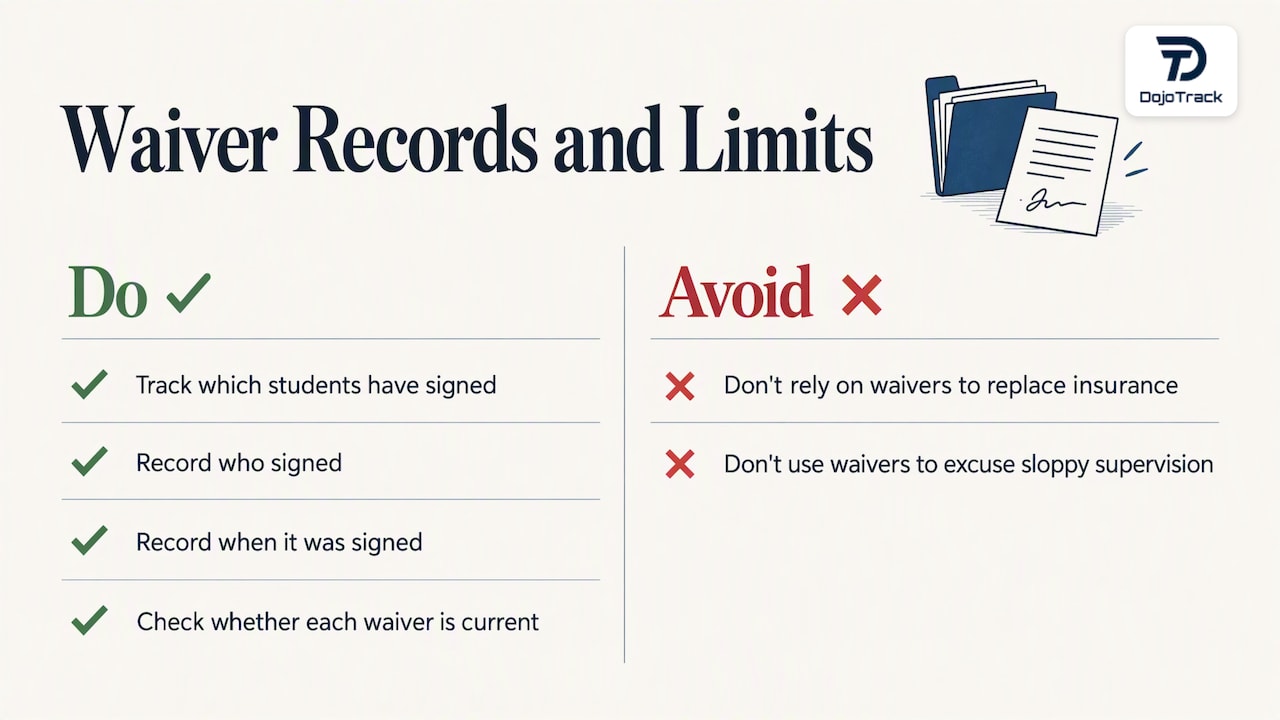
We also think owners should be honest with themselves about what a waiver can do. It will not rescue a school with sloppy supervision, and it is not a substitute for insurance or good instructors. What it can do is document that parents were told the risks and agreed to your rules. That’s worth getting right, and worth keeping organized.
That’s why digital waivers sit inside the same platform as memberships, attendance, family accounts and scheduling. When the waiver lives on the student’s record next to their belt progress and billing, nothing falls through the cracks. Have your attorney write the document. Let your software make sure everyone has signed it.
— DojoTrack
Keeping waivers organized with DojoTrack
DojoTrack includes digital waivers alongside family discounts, attendance tracking, sign-in kiosks and a student mobile app, so waiver status is part of the student record instead of a separate folder. You can start on the Free plan at $0 per month, and paid plans run from Launch at $95 per month up to Master at $245 per month. See the full plan details on our pricing page, or look at DojoTrack to see how the platform fits a kids’ program.
If you’re moving from paper or another system, our data migration tools help you bring existing student records over, so you can collect fresh digital waivers from every family rather than starting from zero.
Minor waiver checklist for new and growing schools
Before your next kids’ class, run through this list:
- [ ] Waiver reviewed by an attorney licensed in your state
- [ ] Written in plain language, with the release clearly marked
- [ ] Activities and risks described specifically
- [ ] Guardian signature required for every student under 18
- [ ] Medical authorization and emergency contacts collected
- [ ] Separate, optional media consent
- [ ] Event-specific waivers for tournaments, camps and testing
- [ ] Annual renewal process in place
- [ ] Concussion and youth contact policies shared with parents
- [ ] One-on-one interaction policy for instructors and minors
- [ ] Instructor first-aid certifications current and documented
- [ ] Insurance coverage confirmed for youth programs
FAQ
Does a parent have to sign a waiver for a child in martial arts?
Yes, as standard practice. A minor’s own signature is generally voidable, so schools collect a signature from a parent or legal guardian. Some states also limit what that signature can release, so have an attorney check your form against your state’s law.
Is a minor waiver legally enforceable?
It depends on your state. Colorado and Michigan have statutes that allow parents to release recreational negligence claims for minors, while other states restrict or reject such releases. No state’s waiver generally covers gross negligence or intentional misconduct.
Do I need a new waiver every year?
No single national rule sets this, so ask your attorney. Many schools renew annually and whenever the program changes, such as a move into sparring or a trip to a tournament. A new waiver is also needed when a student turns 18.
Can a student’s grandparent or carpool parent sign?
Only someone with legal authority over the child should sign, usually a parent or legal guardian. If someone else drops the child off, hold contact training until the proper guardian signs.
Sources
- Voidable, Legal Information Institute
- Exculpatory clause, Legal Information Institute
- Colorado Revised Statutes 13-22-107
- Michigan MCL 700.5109
- Martial arts risk management standards, MAIA
- Safe practice policy, MuayThai GB
- CDC HEADS UP fact sheet for parents
- Minor Athlete Abuse Prevention Policies, U.S. Center for SafeSport