
Payment Links for Gyms: When to Use Them and When Not To

A payment link is a URL that opens a checkout page. You text it, email it or put it on your website, and the person pays on their own phone. For a gym or martial arts school, it is a fast way to collect one-time money: a drop-in class, a seminar spot, a belt test fee, a uniform, a missed payment. It is the wrong tool for monthly dues. Those belong in automated recurring billing that retries failed charges without you lifting a finger.
This guide shows where links earn their keep, how they differ from invoices, what they cost, and how to keep them from turning into a second, messier billing system.
TL;DR
- Use payment links for one-time, low-friction charges: drop-ins, events, testing fees, gear, past-due balances.
- Use recurring billing for monthly dues. A link sent every month means you chase payments by hand every month.
- A link is a request to pay. An invoice is a formal record with terms. Gyms rarely need the second one for members.
- ACH bank debits generally cost much less than cards on recurring dues, but the right mix depends on your member base.
- Whatever you choose, keep every payment tied to the student record so attendance, belts and billing stay in one place.
Table of Contents
- What a payment link actually is
- Where payment links work well in a martial arts school
- Where payment links fail
- Payment link vs. invoice
- What payment links cost
- The part most gyms miss: failed payments
- Our perspective: links are a tool, not a system
- A simple setup for a typical school
- Compliance basics for gym billing
- Choosing management software that handles both
- Try it on the free plan
- FAQ
- Sources
What a payment link actually is
A payment link is a hosted checkout page with a fixed product and price. Stripe’s documentation describes creating one without code and sharing it on social media, in emails or on your website. The customer clicks, enters a card or another supported method, and you get paid. No account creation, no app download.
That simplicity is the whole appeal. A parent standing in your lobby can pay the $40 testing fee in 30 seconds. A prospect who texted you at 9 p.m. can book a seminar before bed.
What a link does not know is who the payer is, which student the money belongs to, or what the family’s discount should be. That context lives in your student records, and that gap is where most link-based systems get messy.
Where payment links work well in a martial arts school
Think of links as the right answer when the charge is one-time, the amount is fixed and the payer is not yet (or not always) on autopay.
- Drop-in and trial classes. Post a link on your website or Instagram bio so visitors can pay before they walk in.
- Seminars and camps. Event registration fits a link well: fixed price, limited spots, a deadline.
- Belt testing and tournament fees. Send one link per event to the families who are eligible.
- Gear and uniforms. A gi or a pair of gloves is a simple, single-price sale.
- Past-due balances. After an automatic charge fails, a link in a text message lets the member fix it in a minute.
- Private lessons. Fixed rate, paid ahead, no awkward conversation after class.
If you run paid events with ticketing, a dedicated event setup can also help. This guide to white-label ticketing explains how to keep ownership of your attendee data while selling tickets, which matters when a seminar draws people from outside your member list.
Where payment links fail
Monthly dues
If you send a link each month, you have built a manual billing process with extra steps. Someone has to send it, someone has to notice who has not paid, and members have to remember. Dues should be authorized once and charged automatically.
Families with multiple students
A link carries one price. A household with three kids, a sibling discount and an adult on a different plan does not fit a fixed-price page. You end up creating custom links, which means doing math by hand and risking mistakes.
Anything that needs to update a record
When a member pays by link, someone still has to mark them paid, reactivate their membership or add a class pack. If the link lives outside your management system, that is a manual step every time.
Payment link vs. invoice
These get confused because both end in a payment. The difference is purpose.
| Payment link | Invoice | |
|---|---|---|
| What it is | A shareable checkout page | A formal bill with line items, terms and a due date |
| Best for | Quick, one-time, fixed-price sales | Custom work, business customers, paper trail |
| Speed | Fast, often paid the same day | Slower, tied to net terms |
| Record keeping | Light | Detailed |
| Typical gym use | Drop-ins, events, gear, balances | Corporate wellness deals, facility rentals, sponsorships |
One comparison guide reports links get paid in 2 to 3 days on average, while invoices take 23 to 30. Treat that as a general benchmark across industries, not a gym-specific number. The direction matches common sense: a link removes friction, an invoice adds terms.
For members, you almost never need an invoice. For a company paying for an employee group class block or a landlord-style rental of your mat space, an invoice makes sense because their accounting team wants a document. Stripe also publishes a support page on choosing between its checkout options and invoicing if you want the processor’s view.
What payment links cost
The link itself is usually free. The cost is processing. On Stripe, online card payments run 2.9% + $0.30, and ACH direct debit runs 0.8% capped at $5. Those are published standard rates and can change, so check your own account.
Here is what that looks like on a $150 monthly membership:
| Method | Fee on $150 | You keep |
|---|---|---|
| Card (2.9% + $0.30) | $4.65 | $145.35 |
| ACH debit (0.8%, $5 cap) | $1.20 | $148.80 |
Over 150 members, that gap is about $517 a month, or roughly $6,200 a year, using these illustrative numbers. Your real figure depends on your plan, your processor and your mix of payment methods.
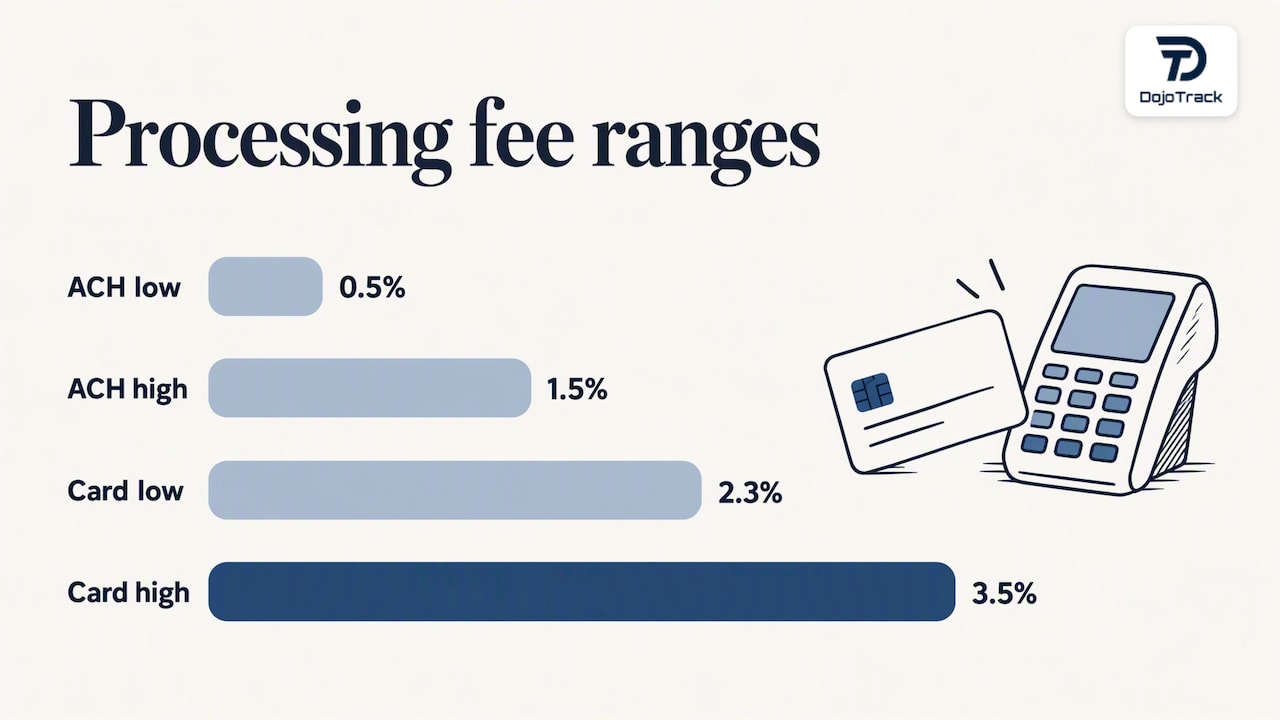
Broader industry figures point the same way. One overview of ACH debit subscriptions puts ACH at roughly 0.5% to 1.5% per transaction versus 2.3% to 3.5% for cards. Savings are real, but ACH has its own tradeoffs: bank debits can take days to settle, and returns for insufficient funds can come back after you thought the money was in.
The part most gyms miss: failed payments
The fee debate gets the attention. Failed payments do the damage.
When a card expires or gets replaced, the monthly charge fails. If nothing happens next, you may not notice for weeks. The member did not decide to quit. Their card changed. But a few missed months and an awkward conversation later, they are gone.
A sensible recovery sequence looks like this:
- Retry automatically a few times over two weeks. Many operators space retries around days 3, 7 and 14.
- Notify the member right after the first failure with a friendly message and a way to update their payment method.
- Send a payment link or update link by text, since people open texts faster than email.
- Flag the account for a human follow-up if it is still unresolved, so the instructor can say something at the next class.
- Pause access only after a clear, documented policy has been communicated.
This is where links and recurring billing work together. Recurring billing handles the normal month. A link handles the exception. ACH helps too, because bank accounts do not carry card expiration dates, which removes one common cause of failed charges. This processor’s overview of recurring dues makes a similar case for predictable recurring billing in membership organizations.
If you send those reminders by email, make sure they land in the inbox. Our guide to gym email deliverability with SPF, DKIM and DMARC walks through the setup without needing an engineer.
Our perspective: links are a tool, not a system
We built DojoTrack after running martial arts schools ourselves, and the same frustration came up again and again: billing in one tool, attendance in another, belts on a spreadsheet, leads in someone’s phone. Every disconnected piece creates a manual task, and every manual task is something you do instead of teaching.
Payment links are a good example. They solve a real problem, getting paid quickly with no friction. But a link that lives outside your student records creates a new problem: now you have money coming in that does not match anything in your system.
Here is how we think about it:
- Dues belong in recurring billing. Authorize once, charge automatically, retry intelligently. Our recurring billing runs on Stripe, so you get a familiar, established processor behind it.
- The payment should update the student. A paid fee should show on that student’s profile, next to attendance and belt progress, not in a separate dashboard you reconcile on Sunday night.
- Retention is a billing problem too. A failed charge is often the first sign a student is drifting. Our AI retention analytics flag students at risk of dropping out, so you can reach out before a missed payment becomes a cancellation.
- Family accounts should not need custom math. Family discounts should be applied by the system, not calculated by you for each link.
- Texting should be cheap enough to use. Texts cost $0.017 each, and you can rent a dedicated DojoTrack number for $2 per month, so a reminder to a handful of past-due members costs pennies.
Use links where they are strongest, and let your management platform own everything that repeats.
— DojoTrack
A simple setup for a typical school
Here is how a school with about 100 students might split things up.
- Monthly tuition: recurring billing, ACH offered first for lower fees, card as the backup. Family discounts built into the plan.
- Drop-ins and trials: one link on your website and social profiles.
- Events and seminars: event registration with a fixed price and cap on spots. If you sell tickets to outside guests, keep the attendee list in your own hands.
- Gear and uniforms: point-of-sale at the front desk, a link for online orders.
- Failed payments: automatic retries, then a text with an update link, then a personal follow-up.
- Check-in: tie attendance to the same student record, for example with RFID tags linked to memberships, so you can see who is attending but not paying, and who is paying but not attending.
That last pairing matters. A student who pays but stops showing up will cancel eventually. A student who shows up but whose card failed needs a quick fix. You can only spot either one if billing and attendance live together.
Compliance basics for gym billing
Take the rules seriously, because regulators do. The FTC’s complaint against LA Fitness concerns allegations about how the chain handled membership sign-up and cancellation. It is an allegation, not a settled finding, but it shows where scrutiny lands: unclear terms and hard cancellations.
Some practical habits that keep a small school out of trouble:
- State your price, billing date and cancellation process in writing before the first charge.
- Get clear authorization for recurring charges, whether card or bank debit. The ACH subscription overview explains authorization and consumer rights in plain terms.
- Make cancellation as easy as sign-up.
- Do not charge a link-based fee the member did not agree to.
- For state-specific rules on auto-renewals and cancellation, check your own state’s attorney general or a local attorney. Requirements vary.
Choosing management software that handles both
When you compare gym or martial arts software, ask these questions:
- Does it run recurring billing and one-time charges in the same place?
- Do payments post to the student or family record automatically?
- Can it retry failed charges and notify members without manual work?
- Does it support bank debits as well as cards?
- Can you text members, and what does that cost?
- Does it handle belts, attendance and waivers, or will you stitch together three tools?
If you are also weighing broader operational tools for a studio, this roundup of project management tools for fitness studios covers the task-tracking side of running a studio.
Try it on the free plan
DojoTrack is built for martial arts schools, MMA gyms, Taekwondo academies and Jiu Jitsu schools. You can start on the Free plan at $0 per month, then move up when you need more automation, billing, SMS or the student app. Paid plans run from Launch at $95 per month to Master at $245 per month. See what each tier includes on the DojoTrack pricing page.
FAQ
Are payment links safe for gym members?
Yes, when they come from a reputable processor. The payment page is hosted by the processor, so card details do not pass through your own systems. Only send links through channels you control, such as your official number or email, so members learn what a real message looks like.
Should I use a payment link or an invoice?
Use a link for quick, fixed-price charges like drop-ins, events and gear. Use an invoice when the payer needs a formal document, such as a company paying for a group class block. For regular members, recurring billing beats both.
Can I use Stripe payment links for monthly memberships?
Stripe’s documentation covers payment links, and you can create a link for a product. But a link only starts the payment. Without a system that ties it to the student record, applies family discounts and retries failures, you will still manage renewals by hand. That is why we run recurring billing on Stripe inside the studio platform.
Is ACH better than cards for gym dues?
Often cheaper, since published rates are lower and bank accounts do not expire. The tradeoffs are slower settlement and returned payments. Many schools offer ACH first and keep a card as a backup.
Sources
- Accept payments online without writing code, Stripe Documentation
- Choosing between Stripe Checkout UIs or Invoicing, Stripe Support
- Stripe fees: a complete guide to pricing and costs, Wise
- Payment Link vs Invoice: When to Use Each (2026 Guide), PayRequest
- How ACH Debit Subscriptions Work: Setup, Rules, and Rights, LegalClarity
- Club Payment Processing: Lower Fees on Recurring Dues, Brookside Payments
- Amended Complaint, FTC v. LA Fitness