

Most schools set freezes at one to three months per year, require written notice tied to the billing cycle, and pause billing while pushing back the membership expiration date by the freeze length. The rest is detail work.
Three variables decide whether your policy protects revenue or bleeds it:
- Duration and frequency: how long a freeze lasts, and how many a student gets per year
- Notice window: how far ahead a request must land before it takes effect
- Billing treatment: whether dues pause, get prorated, or simply push the term end date
Get those three right and everything else (forms, medical exceptions, roster access) falls into place.
Key Takeaways
A defensible membership freeze policy sets a clear duration cap, ties notice windows to the billing cycle, and pauses dues while extending the membership term by the exact freeze length.
| Point | Details |
|---|---|
| Set a duration cap | Limit freezes to 1 to 3 months per calendar year, with a 2 to 4 week minimum request length. |
| Align notice to billing | Require 10 to 30 days’ written notice so the freeze starts before the next billing draft. |
| Choose pause vs. extend | Pause billing for month-to-month plans; extend expiration dates for prepaid or term memberships. |
| Require written requests | Reject verbal freeze requests to keep an auditable record for staff and members alike. |
| Automate the workflow | Platforms like Dojotrack sync freeze requests with billing pauses, roster flags, and reactivation reminders automatically. |
Table of Contents
- Setting Your Membership Freeze Policy: Duration, Frequency, and Fees
- What Reasons Justify a Freeze, and What Proof Do You Need?
- How Do You Process a Freeze Request Step by Step?
- Pausing, Prorating, or Extending: How Freezes Affect Billing
- How Studio Software Reduces Freeze-Related Billing Mistakes
- Copy-Ready Freeze Policy Language for Your Handbook
- Can Members Cancel or Change a Freeze Once It’s Approved?
- Freezes vs. Suspensions vs. Cancellations: What’s the Difference?
- Do Frozen Members Keep Their Perks and Discounts?
- How Should Your School Communicate About Freeze Requests?
- How Many Times Can a Member Freeze in One Year?
- When Does a Freeze Deserve an Exception to Standard Limits?
- Automate Your Freeze Policy Instead of Tracking It by Hand
- Sources
- FAQ
Setting Your Membership Freeze Policy: Duration, Frequency, and Fees
A workable student membership freeze policy needs hard numbers, not vague language like “reasonable time.” Freeze windows commonly run for a minimum of one calendar month up to a few months per year, with most schools capping total frozen time at two or three months annually regardless of how many separate requests a student files.
- Minimum freeze: 2 to 4 weeks, long enough to matter, short enough to discourage casual use
- Maximum freeze: 1 to 3 months per calendar year, renewable only under documented special circumstances
- Notice window: 10 to 30 days before the next billing date, so your merchant processor doesn’t charge a member who’s already on hold
- Fee structure: many national fitness operators charge a small monthly maintenance fee (commonly around $10) during a freeze on month-to-month plans, while extending paid-in-full memberships by the exact freeze duration instead of charging anything
Smaller schools running fewer than 150 students often waive fees entirely and rely on the notice window alone to prevent abuse. Larger academies with tighter margins tend to charge $5 to $15 a month to offset the administrative cost of tracking a paused account.
Pro Tip: Set your notice window to match your billing cycle exactly. If dues draft on the 1st, require freeze requests by the 20th of the prior month. That eliminates the awkward mid cycle refund conversation entirely.
What Reasons Justify a Freeze, and What Proof Do You Need?
Not every freeze request deserves the same scrutiny. A three-week vacation and a torn ACL aren’t the same category, and your written policy should say so explicitly rather than leaving staff to improvise.
Common accepted reasons include:
- Injury or illness, including training-related injuries sustained on your own mats
- Pregnancy, often with an extended allowance beyond the standard cap
- Military deployment or extended work relocation
- Extended travel or family emergencies, typically capped tighter than medical cases
For medical claims, request a brief note from a treating physician confirming the student can’t train, not a detailed diagnosis. Reserve the right to request documentation “at the school’s discretion” rather than mandating it for every case. This keeps a parent’s short travel freeze simple while protecting your ability to verify longer medical exemptions that fall outside the standard annual cap.
How Do You Process a Freeze Request Step by Step?
Verbal freeze requests create disputes. A student tells the front desk they’re “taking a break,” nobody logs it, billing keeps drafting, and three months later you’re refunding charges and apologizing. Written or emailed requests are the standard for a reason: they create a timestamp, a record, and a paper trail if a member later disputes what was agreed.
Build the workflow around these steps:
- Require a written request through a form, portal, or email, never a hallway conversation
- Collect required fields: student name, requested start date, requested duration, reason category, and any supporting documentation
- Confirm within 24 to 48 hours with a written approval or denial, stating the exact effective date
- Update the roster and billing system immediately so front-desk staff and instructors both see the frozen status
- Send a reactivation reminder a few days before the freeze ends, so the returning student and your billing system are aligned
If a student wants to reactivate early, treat it as a new written request too. Don’t let early returns happen on a verbal “just let me back in” basis, or your freeze tracking becomes meaningless within a semester.
Pro Tip: Flag early reactivations in your system the same day they happen. A student who comes back mid freeze and gets billed for a class package they never used is the single fastest way to generate a chargeback.
Pausing, Prorating, or Extending: How Freezes Affect Billing
The billing decision depends entirely on your membership structure. Month-to-month members should have dues paused outright, no charges, no credits owed, clean and simple. Prepaid or fixed-term members need their expiration date pushed back by the exact freeze length instead, since they already paid for a set number of months.
- Month-to-month plans: pause the draft, resume on the agreed reactivation date, no proration needed
- Prepaid annual plans: extend the contract end date by the freeze duration, so a 12-month membership frozen for 6 weeks now expires 6 weeks later than originally scheduled
- Mid-cycle unfreeze: if a student returns early, resume billing on the next regular cycle date rather than prorating a partial period, which avoids messy partial-week math
LA Fitness’s approach of extending paid-in-full memberships by the freeze period rather than issuing refunds is worth copying. It keeps your revenue recognition clean and avoids the accounting headache of partial-month credits. For bookkeeping purposes, treat frozen membership months as deferred revenue that resumes recognition once the student’s classes restart, not as revenue lost.
How Studio Software Reduces Freeze-Related Billing Mistakes
Manual freeze tracking fails the same way every time: someone forgets to flag the roster, the billing system keeps charging, and the student notices before you do. Recurring-membership platforms exist specifically to close that gap, and most now support configurable usage limits and pause behaviors built into the billing engine itself.
A martial-arts-specific platform handles the workflow end to end, such as martial arts school management software that streamlines membership freezes and billing:
- Intake requests through a member portal instead of texts or hallway conversations
- Automatically align the freeze start date with the next billing cycle
- Flag the student’s roster status so front-desk staff can’t accidentally check them into class
- Track belt curriculum progress during the freeze so nothing gets lost when the student returns
- Send automated reactivation reminders before the freeze ends
- Surface frozen-member reports that flag which accounts are at risk of never coming back
That last point matters more than owners expect. A frozen account that never gets a reactivation nudge quietly becomes a cancellation. Reporting that tracks frozen-member churn risk turns a passive administrative status into an active retention workflow.
Pro Tip: Run a monthly report of every currently frozen account and call the ones approaching their reactivation date. A five-minute phone call converts far more returns than an automated email alone.
Copy-Ready Freeze Policy Language for Your Handbook
Adapt these clauses directly, adjusting numbers to match your own duration caps and fee structure.
Month-to-month freeze clause: “Members may freeze their membership for a minimum of 2 weeks and a maximum of 8 weeks per calendar year, with written request submitted at least 14 days before the next billing date. A $10 monthly maintenance fee applies during the freeze period.”
Prepaid/term membership clause: “Freezes on paid-in-full memberships extend the membership expiration date by the exact number of days frozen. No refunds or credits are issued for freeze periods.”
Medical/injury clause: “Members requesting a freeze due to injury or illness may be asked to provide a note from a treating physician. Medical freezes exceeding 60 days may be exempt from the standard annual freeze cap at the school’s discretion.”
A Quick Legal Note
This is operational guidance, not legal advice. Consult an attorney before finalizing prepaid contract terms, since state consumer-protection rules on membership cancellation and auto-renewal vary.
Can Members Cancel or Change a Freeze Once It’s Approved?
Yes, but the policy should spell out exactly how, because “can I change my mind” is one of the most common follow-up requests you’ll get after approving a freeze.
Treat modifications the same way you treat the original request: in writing, with a clear effective date. A student who wants to shorten a freeze and return early should submit that request the same way they requested the freeze, not through a text to their instructor. This keeps your roster and billing records accurate instead of relying on someone remembering a hallway conversation three weeks later.
Set clear rules for the common scenarios:
- Early reactivation: allowed with written notice, effective on the next class day or billing date, whichever your policy specifies
- Extending an active freeze: allowed once, up to the annual cap, with a new written request before the original freeze end date
- Canceling a freeze entirely and converting to full cancellation: treat as a separate request under your standard cancellation terms, not as a freeze modification
One detail owners frequently miss: a student returning early from a long freeze often needs a quick check-in before their first class back, to confirm belt level and flag any curriculum gaps in their progression. Skipping that step means an instructor discovers mid-class that a student missed two stripe requirements during their time off.
Deny verbal changes outright. If your original freeze required a written form, any modification to that freeze deserves the same paper trail. Consistency here is what keeps disputes from escalating into refund demands or negative reviews when a member feels a staff member “changed the rules” on them without documentation.
Freezes vs. Suspensions vs. Cancellations: What’s the Difference?

These three terms get used interchangeably by students, but they should mean three distinct things in your policy, because each carries different billing and access consequences.
A freeze is temporary, requested by the member, and reversible by default: billing pauses or the term extends, and the student returns on a known date with their membership intact. A suspension is usually initiated by the school, often for a behavioral or payment issue, and doesn’t come with the same automatic reactivation path. A cancellation ends the relationship entirely, and reinstating a canceled member typically means rejoining under current pricing and enrollment terms, not simply flipping a switch back on.
The interaction matters most at the edges. If a member’s freeze expires and they don’t respond to reactivation reminders, don’t let the account drift into a gray zone. Set a clear rule: after a defined grace period (commonly 7 to 14 days past the freeze end date with no contact), the membership automatically converts to a cancellation rather than staying frozen indefinitely. Indefinite freezes are where most billing systems and rosters quietly go wrong, because nobody remembers to check on an account that’s been “temporarily” paused for eight months.
If a member is suspended for a billing issue during an active freeze, that suspension should take precedence. Don’t let a payment dispute get buried under freeze status, or you risk losing track of which students actually owe you money versus which are legitimately on hold. Keeping these three statuses visually distinct on your roster (not just three flavors of “inactive”) is the difference between a clean audit trail and a billing reconciliation nightmare at year end.
Do Frozen Members Keep Their Perks and Discounts?
Generally, no, and your policy should say so plainly to avoid confusion. A frozen membership is inactive by design, which means the benefits tied to active participation, like class access, typically pause along with billing.
Where schools differ is on the peripheral perks:
- Merchandise discounts: most schools suspend member pricing during a freeze, since the discount is tied to active enrollment status
- Event and seminar access: frozen members are usually excluded from member-priced event registration, though many schools allow them to attend at guest rates
- Belt testing eligibility: paused entirely, since testing requires active class attendance and instructor sign-off leading up to the exam
- Referral bonuses: typically suspended, since a frozen member isn’t actively representing the school day to day
The one exception worth building into your policy: don’t strip a frozen member’s tenure-based perks retroactively. If a student has been enrolled for three years and qualifies for a loyalty rate, a two-month freeze shouldn’t reset that clock to zero. Tenure should count the calendar time enrolled, freeze periods included, unless your business model specifically depends on continuous unbroken enrollment for that benefit.
Spell this out in your handbook rather than leaving it to staff judgment call by call. A member who shows up expecting their merchandise discount during a freeze and gets told no at the register, with no advance warning, is a preventable friction point. State the rule once, in writing, and reference it if the question comes up.
How Should Your School Communicate About Freeze Requests?
Response speed and communication channel both shape whether a freeze request feels like a smooth process or a frustrating one. Set a standard and stick to it: confirm receipt of any written freeze request within 24 hours, and issue a formal approval or denial within 48 hours of that receipt.
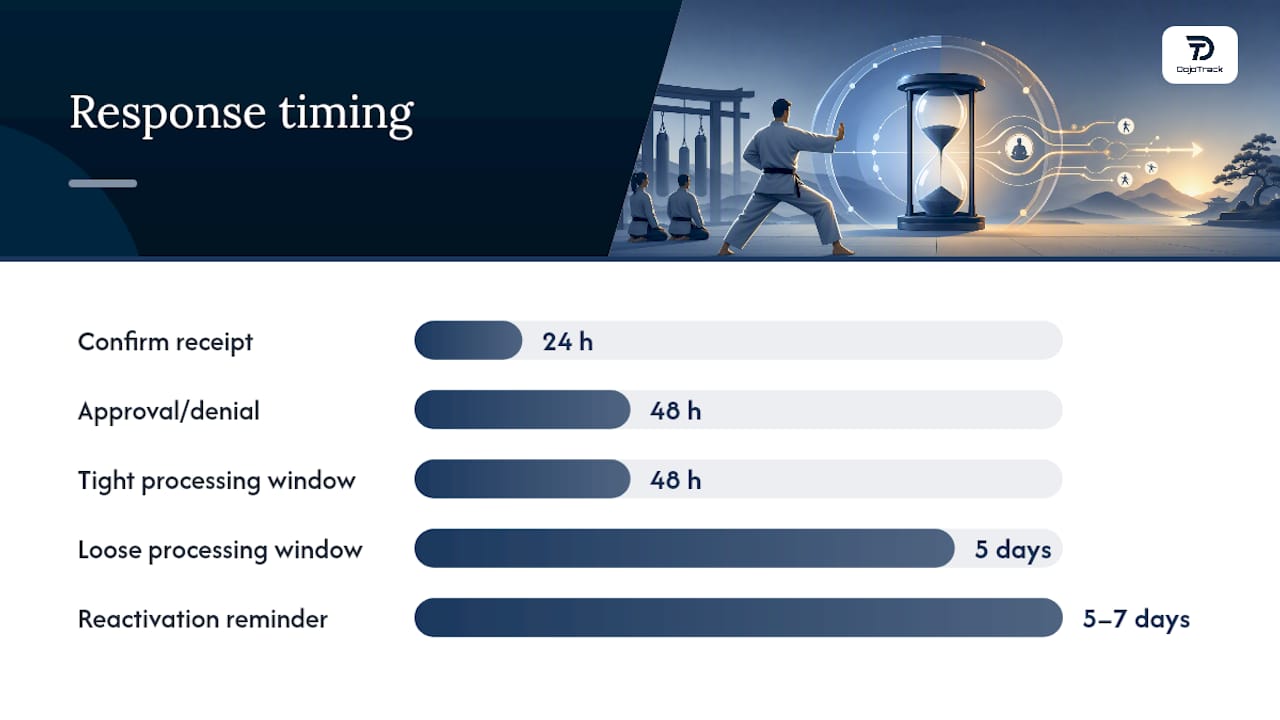
Accept requests through a single primary channel, ideally a member portal or a dedicated email address, rather than scattering intake across text messages, front-desk conversations, and social media DMs. Some schools set processing windows as tight as 48 hours or as loose as five days depending on how far in advance the request lands before the next billing date; either works, as long as your staff and your written policy agree on the same number.
Every response should include three things in writing: the exact freeze start date, the exact end date or reactivation date, and any fee or billing change tied to the freeze. Vague confirmations (“we’ve got you down for a break”) create the exact disputes a written policy is meant to prevent.
- Confirmation email: sent immediately upon approval, stating dates and billing impact
- Roster flag: visible to front-desk and instructor staff the same day, preventing accidental class check-in
- Reactivation reminder: sent 5 to 7 days before the freeze ends, prompting the student to confirm their return date
Consistency in response time matters more than speed alone. A school that always responds within 48 hours builds trust even if a competitor promises same-day turnaround, because members learn to expect and plan around a known timeline rather than wondering if their request got lost.
How Many Times Can a Member Freeze in One Year?
Cap it, and state the cap in the number of months, not the number of requests. A policy that allows “unlimited freezes up to 2 months total per year” is far easier to enforce than one that says “up to 3 freezes per year,” because the second version invites students to split a two-month freeze into three separate one-week requests just to game the count.
Most schools land on a total annual cap of 4 to 8 weeks combined, whether that’s taken in one stretch or split across two or three shorter requests. That cap should apply regardless of reason, with medical and special-circumstance exceptions carved out separately (as covered above) rather than counted against the standard allotment.
Two practical reasons to cap frequency rather than just duration:
- Billing system load: every freeze and unfreeze is a manual or automated event that touches your recurring billing setup; too many toggles per member per year increases the odds of a billing error slipping through
- Retention signal: a member requesting four separate freezes in six months usually isn’t dealing with scheduling conflicts, they’re disengaging, and that pattern deserves a retention conversation, not just another approved form
Track the running total per member per calendar year, not per membership anniversary date, so your reporting stays consistent across your entire roster instead of forcing you to calculate a different reset date for every student. Reset the counter on January 1st, and make sure whatever system tracks freezes flags a member who’s approaching their cap automatically, rather than relying on a staff member’s memory.
If a student exhausts their annual cap and requests another freeze for a non-medical reason, that’s the point where a conversation about full cancellation, rather than a fourth freeze, usually serves both parties better.
When Does a Freeze Deserve an Exception to Standard Limits?
Standard caps exist for the average case. Certain circumstances justify setting the cap aside entirely, and your policy should name them specifically rather than leaving “special circumstances” undefined and open to argument.
Common exceptions worth writing into your handbook:
- Military deployment: active-duty deployment orders typically justify a freeze extending well beyond the standard annual cap, often for the full deployment period plus a short reactivation grace window on return
- Pregnancy: many schools allow an extended freeze covering the later stages of pregnancy through postpartum recovery, frequently running longer than the standard medical exceptions
- Job relocation: a documented out-of-area move, especially one without a comparable school nearby, often qualifies for an extended freeze rather than forcing a full cancellation
- Serious injury or surgery: recovery timelines that exceed the standard medical freeze window, verified by a physician’s note, generally warrant a case-by-case extension rather than a hard cutoff
The common thread across all four: each one is documentable, time-bound, and outside the member’s routine control. That’s the test worth applying whenever a request doesn’t fit neatly into your standard duration and frequency rules. A member asking for an extended freeze because they’re “really busy at work” doesn’t meet that bar; a member with deployment orders or a physician’s letter does.
Write these exceptions into your policy by name, with a note that approval remains at the school’s discretion and may require supporting documentation. That phrasing protects you from being locked into approving every claimed hardship while still giving genuine special cases a documented path that doesn’t force a student out the door entirely.
Why Clear Freeze Rules Protect Both Retention and Your Time
Vague freeze policies cost owners hours every month in back-and-forth clarification and billing corrections that a clear, written policy prevents from happening in the first place. A student who freezes without friction is far more likely to return than one who cancels out of frustration with confusing rules. Studio software that automates the request, billing pause, and reactivation reminder turns a policy on paper into a process that actually runs itself.
— DojoTrack
Automate Your Freeze Policy Instead of Tracking It by Hand
Every rule covered above still depends on someone remembering to flag the roster, pause the draft, and send the reactivation reminder on time. Dojotrack builds that entire workflow into the platform itself: members submit freeze requests through a portal instead of a text message, billing automatically pauses in sync with the next cycle, and the roster flags the student so front-desk staff can’t accidentally check them into class. Belt curriculum tracking stays intact during the freeze, so nothing gets lost when a student comes back.
Dojotrack’s core platform, including membership management, attendance tracking, and digital waivers, is free to start. Automated billing, SMS reactivation reminders, and frozen-member churn reporting unlock as your school scales into the paid tiers. If your current process for handling freezes still runs on sticky notes and spreadsheet columns, set up your Dojotrack account and see how much staff time a properly automated freeze workflow gives back.
Sources
- Policies for Renzo Gracie East Side — Renzo Gracie East Side Martial Arts
- Recurring membership usage limits — TeamUp support
- Policies — 720 Martial Arts
FAQ
How long can you freeze a martial arts membership?
Most schools allow freezes of 2 to 4 weeks minimum, capped at 1 to 3 months total per calendar year, depending on the school’s specific policy.
Is it illegal for a school to refuse to let you cancel your membership?
Refusing cancellation outright can violate state consumer-protection rules on contract terms and auto-renewal, so schools should offer a documented cancellation path alongside any freeze option; consult an attorney for state-specific requirements.
What happens to billing when I freeze my membership?
Billing typically pauses for month-to-month members, while prepaid or paid-in-full memberships get their expiration date extended by the length of the freeze instead.
Can I freeze my martial arts membership, and what proof do I need?
Yes, most schools allow freezes for reasons like injury, relocation, or travel, and may request documentation such as a physician’s note for medical claims, particularly when the freeze exceeds the standard exemption window.