Book More Trials With Facebook Lead Ads for Dojos: SMS & DojoTrack


The single best move for a martial arts school running Facebook ads is to build a campaign around Instant Forms, layer in local or lookalike targeting with short video creative, and back it with an immediate, compliant follow-up sequence that includes email and studio-named consented SMS or a phone call. Get those three pieces right and you have a repeatable trial-booking machine. Skip any one of them and you are paying for leads that go cold before you ever talk to them.
TL;DR:
- Using Instant Forms with local or lookalike targeting and a fast follow-up sequence maximizes trial bookings and reduces lead coldness.
- Short videos and audience-specific carousel ads with strong CTAs outperform static images, especially when targeting parents and adults differently.
- Limiting form fields to essential contact and interest information boosts conversion rates, while consent language for texting must be clear and specific to your studio.
- Calling leads within 15 to 60 minutes significantly increases booking chances, and tracking lead outcomes in a CRM improves follow-up efficiency.
- Starting with a modest daily ad budget of $10 can generate steady leads but slower testing; focus on metrics like cost per lead and lead-to-trial rate to judge success.
Table of Contents
- Why Instant Forms are the right first choice for martial arts schools
- High-converting ad formats and real-world templates you can copy
- Targeting that finds people likely to book a trial
- Creative and copy formulas for families, kids, and adult programs
- Instant Form design: what fields to ask, consent language, and qualification trade-offs
- Lead qualification and compliant follow-up sequence for U.S. studios
- Metrics, budget, and a simple A/B testing plan
- DojoTrack perspective: a studio workflow that captures Facebook leads and closes trials
- What most studios get wrong about Facebook lead ads
- How DojoTrack helps you manage Facebook lead flows and stay compliant
- Sources
- FAQ
Why Instant Forms are the right first choice for martial arts schools
Instant Forms, Meta’s native lead ad format, keep prospects inside Facebook or Instagram instead of sending them to an external landing page. Meta recommends this format specifically because removing that extra step tends to increase how many people finish the conversion, compared with driving traffic off-platform.
For a martial arts school, that friction reduction matters more than it does for most businesses. Parents scrolling on their phones between errands are not going to load a slow landing page, hunt for a contact form, and type out their information on a tiny keyboard. They will tap a pre-filled form and move on with their day.
Instant Forms also fit the offer style that works best for studios:
- They match mobile-first behavior, since most parents and adult prospects browse Facebook on a phone rather than a desktop.
- They suit quick, low-commitment offers like a free trial class or a limited-time enrollment discount.
- They cut the number of steps between “interested” and “lead captured,” which matters when your ad budget is small and every drop-off costs you real money.
If your studio is only running traffic ads to a website, you are adding a step that most local competitors using Instant Forms have already removed.
High-converting ad formats and real-world templates you can copy
Three creative formats consistently pull weight for martial arts lead generation: short video, carousel, and a straightforward single-image ad with a strong headline. Video tends to outperform static images because it shows real class energy, an actual instructor, and students moving, which is hard to fake and easy to trust.
Here is a simple structure to build from:
- Video storyboard (10 to 30 seconds): open on a wide shot of an active class, cut to the instructor speaking directly to camera for 3 to 5 seconds, then close on a clear CTA like “Book your free trial class” over a shot of kids or adults training.
- Carousel by audience segment: dedicate one card to kids’ classes, one to teens, one to adult fitness or self-defense, and one to family pricing, so each viewer sees the program that applies to them first.
- Headline and body pairing: test a benefit-first headline (“Build confidence in 30 days”) against a trial-first headline (“Your first class is free”) and a testimonial-style body line that names a specific result, like improved focus or a first belt earned.
- CTA wording: “Claim your free trial,” “Reserve your spot,” and “Get started this week” all outperform vague CTAs like “Learn more” because they name the action and imply urgency without sounding pushy.
For the form itself, test two versions side by side. The first is a short conversion form asking only for name, phone number, and preferred class time, built to maximize volume. The second is a qualification form that adds a question about program interest or child’s age, which slows down submissions slightly but hands your staff a warmer lead to call.
Pro Tip: Run the short form for your first two weeks to build volume and learn which audience responds, then switch your best-performing ad set to the qualification form once you have follow-up capacity to handle the leads properly.
Targeting that finds people likely to book a trial
Start local and narrow before you try to get clever with audience layering. A martial arts school lives and dies by drive time, so a radius target around your actual location will always outperform a broad interest audience in the early weeks of a campaign.
Once you have enrolled a handful of students from the campaign, build a lookalike audience from your best current students or from everyone who booked a trial, not just everyone who filled out a form. That distinction keeps the lookalike focused on people who actually showed up, not just people who clicked.
From there, layer in behavior and interest signals that match your audience:
- For parents, combine parenting interests with proximity to schools or family-oriented behaviors rather than generic “martial arts” interest targeting, which tends to be dominated by enthusiasts who already train elsewhere.
- For adults, pair fitness and self-improvement interests with age ranges that match your actual adult class demographics.
- Exclude your current student list and recent leads from cold campaigns so you are not paying to reach people your front desk already knows.
- Test Feed, Reels, and Stories placements separately rather than letting Meta’s automatic placement blend them, since video performance often differs sharply between Reels and standard Feed.
A moderate local radius works best for most suburban studios, while dense urban locations can often narrow further and still hit enough volume.
Creative and copy formulas for families, kids, and adult programs
Parents and adult prospects respond to different language, and blending both audiences into one generic ad usually waters down the message for everyone. Write separate copy for each.
For parents, lead with safety, structure, and discipline. A headline like “Watch your child build focus, respect, and confidence” speaks directly to what most parents are actually shopping for, even though the product is martial arts training. For adults, lead with fitness, stress relief, or self-defense confidence instead, since most adult prospects are not looking for a hobby, they are looking for a result.
A few formulas worth testing:
- Benefit-first: “Kids who train martial arts learn focus that carries into the classroom.”
- Trial-first: “Your first class is free, no gear required.”
- Authority-first: “Trained by [instructor name/credential], built for [town/neighborhood] families.”
Video thumbnails matter more than most studios assume. Use a still frame that shows a clear, well-lit shot of a student mid-movement rather than a logo or a static class photo, since Facebook auto-selects a thumbnail if you do not choose one and it is often an awkward mid-motion blur.
The first three seconds of any video need to show action, not a title card or a slow zoom into your studio sign. Keep every CTA outcome-oriented: “Book your trial,” not “Contact us,” and “Reserve your spot,” not “Check out our programs.”
Pro Tip: If you run one ad set for kids and one for adults, give each its own Instant Form so your follow-up team knows immediately which program the lead is interested in before they ever pick up the phone.
Instant Form design: what fields to ask, consent language, and qualification trade-offs
Every field you add to a lead form reduces completion rate slightly, so ask only what you need to start a conversation. Meta’s own Instant Forms guidance supports using prefill fields, which pull a person’s name and contact information from their Facebook profile to cut typing time.
- Name and phone number: non-negotiable, since your team needs a way to reach the lead quickly.
- Preferred class time or day: helps your front desk propose a specific trial slot instead of a vague “come by sometime.”
- Program interest: a single-choice question (kids, teens, adults, family) that routes the lead to the right script.
- Consent language for texting: include a clear, unchecked disclosure near the phone field that names your studio specifically, something like “By submitting, you agree to receive texts from [Your Studio Name] about your trial class.”
Resist the urge to ask for a child’s age, school, or belt history on the form itself. Those details belong in the follow-up call, not the ad. A form with more than four or five fields will cost you completions without giving your staff much they cannot get on the phone in under a minute.
Lead qualification and compliant follow-up sequence for U.S. studios
Speed and compliance are not in tension, and treating them as one workflow is what separates studios that convert leads from studios that collect names in a spreadsheet nobody calls.
The moment a form is submitted, trigger an automated confirmation by email or SMS thanking the person and confirming their preferred trial time. This is a transactional message tied to their own submission, not a cold marketing text, so it carries lower compliance risk than an unsolicited promotional message would.
From there:
- Route high-interest leads (clear program match, specific time preference) to a staff member for a phone call within 15 to 60 minutes rather than the next business day.
- Send lower-priority leads into an automated nurture sequence with a short delay before the first human touch.
- Log every outcome, booked, no-show, or unresponsive, in your CRM so the same lead is never worked twice by two different staff members.
A background pattern worth noting: studios that call leads within the first hour, rather than waiting a full day, tend to book more trials, since interest fades fast once someone has scrolled past your ad and moved on with their evening.
Compliance matters most around promotional SMS. Under the FCC’s rule that took effect January 27, 2025, written consent for marketing texts must name the specific seller, meaning one blanket consent no longer covers multiple businesses buying the same lead. If you capture leads directly through your own Instant Form with consent language naming your studio, you are on solid ground. If you buy leads from a third-party aggregator, confirm the vendor’s consent documentation names your studio specifically before you send a single promotional text, since prior express written consent is the most common trigger for costly TCPA actions.
Metrics, budget, and a simple A/B testing plan
Most small studios can start meaningfully with a modest daily budget and scale once they see which ad set actually produces booked trials, not just cheap leads. Track a small set of numbers instead of drowning in ad-platform dashboards:
- Cost per lead (CPL): what you pay Facebook for each completed form.
- Click-through rate (CTR): an early signal of whether your creative is stopping the scroll.
- Lead-to-trial rate: the number that actually tells you if your follow-up team is doing its job.
- Cost per enrolled student: the only number that tells you if the campaign is profitable.
Run three tests in your first month: video versus carousel creative, short form versus qualification form, and a geo-only audience versus a lookalike seeded from trial-bookers. Give each test enough spend to gather a real sample before you judge it, and scale the winning ad set gradually rather than doubling your budget overnight.
DojoTrack perspective: a studio workflow that captures Facebook leads and closes trials
A typical workflow looks like this: a Facebook Instant Form lead lands in your system, gets scored automatically based on program interest and time preference, triggers an immediate confirmation message, and gets routed to a staff member for a call within the hour. The trial gets booked, tracked, and followed up on until the prospect either enrolls or is marked lost, and the whole path from ad click to paying student stays visible in one place.
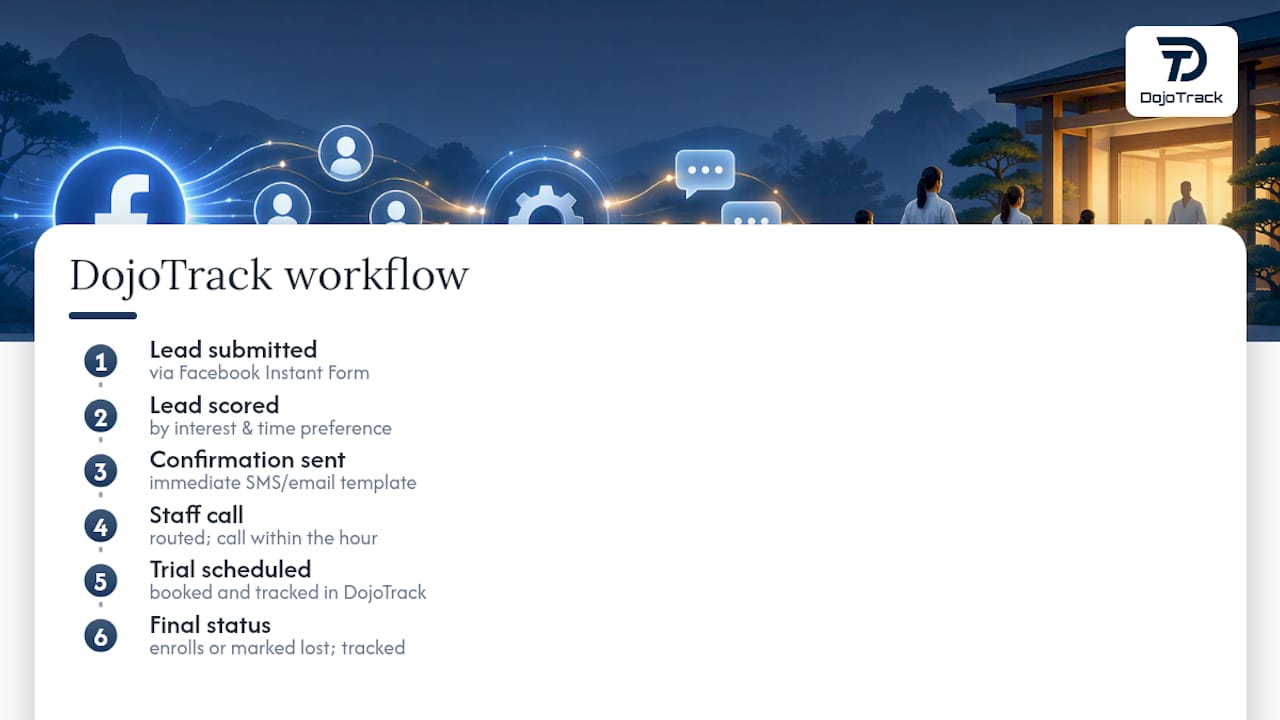
Lead capture, automated follow-up templates, lead scoring, and trial tracking software can support exactly that sequence for martial arts studios, so the handoff between “Facebook lead” and “booked trial” does not depend on a staff member remembering to check a spreadsheet.
What most studios get wrong about Facebook lead ads
The conventional advice treats Facebook Lead Ads as a volume problem: get the cost per lead down, and the rest takes care of itself. That is backward. A studio with a slow or noncompliant follow-up process will lose money on cheap leads faster than a studio with a slightly higher cost per lead and a fast, well-scripted callback process.
The most overlooked piece is not the ad creative, it is the fifteen minutes after the form is submitted. Studios spend hours debating video length and headline wording, then let a lead sit in an inbox for a day before anyone calls. Compliance gets the same treatment: it is often bolted on after a studio has already been sending texts for months, rather than built into the consent language on day one.
If you take one thing from this guide, prioritize the follow-up workflow and the consent language on your form before you spend a single dollar boosting a video. The ad gets you the lead. Everything after that decides whether it becomes a student.
— DojoTrack
How DojoTrack helps you manage Facebook lead flows and stay compliant
Running Facebook Lead Ads solves half the problem. The other half is what happens to that lead the moment it lands, and that is where most studios lose the trial they just paid to generate. DojoTrack pulls Instant Form submissions directly into your CRM, scores each lead by program interest and response speed, and fires an automated email or SMS confirmation the moment someone submits a form, so no lead sits untouched overnight.
From there, staff see a prioritized call list instead of a raw spreadsheet, trial bookings get scheduled and tracked automatically, and every outcome feeds back into your analytics dashboard so you can see which ad set is actually producing paying students, not just cheap form fills.
DojoTrack offers a free core tier with student management, attendance tracking, scheduling, and digital waivers, so you can start organizing your lead flow at no cost, then unlock automated SMS follow-up and lead scoring as your ad volume grows. Compare the Free, Launch, Scale, and other plans to find the right fit, or start with the free signup and connect your Facebook leads directly. For more on organizing follow-up once leads start coming in, see this guide to lead management workflows for new schools.
Sources
- Create more valuable leads than ever with Meta’s Instant Forms
- TCPA SMS marketing compliance rules for 2025 | LeadCompliant
This article is general information, not a substitute for advice from a qualified lawyer. Consult a qualified legal professional about your own circumstances before acting on anything here.
FAQ
Is $10 a day enough for Facebook ads?
A $10 daily budget can generate a small, steady stream of leads for a single local studio, especially with tight geo-targeting and a well-made video ad. It will not produce enough volume to run multiple A/B tests quickly, so expect slower learning cycles than a larger budget would give you.
Can you provide some examples of Facebook lead ads?
Common formats include a short video showing a live class with a “book your free trial” Instant Form, a carousel splitting kids, teens, and adult programs into separate cards, and a single testimonial-style image paired with a headline naming a specific outcome like improved focus or confidence. Each version should link to its own Instant Form so leads arrive pre-sorted by interest.
How much do Facebook ads cost per 1000 views?
Cost per ad impressions varies by location, season, and audience competition, and Meta does not publish a fixed universal rate. Rather than budgeting around impressions, track cost per lead and lead-to-trial rate, since those numbers tell you whether the spend is actually producing enrolled students.
Where do leads from Facebook ads come from?
Leads come from people who see your ad in Facebook or Instagram Feed, Stories, or Reels and complete an Instant Form without leaving the app, or from those who click through to a landing page if you run a traffic campaign instead. Instant Forms tend to capture more completions because they remove the extra step of loading an external page on a phone.
Do I need consent before texting a Facebook lead?
Yes, sending a promotional text requires prior express written consent that specifically names your studio under current FCC rules effective since January 27, 2025. A confirmation message tied directly to someone’s own form submission carries lower risk, but any follow-up marketing text should rely on consent language collected on your own form rather than a third-party vendor’s blanket opt-in.
Recommended
- Follow Up Gym Leads with SMS: Studio Owner’s Playbook
- How Smart Automation Instantly Connects Martial Arts Leads to Your Dojo (with SMS Booking Links)
- Convert Leads into Paying Students: 2026 Guide
- DojoTrack Setup: 10 Essential Steps