

TL;DR:
- Automated belt tracking is an industrial system used to keep conveyor belts properly aligned and prevent damage. It relies on sensors and actuators to detect and correct belt drift in real time, primarily in manufacturing environments. Martial arts schools, however, need specialized software to manage student progress and promotions—not conveyor belt systems.
Automated belt tracking is defined as the use of sensors and mechanical systems to keep industrial conveyor belts properly aligned during operation. If you searched this term hoping to find software that tracks student belt promotions at your martial arts school, you are not alone in the confusion. The industrial definition and the martial arts application share the same words but describe completely different problems. This article explains both, clarifies the terminology, and points you toward the right automation tools for managing student rank progression in your studio.
What is automated belt tracking in industrial settings?
Automated belt tracking is an industrial system that keeps conveyor belts centered on their frames to prevent misalignment, spillage, and equipment damage. The term belongs entirely to manufacturing, mining, and logistics operations. It has no connection to martial arts rank management or student promotion workflows.
The core problem these systems solve is belt drift. Conveyor belts naturally wander off center during operation due to uneven loading, worn components, or environmental conditions. Left uncorrected, a drifting belt damages its edges, spills material, and causes expensive downtime. Automated tracking systems detect that drift and apply corrections in real time, before damage occurs.
Industrial tracking systems apply corrective forces using both mechanical and sensor-based methods to maintain belt alignment continuously. This is a preventive maintenance strategy, not a reactive one. The system works around the clock without requiring a technician to watch the belt.
How do automated belt tracking systems work?
The technology behind belt tracking falls into two main categories: mechanical pivot-arm systems and sensor-based electronic systems. Modern automated tracking uses mechanical pivot-arm trackers or sensor-based methods including lasers, ultrasound, and photoelectric detection, triggering pneumatic or hydraulic corrections for precise belt alignment within 0.010 inches. That level of precision matters in high-speed industrial environments where small deviations compound quickly.
Here is how each component functions:
- Sensors detect the belt’s lateral position in real time. Laser, ultrasonic, and photoelectric sensors each suit different environmental conditions. Laser sensors work well in clean environments. Ultrasonic sensors handle dusty or wet conditions better.
- Actuators receive the signal from sensors and physically move the corrective component. Pneumatic actuators respond quickly. Hydraulic actuators handle heavier loads.
- Idlers and pulleys are the mechanical elements that actually redirect the belt. Sensors detect belt position and actuators correct misalignment by adjusting idler or pulley angles in real time.
- Dual-sensor configurations reduce the frequency of corrections needed. Dual-sensor setups reduce actuator movement by 60–80%, which extends system life and lowers maintenance costs significantly.
Advanced systems now incorporate IoT connectivity. IoT-enabled belt tracking platforms provide real-time digital feedback that supports predictive maintenance, reducing downtime and improving safety in conveyor operations. That shift from reactive to predictive maintenance is the most significant operational benefit these platforms deliver.
Pro Tip: When evaluating industrial belt tracking technology, prioritize dual-sensor configurations over single-sensor designs. The reduction in actuator cycling alone pays for the upgrade through lower maintenance frequency.
What are the benefits and limitations of industrial belt tracking?
Effective automated belt tracking reduces conveyor downtime, mechanical wear, and material loss, making it a core preventive maintenance strategy in industrial settings. Each of those three outcomes carries real financial weight. Downtime in a mining or distribution operation costs thousands of dollars per hour. Material spillage creates cleanup costs and safety hazards. Mechanical wear shortens the lifespan of expensive conveyor components.
The benefits stack up clearly:
- Reduced downtime. The system corrects drift before it causes a shutdown, keeping production lines running.
- Lower material spillage. A centered belt keeps material contained, reducing waste and cleanup labor.
- Extended belt life. Edge damage from misalignment is the leading cause of premature belt replacement. Tracking prevents it.
- Energy efficiency. A misaligned belt creates friction and drag. A properly tracked belt runs with less resistance, consuming less power.
- Predictive maintenance capability. IoT-enabled systems shift operations from reactive to predictive maintenance through real-time monitoring, improving overall uptime.
The limitations are equally worth knowing. Automated trackers are not a substitute for correct initial installation. Relying solely on sensors without correct initial conveyor structure alignment often leads to failure. The system manages dynamic drift during operation. It cannot compensate for a frame that was built out of square.
Belt tracking is also not the same as belt tensioning. Belt tracking differs from belt tensioning, and fixing a tracking problem by adjusting tension alone can cause premature drive failure. These are separate systems that address separate problems. Treating one as a substitute for the other creates new failures.
Pro Tip: Schedule sensor inspections on a fixed calendar interval, not just when problems appear. Automated belt trackers require regular inspection because environmental factors can impair sensor function. They are not set-and-forget devices.
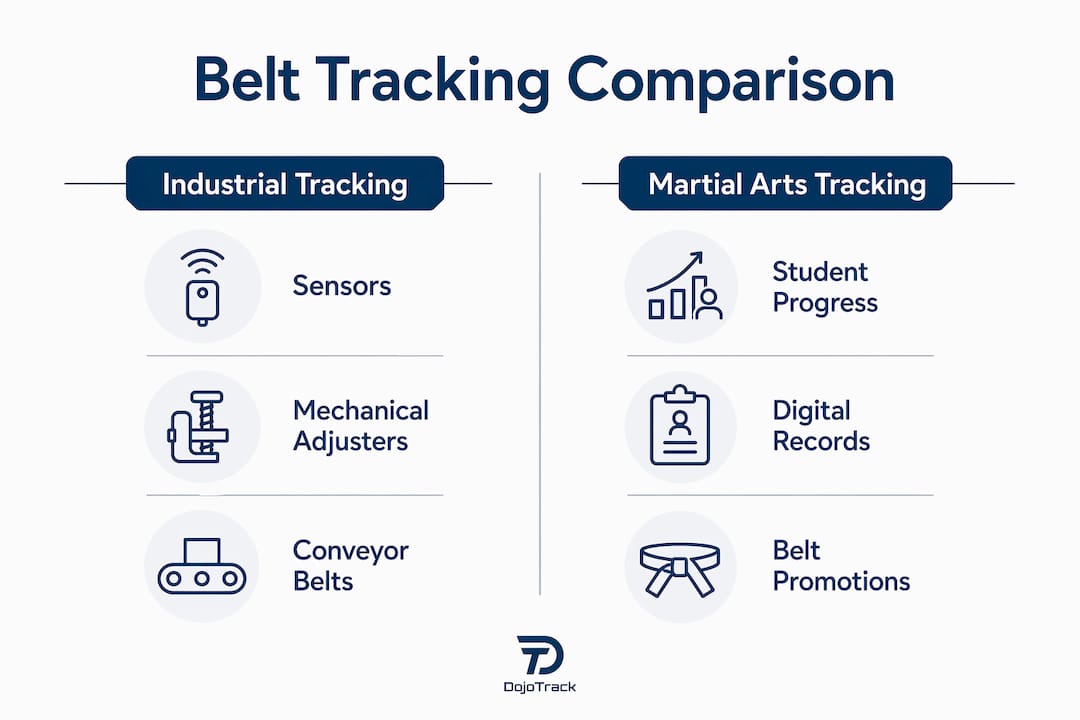
How is industrial belt tracking different from martial arts belt tracking?
The phrase “automated belt tracking” means something entirely different depending on your industry. For a martial arts instructor, the word “belt” refers to rank. For a conveyor engineer, it refers to a rubber transport surface. The terminology overlap causes real confusion when school owners search for software to manage student promotions.
Here is a clear breakdown of the two concepts:
- Industrial belt tracking monitors and corrects the lateral position of a conveyor belt on its frame. It involves sensors, actuators, idlers, and mechanical correction systems. It has no software interface for students or instructors.
- Martial arts belt tracking refers to monitoring each student’s progress through curriculum requirements, attendance milestones, and promotion criteria. It is entirely a software and administrative function.
- The confusion is understandable because both use the word “automated” and both involve tracking something called a belt. The underlying systems share zero overlap in technology or purpose.
- What martial arts schools actually need is a student progress tracking system that manages rank history, promotion scheduling, curriculum checklists, and communication with students and parents.
If you run a Taekwondo academy, a Jiu Jitsu school, or an MMA gym, industrial belt tracking technology offers you nothing. The automation you need lives in purpose-built studio management software, not in conveyor engineering.
What automated solutions exist for martial arts student belt tracking?

Martial arts studios need promotion automation that handles rank management, attendance tracking, and student communication without requiring manual spreadsheets or paper records. Purpose-built platforms for martial arts schools deliver exactly that. Dojotrack is one example, built specifically for martial arts schools, MMA gyms, Taekwondo academies, and Jiu Jitsu schools by someone who ran those schools firsthand.
The core features that matter for belt progress automation include:
- Digital rank management. Every student’s current belt, promotion history, and curriculum requirements live in one place. No paper files, no lost records.
- Promotion scheduling. Set promotion criteria based on attendance, time in rank, or instructor sign-off. The system flags students who qualify automatically.
- Attendance tracking. Class attendance feeds directly into promotion eligibility. You see at a glance which students are on track and which are falling behind.
- Student mobile app. Dojotrack’s student app lets members track their own belt curriculum progress, view class schedules, and receive push notifications about upcoming promotions.
- AI-driven retention alerts. The platform identifies students at risk of dropping out before they quit. That matters because a student who leaves before their next promotion is a student you lose permanently.
| Feature | What it does for your school |
|---|---|
| Digital rank management | Stores belt history and curriculum requirements for every student |
| Promotion scheduling | Flags promotion-ready students based on your criteria automatically |
| Attendance integration | Links class attendance directly to promotion eligibility tracking |
| Student mobile app | Lets students monitor their own progress and stay engaged between classes |
| AI retention alerts | Identifies at-risk students before they stop showing up |
The difference between this and industrial belt tracking technology could not be more stark. Automation benefits for martial arts schools center on reducing administrative work so instructors spend more time teaching and less time managing paperwork. That is the problem worth solving.
Key Takeaways
Automated belt tracking is an industrial conveyor alignment system with no connection to martial arts rank management. Martial arts instructors need purpose-built software, not industrial hardware, to automate student belt promotions effectively.
| Point | Details |
|---|---|
| Industrial vs. martial arts tracking | “Automated belt tracking” is an industrial term; martial arts schools need student progress software instead. |
| How industrial systems work | Sensors detect belt drift and actuators correct it, with dual-sensor setups cutting actuator movement by 60–80%. |
| Key industrial limitation | Automated trackers manage dynamic drift but cannot fix a conveyor frame that was installed out of alignment. |
| Martial arts automation features | Purpose-built platforms handle rank management, promotion scheduling, attendance tracking, and student communication. |
| Right tool for the right problem | Dojotrack is built for martial arts schools and automates belt promotions without requiring manual record-keeping. |
The terminology trap that costs martial arts schools time
The confusion between industrial belt tracking and martial arts belt tracking is not a minor semantic issue. It sends school owners down the wrong research path entirely. I have seen instructors spend hours reading about conveyor sensors and actuator systems when what they actually needed was a way to stop manually updating a spreadsheet every time a student earned a new rank.
The real problem for most martial arts schools is not that they lack information about belt tracking. The problem is that they are managing promotions, attendance, and student communication with tools that were never designed for the job. Generic spreadsheets and paper records create gaps. Students fall through the cracks. Promotions get delayed because no one flagged that a student had met the criteria three months ago.
Purpose-built software changes that equation. When your promotion criteria are built into the system, the system does the watching for you. You focus on teaching. The platform handles the administrative tracking that used to eat your evenings. That is the version of “automated belt tracking” that actually matters for your school. Membership tracking done right connects attendance, billing, and rank progress into one picture of each student’s engagement.
The martial arts industry does not need to borrow concepts from conveyor engineering. It needs software built by people who understand what happens on the mat.
— Dojotrack
How Dojotrack handles student belt promotion automation
Dojotrack gives martial arts school owners in the United States a single platform for managing student belt progress, promotions, attendance, and communication. The platform was built by Jared Reed, a martial arts veteran who experienced the administrative burden of running schools firsthand. Dojotrack’s automated promotion tools flag promotion-ready students, track curriculum completion, and keep students engaged through a dedicated mobile app. The free core tier covers student management, attendance, and scheduling with no upfront cost, so you can sign up for Dojotrack and run your school’s belt tracking without a financial commitment on day one.
FAQ
What is automated belt tracking?
Automated belt tracking is an industrial system that uses sensors and mechanical actuators to keep conveyor belts centered on their frames during operation. It prevents misalignment, material spillage, and equipment damage in manufacturing and logistics environments.
How does belt tracking work in industrial systems?
Sensors detect lateral belt drift and send signals to actuators, which adjust idler or pulley angles to correct the belt’s position in real time. Dual-sensor configurations reduce actuator movement by 60–80%, extending system life.
Is automated belt tracking relevant to martial arts schools?
No. Automated belt tracking is an industrial conveyor term. Martial arts schools need student progress tracking software that manages rank history, promotion criteria, attendance, and communication.
What do martial arts studios use to automate belt promotions?
Purpose-built platforms like Dojotrack automate belt promotions by tracking attendance, curriculum completion, and promotion eligibility, then flagging students who are ready to advance without requiring manual review.
What is the difference between belt tracking and belt tensioning?
Belt tracking corrects lateral drift by adjusting idler or pulley angles. Belt tensioning controls the longitudinal tightness of the belt. Fixing a tracking problem by adjusting tension alone can cause premature drive failure.