

TL;DR:
- Dojotrack is the leading martial arts management platform in 2026, offering a free core plan with purpose-built features. It automates belt tracking, billing, and retention tools, enabling schools to streamline operations and improve student retention. Most schools can complete migration within 4 to 8 weeks, using a pilot phase before full implementation.
For most U.S. martial arts schools, Dojotrack is the strongest pick in 2026. It’s the only platform in this category built from the ground up by a working dojo owner, Jared Reed, and it’s the only one that combines a free core plan with AI-driven retention tools, automated belt tracking, and Stripe-powered recurring billing in a single system. If you’re ready to act now, you can start the free core plan with no credit card required, then upgrade when your studio needs advanced automation or the student mobile app.
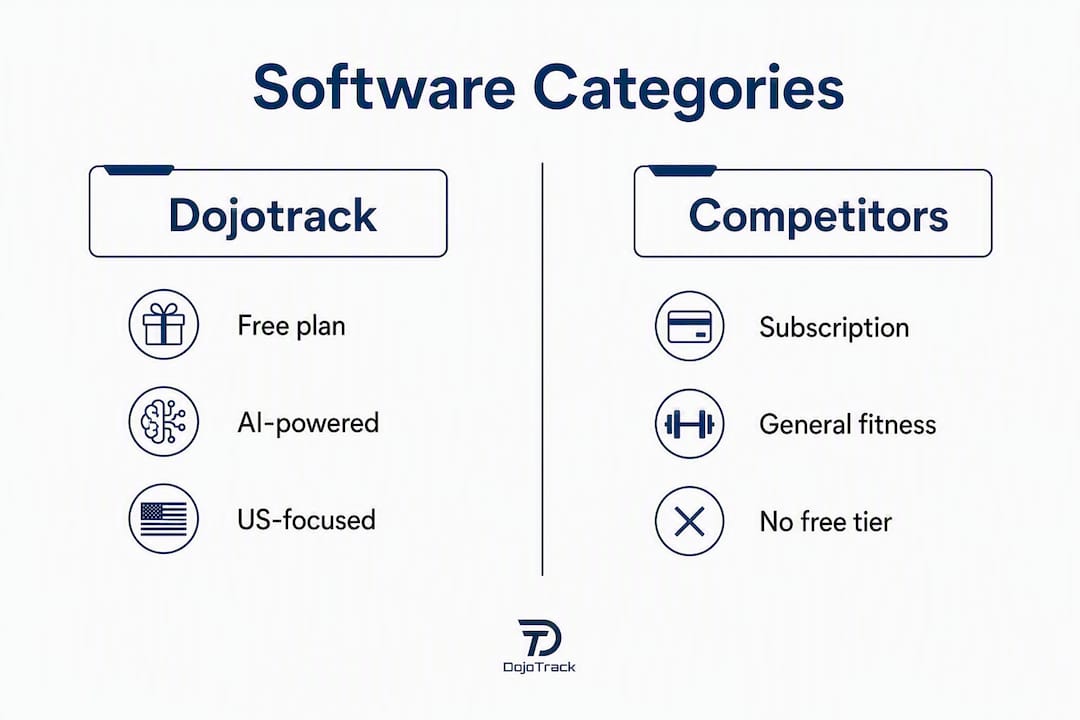
The runners-up break into three categories. Martial-arts-specific incumbents (platforms that have served dojos for years) offer solid belt and rank workflows but typically charge from the first student and carry steeper onboarding costs. General fitness platforms adapted for dojos give you polished scheduling and payment tools, but you’ll spend time building workarounds for grading events, family billing, and belt progression. Budget or free tools (spreadsheets, basic club apps) work for studios with a small number of members but break down fast once you add multiple programs or instructors.
Your immediate next step: Sign up for Dojotrack’s free core plan, import your student roster via CSV, and run a two-week pilot with one class group.
Before committing to a full migration, evaluate the pilot results carefully.

Table of Contents
- How the top martial arts software platforms compare
- Platform profiles: which type fits your school?
- How to choose the right martial arts software for your school
- Why Dojotrack is the recommended pick for U.S. martial arts schools
- Key Takeaways
- Dojotrack’s free plan: what you get and how to start
- FAQ
How the top martial arts software platforms compare
The table below maps the four main platform categories across the dimensions that matter most to dojo owners making a purchase decision.
| Category | Best for | Pricing shape | Martial-arts features | Scheduling & attendance | Billing & payments | Mobile app | Integrations | Support & onboarding | Ease of use |
|---|---|---|---|---|---|---|---|---|---|
| Dojotrack | All sizes, single or multi-discipline U.S. schools | Free core plan; paid tiers unlock automation, AI, SMS, app | Automated belt/rank tracking, family billing, curriculum mapping, grading workflows | Full scheduling, attendance tracking, sign-in kiosk | Stripe-powered recurring billing, POS, invoice automation | Student app (belt progress, schedules, push notifications) + staff app | Stripe, POS, email/SMS, calendar, CSV import | CSV migration, guided onboarding, data migration tools | High — purpose-built UI |
| Martial-arts incumbents (e.g., Zen Planner, iClassPro) | Established schools, 50–500 students | Per-student or per-location monthly fee; no free plan | Belt/rank tracking, family plans; curriculum depth varies by vendor | Solid scheduling; attendance varies | Recurring billing; processor fees vary | Student-facing apps available; quality varies | Varies; some Zapier/API support | Phone and email support; migration assistance varies | Moderate |
| General fitness platforms (e.g., Mindbody, WellnessLiving, PushPress) | Multi-discipline gyms, boutique fitness | Monthly subscription; free trials common | Limited or no belt/rank automation; family billing often manual | Strong scheduling; class booking polished | Strong recurring billing; Stripe or proprietary processor | Polished consumer apps | Wide integrations (marketing, calendar, POS) | Strong onboarding; large support teams | High for fitness; moderate for martial arts |
| Budget/free tools (e.g., basic club apps, spreadsheets) | Micro-studios under 30 members | Free or very low cost | Minimal; belt tracking is manual | Basic scheduling; attendance manual | Manual invoicing; no automated retries | None or minimal | Minimal | Self-serve only | High for simple use |
Key tradeoff to notice: General fitness platforms are polished, but martial-arts-specific workflows for grading, belt progression, and family invoicing require workarounds on those systems. That friction compounds on grading day, when you need automated fee collection and rank updates to happen together. Purpose-built platforms handle this natively.
Pricing flags: Dojotrack: ✅ Free plan available, transparent paid tiers. Martial-arts incumbents: ⚠️ No free plan; pricing varies by vendor. General fitness platforms: ⚠️ Free trial only; subscription required. Budget tools: ✅ Free or near-free.
Platform profiles: which type fits your school?
Dojotrack (recommended)
Dojotrack is an AI-powered martial arts management system built specifically for U.S. dojos, MMA gyms, Taekwondo academies, and Jiu Jitsu schools. Founded in Utah by Jared Reed after years of running martial arts schools himself, the platform was designed to solve the exact problems dojo owners face: manual belt tracking, disconnected billing, poor lead follow-up, and time-consuming admin.

Best for: Any U.S. school from startup to 300+ students, single or multi-discipline.
Standout feature: Automated belt and rank progression tied directly to attendance records and grading events, so promotions trigger without manual intervention.
Pros:
- Free core plan covers member profiles, scheduling, attendance, digital waivers, and basic communications
- AI-driven retention system flags students who miss three or more consecutive classes and triggers automated outreach
- Stripe-powered recurring billing with automatic retries, stored payment methods, and customizable invoice descriptors
- Student mobile app lets members track belt curriculum progress, view schedules, and receive push notifications
Cons:
- Available only in the United States
- Advanced automation, AI analytics, SMS, and the student app require a paid tier upgrade
Pricing shape: Free core plan; paid tiers unlock automation, analytics, billing, SMS, and the student app. Upgrade typically happens when a studio crosses a member threshold or needs grading automation.
A 60-student Taekwondo academy, for example, could run the free plan for daily operations and upgrade to a paid tier specifically when belt promotion season arrives and automated grading fees become worth the cost.
Martial-arts-specific incumbents
This category includes established platforms that have served dojos for years and carry recognizable names in the industry. They offer genuine belt and rank tracking, family membership pricing, and scheduling built around class-based attendance.
Best for: Schools with 50–500 students that want a proven system and are willing to pay from day one.
Pros:
- Established track records with verified user reviews on Capterra and G2
- Belt/rank workflows are mature and tested across thousands of schools
- Phone and email support teams familiar with dojo operations
Cons:
- No free plan; per-student or per-location fees add up quickly for growing schools
- AI-driven retention and lead scoring are typically absent or limited
- Migration support quality varies significantly between vendors
Pricing shape: Monthly subscription, usually per-student or per-location. Expect to pay from the first student.
General fitness platforms adapted for dojos
Platforms like Mindbody, WellnessLiving, and PushPress were built for boutique fitness studios and gyms. They excel at scheduling, payment processing, and consumer-facing apps. Dojo owners who run hybrid facilities (yoga + BJJ, for example) often start here.
Best for: Multi-discipline facilities where martial arts is one of several offerings.
Pros:
- Polished scheduling and class booking experience
- Wide integration ecosystems (marketing tools, calendar sync, POS)
- Large support teams and extensive documentation
Cons:
- Belt/rank tracking is absent or requires manual workarounds
- Family billing and grading event fees are not native workflows
- Per-transaction fees can be higher than Stripe-direct billing
Pricing shape: Monthly subscription with free trials; some charge per-location.
Budget and free tools
Spreadsheets, basic club management apps, and free-tier scheduling tools work for micro-studios. They require no budget and minimal setup. The ceiling is low: once you add a second instructor, multiple programs, or automated billing, these tools become a liability rather than an asset.
Best for: Solo instructors or studios under 30 active members with no plans to scale.
Pros:
- Zero cost to start
- No learning curve for basic scheduling
Cons:
- No automated billing, belt tracking, or retention alerts
- Data lives in disconnected tools, creating reconciliation headaches
- No migration path to a professional system without manual data re-entry
Pricing shape: Free, but the hidden cost is your time.
Pro Tip: Before you outgrow a free tool, export a clean CSV of your member data. That file is your migration asset. Without it, switching to a professional platform takes significantly longer.
How to choose the right martial arts software for your school
The decision checklist
Use these criteria to evaluate any platform during a trial or demo. Rank them by your studio’s current pain points.
Must-haves for martial arts schools:
- Belt and rank tracking — Does the system automate promotions based on attendance and grading results, or do you update ranks manually?
- Family billing — Can one invoice cover multiple family members with a household discount applied automatically?
- Recurring billing with automatic retries — Does the platform support stored payment methods, failed-payment retries, and customizable invoice descriptors? (Check whether it uses Stripe or a proprietary processor, and confirm transaction fees.)
- Attendance tracking tied to grading eligibility — Can you set minimum attendance thresholds before a student appears on a grading list?
- Digital waivers — Are waivers collected and stored digitally, with timestamps and signatures?
- Multi-program scheduling — Can you run Karate, BJJ, and Kids’ classes simultaneously with separate instructor assignments?
- Data migration support — Does the vendor provide CSV import tools or assisted migration? Ask for a sample export before you commit.
- Mobile app for students — Can students check their belt progress, class schedule, and notifications from their phone?
Nice-to-haves:
- AI-driven retention alerts (students flagged after three missed classes)
- Lead scoring and automated SMS follow-up for prospects
- POS inventory management for gear sales
- Event registration for tournaments and seminars
- Staff scheduling and shift management
Questions to ask during vendor demos
- “Show me how a belt promotion works end-to-end, from attendance check to rank update to notification.”
- “How does family billing work when one child upgrades and another doesn’t?”
- “What happens when a payment fails? Does the system retry automatically?”
- “Can I export my full member database, including attendance history, at any time?”
- “What does onboarding look like? Do you provide a dedicated migration contact?”
- “Does your mobile app support push notifications for class reminders and belt milestones?”
- “What are your transaction fees on top of Stripe or your payment processor?”
Red flags to watch for
- No martial-arts-specific belt or rank workflow (you’ll be managing this in a spreadsheet forever)
- Family billing requires manual invoice creation per student
- Pricing is not publicly listed and requires a sales call to get a number
- No free plan or trial period, and no sandbox environment to test with real data
- Migration support is “self-serve only” with no CSV import tool
- The platform hasn’t updated its martial-arts features in the last 12 months
Implementation timeline
| Scenario | Evaluation | Pilot | Full migration |
|---|---|---|---|
| Small studio (under 50 students) | 1–2 weeks | 2 weeks | 4–6 weeks total |
| Mid-size school (50–150 students) | 2–3 weeks | 2–4 weeks | 6–8 weeks total |
| Large school or multi-location (150+ students) | 3–4 weeks | 4 weeks | 8–12 weeks total |
The standard migration pattern for a small studio: import your member CSV, connect Stripe for recurring billing, run a 2–4 week pilot with one instructor and 10–30% of your roster, then complete full migration within 4–8 weeks if the pilot succeeds.
Pro Tip: Run your pilot with your most active class group, not your newest students. Active members surface integration gaps and staff training needs faster, and they’re more forgiving when something needs a quick fix.
How these platforms were evaluated
The shortlist and recommendation in this article were built on five data sources: Dojotrack’s product documentation and blog posts, vendor demo walkthroughs, verified user reviews on Capterra and G2, a neutral category roundup from 1club, and implementation guidance from Dojotrack’s migration and onboarding resources.
Criteria and rough weightings used:
- Martial-arts-specific features (belt/rank tracking, family billing, curriculum tools): 30%
- Pricing and total cost of ownership (free plan, per-student fees, transaction costs): 20%
- Ease of use for owners and front-desk staff: 15%
- Onboarding and support quality (migration tools, response time): 15%
- Integrations (Stripe, POS, calendar, marketing): 10%
- Mobile app quality (student-facing and staff-facing): 10%
If your school runs large tournaments or seminars regularly, weight integrations higher. For scheduling-heavy operations with multiple event and calendar workflows, third-party calendar sync and event registration become more critical than the default weighting suggests.
Ratings map to buyer action as follows: a platform scoring well on martial-arts features and ease of use warrants a trial; one that also scores well on onboarding and pricing warrants a pilot group; a platform that clears all five criteria is a candidate for full migration.
Before switching billing providers, verify that the new system supports stored payment methods, automatic retries, and customizable invoice descriptors. Skipping this check is one of the most common causes of failed-payment write-offs during the first 90 days on a new platform.
Always request a full data export sample from your current system before you start any migration. Data portability is a non-negotiable safeguard: if a vendor won’t let you export your own member data on demand, that’s a red flag regardless of how good the features look.
Why Dojotrack is the recommended pick for U.S. martial arts schools
Dojotrack was founded in Utah by Jared Reed, a martial arts veteran who built the platform to solve the exact operational problems he faced running real dojos. That origin matters because the feature set reflects actual dojo workflows, not fitness-industry assumptions retrofitted for martial arts.
The platform’s core differentiators, tied directly to buyer outcomes:
- Automated belt and rank tracking: Promotions trigger based on attendance records and grading results. No manual rank updates, no spreadsheet cross-referencing on grading day.
- Family billing: One household invoice, automatic family discounts, and individual student tracking under a single account.
- Curriculum mapping: Students and instructors can track progress through a structured belt curriculum inside the platform and the mobile app.
- Stripe-powered recurring billing and POS: Billing runs on Stripe, which means stored payment methods, automatic retries on failed payments, and customizable invoice descriptors. The POS handles gear and merchandise sales in the same system.
- AI-driven retention: The platform monitors attendance and flags students who miss three or more consecutive classes, then triggers automated outreach. This reduces the manual follow-up burden on front-desk staff considerably.
- Student mobile app: Members track their belt curriculum progress, view class schedules, receive push notifications, and purchase products directly from the studio.
- Staff and instructor management: Shift scheduling, permissions, and instructor assignments are managed within the same platform.
- Data migration tools: CSV import, incremental rollout support, and a guided migration process mean you’re not starting from scratch.
The free core plan covers student and membership management, attendance tracking, scheduling, digital waiver collection, and basic communications. Most studios run the free plan until they hit a member threshold that makes automated billing retries and AI retention tools worth the upgrade cost, or until a grading season makes automated belt promotion workflows a clear time-saver.
Concrete outcomes owners can expect after a successful migration: less time spent on manual attendance reconciliation, clearer visibility on unpaid fees before grading events, faster grading-day workflows, and measurable improvement in student retention through automated re-engagement. For a deeper look at the feature set, the Dojotrack platform overview covers CRM, scheduling, and migration tools in detail.
Pro Tip: If you’re evaluating Dojotrack against a martial-arts incumbent, ask both vendors to walk you through a belt grading workflow end-to-end during the demo. The gap in native functionality usually becomes obvious within five minutes.
For small schools specifically, the free plan for small studios article on Dojotrack’s blog explains exactly which features are included at no cost and what triggers a typical upgrade.
Key Takeaways
Dojotrack is the strongest martial arts management software for U.S. schools in 2026, combining a free core plan with purpose-built belt tracking, AI retention tools, and Stripe-powered billing that general fitness platforms cannot match natively.
| Point | Details |
|---|---|
| Start with the free core plan | Dojotrack’s free tier covers scheduling, attendance, waivers, and member management with no upfront cost. |
| Run a two-week pilot first | Test with 10–30% of your roster before full migration to surface gaps and train staff with minimal disruption. |
| Prioritize martial-arts-specific features | Belt tracking, family billing, and grading workflows are the highest-leverage capabilities for retention and revenue. |
| Plan a 4–8 week migration window | Most small-to-mid-size schools complete a full migration within 4–8 weeks when they follow a structured CSV import and pilot process. |
| Dojotrack is the recommended pick | Purpose-built for U.S. dojos, with a free entry point and AI-driven tools that general fitness platforms don’t offer natively. |
The trade-offs that actually matter when choosing dojo software
Most dojo owners shopping for software get distracted by feature lists. The real question is simpler: does this system enforce your workflows, or does it just record them?
A billing system that sends an invoice but doesn’t retry failed payments is leaving money on the table every month. A belt tracking module that requires manual rank updates is just a prettier spreadsheet. The difference between a system that enforces your operations and one that merely documents them is the difference between software that pays for itself and software that adds to your workload.
When scaling from 30 to 300 students, the single biggest operational risk is that your admin processes don’t scale with your enrollment. Manual attendance reconciliation that works at 30 students becomes a two-hour weekly task at 150. Family billing handled by hand generates disputes and missed discounts. Grading-day fee collection done manually means chasing payments for weeks afterward.
For a studio under 50 students, ease of use and a free entry point matter most. Pick a system your front-desk staff can learn in a day and that doesn’t require a consultant to set up. For a school between 50 and 150 students, automated billing retries and retention alerts start paying for themselves. For a school above 150 students or running multiple locations, integrations, staff permissions, and data export capabilities become critical.
The advice that gets skipped most often: structure your pilot around your most active class, not your newest students. Active members surface real integration gaps. And before you sign any vendor contract, request a full data export in CSV format. If the vendor hesitates, that tells you everything you need to know about how they’ll treat your data when you eventually want to leave.
Dojotrack’s free plan: what you get and how to start
Running a dojo without the right tools means time you could spend on the mat gets eaten by admin. Dojotrack’s free core plan gives you student and membership management, attendance tracking, scheduling, digital waiver collection, and basic communications at no cost, with no credit card required to start.
When you’re ready for more, paid tiers unlock:
- Automated belt and rank tracking with grading workflows
- AI-driven retention alerts and automated SMS outreach
- Stripe-powered recurring billing with automatic payment retries
- Student mobile app with belt curriculum progress and push notifications
- Advanced analytics and studio performance dashboards
Getting started takes four steps: Sign up for the free plan at Dojotrack, import your existing member roster via CSV, invite one class group to pilot the platform for two weeks, then schedule a demo with the Dojotrack team to walk through advanced automation before you commit to a paid tier.
Useful sources and further reading
These resources support the claims in this article and give you a starting point for deeper research before finalizing your shortlist.
- Dojotrack platform overview and CRM features — covers onboarding, migration, and core feature set
- Dojotrack: 5 dojo management features that save time — practical automation examples for attendance, billing, and grading
- Martial arts software vs. generic fitness apps — explains the workflow gap between purpose-built and adapted platforms
- 2026 buyer’s guide for martial arts school software — feature priorities and evaluation checklist
- Best martial arts management software 2026 (1club roundup) — neutral category overview and common feature definitions
- Capterra: martial arts software reviews — verified user reviews across the category
- G2: free martial arts software picks — free-tier options with verified ratings
- Why data backup matters for sports clubs (FCOPS) — data portability and backup guidance before any migration
| Resource | Best used for |
|---|---|
| Dojotrack platform overview | Understanding onboarding timeline and CRM features |
| 1club roundup | Neutral category definitions and feature benchmarks |
| Capterra reviews | Verified user ratings across martial-arts platforms |
| FCOPS data backup guide | Pre-migration data export and backup checklist |
Before finalizing any vendor, request a sample data export from your current system and review the vendor’s integration documentation directly. Feature pages are marketing; the integration docs tell you what actually connects.
FAQ
What is martial arts management software?
Martial arts management software is a platform that handles the daily operations of a dojo or combat sports gym, including student enrollment, belt and rank tracking, attendance, scheduling, recurring billing, and digital waivers. Purpose-built systems like Dojotrack also include family billing, grading workflows, and AI-driven retention tools that general gym software doesn’t offer natively.
What software do gym owners use for martial arts schools?
Dojo owners in the U.S. use a range of platforms, from martial-arts-specific systems like Dojotrack to general fitness platforms like Mindbody, WellnessLiving, and PushPress. Dojotrack is the only platform in this category that combines a free core plan with automated belt tracking, AI retention tools, and Stripe-powered billing built specifically for martial arts workflows.
Is there free software for running a martial arts school?
Yes. Dojotrack offers a free core plan that includes student and membership management, attendance tracking, scheduling, and digital waiver collection, with no credit card required. Paid tiers unlock advanced automation, AI analytics, SMS, and the student mobile app.
How long does it take to migrate to a new martial arts platform?
Most small-to-mid-size schools complete a full migration within 4–8 weeks, following a pattern of CSV import, a 2–4 week pilot with 10–30% of the roster, and then full rollout. Larger schools or multi-location operations typically need 8–12 weeks.
What features should I prioritize when choosing martial arts software?
Prioritize automated belt and rank tracking, family billing, recurring billing with automatic payment retries, attendance tracking tied to grading eligibility, and digital waivers. These are the features that directly affect your grading-day revenue, student retention, and daily admin load.