
Set Up a Copyable Sibling Discount Structure and Billing Steps

The simplest, most defensible sibling discount structure is a tiered percentage: the oldest or first-enrolled child pays full tuition, the second gets 10% off, and the third gets 15% off (or flat-dollar equivalents if your billing is simpler that way). It only works reliably if your enrollment or billing system supports family accounts or a sibling_order field. Adjust the defaults for high-cost programs, capacity-limited classes, or existing means-tested aid.
TL;DR:
- Sibling discounts should be tied to clear rules such as relationship proof, enrollment timing, and whether discounts stack with other offers to prevent disputes.
- The most common model offers a 10% discount for the second child and a higher percentage for additional siblings, with policies often capping the number of children receiving discounts.
- Implementing automation through family accounts and sibling-order fields minimizes billing errors and dispute risks, especially during mid-term enrollments.
- The financial benefit relies on high retention rates, as the discount itself typically covers a small margin, making accurate tracking and consistent policy application crucial.
- Clear communication, testing invoices beforehand, and setting written rules with documentation requirements ensure smooth policy rollout and ongoing compliance.
Table of Contents
- What Is a Sibling Discount Structure, Exactly?
- Common Sibling Discount Structures (and Where Each Fits)
- What Rules Does Your Policy Need to Define?
- How Do You Calculate and Apply the Discount?
- How Should You Implement This in Registration and Billing?
- Does a Sibling Discount Actually Pay Off?
- Ready-to-Use Sibling Discount Policy Templates
- Rolling Out the Policy Without Confusing Parents
- What Do Real Institutional Policies Look Like Side by Side?
- The Automation Lesson Studio Owners Learn the Hard Way
- Let DojoTrack Handle Your Family Billing
- Sources
- FAQ
What Is a Sibling Discount Structure, Exactly?
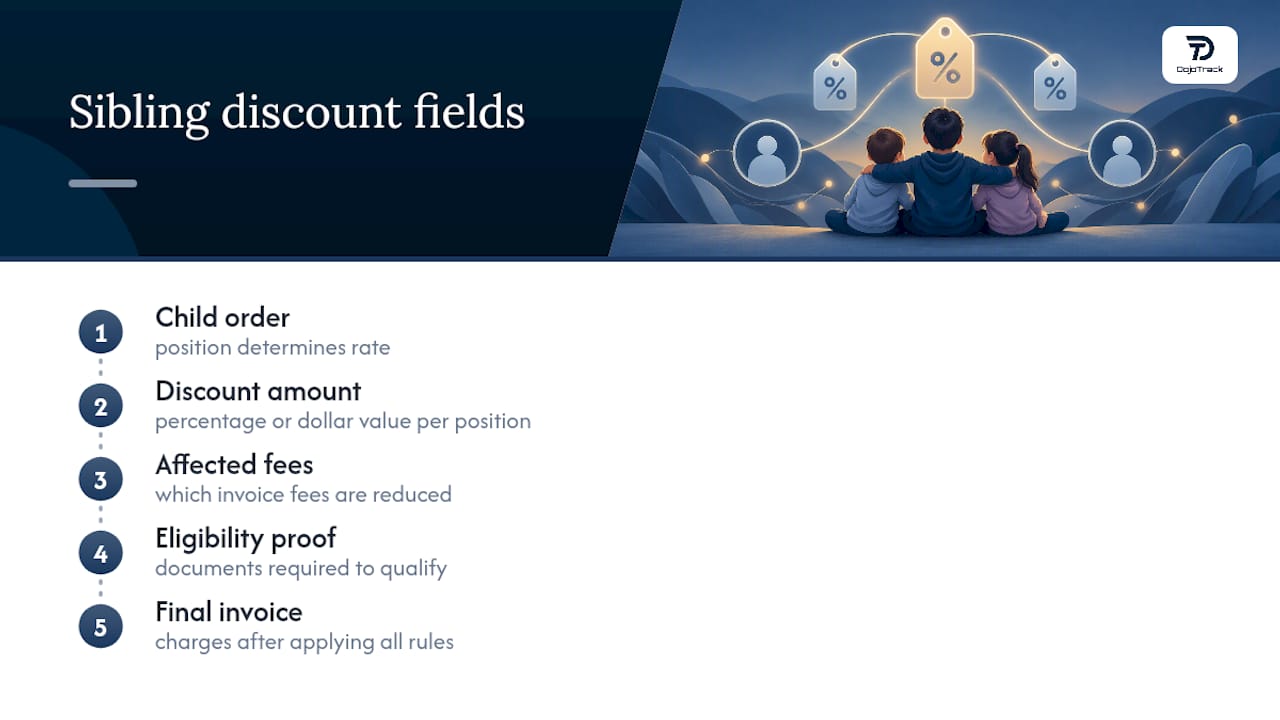
A sibling discount structure is the set of rules that determines how much a family saves when it enrolls more than one child, and how that savings gets calculated and applied on the invoice. It’s not just “10% off.” It’s the order of children, the percentage or dollar amount tied to each position, which fees it touches, and the proof required to qualify. Programs that skip this definition end up improvising at the front desk, which is where sibling discount policy usually breaks down.
Common Sibling Discount Structures (and Where Each Fits)
Most programs choose between a handful of proven models rather than inventing something new. Brightwheel’s breakdown of childcare discount options groups them into percentage-based, flat-dollar, and tiered structures, and that framework holds up across tuition-driven businesses generally.
- Second-child-only discount: only the second enrolled child gets a break (commonly 10%), and additional siblings pay full price. Simple to explain, cheap to run.
- Per-child (escalating) discount: every sibling after the first gets a discount, often increasing with each additional child. Roger Williams University’s multiple sibling tuition discount policy escalates this way: two students each get 10% off, while a third student’s household can see rates climb to 20% and a fourth to 25%.
- Flat-dollar discount: a fixed amount per sibling regardless of program price, similar to how the University of the Incarnate Word applies a $500-per-semester award rather than a percentage.
- Flat family-rate: one bundled price covers all children in the household, common in gyms and studios with a per-person add-on for each extra child.
What Rules Does Your Policy Need to Define?
Every dispute over a sibling discount traces back to something the policy never specified. Before you launch one, lock down these five things in writing:
- Qualifying relationships. Decide whether biological, adopted, step, and half-siblings all qualify, and what proof you’ll accept (birth certificate, custody paperwork, or a signed affidavit). Finalsite’s enrollment documentation flags that half- and step-siblings must be manually set in the system, because software won’t infer blended-family relationships on its own.
- Simultaneous enrollment terms. State whether the discount requires all siblings to be actively enrolled at the same time, and what happens when one withdraws mid-term.
- Deadlines and renewal. Set an annual or per-term application window, and make clear the discount isn’t retroactive. Gonzaga University’s family discount policy requires families to self-identify before the term starts precisely to avoid retroactive claims.
- Stacking rules. Spell out whether the sibling discount stacks with scholarships, staff discounts, or seasonal promotions, or whether only the single largest discount applies.
- Age or status limits. If you cap eligibility by age, grade level, or full-time enrollment status, put the exact cutoff in the policy text, not in a manager’s memory.
How Do You Calculate and Apply the Discount?
Sibling order drives the math. The first-enrolled or oldest child is order 1 and pays full tuition; each subsequent child moves up the discount schedule. When siblings enroll on the same day or are twins, most policies default to birth order or let the family designate the sequence, since either resolves the tie without ambiguity.
A few worked examples make this concrete:
- Percentage on monthly billing: A $150/month program with a 10% second-child discount bills the second sibling at $135/month. A third sibling at 15% off bills at $127.50/month.
- Flat-dollar on term billing: A $2,000 semester program using UIW’s $500 flat award simply subtracts $500 from the second sibling’s invoice, regardless of that program’s list price.
- Applying to the lowest-cost program: Some policies apply the discount only to the cheapest program a sibling is enrolled in, which limits your exposure when one child takes multiple classes. Others apply it across every program the sibling attends. Decide this once, in writing, before your first multi-child family enrolls.
How Should You Implement This in Registration and Billing?
Family accounts or a native sibling_order field beat manual discount codes every time. Finalsite’s SchoolAdmin documentation shows how the field works in practice: sibling_order 1 gets no discount, order 2 triggers a percentage, order 3 triggers a larger one, and the system reads the family record instead of relying on a staff member remembering who’s related to whom.
- Use discount codes only as a fallback when your platform lacks true family accounts. They’re workable, but every code is a chance for someone to apply it twice or forget it entirely.
- Charge one-time family fees (registration, uniform, testing) exactly once per household, tied to the family account, not per child.
- Prorate mid-term enrollments by the days remaining in the billing cycle, and reconcile family accounts monthly so a withdrawn sibling doesn’t quietly keep generating a discount for a sibling who’s still enrolled.
- If your system has no family billing feature, run a manual quarterly audit: pull every household with multiple active enrollments and verify the applied discount against your written policy.
Pro Tip: Run a test invoice for a three-child family before you launch the policy publicly. Half the errors in a sibling discount structure show up the first time real numbers hit real invoice lines, not in the planning meeting.
Does a Sibling Discount Actually Pay Off?
A sibling discount is worth offering only when the marginal cost of the additional child is well below the discounted price you’re charging. If a martial arts class costs you $8 in instructor time and materials per additional student per month, and you’re discounting a $150 tuition down to $127.50, you’re still capturing enormous margin on that seat.
The bigger financial win is usually retention, not the discount itself. A sibling enrollment costs you close to nothing in acquisition, since the family already trusts you, and industry guidance on family plans suggests keeping per-person effective rates above roughly 65% of your individual rate so you don’t train the whole market to expect a discount. Track these four numbers monthly:
- Enrollment lift among existing families after the policy launches
- Family-level average revenue per household (not per student)
- Churn rate for multi-child families versus single-child families
- Discount redemption rate versus how many eligible families actually apply
Ready-to-Use Sibling Discount Policy Templates
Copy these directly into your handbook or parent portal, and adjust the numbers to match your own margin.
- Second-child-only percentage template: “Families enrolling two or more children receive 10% off tuition for the second enrolled child. The discount applies only while both children are actively and simultaneously enrolled, does not apply retroactively, and requires proof of relationship (birth certificate, adoption record, or signed household affidavit) on file before the discount is applied.”
- Per-child tiered template with a cap: “The first enrolled child pays full tuition. The second enrolled child receives 10% off. The third and each subsequent child receives 15% off, capped at three discounted children per household. Families must reapply each academic year, and discounts take effect the billing cycle following approval, not before.”
Worked invoice example: A family with three children in a $160/month program would see: Child 1 at $160.00, Child 2 at $144.00 (10% off), Child 3 at $136.00 (15% off), for a household total of $440.00 instead of $480.00, a $40 monthly reduction applied only after documentation is verified.
Rolling Out the Policy Without Confusing Parents
A clean rollout prevents most of the support tickets a new discount generates.
- Finalize the written policy internally, then run three or four test invoices through your billing system before announcing anything.
- Train front-desk and enrollment staff on eligibility questions before the policy goes live, not after the first family asks about it.
- Update your website, enrollment forms, and FAQ page with the same policy language, word for word.
- Send a short parent message: “Families with more than one child enrolled qualify for a sibling discount. The second child receives 10% off tuition, applied once relationship documentation is on file. Discounts begin the billing cycle after approval and are not retroactive.”
- After launch, audit family accounts monthly for the first quarter to catch prorating or double-application errors early.
What Do Real Institutional Policies Look Like Side by Side?
Seeing three real policies next to each other clarifies how much room programs have to design around their own margins. UIW’s model ignores tuition size entirely and applies one fixed dollar amount per approved sibling per semester, which is easier to budget but less generous for expensive programs. Gonzaga’s version ties the percentage explicitly to birth order rather than enrollment date, and requires the family to self-identify before the term begins, closing the door on late or retroactive claims.
The pattern across all three: none of them treat the discount as automatic. Every one requires an application, a verification step, and a defined timing rule. That’s the detail smaller programs skip, and it’s usually the reason a sibling discount policy that looked generous on paper ends up costing more than intended. A policy without a deadline or a documentation requirement isn’t a discount structure. It’s an open invitation to interpret the rules differently for every family that walks in.
The math only holds if the definitions hold. It’s a much larger discount you never modeled.
The Automation Lesson Studio Owners Learn the Hard Way
Most billing errors we see trace back to a discount applied by memory instead of by rule. A sibling_order field and automated prorating remove that guesswork entirely, cutting disputes before they start. Test your own family billing workflow with real invoices, not assumptions, before your policy goes live.
— DojoTrack
Let DojoTrack Handle Your Family Billing
DojoTrack replaces manual sibling tracking with a system built to get it right the first time: family accounts, automated sibling-order rules, prorated billing for mid-term enrollments, and one-time family fees that charge correctly instead of duplicating per child. Where a spreadsheet or a generic CRM makes you police every discount by hand, DojoTrack applies your policy automatically once you set it up, the same way it handles family billing for martial arts schools already running multi-child households through the platform.
If you’re still working out your pricing tiers before you automate anything, the membership pricing models guide is worth a read first. When you’re ready to see the billing side in action, check the DojoTrack pricing page and start with a plan that fits your studio’s size.
Sources
The policy examples and calculation models above draw from published institutional and vendor documentation, including Roger Williams University’s tuition discount policy, UIW’s sibling discount application, Gonzaga’s family discount policy, and Finalsite’s sibling-order documentation, each chosen because it shows a real, working version of the rules this article recommends.
- Sibling Discounts & Family-Based Fees
- Multiple Sibling Tuition Discount Policy
- Sibling Discount Application (UIW)
- Should You Offer Sibling Discounts at Your Childcare Program? (Brightwheel)
FAQ
What Is a Typical Sibling Discount?
A typical sibling discount runs 10% off for a second child, with some programs offering 5% to 10% starter discounts and increasing to 15% or 20% for a third child. Institutional policies vary widely, from Roger Williams University’s escalating percentage schedule to UIW’s flat $500 per-semester award.
Why Did FAFSA Get Rid of Sibling Discounts?
FAFSA’s formula previously divided a family’s expected contribution across the number of children in college at once, effectively giving multi-child families a built-in discount on financial aid calculations. That provision was removed under the FAFSA Simplification Act, which now calculates each student’s aid independently regardless of how many siblings are also enrolled in college.
How Much Should a Family Discount Be?
This mirrors the general guidance to pilot a modest discount and track uptake rather than launching with your most generous possible schedule.
Are Siblings Financially Responsible for Each Other?
No. Siblings are not legally responsible for each other’s tuition or program fees; the enrolling parent or guardian remains the responsible party on the account. Sibling discount policies reduce the family’s combined bill, but the billing relationship stays with the household’s designated payer, not the children themselves.
Does DojoTrack Support Sibling Discount Billing?
Yes. DojoTrack supports family accounts, automated sibling-order discount rules, and prorated billing so multi-child households are billed correctly without manual tracking. Pricing details for each plan are available on the DojoTrack pricing page.