

TL;DR:
- Pricing for martial-arts studio software depends mainly on active student count, payment volume, and location support. Vendors offer tiered, per-location, or seat-based billing models with additional costs for add-ons, processing, and migration. The largest variable cost often stems from payment-processing markup, which should be carefully modeled before choosing a plan.
To get an accurate pricing quote for martial-arts studio management software, submit your active student count, monthly payment volume, number of locations, and desired features through the vendor’s contact or signup funnel. A complete, usable quote will list:
- Base subscription fee (monthly or annual rate)
- Per-student fees, if the plan scales with enrollment
- Payment-processing line: processor name (Dojotrack uses Stripe), base card rate, and any vendor markup
- Setup and data-migration fees, especially for multi-location schools
- SMS and marketing credits (often billed separately or capped by tier)
- Branded mobile app or add-on modules and their monthly cost
- Contract terms: length, auto-renew date, and cancellation policy
You can start the process at Dojotrack’s signup page or reach the sales team directly through the contact form. Attach a student-count export or a simple CSV of your current billing volume to get a written first-year total on the first reply.
Table of Contents
- What actually drives the price of martial-arts studio software
- How vendors structure billing on a quote
- Free core tier versus paid plans: what do you actually get?
- Quick quote workbook: estimate your real monthly cost
- How to evaluate and validate a vendor quote
- From quote to live: what the timeline looks like
- Why Dojotrack’s background matters when you review a quote
- Key Takeaways
- The real question owners should ask before requesting a quote
- Dojotrack gives you a clear path from free to fully automated
- Sources and further reading
- FAQ
What actually drives the price of martial-arts studio software
Price quotes for martial-arts software are not one-size-fits-all. Several variables push costs up or down, and knowing which ones scale with your growth helps you negotiate smarter.
Active student count is the most direct driver for per-seat or tiered plans. Monthly payment volume matters even more on flat-subscription plans, because payment-processing markup is a percentage of every dollar collected. A school billing $20,000 per month pays that markup twelve times a year. Multi-location support, staff seats, and hardware (sign-in kiosks, card readers) each add fixed or per-unit costs. SMS and marketing volume typically bills per message or per campaign above a free threshold. AI-driven features like retention scoring and lead automation are often gated behind premium tiers because of real compute costs, as buyer frameworks confirm.
Pro Tip: The single most overlooked cost in any quote is the payment-processing markup. Before signing, ask the vendor for their exact card rate and ACH rate, then multiply your average monthly billing volume by that rate. A small percentage markup on monthly revenue can add hundreds or thousands to annual costs — often more than the subscription itself.
How vendors structure billing on a quote
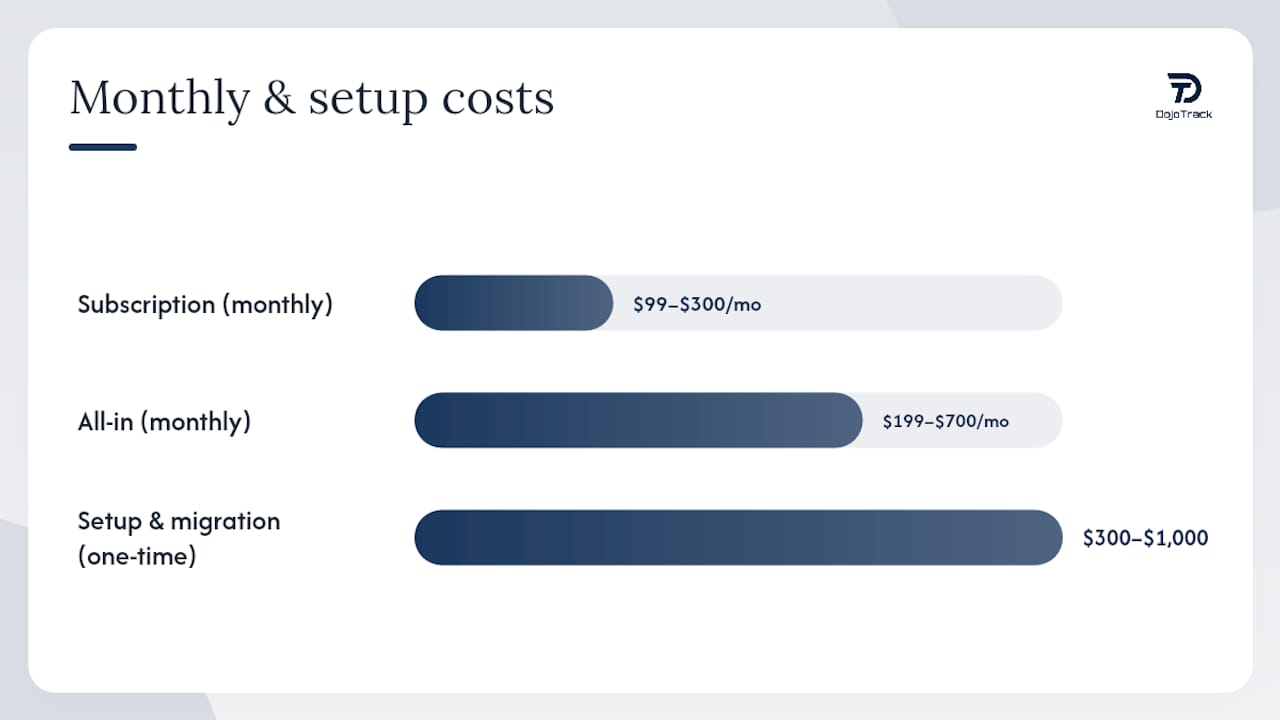
Industry benchmarks show most independent schools budget $99–$300 per month for the subscription alone, with realistic all-in monthly costs landing between $199 and $700 once processing and add-ons are included.
Vendors present costs in a few standard models:
| Billing Model | How It Works | Best Fit |
|---|---|---|
| Flat per location | Fixed monthly fee per school | Predictable, single-location owners |
| Per-active-student | Fee scales with enrollment | Fast-growing schools |
| Tiered membership bands | Price jumps at student-count thresholds | Schools with stable enrollment |
| Seat-based | Charged per staff login | Multi-instructor operations |
Beyond the base subscription, expect add-on line items: CRM and marketing modules, branded mobile apps, SMS credit bundles, advanced reporting, POS and inventory management, and AI features billed per usage. Payment processing sits on top of all of it. Stripe’s published baseline card rate is 2.9% plus $0.30 per transaction; vendors layer their own markup of anywhere from 0.5% to several percentage points above that, as detailed cost analysis shows. Contract mechanics also vary: monthly billing offers flexibility, while annual billing usually earns a discount. Setup and migration fees of $300–$1,000 are common for multi-location or data-heavy transitions and should be amortized across the contract term in your budget.
Free core tier versus paid plans: what do you actually get?
Dojotrack’s free core tier covers the daily essentials: student and membership management, attendance tracking, scheduling, digital waiver collection, and basic communication tools. That is enough to run a small school without spending anything upfront.
Free tiers across the industry share common limits, though. Marketing automation, advanced SMS campaigns, branded mobile apps, AI-driven retention scoring, and deep analytics are typically gated behind paid plans. Free-tier analysis confirms that schools planning growth usually need a paid tier within six months, and free plans sometimes carry higher processing rates that quietly offset the zero subscription cost.
Pro Tip: The right time to upgrade is when the staff hours spent on manual lead follow-up, retention outreach, and belt-tracking paperwork cost more than the monthly subscription. If one instructor spends four hours a week on admin that automation would handle, the math usually favors the paid plan.
Quick quote workbook: estimate your real monthly cost
Use this table as a fill-in worksheet before your sales call. The worked example assumes a 120-student school billing $12,000 per month.
| Cost Line | Formula | Example ($) |
|---|---|---|
| Base subscription | Vendor quote | — |
| Processing (card rate + markup) | Monthly volume × total rate | — |
| Per-transaction fees | $0.30 × monthly transactions | — |
| Add-on modules (SMS, AI, app) | Sum of add-on line items | — |
| Setup/migration (amortized 12 mo.) | One-time fee ÷ 12 | — |
Run two sensitivity checks: shift the processing rate up and down by 1% to see how much that single variable moves your total. Then model a 20% enrollment increase to confirm the subscription tier still fits. Use Dojotrack’s price comparison tool to run these scenarios interactively.
How to evaluate and validate a vendor quote
A quote is only useful if every line is explicit. Before you sign, confirm:
- Exact processing rates for card and ACH transactions, stated as a percentage plus per-transaction fee
- Whether you can bring your own processor or are locked into the vendor’s arrangement
- Which features are in the base plan versus gated as paid add-ons
- SMS costs: per-message rate and the monthly threshold before overage charges apply
- Branded app fees: one-time build cost and ongoing monthly hosting fee
- Setup and data-migration line items: stated as fixed amounts, not “contact sales”
- Contract length, auto-renew date, and cancellation terms
Watch for vague language like “subject to volume pricing” or “marketplace commission may apply.” Those phrases signal costs that will appear on your first invoice but not on the quote. Vendor evaluation guidance recommends requesting a written first-year total and a 12-month amortized cost before any commitment.
From quote to live: what the timeline looks like
A single-location school typically moves from signed quote to full launch in two to four weeks. Multi-location rollouts with significant data migration run four to eight weeks.
Milestone sequence: Signed quote → kickoff call (day 1–2) → data migration and account configuration (days 3–10) → staff training (days 10–14) → pilot group soft launch (days 14–21) → full member go-live (week 3–4 for single location).
Your deliverables at kickoff: a clean student CSV, your Stripe merchant account credentials or banking details for a new Stripe setup, and brand assets (logo, colors) if you want a configured sign-in kiosk or branded app. Dojotrack’s team handles platform configuration and confirms each milestone before moving forward.
Why Dojotrack’s background matters when you review a quote
Dojotrack was founded in Utah by Jared Reed, a martial-arts veteran who built the platform to solve the exact problems he faced running schools. That operator background matters when evaluating a quote because the features are designed around real dojo workflows, not adapted from generic gym software.
A quote from Dojotrack should include line items for: automated belt promotions, attendance analytics, Stripe-powered recurring billing, sign-in kiosks, event registration, and AI-driven retention and lead scoring — all purpose-built for martial-arts schools, not retrofitted from a general fitness platform.
Those features translate to concrete operational differences: automated belt tracking eliminates manual promotion paperwork, AI retention alerts flag at-risk students before they cancel, and Stripe-powered billing reduces failed-payment churn. For a deeper look at how martial-arts-specific features affect total cost and daily operations, that comparison is worth reading before your sales call.
Key Takeaways
Processing markup, not the subscription fee, is usually the largest variable in a martial-arts software quote, and modeling it across your actual monthly billing volume is the single most important step before signing.
| Point | Details |
|---|---|
| Model all three cost layers | Compare subscription fee, processing markup, and AI/add-on charges before deciding. |
| Free tiers have real limits | Core workflows are covered, but marketing automation and AI retention require a paid plan. |
| Amortize setup fees | Spread $300–$1,000 migration costs over 12 months to see true first-year cost. |
| Request a written first-year total | Ask every vendor for a 12-month amortized figure, not just a monthly headline price. |
| Dojotrack’s free tier is a real starting point | Start on the free core tier, then upgrade when automation savings exceed the subscription cost. |
The real question owners should ask before requesting a quote
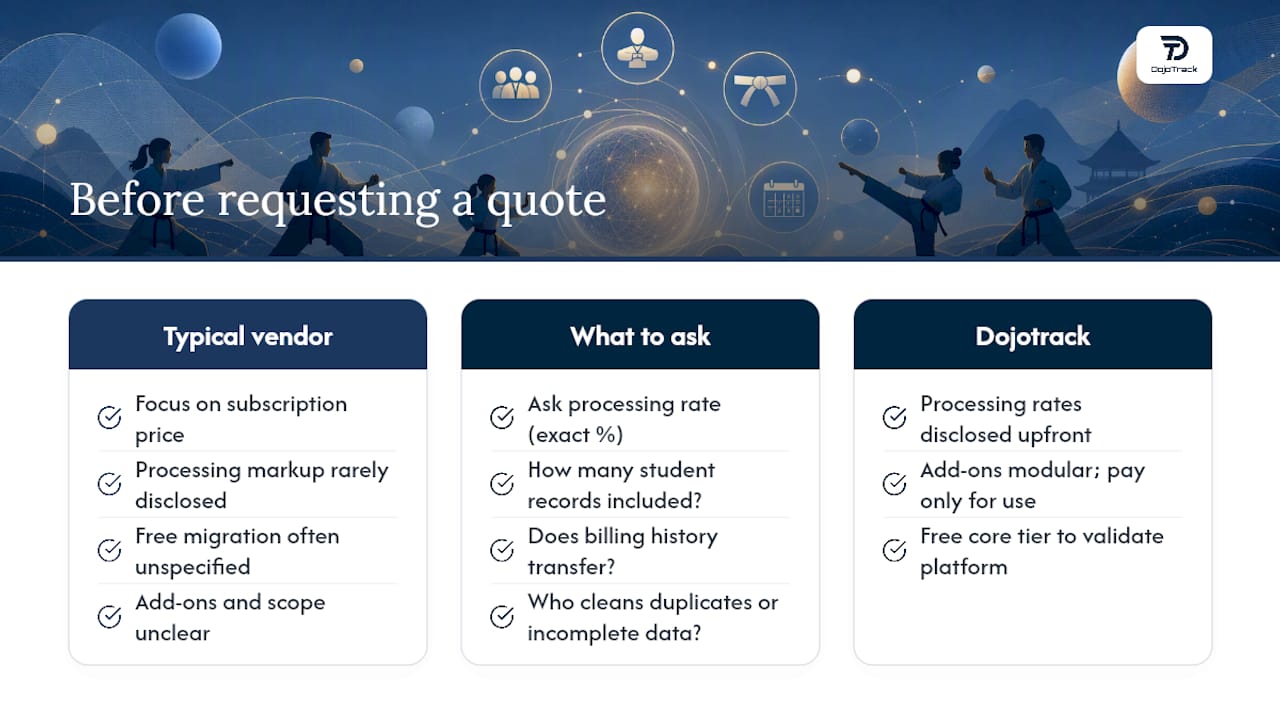
Most studio owners focus on the subscription price and miss the number that actually determines whether a platform is affordable: the processing markup. A $99/month subscription with a 4% processing rate costs more than a $199/month plan at 2.9% for any school billing over $8,000 per month. The math is straightforward, but vendors rarely volunteer it.
The second thing owners underestimate is migration. Moving student records, billing history, and waivers from one system to another takes real time and sometimes real money. A quote that lists “free migration” without specifying scope is not a guarantee. Ask exactly what is included: how many student records, whether billing history transfers, and who cleans up duplicate or incomplete data.
Dojotrack’s approach to quoting is built around transparency on both points. Processing rates are disclosed upfront, add-ons are modular so you pay only for what you use, and the free core tier lets you validate the platform before committing to a paid plan.
Dojotrack gives you a clear path from free to fully automated
Running a school on Dojotrack’s free core tier costs nothing to start. You get student management, attendance, scheduling, digital waivers, and basic billing from day one. When your school is ready to grow, upgrading unlocks AI-driven retention alerts, automated lead scoring, SMS follow-up sequences, a branded student mobile app, and advanced analytics — the features that reduce the administrative hours that otherwise scale with every new student you add.
To get a written quote with a 12-month cost breakdown, sign up or contact the team at Dojotrack. Attach your student count and monthly billing volume, and a solutions engineer will return a line-item quote covering subscription, processing, add-ons, and any migration scope. If you want to run the numbers yourself first, the price comparison tool lets you model enrollment and processing scenarios before the call.
Sources and further reading
- Free vs. Paid Martial Arts Software: True Costs 2026
- Gym Management Software Cost in 2026: Pricing Guide
- How to Choose Martial Arts Gym Management Software in 2026 (Buyer’s Framework) | Vibefam
- AI Powered Martial Arts Software | DojoTrack
- The Ultimate Guide to Martial Arts School Automation: Everything You Need to Succeed in 2025 | DojoTrack
FAQ
What does a martial-arts software quote typically include?
A complete quote lists the base subscription, payment-processing rate and markup, per-student or per-location fees, SMS credit costs, add-on module fees, setup or migration charges, and contract terms including auto-renew date.
Most independent schools pay $99–$300 per month for the subscription, with realistic all-in monthly costs between $199 and $700 once processing and add-ons are included.
Does Dojotrack offer a free plan?
Yes. Dojotrack’s free core tier includes student management, attendance tracking, scheduling, digital waivers, and basic billing. Advanced automation, AI retention, and the branded student app require a paid plan.
What information should I send when requesting a quote?
Send your active student count, average monthly billing volume, number of locations, staff seat count, hardware needs, and a note on any data migration scope. A CSV export from your current system speeds up the process significantly.
Why does payment processing matter more than the subscription price?
Processing fees are a percentage of every dollar you collect, so they scale with revenue. A small percentage markup on monthly revenue can add hundreds or thousands to annual costs, which often exceeds the annual subscription cost difference between two competing platforms.
Recommended
- What You’re Missing Without Martial Arts Software | DojoTrack
- What to Look for in Martial Arts School Software (2026 Buyer’s Guide) – DojoTrack
- Martial Arts Management Software vs Generic Fitness Apps | DojoTrack
- Best Martial Arts Studio Software for Small Schools: Features, Benefits, and AI Advantages | DojoTrack