
New Martial Arts Studio Setup Checklist: 2026 Guide

TL;DR:
- Before opening a martial arts studio, owners must confirm zoning approval, secure insurance, and set up operational systems. Proper planning involves legal registration, designing the space for safety and accessibility, hiring focused staff, and launching marketing campaigns. Using platforms like Dojotrack streamlines compliance and automation, helping new studios avoid common early failures.
Before you sign a lease or spend a dollar on mats, confirm your zoning classification, form your LLC and get your EIN, secure proof of general liability insurance, set up digital waiver collection and membership billing, and book a soft-launch marketing window. Do those six things in that order and you avoid the mistakes that kill most new studios before month three.
Three actions to complete before signing any lease:
- Confirm zoning allows assembly occupancy (and whether a Conditional Use Permit is required).
- Get a certificate of occupancy quote and timeline from your local building department.
- Obtain a written insurance binder showing $1M per-occurrence general liability coverage.
The sections below expand each checklist item with timelines, conservative cost ranges, and an operations path using Dojotrack so you can automate the administrative work before your first student walks in.
Table of Contents
- Before you spend money: what is your primary business goal?
- What permits, insurance, and legal steps do you need first?
- How should you plan your space layout and equipment?
- Who should you hire first, and what safety systems do you need?
- What operations systems do you need before opening day?
- How do you fill your first classes before opening day?
- What does a realistic timeline and budget look like?
- What do you check on opening day itself?
- Key Takeaways
- What most new studio owners get wrong
- Dojotrack gets your checklist done faster
- Useful sources and planning references
- FAQ
Before you spend money: what is your primary business goal?
Pick one primary goal and design every early decision around it. Child-focused beginner retention, adult competition pipeline, and community fitness are three very different businesses. They require different floor plans, different first hires, and different pricing shapes.
Answer these questions before you negotiate a lease:
- Who is your target demographic (age, experience level, income range)?
- What is your program mix for the first 90 days?
- Will you charge monthly, by term, or both?
- What secondary revenue streams will you offer (retail, camps, workshops, private lessons)?
Pro Tip: If your primary goal is beginner retention, design your floor plan with a parent viewing area and budget for a patient, beginner-focused first instructor. A competition-focused layout with no seating for parents will cost you families in month two.
What permits, insurance, and legal steps do you need first?
Form your LLC and secure proof of insurance before signing a lease or accepting any payments. That sequence protects your personal assets and satisfies most commercial landlord requirements.
Mandatory registrations and permits:
- LLC or DBA filing with your state
- Federal EIN (free via IRS.gov, same-day)
- City or county business license
- Seller’s permit if you sell gear, uniforms, or taxable memberships
- Certificate of occupancy for assembly use
- Sign permit (if exterior signage is planned)
Permit sequence and timeline:
| Step | Action | Typical Duration |
|---|---|---|
| 1 | Form LLC, obtain EIN | 1–4 days |
| 2 | Verify zoning and CO requirements | 1–2 weeks |
| 3 | Apply for certificate of occupancy | 2–6 weeks |
| 4 | Obtain business license | 1–2 weeks |
| 4 | Secure insurance binder | 3–6 days |
Zoning permits commonly cost several hundred dollars, occupancy permits generally cost under a thousand dollars, and fire inspections may be in a similar range. A Conditional Use Permit can add significant time to your timeline if the space has never held an assembly-use tenant.
Insurance budget: General liability minimums start at $1M per occurrence. Basic coverage for a new school may cost a few hundred to low thousands annually; comprehensive policies covering contact sports, professional liability, and workers’ comp typically cost more. Some standard policies exclude full-contact sparring, so confirm your discipline is covered before binding.
How should you plan your space layout and equipment?
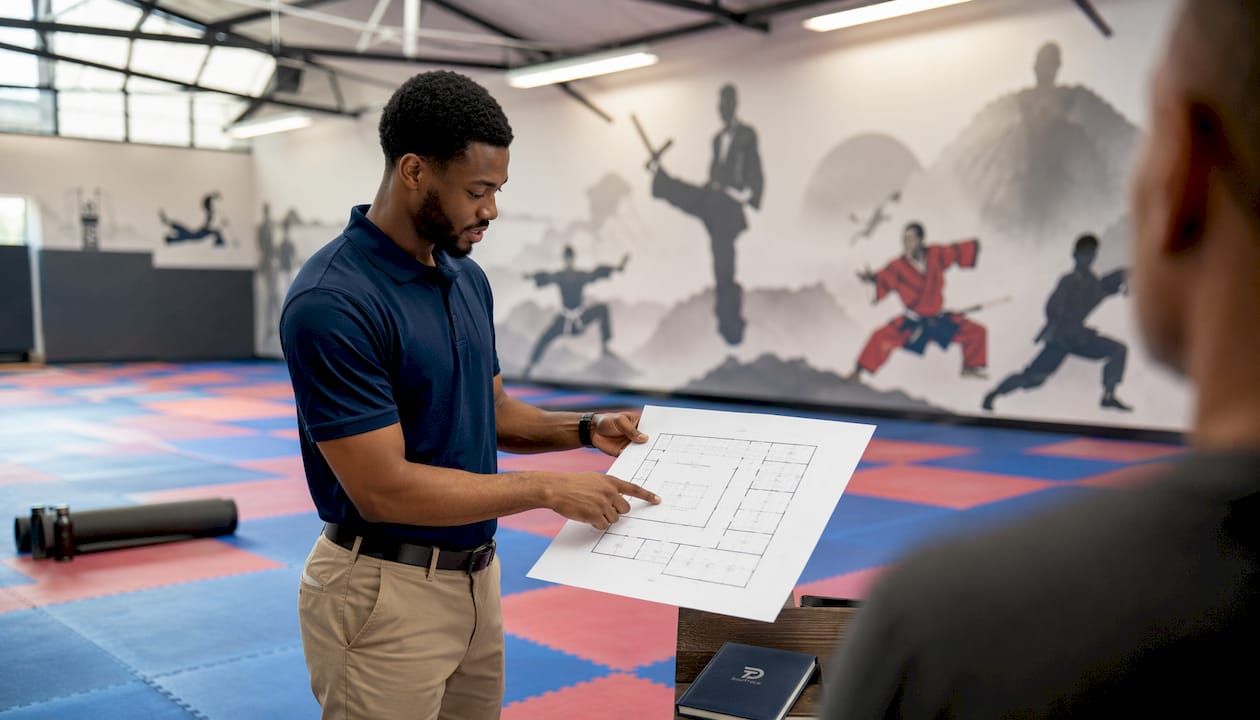
Prioritize a floor plan that satisfies fire egress, ADA access, and occupancy load rules before you think about aesthetics. Keep spectator and parent areas physically separate from the training floor.
Build-out items that affect your CO:
- Mat systems and floor finish (must meet slip and impact standards)
- Mirror placement (avoid blocking egress paths)
- Exit signage and emergency lighting
- HVAC and ventilation capacity for your occupancy load
- Acoustic treatment if neighbors or zoning require it
- Security cameras and Wi-Fi (needed for payment terminals and the student app)
Equipment checklist for your first 90 days:
- Interlocking mats or tatami covering the full training area
- Wall padding at impact zones
- Heavy bags, kick shields, and focus mitts
- Grappling dummies or striking pads (discipline-specific)
- First-aid kit and AED if required by local code
- Cleaning supplies and mat sanitizer (non-negotiable for contact sports)
- Reception desk, seating, and storage
Pro Tip: Renting shared gym or school space for a few hundred dollars per month is a legitimate bootstrap strategy. It lets you build your student base and prove demand before committing to a commercial lease and a full build-out.
Structural changes and expanded occupancy almost always trigger additional permit work. Confirm with your local building department before signing.
Who should you hire first, and what safety systems do you need?
Your first hire should excel at onboarding and retaining beginners, not necessarily be your highest-ranked competitor. The first employee who can explain a front kick to a nervous seven-year-old and follow up with their parent the next day is worth more than a champion who struggles to communicate.
Essential HR items:
- Job descriptions focused on beginner instruction and parent communication
- Background checks for all staff with student contact
- Clear pay structure (hourly employee vs. independent contractor, documented)
- Written SOPs for substitutions, absences, and class coverage
Safety protocols to document before opening:
- First-aid and CPR certification required for all instructors
- Written sparring policy with contact rules by age and rank
- Equipment inspection schedule (weekly minimum)
- Mat-cleaning protocol (daily for grappling arts; staph and ringworm are real risks)
- Incident report template that captures injury description, witnesses, and follow-up actions
Pro Tip: Post your sparring policy and mat-cleaning schedule visibly in the training area. Parents notice, and it signals that you run a professional operation.
What operations systems do you need before opening day?
Digital waivers and membership billing must be in place before your first class. Without them, you will spend your first month drowning in paperwork instead of teaching.
Minimum system capabilities:
- Digital waiver capture and cloud storage
- Recurring billing via Stripe
- Class scheduling with waitlist support
- Attendance tracking by student and class
- Family account management
- Point-of-sale for retail
- Basic retention analytics
Implementation milestones:
- Pre-launch (weeks 1–4): Configure digital waivers, set up recurring billing, and load your class schedule.
- Week 0 (opening week): Activate attendance tracking, kiosk sign-in, and the student-facing app.
- Month 1: Turn on retention automations, lead scoring, and automated SMS follow-ups for trial students.
Dojotrack covers every item on that list in one platform. Its AI retention system flags students who are at risk of dropping out before they ghost you, and automated belt promotion tracking keeps your curriculum consistent without manual record-keeping. The free core layer includes student management, attendance, scheduling, and digital waivers so you can launch without upfront software cost.
Pro Tip: Use AI lead scoring from day one. Knowing which trial registrants are most likely to convert lets you prioritize your follow-up calls and SMS messages instead of treating every lead the same.
How do you fill your first classes before opening day?
Run a four-week pre-launch campaign focused on trial-class sign-ups and local visibility. Brand perfection can wait. Student count cannot.
Pre-launch checklist:
- Claim and verify your Google Business Profile
- Launch a simple website with a booking form and trial-class offer
- Set up social profiles (Facebook and Instagram minimum)
- Reach out to local schools, youth sports leagues, and community organizations
- Submit a press release to local media
- Run paid local ads targeting your trial-class offer
Trial registrant follow-up sequence:
- Immediately after sign-up: Welcome SMS with class time, address, and what to wear.
- 24 hours before class: Reminder SMS with a parking note and an encouraging line.
- Day of class: Brief email with what to expect in the first session.
- 48 hours after trial: Personal follow-up call or SMS asking about their experience and offering a first-month discount.
Measure trial-to-paid conversion rate and cost-per-acquisition from week one. Owners who spend significant time on marketing in year one sustain student growth; those who deprioritize it stall at 30–40 students and wonder why.
What does a realistic timeline and budget look like?
Expect 8–16 weeks from lease signing to opening for a typical small-studio build-out. A CUP or CO conversion adds time.
| Milestone | Typical Duration |
|---|---|
| Entity formation and EIN | Week 1 |
| Lease contingency and zoning confirmation | Weeks 1–2 |
| CO application and approval | Weeks 2–8 |
| Build-out and equipment installation | Weeks 4–12 |
| Systems setup (billing, waivers, scheduling) | Weeks 6–9 |
| Pre-launch marketing window | Weeks 10–15 |
Conservative cost ranges for a commercial launch:
| Line Item | Estimated Range |
|---|---|
| Rent deposit (first + last + security) | $6,000–$12,000 |
| Mats, mirrors, and equipment | $8,000–$18,000 |
| Minor build-out and signage | $4,000–$15,000 |
| Insurance (first year) | $2,000–$4,000 |
| Permits and inspections | $600–$2,000 |
| Initial marketing | $2,000–$3,500 |
| Total (mid-range commercial launch) | $50,000–$85,000 |
For detailed startup cost categories, see Dojotrack’s 2026 breakdown. Keep 3–6 months of fixed costs in reserve. Most schools reach break-even within about one to one and a half years; owner livable income typically follows within two or three years.
Quick break-even example: At $150/month per student, you need 40 students to cover $6,000 in monthly fixed costs. At $120/month, you need 50. Price accordingly from day one.
What do you check on opening day itself?
Use a prioritized checklist the morning of your first public class. Verify safety and compliance before you check anything else.
Pre-class checks:
- CO and insurance certificates on file and accessible
- Emergency exits clear and exit signs lit
- Mats secured, no trip hazards
- First-aid kit stocked and accessible
Tech checks:
- Payment terminal tested with a live transaction
- Wi-Fi confirmed on all devices
- Scheduling kiosk or app active and showing correct classes
- Digital waiver link live and tested
Staff checks:
- Team briefed on class plan, emergency roles, and substitution protocol
- Emergency contact list posted
Front-desk checks:
- Sign-in process rehearsed
- Retail display set and priced
- Trial-student welcome script reviewed by front-desk staff
- Dojotrack attendance tracking active for first class
Copy this list into Dojotrack as a recurring opening-day task with assigned owners and completion timestamps so nothing gets skipped on a busy morning.
Key Takeaways
Confirm zoning, secure insurance, and document your beginner-onboarding SOP before committing any capital — those three steps prevent the most common and most expensive launch failures.
| Point | Details |
|---|---|
| Zoning before lease | Confirm assembly occupancy and CO requirements before signing anything. |
| Insurance minimum | Secure $1M per-occurrence general liability coverage before accepting students. |
| Systems before opening | Digital waivers and recurring billing must be live before your first class. |
| Budget realistically | A mid-range commercial launch involves tens of thousands of dollars in startup costs; it is important to keep several months of reserves. |
| Dojotrack from day one | Dojotrack’s free core layer covers waivers, billing, scheduling, and attendance so you launch without upfront software cost. |
What most new studio owners get wrong
The studios that fail in year one almost always share three habits: they priced too low to attract students, hired for rank instead of teaching ability, and skipped written SOPs because they planned to “figure it out as they go.”
Pricing is the one you cannot fix quietly. Undercharging from day one creates a ceiling you will struggle to raise later because your existing students will resist any increase. Price at a sustainable level from the start, even if it means slower initial enrollment.
The first-hire mistake is equally costly. A high-rank instructor who cannot explain a basic stance to a nervous adult beginner will drive your trial-to-paid conversion rate into the ground. Hire for communication and patience first.
SOPs feel bureaucratic when you have twelve students. At sixty students, the absence of a substitution policy or a mat-cleaning schedule becomes a liability. Dojotrack was built by Jared Reed, a martial arts veteran who lived these exact frustrations, and the platform reflects what operators actually need: automated belt tracking, AI retention signals, and documented workflows that run without the owner being present for every decision.
Dojotrack gets your checklist done faster
Running through this checklist manually takes weeks. Dojotrack maps directly to the operations items that matter most: digital waiver collection, Stripe-powered recurring billing, class scheduling, attendance tracking, and AI-driven retention scoring. The student mobile app keeps members engaged between classes with belt progress tracking and push notifications, while automated SMS follow-ups convert more trial students into paying members without extra staff time.
The free core layer gives you student management, attendance, scheduling, and digital waivers at no upfront cost. As your school grows, you unlock advanced automation, analytics, and the full AI retention suite. Studios migrating from spreadsheets or older systems can use Dojotrack’s data migration service to move cleanly without losing student records. Start your free account today and have your operations stack ready before opening day.
Useful sources and planning references
Bookmark these resources before you start your build-out:
- StartPermit: Martial Arts Studio Licenses and Permits Guide — permit sequence, CO requirements, and seller’s permit guidance
- DojoPractice: What You Need to Open a Martial Arts Dojo — cost estimates, bootstrap options, and break-even benchmarks
- ZenBusiness: How to Open a Martial Arts Academy — operations system requirements and staging recommendations
- Wexford Insurance: Martial Arts Studio Equipment Checklist — equipment and insurance coverage overview
- Dojotrack Startup Cost Guide — detailed line-item cost categories for US studios
- Dojotrack Business Model Guide — program mix and pricing model options
- Dojotrack Features Page — full platform capability reference
- Dojotrack Signup — free account to get started immediately
FAQ
What permits do you need to open a martial arts studio in the US?
You typically need an LLC or DBA, a federal EIN, a city business license, a seller’s permit if you sell taxable goods, and a certificate of occupancy for assembly use. Some locations also require a Conditional Use Permit, which can add 60–120 days to your timeline.
How much does it cost to open a martial arts studio?
A mid-range commercial launch in a 2,500 sq ft space typically runs $50,000–$85,000, covering rent deposits, mats, equipment, insurance, permits, minor build-out, and initial marketing. Keep 3–6 months of fixed costs in reserve.
When should I set up billing and digital waivers?
Before your first class. Digital waivers and recurring billing must be live on day one to avoid an administrative backlog. Dojotrack’s free core layer includes both, so you can configure them weeks before opening.
How long does it take to open a martial arts studio?
Expect 8–16 weeks from lease signing to opening for a standard small-studio build-out. A CO conversion or Conditional Use Permit can extend that timeline significantly.
When do most martial arts studios reach break-even?
Most schools reach break-even in 12–18 months, with owner livable income typically following at 24–36 months, assuming consistent marketing and steady student growth.