
Dojo Ready Martial Arts Digital Waivers: Template and Kiosk Workflow

Yes, digital waivers are legally valid for martial arts schools when they meet ESIGN and UETA retention requirements and use verifiable parental consent for minors. That means the record has to be stored in a format you can reproduce on demand, and any waiver signed on behalf of a child needs a consent method that actually confirms a parent approved it. Below, you will find a copyable template, the exact clauses that hold up best, and a launch checklist you can run this week.
TL;DR:
- Digital waivers are enforceable if they meet ESIGN and UETA standards, including proper record retention and verifiable parental consent for minors.
- For court and insurer readiness, digital records must include timestamps, IP addresses, device info, and be stored in tamper-evident formats to ensure authenticity.
- Key waiver language should specify exact risks, feature prominent release clauses, and include severability and limited indemnity language for enforceability.
- Implementing pre-class signing links, on-site kiosks, and automated reminders can significantly increase sign-up rates and reduce liability gaps.
- Prioritizing secure collection, storage, and retrieval systems is more critical than perfect legal wording in maintaining valid, enforceable waivers.
Table of Contents
- A copyable waiver template for sparring, tournaments, and minors
- What makes a waiver actually enforceable
- Does ESIGN actually make electronic waivers hold up?
- Digital versus paper: when a backup copy still helps
- Setting up the sign-before-class workflow
- Raising your sign rate without adding staff work
- A practical checklist from the people who run studios
- What most studios get wrong about waivers
- How DojoTrack makes waiver compliance part of your daily workflow
- Where these legal standards come from
- Sources
- FAQ
A copyable waiver template for sparring, tournaments, and minors
A martial arts waiver needs more than a generic gym release. It has to name the specific risks your students face, and it has to collect the right signature depending on who is stepping onto the mat.
Here is a bare-bones structure you can adapt:
- Acknowledgment of risk: name the activity (striking, grappling, sparring, throws) and state that injury is a known possibility.
- Release of liability: the student (or parent) releases the school, instructors, and staff from claims arising from ordinary training risks.
- Medical authorization: permission to administer first aid or seek emergency care if the student cannot consent in the moment.
- Minor authorization block: a separate signature line for the parent or guardian, with their name, relationship to the student, and date.
- Signature and timestamp: full legal name, electronic signature, date, and a record of how consent was captured.
For sparring or tournament waivers, add a line that spells out contact-level risk: controlled striking, takedowns, submissions, and the possibility of concussion or joint injury. Generic language rarely survives a challenge the way specific language does, according to practical waiver template guidance. For a deeper breakdown of court-ready language, see this guide on making your waiver court and insurer ready.
What makes a waiver actually enforceable
A signed waiver is not automatically a shield. Courts look at how clearly the risks were disclosed and whether the release language was buried or prominent.
- Specific risk disclosure: list the actual hazards of your discipline (joint locks, falls, strikes) instead of vague phrases like “physical activity.”
- Prominent release clause: keep the liability release in plain, readable text, not six-point font at the bottom of a form.
- Severability language: state that if one clause is found unenforceable, the rest of the waiver still stands.
- Limited indemnity wording: be precise about what the student or parent is agreeing to cover, rather than an open-ended indemnity that courts may strike down.
State laws vary on how much a waiver can limit liability, especially for minors, so a general release that works in one state may not hold in another. A local attorney can confirm your waiver matches your state’s rules, particularly if you run tournaments that draw students from outside your area.
Does ESIGN actually make electronic waivers hold up?
The ESIGN Act gives electronic signatures and records the same legal weight as paper, as long as the record can be retained and accurately reproduced later, under 15 U.S.C. § 7001. That single requirement, retention and reproducibility, is the backbone of every digital waiver system.
ESIGN also requires consumer consent disclosures before someone signs electronically. The FTC’s guidance on ESIGN’s consumer consent provision explains that you need to tell the signer what hardware or software they need, confirm they can get a paper copy if they ask, and give them a clear way to opt in or withdraw consent. Skipping that disclosure step weakens your compliance even if the signature itself looks valid.
For minors, verifiable parental consent matters more than the signature format. Acceptable methods include a signed statement under penalty of perjury, a small payment-based identity check, or a government ID review, based on Colorado’s verifiable parental consent rule.
To make a waiver evidence-ready:
- Capture an audit trail: timestamp, IP address, and device used to sign.
- Store the record in a tamper-evident, retrievable format, not a folder of loose PDFs.
- Consider a Rule 902(13) certification process for records you may need to self-authenticate in court.
Digital versus paper: when a backup copy still helps
Digital waivers win on speed. You can search a name during a lawsuit threat instead of digging through a filing cabinet, and automated reminders catch the student who never got around to signing.
- Speed and search: find any signed waiver in seconds instead of sorting paper files by hand.
- Insurer concerns: some insurers still ask for a printable, dated copy, so export a PDF version rather than relying on a database screenshot.
- Court concerns: opposing counsel may challenge authenticity, which is where metadata and certification matter more than the signature itself.
- When paper helps: keep a scanned original for high-risk events like tournaments, where you want a belt-and-suspenders record.
When you send records to an insurer or attorney, include the PDF, the signer’s metadata (timestamp, IP, device), and a short chain-of-custody note describing how the waiver was stored and retrieved.
Setting up the sign-before-class workflow
Most compliance gaps happen at the front desk, not in the waiver language itself. A few workflow fixes close most of that gap.
- Send a pre-registration signing link before the student’s first class, so the waiver is done before they walk in.
- Set up an on-site kiosk or QR code for trial students, with the device locked to the waiver app and a timestamp recorded automatically.
- Attach the signed waiver directly to the student’s profile so staff can pull it up during enrollment, renewal, or an incident review.
- Export waivers with full metadata, including signer IP and timestamp, whenever an insurer or court requests records.
- Confirm your studio management software supports this chain end to end, since disconnected tools are where records go missing. See this checklist for evaluating martial arts CRM software if you are still shopping.
Pro Tip: Lock your kiosk to the waiver app only, so a trial student cannot accidentally back out of the flow and leave an unsigned record.
Raising your sign rate without adding staff work
An unsigned waiver is a liability gap, and the fastest way to close that gap is to make signing unavoidable before the first class.
- Make it a hard rule: no mat time until the waiver is signed, and post that policy at the front desk.
- Use mobile-first forms and a single family account so one guardian can sign once and cover every child on the account.
- Automate reminders by email and text for anyone who registers but has not completed the waiver within a short period before the first class.
- Track your unsigned rate and average time-to-sign monthly, since a rising number usually points to a broken step in the flow.
Pro Tip: A front-desk script as simple as “let’s get your waiver done on your phone before we start” closes most gaps on the spot.
A practical checklist from the people who run studios
A martial arts software platform was built by a martial arts school operator who ran into the same waiver headaches this article covers: paper forms that went missing, parents who signed for the wrong child, and no clean way to pull a record when an insurer asked for one. That firsthand frustration shaped the platform’s waiver tools, including family accounts, digital waiver collection, and exportable records tied to each student profile.
A launch checklist for your own studio:
- Audit your current waiver for missing risk language and outdated clauses.
- Build or adapt a template that names your specific disciplines and risks.
- Turn on pre-sign links so every new student signs before their first class.
- Set up a kiosk or QR flow for walk-ins and trials.
- Train front-desk staff on the sign-before-class rule and the reminder workflow.
- Test your export process before you need it for an insurer or attorney.
What most studios get wrong about waivers
Most studio owners treat the waiver as a one-time legal checkbox: get it signed, file it, forget it. That mindset misses the bigger risk, which is not the waiver’s wording but whether you can actually produce it, with a clean audit trail, months or years later when it matters.
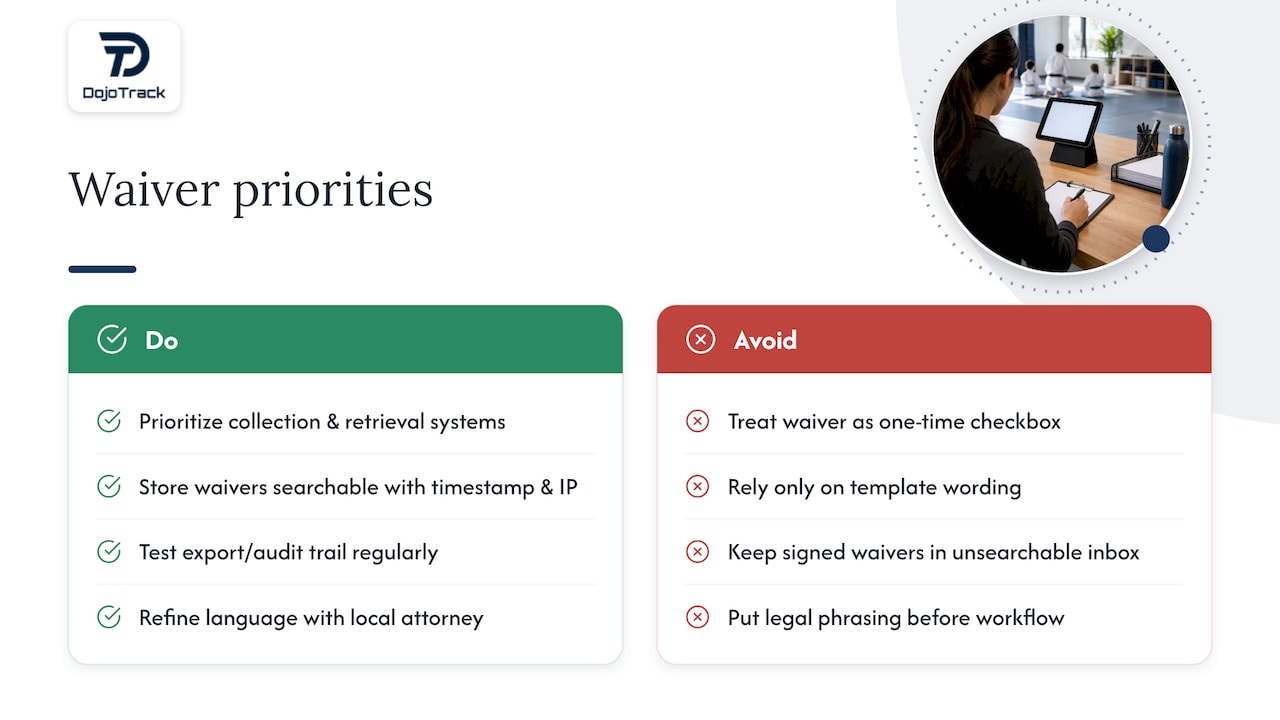
The conventional advice leans hard on template wording, as if the perfect clause is what protects you. In practice, retention and reproducibility carry more weight under ESIGN than any single sentence in the release. A beautifully worded waiver that lives in an unsearchable inbox is worth less than a plain one stored with a timestamp, an IP address, and an export function that works on the day you need it.
If you take one thing from this, prioritize the system before the script. Fix how waivers are collected, stored, and retrieved first. Refine the legal language second, ideally with a local attorney who knows your state’s rules on minors and liability releases. Parents care about trust as much as paperwork, and a smooth, mobile sign-before-class flow does more for that trust than legal phrasing ever will.
— DojoTrack
How DojoTrack makes waiver compliance part of your daily workflow
Some martial arts studio management software builds digital waiver collection directly into student records, so every signature, family account, and export lives in one place instead of scattered across apps. Studios can start on a free plan to test waiver collection and kiosk sign-in before deciding whether to upgrade for automation and analytics.
If you are ready to see it running in your own studio, check DojoTrack’s pricing plans or create a free account to test the waiver and kiosk workflow this week.
Where these legal standards come from
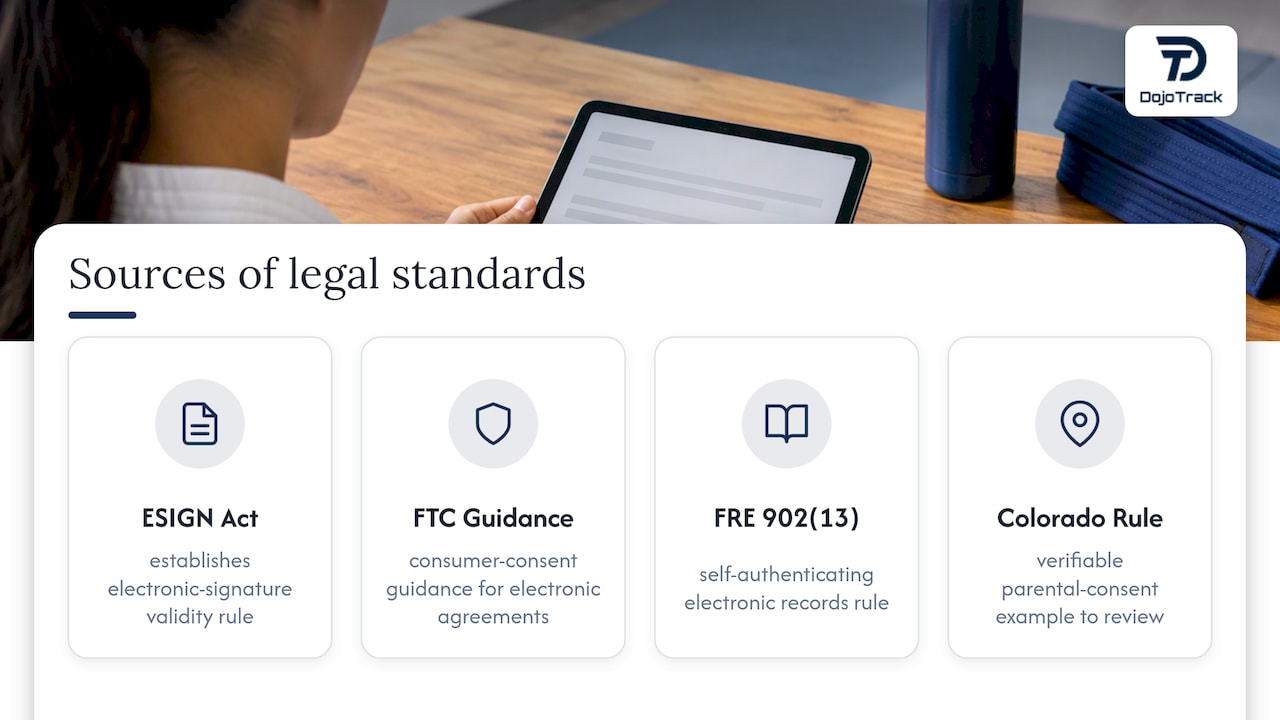
The legal backbone here comes from the ESIGN Act’s validity rule, the FTC’s consumer-consent guidance, and Federal Rule of Evidence 902(13) on self-authenticating electronic records. For parental consent specifics, Colorado’s verifiable consent rule offers a concrete regulatory example worth reviewing alongside your own state’s requirements.
This article is general information, not a substitute for advice from a qualified lawyer. Consult a qualified legal professional about your own circumstances before acting on anything here.
Sources
- 15 U.S. Code § 7001 – General rule of validity | Legal Information Institute
- Electronic Signatures in Global and National Commerce Act: Consumer Consent Provision (FTC)
- Self-authentication of electronic evidence: new rules (G. Joseph)
- Colorado verifiable parental consent guidance (4 CCR 904-3-7.06)
FAQ
Can you legally make your own waiver?
Yes, you can draft your own waiver, but enforceability depends on clear risk disclosure, readable release language, and compliance with your state’s rules on liability limits. A local attorney can confirm your wording holds up for your specific state and discipline.
Do waivers actually hold up in court?
Waivers hold up more often when they name specific risks, use prominent release language, and include severability clauses, though outcomes vary by state and by how the injury occurred. A vague, generic waiver is far more likely to be challenged successfully than one with sport-specific risk language.
Are online waivers legal?
Yes, online waivers are legally valid under the ESIGN Act as long as the record can be retained and accurately reproduced later. For minors, the school also needs a verifiable parental consent method, not just an electronic signature.
How enforceable are liability waivers?
Enforceability depends on clear risk disclosure, readable release clauses, and state-specific rules on what liability can be waived, especially for minors. A waiver naming your actual training risks, like sparring or throws, tends to hold up better than generic gym language, according to practitioner template analysis.