
Class Check-In Methods for Martial Arts Schools

The best class check-in method for most martial arts schools is self-check-in at the door, backed by a coach’s roster on the mat for anyone who gets missed. Students tap in on a kiosk or phone in seconds, and the instructor only touches the system to fix exceptions. Below you will find every common method compared, how to handle late arrivals, how to use attendance rewards without making them unfair, and how to tell whether any of it is working.
TL;DR
- Self-check-in (kiosk, phone or card) is the fastest option for classes of 15 or more, because it takes the instructor out of the line.
- A coach roster with one-tap statuses works for small or private classes and as a backup for everyone else.
- Write down a late-arrival rule and apply it the same way every time. Safety, not punishment, is the strongest reason for it.
- Reward consistency in ways every student can earn, and keep the focus on fun, since youth sports lose a large share of kids every year.
- Judge any method by three numbers: check-in time, attendance rate per class, and how many students go quiet for 30 days.
Table of Contents
- Why check-in method matters more than it looks
- The main check-in methods, compared
- How to choose: four questions
- Keep check-in from disrupting class
- Handling late arrivals, corrections and different classes
- Attendance gamification that works
- How to tell if it is working
- Our perspective
- Try it at your school
- A simple rollout plan
- FAQ
- Sources
Why check-in method matters more than it looks
Attendance is the earliest signal in your business. A student who stops showing up is almost always a student who will stop paying a few weeks later. If check-in is slow, messy or skipped, you lose that signal and you also lose the data behind belt eligibility, class-size planning and instructor pay.
The pain is familiar. A paper sign-in sheet gets lost under a pile of gis. A parent has questions at the front desk while 20 kids are waiting on the mat. The instructor marks attendance from memory after class and gets half of it wrong. Every one of these costs you time you could spend on the mat.
We covered the revenue side of this in more depth in our guide to attendance tracking and dojo revenue. Here the focus is practical: which method fits which school.
The main check-in methods, compared
Most schools end up using one of five approaches, or a mix.
| Method | Speed at the door | Setup effort | Best for | Watch out for |
|---|---|---|---|---|
| Paper sign-in sheet | Slow | None | Very small or new schools | Illegible entries, no reporting, lost sheets |
| Coach roster (one-tap statuses) | Medium | Low | Small classes, private lessons | Instructor is busy right when class starts |
| Front-desk staff check-in | Medium | Needs a person | Schools with a paid front-desk team | Staff cost, bottleneck at peak times |
| Self-check-in kiosk or tablet | Fast | Low to medium | Mid-size and large classes | Students tapping in for others, needs a mounted device |
| Phone, QR code or card/tag scan | Fast | Medium | Adult programs, open mats, events | Students forgetting phones or cards |
Paper sign-in sheets
Paper is free and everyone understands it. It also leaves you with a stack of data that nobody will ever enter. If you are just opening your doors, it is a reasonable first week. After that, the time you spend typing names into a spreadsheet is the time a software tool would give back.
Coach roster with one-tap statuses
The coach opens the day’s class roster, which was loaded in advance, and taps each student as present, late, no-show or excused. This works well when the class is small enough that the instructor knows everyone by name. The weakness is timing: the instructor is doing the roll call at the moment they should be starting the warm-up. A common fix is to let students check themselves in and keep the roster only for corrections.
Front-desk check-in
If you have a staffed desk, a person can greet each student, check membership status and answer questions at the same time. That is a real advantage for the welcome experience. The tradeoff is cost and the line that forms when the 5:30 p.m. kids’ class and the 6:00 p.m. adult class overlap.
Self-check-in kiosk or tablet
A tablet by the door lets students find their own name or tap a photo and check in. This is the method that scales best, because 25 students can check in at the same time without a single instructor involved. Pair it with a rule that the screen is the official record, so no one asks the coach to “just put me down.”
DojoTrack includes sign-in kiosks as part of its attendance tracking, so the check-in feeds straight into the student’s record, belt progress and membership data instead of living in a separate tool.
Phone, QR code and card or tag scans
QR codes and tags let students check in with a device they already carry. They suit open mats, seminars and tournaments, where there is no fixed roster. Our write-ups on QR code check-in and RFID check-in for gyms explain how these approaches work in detail. The main practical issue is the forgotten phone or tag, so keep a backup path, such as name lookup on the kiosk.
How to choose: four questions
Skip the feature lists and answer these:
- How many students arrive in the 10 minutes before class? Under 8, a coach roster is fine. Over 15, you need self-check-in.
- Who is at the door? If nobody is, the system has to work without staff.
- How old are your students? Young kids rarely carry phones. A kiosk with names or photos, or a parent-assisted check-in, works better. Teens and adults handle phones and cards easily.
- What do you need to do with the data? If attendance drives belt promotions, billing for class packs or retention alerts, it must be digital and tied to the student record.
A simple default for a mixed school: kiosk at the door for all regular classes, coach roster as the correction tool, QR or card scans for events and open mats.
Keep check-in from disrupting class
Speed comes from preparation, not from rushing.
- Load the roster before class. The coach should open a session that already lists who is booked or expected, not build one on the spot.
- Open check-in before class, not at the bell. Let students check in as they walk in, ideally 10 to 15 minutes early, while they tie belts and stretch.
- Use short status options. Present, late, no-show and excused cover almost everything. More options just slow the coach down.
- Put the device where it does not block the door. A line of kids blocking the entrance is a safety problem as well as an annoyance.
- Make one person responsible for corrections. A lead instructor or manager reviews the roster at the end of class and fixes mistakes in one pass.
This pattern of preloaded rosters, self-check-in and one-tap statuses is also how attendance tools for coaches are commonly described, though a martial arts school adds belt and billing needs on top.
Handling late arrivals, corrections and different classes
Late arrivals are where check-in rules get tested. The question is not only how to record them but whether to let them train.
Set a clear late cutoff
Some schools make it a hard rule. AcroSports, a U.S. gym, requires check-in before class and locks its check-in iPad 15 minutes after class begins, treating a student who arrives that late as a safety concern because they may have missed the warm-up. Warm-ups matter in martial arts for the same reason: throws, joint locks and kicks on cold muscles are where injuries happen.
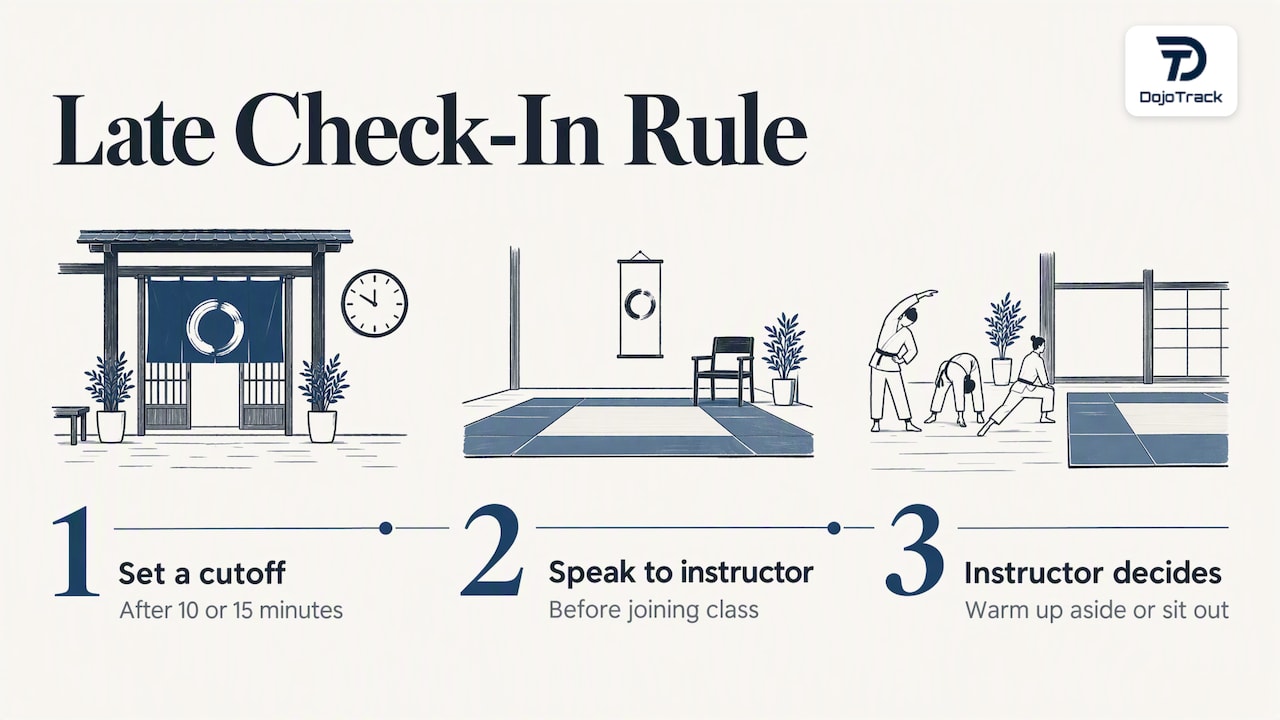
You can adopt a similar rule: after 10 or 15 minutes, the student speaks to the instructor before joining, and the instructor decides whether they do a short warm-up on the side or sit out.
Make late entry quiet
A dojo has its own etiquette for this. Bedford Jujitsu, a UK club, asks that late students wait at the edge of the mat until the instructor invites them in. That keeps a late arrival from interrupting a drill and gives the coach control of when and how the student joins. Pair that with a kiosk check-in that happens before the student steps onto the mat, and nothing about the late arrival needs to be said aloud.
Allow corrections, with a trail
Students will check into the wrong class, forget to check in, or tap in for the wrong child in a family. Let instructors correct the record within a set window, such as the same day, and keep a note on who changed what. That keeps your attendance numbers trustworthy for belt eligibility.
Adjust by class type
- Kids’ classes: parents often do the check-in. Group siblings so one tap checks in a family.
- Teens and adults: self-check-in on a kiosk or phone is usually enough.
- Open mats and seminars: use QR or card scans, since there is no fixed roster.
- Private lessons: a coach roster is fine; there is only one name to mark.
If you want to compare how different management tools treat late students and attendance records, this overview of project management tools for fitness studios is a place to start.
Attendance gamification that works
Once check-in is reliable, attendance data can power rewards. The goal is more consistent students, not a leaderboard that only the same three people win.
Why consistency needs help
Youth sports lose participants constantly. The President’s Council on Sports, Fitness & Nutrition reports that about one-third of youth-sports participants quit each year, and that about 70% of children who start organized sports are no longer playing by adolescence. The Fun Comes First Playbook adds that children commonly stop around age 10½ and recommends youth-centered, inclusive and fun environments to keep them. That is the standard your rewards should meet: make showing up feel good.
What the research suggests
In a U.S. high-school soccer program, the WAVE study named coach encouragement, incentives and fun competitive activities among the best practices for engagement. The same study showed how fragile attendance can be: 90% of students attended the first-year lessons, and 39% attended the second-year lessons. It is a different sport and setting, but the lesson carries over. Encouragement from the coach and small incentives help, and engagement needs ongoing effort.
Reward ideas that are fair
- Streaks with a grace rule. Count weeks, not days, and allow one missed week for illness or travel, so a single absence does not wipe out progress.
- Personal goals. “Reach 12 classes this month” is fair to a student who can only train twice a week, where “most classes in the school” is not.
- Team challenges. A class-wide goal, like 200 total classes in a month, rewards the group and keeps beginners from feeling outpaced.
- Milestone recognition. 25, 50 and 100 classes earn a patch, a shout-out or a stripe on the belt. It fits naturally into belt culture.
- Coach recognition. A short “great to see you back” from an instructor often outweighs a prize.
Pitfalls to avoid
- Rewarding attendance at any cost. Students who are sick or injured should not feel pressure to train. Excused absences should not break a streak.
- Public rankings of kids. A visible leaderboard can discourage the students who need encouragement most.
- Prizes that get expensive. Prefer recognition and small, inexpensive items.
- Check-in cheating. If friends can tap in for each other, rewards lose their meaning. Coach verification and a kiosk in view of the mat solve most of it.
The student app is useful here: DojoTrack’s mobile app lets members see class schedules, follow belt curriculum progress and receive push notifications, so a milestone or a nudge reaches them outside the dojo.
How to tell if it is working
Check these numbers monthly:
| Measure | What it tells you | A sign to act |
|---|---|---|
| Average check-in time at the door | Whether the method is fast enough | A line forms before most classes |
| Attendance rate per class (checked in vs. enrolled) | Whether students are showing up | A steady drop over two to three months |
| Students with no check-in for 30 days | Who is at risk of leaving | A growing list with no outreach |
| Percent of check-ins needing correction | Whether students are using the system properly | Corrections rising over time |
| Participation in challenges | Whether rewards are engaging or ignored | Only the top few students take part |
If your attendance data sits in one system and membership data in another, you will do this by hand. Our guide to membership tracking for MMA gyms shows how attendance and retention connect. DojoTrack’s retention tools are designed to flag students at risk of dropping out so you can reach out before they disappear.
Our perspective
We built DojoTrack after running martial arts schools ourselves, and the check-in desk was where we felt the pain first. Paper sheets, a spreadsheet nobody updated and a billing tool that did not know who had trained all led to the same problem: we knew a student had left only after the last payment.
Our view is that check-in should be the quietest part of class. Students tap in at a sign-in kiosk, the record lands in the same place as their membership, belt progress and billing, and the instructor spends the first minutes of class teaching instead of taking roll.
We also believe attendance data should lead to action. When a student’s pattern changes, the school should know now, and a friendly text or a word from the instructor should be easy to send. That is the idea behind our AI-driven retention system and automated SMS follow-ups, which are designed to help you catch drop-off early.
A generic gym tool treats a karate class like a spin class. Martial arts schools have belts, families, kids’ programs and testing cycles, and your check-in should know about all of them.
DojoTrack
Try it at your school
If you want check-in, attendance, belt tracking and billing in one place, DojoTrack has a free plan so you can set up your roster and kiosk before you spend anything. Paid plans on the pricing page run from Launch at $95 per month to Master at $245 per month, with Scale at $125, Expand at $165 and Grow at $195 in between. Text messages cost $0.017 each, and a dedicated DojoTrack number is $2 per month. You can start in the DojoTrack app whenever you are ready.
A simple rollout plan
- Pick your default method. Kiosk for regular classes, coach roster as the correction tool.
- Write the late rule. Decide the cutoff, who decides, and what the late student does first.
- Tell students and parents. Explain it in a short email and a sign by the door.
- Run it for two weeks. Watch the door at your busiest class and note where a line forms.
- Add one reward. Start with a personal-goal milestone, not a competition.
- Review the numbers monthly. Use the table above and adjust.
FAQ
What is the fastest way to check students into a martial arts class?
Self-check-in is the fastest, using a kiosk, tablet or phone at the door. Many students can check in at once without involving the instructor. Keep a coach roster as a backup for corrections and for students who forget their phone or tag.
How should I handle students who arrive late?
Set one written cutoff, such as 10 to 15 minutes after the start, and apply it to everyone. Past that point, the student checks with the instructor first, since they may have missed the warm-up. Ask late students to wait at the mat edge until invited in, so nobody interrupts a drill.
Does attendance gamification work for kids?
It can, when it is fun and open to every child. Youth sports see high dropout, and guidance from U.S. youth-sports organizations stresses fun, inclusive settings. Use personal goals, milestones and team challenges, and avoid public rankings.
Should attendance be tied to belt promotions?
Many schools use minimum class counts as one requirement among several, alongside skill and attitude. A digital attendance record makes that count accurate. Excused absences should be handled by a clear policy so that illness does not penalize a student.
Sources
- Policies, AcroSports
- Club Rules, Bedford Jujitsu
- PCSFN Science Board Report on Youth Sports
- Fun Comes First Playbook
- WAVE Ripples for Change Obesity Two-Year Intervention