
This Month: 4 Chargeback Fixes & Evidence for Martial Arts Studios

The most effective chargeback prevention for martial arts studios combines four things: a membership agreement that spells out billing terms in plain language, a cancellation process that’s actually easy to find, a billing descriptor students recognize on their bank statement, and documented proof of service tied to attendance records. Studios that layer tokenized recurring billing on top of these four fixes see fewer disputes and win more of the ones that still land. Good evidence wins disputes, but prevention is what keeps your front desk out of the paperwork business altogether.
TL;DR:
- Implement clear, signed membership agreements that specify billing amounts, recurrence, and cancellation procedures to prevent misunderstandings and disputes.
- Use a straightforward cancellation process with timestamped confirmation records, avoiding complex steps that prompt bank disputes.
- Ensure your billing descriptor on bank statements clearly matches your studio’s name to reduce confusion and fraud suspicion.
- Enforce tokenization, AVS, and CVV checks during signup and monitor failed payments with automated recovery workflows to minimize chargeback risks.
- Automatically log attendance at every class for each member to provide rapid, concrete proof of service if disputes arise.
Table of Contents
- What Is a Chargeback, and Why Does It Matter for Membership Billing?
- Why Do Martial Arts Studios Get Hit With Chargebacks So Often?
- What’s the Fastest Way to Reduce Chargebacks This Month?
- How Do You Build a Winning Chargeback Evidence Packet?
- What Cancellation and Billing Rules Do You Need to Follow?
- What Staff Workflows Actually Stop Disputes Before They Start?
- How DojoTrack Builds Chargeback Protection Into Daily Operations
- Where Should a Studio Owner Focus First?
- Get Billing, Attendance Proof, and Dispute Records in One Place
- Sources
- FAQ
What Is a Chargeback, and Why Does It Matter for Membership Billing?
A chargeback happens when a cardholder disputes a charge directly with their bank, and the bank pulls the funds back from your account before you’ve had a chance to respond. That’s different from a refund, which you issue voluntarily, and different from a pre-dispute inquiry, where the card network flags a complaint and gives you a short window to resolve it before it becomes a formal dispute.
The financial hit goes beyond the lost membership payment. You typically eat a chargeback fee on top of the reversed charge, and the disputed funds get held during the review period. Rack up too many disputes relative to your transaction volume, and your acquiring bank may flag your account as high risk, which can mean higher processing rates or even account review.
Recurring membership billing amplifies this exposure for a few reasons:
- Card-not-present transactions carry more fraud risk than in-person swipes, since there’s no physical card or signature to verify.
- Monthly auto-drafts continue for months after a student stops attending, creating a gap between “still being billed” and “still training.”
- One missed cancellation request can generate three or four disputed charges before anyone notices.
Why Do Martial Arts Studios Get Hit With Chargebacks So Often?
Preventing chargebacks in martial arts studios starts with understanding why they happen in the first place, and the root causes are almost always operational, not criminal. A handful of patterns show up again and again:
- Trial-to-paid confusion. A student signs up for a free or discounted trial period, forgets the exact date it converts to a paid membership, and disputes the charge as unauthorized when they see it on their statement.
- Descriptor mismatch. Your studio bills under a parent company name, a payment processor’s generic label, or an abbreviation the cardholder doesn’t recognize, so they assume fraud and call their bank instead of you.
- Family billing errors. One parent pays for three kids under one card, a sibling quits, and the billing system keeps charging for a student who no longer attends because nobody updated the payer-to-student mapping.
- Service-delivery disputes. A member missed six weeks of classes due to travel or injury, still got billed, and decides the fairest fix is disputing the charge instead of calling the front desk.
- Friendly fraud. The cardholder authorized the original charge but disputes it anyway, often because canceling through the bank feels faster than dealing with your cancellation process.
Every one of these is fixable with better front-end communication and cleaner records, which is exactly where the checklist below comes in.
What’s the Fastest Way to Reduce Chargebacks This Month?
You don’t need a compliance department to fix most of this. Work through these steps in order, and you’ll close the gaps that generate the majority of studio disputes.
- Rewrite your membership agreement in plain language. State the billing amount, the recurrence schedule, the start date, and exactly how to cancel. Have every member sign it, digitally or on paper, and store it somewhere you can pull up in under a minute.
- Build a cancellation process that produces a receipt. If canceling requires three phone calls and a manager’s approval, members will call their bank instead. A cancellation confirmed by email or text, timestamped and stored, is your best defense against “I tried to cancel and you kept charging me.”
- Test your billing descriptor from a cardholder’s point of view. Pull up a real bank statement and see what actually shows up. If it reads like a random string of letters, change it to something that clearly matches your studio’s name.
- Turn on tokenization and enforce AVS/CVV checks at signup. Card tokenization protects stored payment data, while address and security code verification catches a meaningful share of fraudulent signups before they become a billing problem. Stripe Radar scores initial enrollment differently than it scores the recurring payments that follow, so risk controls need to cover both the moment someone signs up and every payment after.
- Add signup verification and watch your recurring payments separately from one-time sales. A confirmed email or phone number filters out a surprising number of fraudulent or mistyped signups before they ever generate a charge.
- Build a failed-payment recovery sequence. Automated retries plus a friendly SMS or email nudge before a card expires or a payment fails will recover revenue that would otherwise turn into a “why was I charged” dispute weeks later. A recovery workflow that runs on autopilot catches most of these before they escalate.
- Log attendance automatically, every class, every student. This becomes your proof of service if a member ever claims they weren’t using what they paid for.
Pro Tip: Run your billing descriptor test on a Sunday. That’s when most members casually scroll through their bank app, and it’s the moment a confusing charge is most likely to trigger a “what is this?” call to their bank instead of to you.
How Do You Build a Winning Chargeback Evidence Packet?
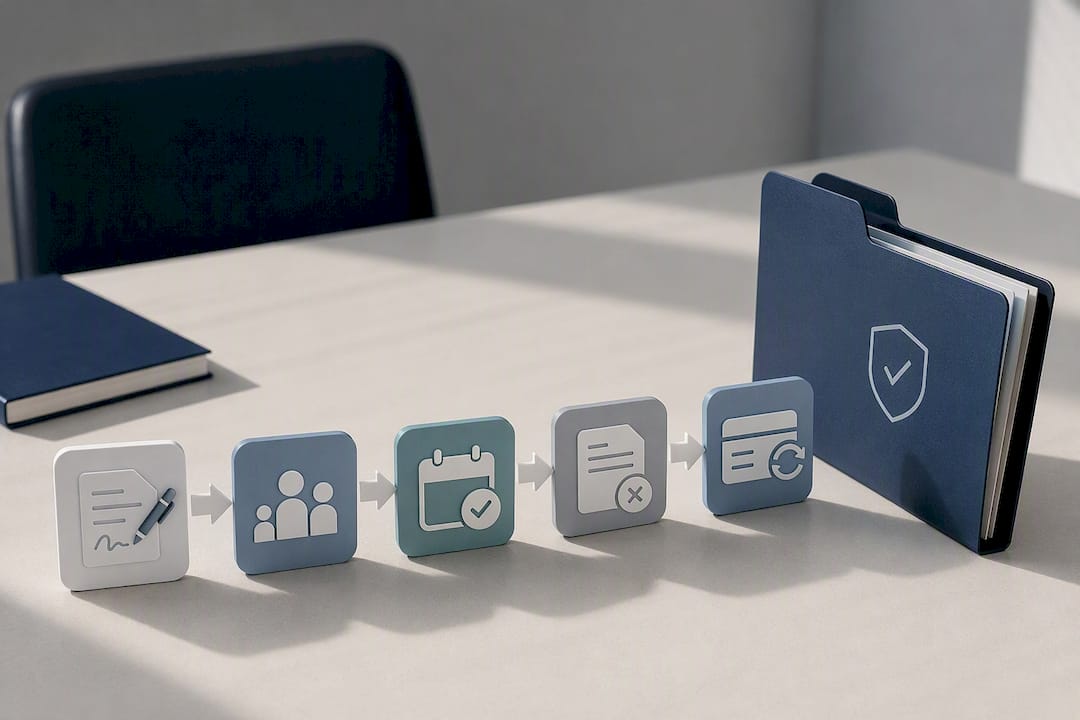
Speed matters as much as content. The moment a dispute notification lands in your processor dashboard, check the reason code and the deadline. Miss the window and you lose automatically, regardless of how strong your case would have been.
Assemble these pieces before you touch the response form:
- The signed membership agreement showing the exact billing terms the member agreed to.
- Documentation of authorization, including the date and method of signup.
- Any cancellation record, or the clear absence of one.
- Attendance logs showing the member used the service during the billing period in dispute.
- Communication history: emails, texts, or notes from calls about billing or cancellation.
- Transaction receipts and a screenshot of how your billing descriptor actually appears.
- Access logs or device/IP data from the original signup, where available.
Stripe’s dispute evidence guidance lists these exact fields, from customer contact details to service dates and access logs, and stresses submitting the full packet before the dashboard deadline rather than piecemeal. For recurring transactions specifically, Visa’s compelling-evidence rules let merchants use historical undisputed payments and device fingerprint data from the original transaction to argue the current charge fits an established, authorized pattern.
Not every dispute is worth fighting. If the amount is small and your evidence is thin, refunding is often cheaper than the staff time a formal response takes. Fight the ones where your paperwork is solid and the dollar amount justifies the effort, and loop in your acquirer early if a case looks headed for arbitration.
What Cancellation and Billing Rules Do You Need to Follow?
The Consumer Financial Protection Bureau makes a distinction that trips up a lot of studio owners: stopping an automatic debit is not the same as canceling a membership contract. A declined card doesn’t cancel anything on its own, and if you keep billing a canceled member because nobody updated the system, that’s on you, not them.
The CFPB has also warned that negative-option marketing which auto-converts a free trial into a paid subscription can cross into unfair or deceptive territory if the terms aren’t disclosed clearly upfront. Cover these bases:
- Get explicit sign-off on the billing amount, frequency, and start date, in writing, before the first charge.
- Build a cancellation flow that generates an immediate, storable confirmation, not a verbal “okay, we’ll take care of it.”
- For family accounts, keep a clean record mapping which payer is billed for which student, updated the moment a sibling starts or stops.
- Capture five disclosure elements at signup: amount, recurrence, start date, cancellation method, and who authorized it.
What Staff Workflows Actually Stop Disputes Before They Start?
Most chargebacks are preventable at the front desk, days or weeks before a member ever calls their bank. Give your team a script and the resolution rate goes up dramatically:
- Standardize the billing-question response. Train staff to pull up the member’s agreement and payment history live during the call, not promise to “check and call back.”
- Log every check-in. Attendance data becomes your service-delivery proof, so make sure the front desk or kiosk system captures it every class, without exception.
- Audit for duplicate or manual billing errors monthly. A student billed twice in one cycle because two staff members processed the same payment is an avoidable dispute, not a fraud case.
- Track dispute rate per 1,000 transactions and decline rate monthly. A rising trend usually points to one root cause, like an expired-card wave or a confusing statement descriptor, that’s fixable before it snowballs.
Visa’s merchant guidelines note that a large share of disputes trace back to avoidable processing errors rather than actual fraud, which is exactly why staff training pays off faster than any fraud-detection tool.
Pro Tip: Assign one person to own the monthly dispute-rate check. Metrics that “everyone” is responsible for tend to get reviewed by no one.
How DojoTrack Builds Chargeback Protection Into Daily Operations
DojoTrack ties signed membership authorizations, family payer mapping, and automated cancellation confirmations directly to attendance records, so proof of service is already on file before a dispute ever arrives. Stripe-integrated recurring billing and exportable evidence make responses faster, and AI-driven retention flags failed payments before they turn into disputes. Studios can dig deeper into the mechanics in DojoTrack’s recurring billing guide.
Where Should a Studio Owner Focus First?
Cancellation friction and a confusing billing descriptor cause more disputes than actual fraud ever will, and fixing both costs nothing but a few hours of setup. Save fraud-detection tools and tokenization upgrades for after your agreements and cancellation flow are airtight. Chasing sophisticated fraud controls while your cancellation process still requires three phone calls is solving the wrong problem first.
— DojoTrack
Get Billing, Attendance Proof, and Dispute Records in One Place
Every fix on this checklist, from documented authorizations to attendance-linked proof of service, is easier to run when your billing, agreements, and class records live in one system instead of three disconnected ones. DojoTrack pairs Stripe-powered recurring billing with automated attendance tracking, family billing maps, and cancellation confirmations that generate their own paper trail, so when a dispute lands, your evidence is already assembled instead of scattered across email threads and spreadsheets. The Free plan covers the core membership and attendance tools most studios need to start closing these gaps immediately, with paid tiers unlocking deeper automation and AI-driven retention as you grow. Check the DojoTrack pricing page to see which tier fits your studio’s size, or start a free signup today and get your cancellation flow and billing descriptor cleaned up before your next billing cycle runs.
Sources
- Stripe — How Radar works
- CFPB — How do I stop automatic payments?
- Visa — Dispute Management Guidelines for Merchants
FAQ
How Do I Fight a Chargeback on a Membership Payment?
Pull the dispute reason code and deadline from your processor dashboard immediately, then submit your evidence packet, membership agreement, cancellation records, attendance logs, and communication history, before that deadline. Stripe’s evidence guidance outlines exactly which fields carry the most weight, and platforms like DojoTrack can pull attendance and billing records together quickly when you need to respond fast.
Is a Chargeback a Legitimate Process, or Is It a Scam?
A chargeback is a legitimate consumer protection mechanism run by card networks and banks, not a scam, though it’s sometimes misused for “friendly fraud” when a cardholder disputes a charge they actually authorized. Card networks like Visa expect merchants to fight illegitimate disputes with proper evidence rather than accept every claim at face value.
Can Someone Face Criminal Charges for Filing a Chargeback?
Filing a single false chargeback claim rarely leads to criminal charges, but repeated, deliberate fraudulent disputes can expose someone to fraud liability in serious cases. Most disputed membership charges are resolved as ordinary billing disagreements rather than matters for law enforcement.
Can a Member Dispute a Gym or Studio Membership Charge?
Yes, a cardholder can dispute a gym or martial arts membership charge with their bank at any time, whether or not they contacted the studio first. That’s exactly why documented cancellation confirmations and attendance-linked proof of service matter: they give you the evidence needed to fight disputes that don’t reflect what actually happened.