

Yes, attendance rewards work. Simple, frequent milestones like stamps, streaks, and patches raise class attendance and cut early dropout, especially when students earn a win every few weeks instead of waiting months for a belt. Pick one class or age group, choose a single mechanic, such as a 20 stamp punch card, and pilot it for eight weeks before rolling it out school wide.
TL;DR:
- Short-term attendance rewards, such as an eight-week streak or 20 stamps, keep students motivated during the most fragile retention period between months two and four.
- Digital tracking tools, like mobile apps with push notifications and automated alerts, significantly reduce administrative workload and improve reward redemption rates.
- Physical rewards such as patches, stickers, and certificates are especially effective for younger students, while points redeemable for private lessons or gear motivate older students.
- Implementing a single mechanic and threshold, with clear staff responsibility and a pilot period, ensures the rewards program is sustainable and adaptable based on early results.
- Public recognition boosted by announcements, leaderboards, or social media shoutouts enhances the impact of rewards without additional cost.
Table of Contents
- Why Attendance Rewards in Martial Arts Matter Most Early On
- Practical Reward Ideas and Real Dojo Examples You Can Copy
- How to Design a Fair, Low-Effort Attendance Rewards Program
- Digital Tracking and the Features That Actually Matter
- Launch, Measure, and Iterate: What to Track and When to Change It
- How DojoTrack Supports Attendance Rewards Without the Admin Load
- Examples of Attendance Rewards: Stickers, Patches, Points, and Perfect Attendance
- Instructor Checklist: Ship a Pilot in Two Weeks
- Try DojoTrack to Put Attendance Rewards on Autopilot
- Sources
- FAQ
Why Attendance Rewards in Martial Arts Matter Most Early On
Retention is most fragile between months two and four of a student’s membership, right after the initial excitement fades and before the next belt test feels close enough to matter. That’s the window where non-belt recognition does the heaviest lifting, because it gives students something to chase on a weekly basis rather than a quarterly one.
Belt promotions are powerful, but they’re a long-horizon reward. A white belt might wait three to six months for the next stripe, and that gap is exactly where students quietly stop showing up. Attendance rewards fill that space with shorter, more frequent wins.
Pro Tip: If a student’s only reward is their next belt, you’re asking them to stay motivated for months with nothing in between. Give them something to earn every two to four weeks instead.
Public recognition matters just as much as the physical reward itself. A stamp on a card is nice, but announcing a student’s streak in front of the class, or posting it where parents can see, extends that signal well past the moment it happens.
Practical Reward Ideas and Real Dojo Examples You Can Copy
You don’t need to invent a rewards program from scratch. Several dojos have already published theirs, and the mechanics are simple enough to copy directly.
Digital stamp cards. One widely used model: one stamp per class attended, and a set number of stamps earn a free month of tuition. This kind of dojo loyalty program gives students a visible countdown instead of a vague sense that “showing up matters.”
Attendance streaks. Set a weekly minimum, say two classes per week, and award a bonus stamp or a small patch after an eight-week streak. This rewards consistency rather than just raw class count, which matters for kids balancing school and sports schedules.
Physical rewards. Gi patches, certificates, and stickers remain some of the cheapest and most effective tools available. Strive Taekwondo’s Heroes Rewards program has students collect 10 stickers for a certificate, then two certificates for a special gift, a reward ladder that works because each rung is small and achievable.
Experience rewards. Once a student hits a bigger milestone, offer something they can’t buy: a private lesson, a seminar invite, or open-mat access typically reserved for higher belts.
Referral bonuses. Extra stamps or private lesson credits for a successful referral turn your most loyal students into recruiters, and tie the reward back to the same points system they already understand.
Here’s how a few real programs structure the payoff:
- Perfect Attendance Award: simple public recognition, no purchase required, just an announcement and a social media shoutout.
- AMA Rewards Program: 5 points for attending two classes in a week, with 50 points redeemable for a private lesson.
- Reward points systems: points earned per class, redeemable for gear discounts or lesson credits.
- Bonus stamp mechanics: extra stamps for seminars, competitions, and referrals on top of the base attendance count.
How to Design a Fair, Low-Effort Attendance Rewards Program
Building a program that actually runs, instead of dying after week three, comes down to five steps.
- Define the behavior and the target number. Decide what you’re trying to fix, whether that’s reducing month three churn by a set amount or simply getting once-a-week students to two classes. Write the goal down before picking a mechanic.
- Pick one mechanic and one threshold. Don’t launch stamps, streaks, and points all at once. Choose a single system, such as 20 stamps for a free month or an eight-week streak for a patch, and run with it.
- Build a parallel track for low-frequency students. A kid training once a week will never catch a student training four times a week under the same threshold. Either tier the rewards by class frequency or set the bar low enough that consistency, not volume, is what’s being measured.
- Assign staff ownership. Someone at the front desk needs to be responsible for handing out stamps or updating the tracker every single class. Vague ownership is the fastest way a rewards program quietly disappears.
- Run a two-week pilot before you announce it school wide. Test the mechanic with one class, fix the friction points, then expand.
Digital Tracking and the Features That Actually Matter
Paper punch cards work for a handful of students. They fall apart past a hundred. Once your school scales, the software running your attendance tracking for martial arts needs a specific set of features, not just a generic check-in log; that’s why technology to track athlete progress is increasingly essential for optimizing retention.
- Check-in flexibility. Kiosk mode at the front desk, QR code scanning, manual entry for late arrivals, and a mobile app option all need to work together, not as separate systems.
- Digital wallet passes. A stamp card that lives on a student’s phone lock screen, complete with push notifications for milestones, gets checked far more often than a laminated card in a drawer.
- Automated milestone nudges. The system should flag a student approaching a reward, and separately flag one who’s gone quiet, without a staff member having to comb through spreadsheets.
- Per-student and cohort reporting. You want to see attendance history for one student and retention trends for an entire age group side by side.
Vendor pages across the martial arts attendance software space consistently highlight gamification and check-in flexibility as the two features schools ask for first, which tells you where the real demand sits.
Launch, Measure, and Iterate: What to Track and When to Change It
Run your pilot for 8 to 12 weeks. That’s enough time to capture a full attendance cycle and catch whether the program is actually changing behavior in the retention window that matters most.
| Metric | What to watch for | Action if it’s flat |
|---|---|---|
| Attendance lift | Average classes per student per week | Lower the threshold or add a bonus stamp |
| Retention at months 2 to 4 | Percentage still enrolled at each checkpoint | Add a mid-tier reward before the current one |
| Referral growth | New sign-ups tied to referral bonuses | Increase the referral reward, not the base one |
| Redemption rate | Percentage of eligible students who actually claim rewards | Simplify the redemption process, not the reward itself |
If redemption rates stay low even when attendance is climbing, the reward is probably too hard to claim, not too small to matter.
How DojoTrack Supports Attendance Rewards Without the Admin Load
Running any of this by hand, tracking stamps on paper, texting parents about streaks, means a program dies the first busy week. DojoTrack’s attendance tracking features log every check-in automatically, and its student mobile app pushes milestone alerts the moment a student hits a threshold. Event registration tools handle seminar sign-ups tied to bonus rewards, and built-in reporting shows you who’s close to a reward and who’s gone quiet, all without a spreadsheet. Because the core platform is free, you can pilot a stamp or streak system at zero cost before deciding whether to layer on paid automation.
Examples of Attendance Rewards: Stickers, Patches, Points, and Perfect Attendance
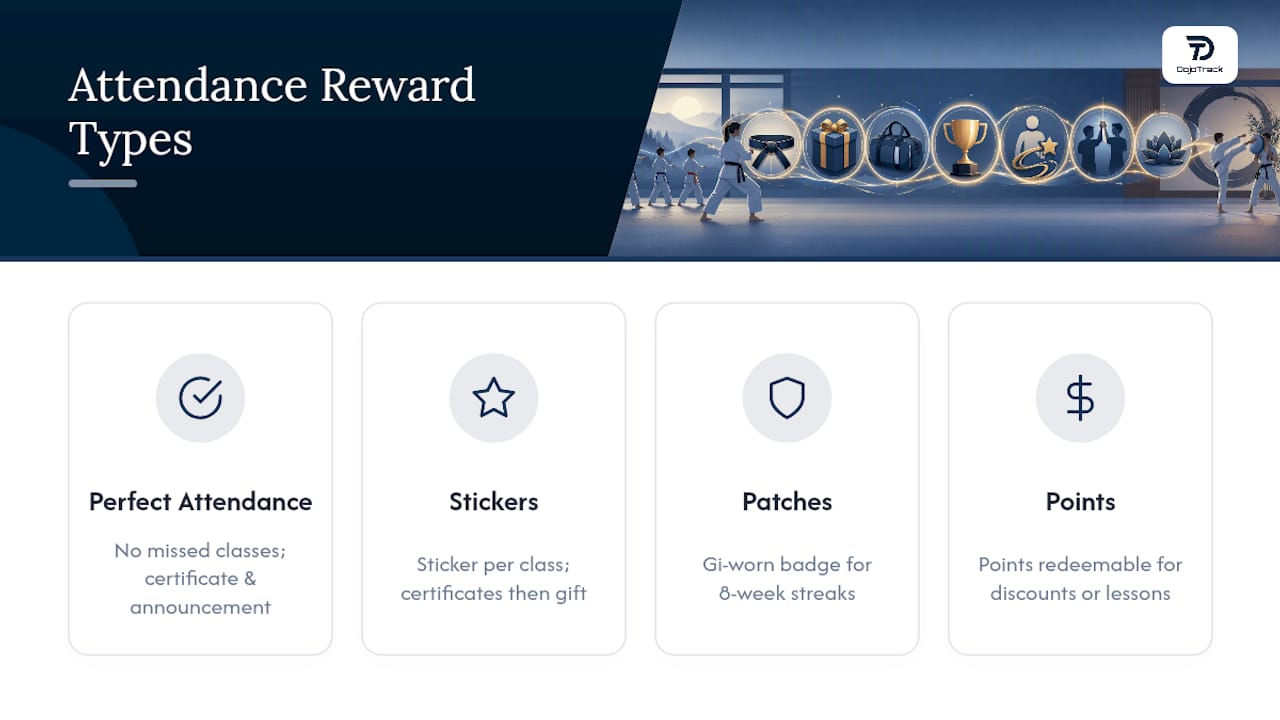
The reward categories that show up across successful programs break down into four types, and most schools end up running a mix of two or three.
Perfect attendance recognition rewards students who don’t miss a single scheduled class in a given stretch, typically a month or a testing cycle. It costs nothing beyond a certificate and an announcement, which makes it the easiest starting point for any school testing the waters.
Stickers and sticker ladders work especially well with younger students. A sticker per class, building toward a certificate, then a small gift after multiple certificates, gives kids a visual, tactile sense of progress that a digital point count can’t replicate at that age.

Patches carry weight because they attach to the gi itself, visible every single class. A patch tied to an eight-week streak or a referral milestone becomes a badge students want to show off, not just a line item in a tracker.
Points systems scale better for older students and adults who respond to redeemable value. Points earned per class that convert into gear discounts, private lessons, or free months give the reward real, spendable weight rather than just recognition.
Mixing formats by age group tends to outperform a single system applied uniformly. Younger kids respond to stickers and patches they can see and touch. Teens and adults respond more to points they can redeem for something they actually want, like a private lesson or discounted gear.
Instructor Checklist: Ship a Pilot in Two Weeks
Before you launch, lock down four things: your threshold (20 stamps, eight-week streak, whichever you picked), a one-line staff brief so everyone hands out rewards the same way, enough physical stock (patches, stickers, certificates) to last a month, and one check-in method you’ll stick with.
The most common pitfall is picking a threshold too high for once-a-week students. If half your class can’t realistically reach it, lower the bar before you launch, not after complaints start.
Announce it once, clearly, in class and by text or app notification, and keep it visible on a board or leaderboard so momentum doesn’t fade after week one.
— DojoTrack
Try DojoTrack to Put Attendance Rewards on Autopilot
Running a stamp card or streak program by hand works for a few weeks, then someone forgets to update it during a busy Saturday, and the whole thing quietly dies. DojoTrack automates the parts that usually break: attendance gets logged at check-in, milestone alerts push straight to the student mobile app, and staff get a report showing exactly who’s close to a reward and who needs a nudge. The free core tier lets you pilot a rewards program at no cost, then unlock automated SMS and advanced reporting as your school grows. If you’re ready to stop tracking stamps on paper, sign up for DojoTrack and set up your first reward tier this week.
Sources
- Martial Arts Dojo Loyalty Program (2026 Guide)
- Martial Arts Loyalty Programs: Non-Belt Recognition That Keeps Students Showing Up — Zatrovo Blog
- Perfect Attendance Award – San Diego Sidekicks Martial Arts
- Strive Taekwondo Heroes Rewards
- Exploring the benefits of reward points — Of the Void Martial Arts
FAQ
What are some rewards for good attendance?
Common rewards include digital or physical stamp cards that redeem for a free month, gi patches for attendance streaks, stickers and certificates for younger students, and points that convert into private lessons or gear discounts.
What is the best martial arts attendance software?
The right software depends on your school’s size, but look for one that combines flexible check-in options (kiosk, QR, app), digital wallet passes with push notifications, and per-student reporting; platforms like DojoTrack build these features specifically for martial arts schools rather than adapting generic gym software.
What are some incentives for perfect attendance?
A public recognition post or in-class announcement works as a low-cost, high-impact incentive, and pairing it with a small physical reward like a patch or certificate reinforces the habit without a major expense.
What are some ideas for a Perfect Attendance Award?
Ideas include a monthly certificate for zero missed classes, a dedicated patch for a full testing cycle without an absence, or a spot on a visible leaderboard that resets each quarter so new students always have a shot at it.