

TL;DR:
- Stripe billing automates recurring memberships and one-time charges for martial arts studios, using APIs and features that improve cash flow and reduce manual work. It includes smart retries, self-service portals, and webhook automation that help recover failed payments and keep member access consistent. Studio owners should own their Stripe account to retain control, implement ACH payments to lower fees, and use structured dunning sequences to maximize revenue.
Stripe billing for a martial arts studio is defined as an automated payment system that handles recurring membership charges and one-time fees like belt testing or merchandise through Stripe’s Subscriptions API and Payment Intents API. Studio owners use it to replace manual invoicing with scheduled, automatic drafts that run without staff involvement. The system includes Smart Retries to recover failed payments, customer self-service portals for members to update card details, and webhook events that sync payment status with class booking access. For any studio running memberships at scale, this is the payment infrastructure that keeps cash flow predictable.
What is Stripe billing for a martial arts studio?
Stripe billing is the combination of Stripe’s Subscriptions API, Payment Intents API, and Smart Retries working together inside your studio management software. Each piece handles a different part of your payment workflow.

The Subscriptions API automates recurring membership charges on a fixed schedule. You set the billing date, the amount, and the plan. Stripe handles every charge from that point forward without any manual input from your team.
The Payment Intents API handles one-time charges. Belt testing fees, uniform sales, event registrations, and merchandise purchases all run through this API. Your front desk staff can collect these payments in seconds without switching between systems.
Smart Retries automatically recover 3–7% of failed payments by retrying the charge on days when the card is statistically more likely to succeed. That recovery happens over a 7–14 day window without any staff action required. For a studio with 150 members, that percentage represents real money every month.
- Subscriptions API runs your monthly membership drafts automatically on the scheduled billing date.
- Payment Intents API processes one-time charges like belt testing fees and retail purchases at the front desk.
- Smart Retries attempt failed charges on optimal days over a 7–14 day window to recover declined payments.
- Customer self-service portals let members update expired cards or switch payment methods without calling the studio.
- Webhook events like
payment_intent.payment_failedandinvoice.upcomingsync payment status with class booking access in real time.
Pro Tip: Set up the invoice.upcoming webhook to send members an automated reminder three days before their billing date. This single step reduces card declines caused by expired cards.
What does Stripe billing cost for a martial arts studio?
Stripe’s fee structure directly affects your monthly margin, and most studio owners do not run the numbers until they are already losing hundreds of dollars per month in processing costs.
Standard card processing fees are 2.9% plus $0.30 per transaction. ACH direct debit costs 0.8% capped at $5 per transaction. The difference compounds fast at studio-level volumes.
| Payment type | Fee structure | Fee on $180 membership | Fee on $20,000 monthly volume |
|---|---|---|---|
| Credit/debit card | 2.9% + $0.30 | $5.52 | $580 |
| ACH direct debit | 0.8%, max $5 | $1.44 | $160 |
| Savings with ACH | $4.08 per member | $420 per month |
Studios processing $40,000 monthly in tuition can save roughly $1,000 per month by shifting members from card payments to ACH direct debit. That is $12,000 per year that stays in your business instead of going to payment processors.
ACH does carry a two to three business day settlement delay compared to card payments. For most studios on monthly billing cycles, that delay has no practical impact on cash flow.
Pro Tip: When a new member signs up, present ACH as the default payment option rather than a secondary choice. Most members will accept the default without question, and the fee savings add up immediately.
Should your studio own its Stripe account?
The single most important question to ask any billing platform is: whose Stripe account processes your payments? The answer determines how much control you actually have over your revenue.
Owning your Stripe account means your negotiated rates, payout schedules, and customer payment tokens belong to you. When you connect your own Stripe account to a platform like Dojotrack, the payment data stays in your account. If you ever switch software, you do not need to re-collect card information from every member.
A vendor that says “we handle payments for you” typically owns the Stripe account. That arrangement creates real problems:
- Your payout schedule is controlled by the vendor, not by Stripe’s standard two-day deposit timeline.
- Your customer payment tokens live in the vendor’s account. Switching platforms means asking every member to re-enter their card details.
- Your negotiated processing rates disappear if you leave the platform.
- Dispute management and chargeback responses go through the vendor, not directly through your Stripe dashboard.
A vendor that says “connect your Stripe account” gives you full ownership. Customer payment tokens stay yours, making future platform migrations far simpler. Always verify account ownership before signing a software contract.
Stripe also lets studios attach signed contracts and attendance logs directly to chargeback disputes inside the dashboard. This matters because tuition chargebacks are common when parents dispute prior charges after a student stops attending. Owning your account means you control that dispute response directly.
How should studios handle failed payments without losing members?
Canceling a membership the moment a payment fails is the fastest way to lose a member who had every intention of paying. The better approach is to suspend access and recover the payment through a structured retry sequence.
Dunning sequences that combine automated retries, SMS reminders, and email alerts recover 78–85% of failed payments. Studios without a structured retry process recover only 30–40%. That gap represents a significant amount of lost revenue over a full year.
- Day 1: Stripe attempts the first retry automatically. Send an automated email notifying the member of the failed payment.
- Day 3: Stripe retries again. Send an SMS reminder with a direct link to the member self-service portal.
- Day 7: Stripe retries a third time. Send a second email with a clear call to update payment details.
- Day 11: Suspend class booking access. Do not cancel the membership. The member record and belt progress stay intact.
- Day 14: Final outreach from a staff member by phone or personal message before any further action.
Gating booking access rather than canceling the membership preserves the member relationship. The student’s belt rank, attendance history, and profile remain active. Once payment resolves, access restores automatically through the webhook sync. Canceling and re-enrolling a member creates unnecessary friction and often results in permanent dropout.
Pro Tip: Train your front desk staff to recognize members in the grace period and greet them warmly. A personal conversation about updating payment details closes more accounts than any automated message.
How to set up Stripe billing for your martial arts studio
Setting up Stripe billing correctly from the start saves significant troubleshooting time later. The configuration decisions you make on day one affect your fee costs, recovery rates, and member experience for years.
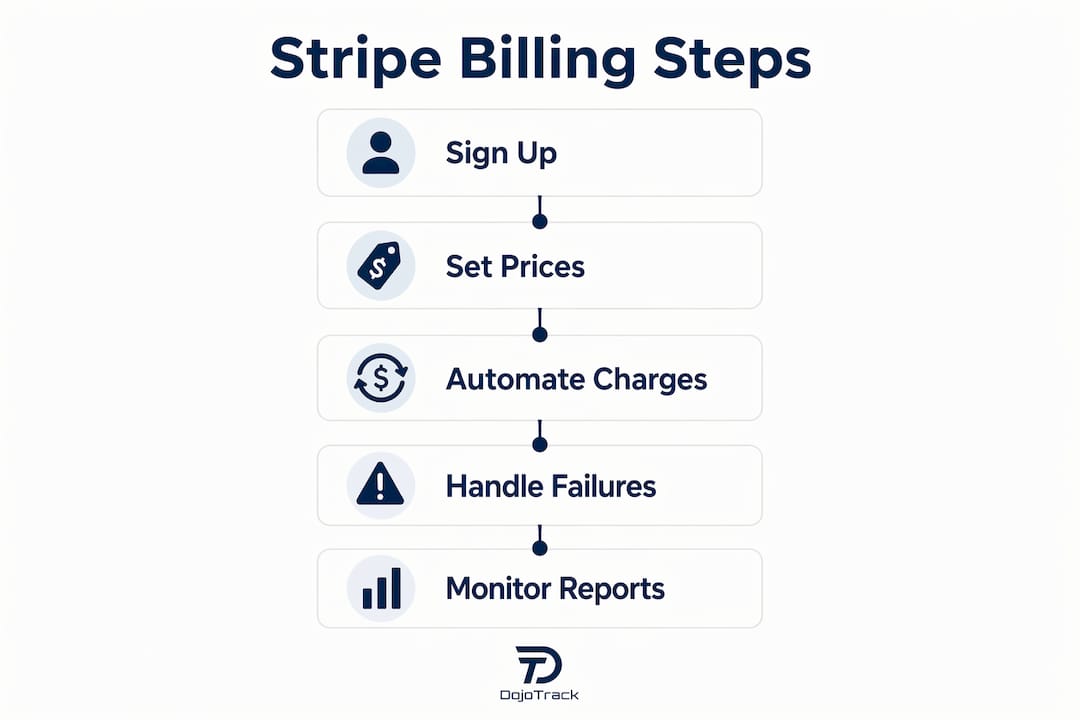
- Create or connect your Stripe account. Go to stripe.com, create a business account under your studio’s legal name, and complete identity verification. If your management software supports it, connect this account directly rather than letting the vendor create one on your behalf.
- Enable ACH direct debit. Inside your Stripe dashboard under Payment Methods, activate ACH debit. Then set ACH as the default payment option inside your studio management software’s billing settings.
- Configure Smart Retries. In the Stripe dashboard under Billing settings, enable Smart Retries and set your preferred retry window. Most studios use an 11-day window before suspending access.
- Set up webhook endpoints. Work with your software provider to confirm that
payment_intent.payment_failedandinvoice.upcomingwebhook events are connected and triggering the correct automations in your platform. - Schedule dunning emails. Configure automated email and SMS sequences inside your management software to fire on days 1, 3, and 7 of a failed payment cycle. Link each message directly to the member self-service portal.
- Train your staff. Show your front desk team how to read the payment dashboard, identify members in the retry window, and guide members through the self-service portal to update their payment details.
For a deeper look at recurring membership payment setup, Dojotrack’s blog covers the full configuration process specific to martial arts studios.
Key Takeaways
Stripe billing gives martial arts studios the tools to automate membership payments, cut processing costs with ACH, and recover failed payments through structured retry sequences rather than losing members to cancellation.
| Point | Details |
|---|---|
| Own your Stripe account | Always connect your own account to retain payment tokens, rates, and payout control. |
| Use ACH to cut fees | Shifting to ACH direct debit saves studios up to $1,000 per month at $40,000 monthly volume. |
| Gate access, don’t cancel | Suspending booking access on day 11 recovers 78–85% of failed payments versus canceling immediately. |
| Configure webhooks correctly | Webhook events sync payment status with class access automatically, removing manual staff work. |
| Smart Retries recover revenue | Stripe’s Smart Retries recover 3–7% of failed payments over a 7–14 day window without staff action. |
The mistake most studio owners make with Stripe billing
Most studio owners set up Stripe billing once and never revisit the configuration. They accept the default card payment option, skip ACH setup, and let the platform handle the Stripe account on their behalf. Those three decisions quietly cost thousands of dollars per year.
The account ownership question is the one I see ignored most often. Studio owners sign up for a management platform, start collecting payments, and never ask whose Stripe account is actually processing the money. Then they try to switch software two years later and discover they cannot transfer their members’ payment data. They have to ask every single member to re-enter their card information. Half of those members never complete the process, and the studio loses them.
The ACH savings are equally overlooked. Studios processing $40,000 per month in tuition treat card fees as a fixed cost of doing business. They are not. ACH direct debit cuts that cost dramatically, and most members will use it if you present it as the default option at signup.
Failed payment handling is where I see the most revenue lost. Canceling a membership on the first failed charge feels decisive, but it destroys the member relationship. A structured dunning sequence with access gating keeps the member in your system, preserves their belt progress, and gives them a clear path to resolve the issue. The automated billing approach that combines retries, reminders, and gating consistently outperforms any manual process.
Stripe billing is not a set-it-and-forget-it tool. The studios that get the most from it are the ones that revisit their configuration, train their staff on the dashboard, and treat payment recovery as an active part of their membership retention strategy.
— Dojotrack
How Dojotrack uses Stripe billing for martial arts studios
Dojotrack connects directly to your own Stripe account, so your payment tokens, payout schedule, and processing rates stay under your control from day one. The platform supports ACH direct debit as a default payment option, which means you can start cutting processing costs immediately without any manual configuration work.
Smart Retries and customer self-service portals are built into the platform. Members receive automated reminders and can update their payment details through a hosted portal without contacting your front desk. Webhook events sync payment status with class booking access automatically, so your staff never has to manually suspend or restore a member’s account.
Use the lifetime value calculator to estimate exactly how much Stripe billing automation is worth to your studio based on your current membership volume and average tuition rate. For more on how Dojotrack integrates billing with full studio management, visit dojotrack.com.
FAQ
What is Stripe billing for a martial arts studio?
Stripe billing is an automated payment system that uses Stripe’s Subscriptions API for recurring membership charges and the Payment Intents API for one-time fees like belt testing. It includes Smart Retries, member self-service portals, and webhook-based access control built into studio management software.
How much does Stripe charge per transaction for studio memberships?
Standard card processing costs 2.9% plus $0.30 per transaction. ACH direct debit costs 0.8% capped at $5, making it significantly cheaper for high-volume monthly tuition drafts.
What happens when a member’s payment fails?
Stripe’s Smart Retries attempt the charge on optimal days over a 7–14 day window. Best practice is to combine automated retries with SMS and email reminders, then gate class booking access around day 11 rather than canceling the membership.
Should I own my studio’s Stripe account or let the software vendor manage it?
Always own your Stripe account. Vendor-held accounts limit your payout control and make platform migration difficult because customer payment tokens stay in the vendor’s account, not yours.
Can Stripe help with tuition chargebacks?
Yes. Stripe lets studios attach signed contracts and attendance logs directly to chargeback disputes inside the dashboard, which is the most effective defense against tuition disputes from former members.