

TL;DR:
- Attendance tracking enables dojo owners to identify student disengagement early and boost retention. Automated systems provide real-time alerts, improve billing accuracy, and increase revenue through better upsell and family plan management. Ignoring attendance data results in revenue loss and hampers long-term growth.
Attendance tracking is the process of monitoring student presence at every class, and it directly determines how much revenue your dojo generates each month. The role of attendance tracking in dojo revenue goes far beyond knowing who showed up. It tells you which students are drifting away, which ones are ready to buy private lessons, and where your billing system is leaking money. Platforms like Dojotrack and Zen Planner have made this data automatic and real-time, giving studio owners a clear financial picture that manual sign-in sheets simply cannot provide.
How does attendance tracking influence student retention and dojo revenue?
Attendance data is your earliest warning system for student churn. When a student who normally trains four times a week drops to once, that pattern shows up in your tracking system before they ever send a cancellation email. Instructors who use attendance data can intervene with a personal call or a check-in message while there is still time to re-engage that student.
The financial case for retention is stark. A 5% improvement in retention can nearly double dojo profitability. That figure reflects how much revenue compounds when students stay longer, test for more belts, and buy more add-ons over time.
Attendance also predicts upsell readiness. A student who attends consistently is far more likely to say yes to a private lesson package, a seminar, or an accelerated belt testing track. Up to 30% of a studio’s total revenue comes from membership add-ons, and those add-ons are almost always purchased by your most engaged, most present students.
- Attendance gaps signal churn risk before a student quits
- High attendance correlates directly with add-on purchases
- Retention is cheaper than acquisition, making tracking a cost-control tool
- Real-time data lets instructors act fast instead of reacting after the fact
Pro Tip: Set an automated alert in your management platform to flag any student who misses more than two consecutive classes. A personal text from an instructor at that point recovers more students than any promotional email campaign.
Manual vs. automated attendance tracking: which one actually works?
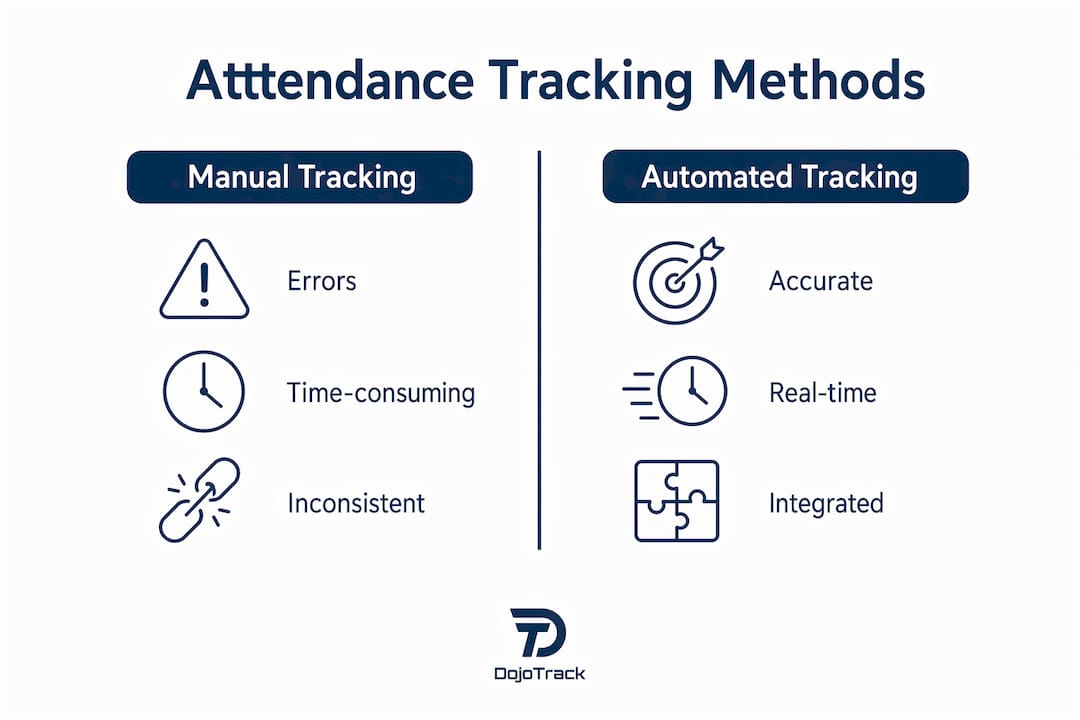
Manual attendance tracking fails dojos in three specific ways: it produces errors, it wastes instructor time, and it generates data nobody ever analyzes. A paper sign-in sheet at the front desk tells you who came today. It does not tell you that a student’s attendance has dropped 40% over the past six weeks.

Automated attendance management software eliminates manual dependency and delivers real-time analytics that feed directly into billing, scheduling, and retention workflows. The difference in operational output is significant.
| Feature | Manual tracking | Automated tracking |
|---|---|---|
| Data accuracy | Prone to human error | Consistent and reliable |
| Time required | 5–10 minutes per class | Near zero, self-service |
| Retention alerts | None | Automated flags for at-risk students |
| Billing integration | Separate, disconnected | Synced with payment workflows |
| Reporting | Manual compilation | Real-time dashboards |
| Upsell identification | Guesswork | Data-driven triggers |
QR code-based check-in is the most widely adopted automated method in martial arts studios. Students scan a printed or digital code on arrival, and the system logs the visit instantly. Biometric kiosks and app-based self-check-in are also in use at larger academies.
Platforms like Dojotrack combine attendance with scheduling, billing, and CRM data in one place. That integration is what turns raw attendance numbers into revenue decisions. Zen Planner offers similar integration, connecting membership management and billing directly to class attendance records.
Pro Tip: Place your QR code check-in station at the entrance, not near the changing rooms. Students who check in before class are more likely to complete the process consistently, giving you cleaner data.
What revenue streams does attendance tracking directly impact?
Attendance data touches every major revenue category in your dojo. Understanding which streams it affects helps you prioritize where to focus your tracking efforts.
-
Membership add-ons. Private lessons, seminars, and belt testing fees represent a large share of total revenue. Students who attend regularly are the ones who buy these extras. When your system flags a student as highly engaged, that is your cue to offer a private session or invite them to an upcoming seminar.
-
Failed payment recovery. Most dojos lose between $2,000 and $5,000 per month in failed payments without a systematic recovery process. Automated dunning workflows tied to attendance data catch these failures and retry billing without any manual follow-up from your staff.
-
Family plans. Family plans generate up to 25% higher retention compared to individual memberships. Attendance data helps you identify families where one child is highly active and another has gone quiet, giving you a natural opening to re-engage the whole household.
-
Targeted marketing and upselling. Attendance history lets you segment your student list by engagement level. You can send a belt testing invitation only to students who have attended enough classes to qualify, rather than blasting your entire list. That precision increases conversion and reduces unsubscribes.
-
Customer lifetime value. A student who trains consistently for three years generates far more revenue than one who trains for six months and quits. Attendance tracking is the mechanism that keeps students on the longer path by catching disengagement early and giving instructors the data to act on it.
How can dojo owners implement attendance tracking for maximum revenue impact?
Getting the most from attendance tracking requires more than installing a check-in kiosk. The data only creates revenue when it connects to the right workflows and the right people.
-
Choose an integrated platform. A standalone attendance app that does not connect to your billing or CRM system creates data silos. Dojotrack integrates attendance with Stripe-powered billing, student retention alerts, and instructor dashboards in one platform. Learning how to track student attendance in a system built for martial arts schools saves significant setup time.
-
Train your instructors to use the data. Attendance reports are only useful if instructors check them before class. A two-minute review of who has been absent lets an instructor greet a returning student by name and ask how they have been. That personal touch is what keeps students paying month after month.
-
Automate your follow-up workflows. When a student misses three classes, the system should automatically send a check-in message. When a student hits 30 classes, the system should trigger a belt testing notification. Automating these administrative tasks removes the burden from your staff and makes sure no student falls through the cracks.
-
Review attendance trends monthly. Look for patterns across your entire student base, not just individual absences. If attendance drops every january and july, you can plan retention campaigns around those months before the dip happens.
-
Connect attendance to your CRM. Your CRM should reflect each student’s engagement level in real time. Getting the most from your martial arts CRM means using attendance data to score leads, segment students, and trigger personalized outreach at the right moment.
What challenges come with attendance tracking and how do you fix them?
The most common problem is member compliance. Students forget to check in, especially in the first few weeks after you switch systems. The fix is a simple habit loop: instructors confirm check-ins at the start of class and gently redirect anyone who skipped the kiosk. Within two to three weeks, compliance becomes automatic.
Staff resistance is the second barrier. Instructors who have run classes the same way for years sometimes see attendance software as extra work rather than a tool that helps them. Showing them a concrete example, such as a student they personally retained because an alert flagged the absence, converts skeptics faster than any training session.
Choosing the right technology matters too. A system that is hard to use will not get used. Automated attendance systems that provide real-time analytics and reduce administrative burden work best when they are built specifically for the martial arts context, not adapted from generic workforce management software.
Key takeaways
Attendance tracking is the single most direct operational lever dojo owners have for protecting and growing revenue.
| Point | Details |
|---|---|
| Retention drives profitability | A 5% retention improvement can nearly double dojo profits, making attendance data your highest-value metric. |
| Add-ons depend on engagement | Up to 30% of studio revenue comes from add-ons purchased by consistently attending students. |
| Automation beats manual tracking | Automated systems provide real-time alerts, billing integration, and retention triggers that paper logs cannot. |
| Failed payments cost thousands | Dojos lose $2,000–$5,000 monthly in failed payments without attendance-linked billing automation. |
| Family plans amplify retention | Family memberships generate up to 25% higher retention and create natural upsell opportunities. |
The real cost of ignoring attendance data
Running a dojo without attendance data is like coaching a student you never watch train. You might sense something is off, but you cannot act on it with any confidence. That gap between intuition and data is where revenue disappears.
At Dojotrack, we built our attendance system after watching studio owners lose students they could have saved. The pattern was always the same: a student goes quiet, nobody notices for three weeks, and by the time someone reaches out, the student has already joined another school or quit entirely. The data was always there in hindsight. The problem was that nobody had a system to surface it in time.
The studios that grow consistently are not necessarily the ones with the best instruction. They are the ones that treat attendance as a business metric, not just a class record. They review it weekly, act on it immediately, and connect it to every revenue decision they make. That discipline compounds over time in a way that no marketing campaign can replicate.
The technology to do this is not expensive or complicated. The real investment is the decision to stop running your school on gut feel and start running it on data. That shift is what separates studios that plateau from those that grow year after year.
— Dojotrack
Dojotrack’s approach to attendance and revenue management
Dojotrack is an AI-powered martial arts management platform built specifically for studios in the United States, combining attendance tracking, Stripe-powered billing, and AI-driven retention alerts in one system. When a student’s attendance drops, Dojotrack flags them automatically and triggers a follow-up workflow before they cancel. The platform also connects attendance data to upsell opportunities, family plan management, and belt promotion readiness, so your revenue decisions are always grounded in real student behavior. Use the lifetime value calculator to see exactly how much each retained student is worth to your school.
FAQ
What is attendance tracking in a martial arts dojo?
Attendance tracking is the process of recording which students attend each class, using methods like QR codes, app check-ins, or kiosks. The data feeds into retention alerts, billing systems, and upsell workflows to support revenue management.
How does attendance affect dojo revenue directly?
Consistent attendance predicts add-on purchases, belt testing readiness, and long-term membership retention. A 5% improvement in retention can nearly double dojo profitability by extending student lifetime value.
What is the best attendance tracking system for martial arts studios?
Integrated platforms like Dojotrack, which connect attendance with billing, CRM, and retention automation, outperform standalone check-in apps. The key is choosing a system built for martial arts schools rather than adapted from generic software.
How much revenue do dojos lose from poor attendance tracking?
Dojos without automated billing recovery lose between $2,000 and $5,000 per month in failed payments alone. Untracked attendance gaps also lead to student churn that costs far more in lost lifetime value.
Can attendance tracking help with family memberships?
Family plans generate up to 25% higher retention, and attendance data helps identify when one family member has gone inactive. That insight gives instructors a targeted reason to reach out and re-engage the whole household.