

TL;DR:
- Effective BJJ academy memberships use three outcome-based tiers to match student goals and commitment levels. Proper pricing, automated billing, and clear communication help retain students and increase revenue steadily. Software like Dojotrack simplifies managing tiers and tracking student progress for scalable growth.
Managing BJJ academy membership tiers is the process of structuring, pricing, and maintaining distinct membership levels that match each student’s goals and commitment. Done well, tiered memberships reduce student dropout, increase average revenue per member, and give your academy a clear identity in a competitive market. Academies that manage martial arts tiers with defined outcomes rather than vague access see stronger retention and fewer pricing objections. This guide covers the three core membership levels for BJJ, proven bjj dojo pricing strategies, and the software tools that make the whole system run without constant manual effort.
What are the most effective membership tiers for a BJJ academy?
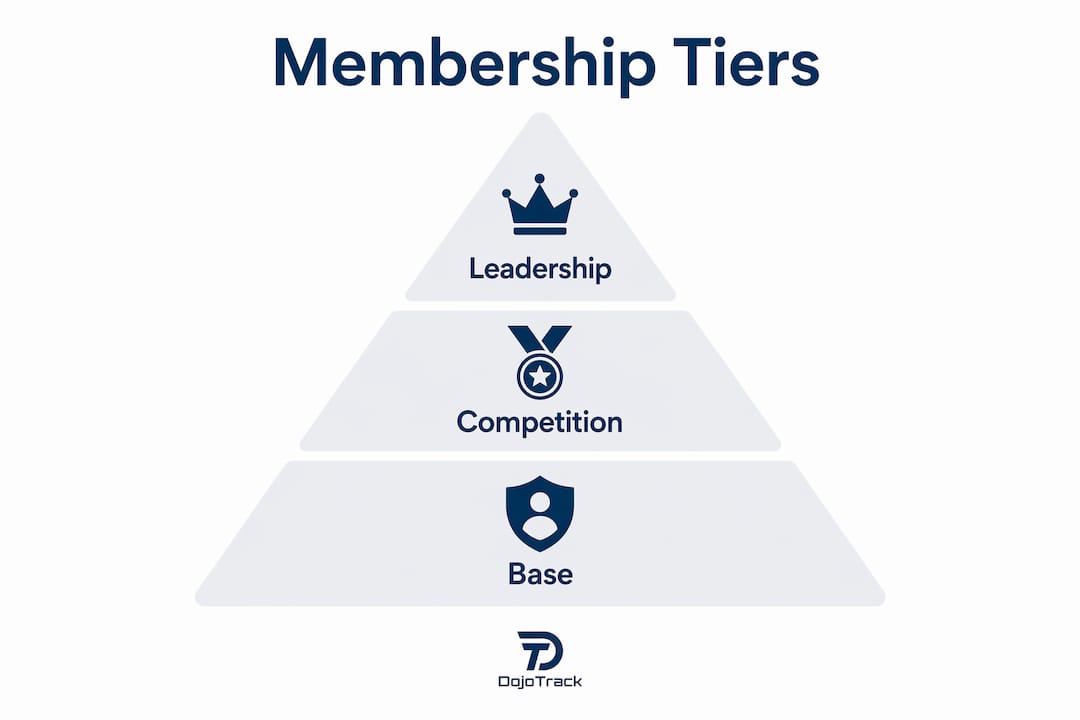
A three-tier structure is the most effective way to organize BJJ academy membership options. Three tiers give students a clear progression path, justify price differences with real benefits, and avoid the decision paralysis that comes from too many choices.

Base tier: foundational training
The base tier covers unlimited group classes, open mat access, and standard belt progression tracking. Base BJJ membership pricing should sit at $179–$199 per month. Pricing below that range signals low value to prospective students and leaves real revenue on the table for your academy.
This tier serves the majority of your student body: hobbyists, beginners, and adults training for fitness or self-defense. The benefits should be concrete and clearly listed, not vague promises of “access to the gym.”
Competition team tier: performance-focused training
The competition tier targets students who compete or plan to compete. Competition team pricing runs $249–$299 per month and includes specialized competition coaching, drilling sessions, tournament preparation, and video analysis. The higher price reflects a higher level of instructor time and a defined outcome: podium performance.
Students in this tier are your most motivated members. They train more frequently, refer teammates, and stay enrolled longer because their goals are tied directly to the program.
Leadership and coaching tier: mentorship and mastery
The top tier is built for advanced belts who want to develop as coaches or leaders within your academy. Leadership tier pricing starts at $349 per month and includes private instruction, leadership training, mentorship from senior instructors, and assistant coaching opportunities. This tier creates a pipeline of future instructors and deepens loyalty among your most advanced students.
| Tier | Monthly Price | Core Benefits |
|---|---|---|
| Base | $179–$199 | Unlimited group classes, open mat, belt tracking |
| Competition Team | $249–$299 | Competition coaching, drilling, tournament prep |
| Leadership/Coaching | $349+ | Private lessons, mentorship, assistant coaching |
Pro Tip: Label your tiers with outcome-oriented names like “Foundations,” “Competitor,” and “Black Belt Track” rather than generic labels like “Basic,” “Standard,” and “Premium.” Names that reflect student goals sell the tier before the price is even mentioned.
How to price your BJJ academy membership tiers strategically
Pricing is not just a number. It is a signal of value. Students buy outcomes, not access, so every tier’s price must connect directly to a specific result the student will achieve. An academy that charges $150 per month for “unlimited classes” is selling access. An academy that charges $189 per month for “a structured path to your blue belt in 12–18 months” is selling an outcome.
Use anchoring to your advantage
Launching all three tiers simultaneously creates an anchoring effect that makes the mid-tier feel like the obvious choice. When a prospective student sees $179, $269, and $349 side by side, the $269 competition tier reads as the best value. The top tier makes the middle tier look reasonable. The base tier looks accessible. This is not manipulation. It is clear communication of value at different commitment levels.
Anchoring also smooths price increases for existing members. When you introduce a new top tier, your current base members feel less pressure because the new tier is clearly positioned above them.
Pricing tactics that protect your revenue
- Avoid monthly-only pricing. Offer an annual payment option at a 10–15% discount. Annual members churn far less than month-to-month members.
- Never discount the base tier below $179. Discounting signals that the full price was arbitrary, which destroys trust.
- Bundle gear or events into higher tiers rather than discounting the membership price itself. A gi, a competition entry fee, or a seminar seat adds perceived value without cutting your margin.
- Review pricing every 12 months. Costs rise. Your instruction quality improves. Your pricing should reflect both.
For a deeper look at martial arts pricing models that work across different academy sizes, Dojotrack’s blog covers the full range of structures used by successful schools.
Pro Tip: When a prospective student says your price is too high, the real problem is usually that they don’t yet see the outcome clearly enough. Revisit how you describe each tier’s benefits before you consider lowering the price.
How do you implement and manage membership tiers with software?
Setting up tiers on paper is straightforward. Managing them across dozens or hundreds of students over months and years requires software. Dojotrack provides automated billing, attendance tracking, and rank progression management built specifically for BJJ academies and other martial arts schools.
Here is a practical step-by-step approach to launching and managing your tier system:
- Define each tier’s benefits in writing. List every included benefit for each tier before you build anything in software. Vague tiers create billing disputes and student confusion later.
- Build your tiers in your management platform. In Dojotrack, you configure each membership level with its price, billing cycle, and included features. The system handles Stripe-powered recurring billing automatically from that point forward.
- Automate recurring payments. Automating recurring membership payments reduces administrative work and keeps cash flow consistent. Manual invoicing creates gaps, late payments, and awkward conversations with students.
- Track attendance and promotion readiness by tier. Effective management software includes promotion readiness indicators and student progress dashboards. Knowing which competition tier members are attending consistently helps you identify who is ready to compete and who needs a check-in conversation.
- Communicate tier changes clearly and early. When you introduce new tiers or adjust pricing, give existing members at least 30 days’ notice. Explain the new structure in terms of what they gain, not what changes.
- Monitor upgrade patterns monthly. Track how many students move from base to competition tier each quarter. Low upgrade rates signal that the competition tier’s benefits are not being communicated effectively.
| Management Task | Tool or Method | Frequency |
|---|---|---|
| Recurring billing | Dojotrack automated billing | Monthly/Annual |
| Attendance tracking | Dojotrack sign-in kiosk | Per class |
| Promotion readiness | Progress dashboard | Monthly review |
| Tier upgrade outreach | Automated SMS or email | Quarterly |
What are the common pitfalls when managing BJJ membership tiers?
Most academy owners who struggle with tier management make the same handful of mistakes. Recognizing them early saves you months of lost revenue and frustrated students.
- Treating price as the only retention driver. Price matters, but owners who focus too much on price rather than clearly defined student outcomes see higher dropout rates. A student who understands exactly what they are working toward stays enrolled through plateaus and busy seasons.
- Creating too many tiers. Four or more tiers cause decision paralysis. Prospective students spend more time comparing options than committing to training. Three tiers is the ceiling for most academies.
- Failing to communicate tier benefits consistently. Your front desk staff, your website, and your intro class pitch all need to describe each tier the same way. Inconsistent messaging creates doubt.
- Ignoring existing members during a tier rollout. Transitioning current members to a new structure requires a clear, written explanation and a fair timeline. Springing price changes on loyal students without context damages trust that took years to build.
- Never revisiting the tier structure. A tier system that worked two years ago may not reflect your current class schedule, instructor team, or student demographics. Review your tiers annually and adjust based on what your data shows.
“The biggest mistake I see BJJ academy owners make is building a tier system once and never touching it again. Your academy grows. Your students’ needs change. Your pricing should evolve with both.”
For practical guidance on keeping students enrolled past the initial excitement, Dojotrack’s guide on boosting student retention covers the five steps that matter most.
Key Takeaways
Structured BJJ membership tiers with outcome-focused pricing, automated billing, and consistent communication are the most reliable way to improve student retention and grow academy revenue.
| Point | Details |
|---|---|
| Use three tiers | Base, competition, and leadership tiers cover every student goal without causing decision paralysis. |
| Price to outcomes | Base tier starts at $179–$199/month; price each tier around the result students achieve, not just class access. |
| Launch tiers together | Presenting all three tiers simultaneously creates an anchoring effect that positions the mid-tier as the best value. |
| Automate billing | Recurring payment automation reduces administrative work and keeps cash flow predictable month to month. |
| Review annually | Revisit tier benefits and pricing every 12 months to reflect your academy’s growth and student needs. |
What we’ve learned about tiers after working with hundreds of academies
The academies that manage their membership tiers most effectively share one trait: they treat the tier system as a student development tool, not just a pricing menu. When a student enrolls in the competition tier, they are not just paying more. They are committing to a specific version of themselves. That commitment is what keeps them showing up on hard weeks.
We have seen owners agonize over whether to charge $179 or $189 for the base tier while completely ignoring the fact that their competition tier has no defined outcome. The price difference is $10. The outcome gap is enormous. Students will pay more when they can see exactly what they are working toward.
The other thing worth saying directly: software makes this manageable at scale. Tracking which students are on which tier, who is approaching a promotion, and who has missed three weeks of class is not something you can do reliably in a spreadsheet once your academy passes 80 members. Dojotrack’s membership tracking tools give you that visibility without adding hours to your week.
Tier management is not a one-time setup task. It is an ongoing practice. The academies that treat it that way are the ones that grow.
— DojoTrack
How Dojotrack supports BJJ academy tier management
Dojotrack is built for exactly this kind of work. The platform handles recurring billing through Stripe, tracks attendance by membership tier, flags students who are at risk of dropping out, and gives you a real-time view of your academy’s revenue by tier. You can configure your base, competition, and leadership tiers directly in the platform and let the automation handle the rest.
If you want to understand the long-term revenue impact of your tier structure, the lifetime value calculator shows you exactly what each membership tier is worth over a student’s full enrollment. That number changes how you think about pricing, retention, and where to invest your time. Dojotrack is currently available for academies in the United States.
FAQ
What are the standard membership levels for a BJJ academy?
Most BJJ academies use three tiers: a base training membership ($179–$199/month), a competition team membership ($249–$299/month), and a leadership or coaching membership ($349+/month). Each tier targets a different student goal and commitment level.
How do I set up BJJ memberships without losing existing members?
Introduce new tiers alongside your current pricing, give existing members at least 30 days’ notice, and frame the change around added value rather than price increases. The anchoring effect of three tiers makes transitions easier for current members to accept.
Why should I avoid pricing my base membership below $179/month?
Pricing below $179 per month signals low value to prospective students and undercuts your ability to cover instructor costs, facility expenses, and quality programming. Industry pricing data shows $179–$199 as the floor for a credible base tier.
What software helps manage BJJ academy membership tiers?
Dojotrack provides automated recurring billing, attendance tracking, rank progression management, and student progress dashboards built specifically for BJJ academies and other martial arts schools in the United States.
How often should I review my BJJ dojo pricing strategy?
Review your tier structure and pricing at least once per year. Factor in changes to your instructor team, class schedule, local competition, and student demographics to keep your pricing aligned with the value you deliver.