

TL;DR:
- A purpose-built CRM system centralizes student data, billing, and communication, reducing manual work and operational bottlenecks. It improves retention, automates payments, and provides actionable insights that help studios grow efficiently. Implementing a martial arts-specific CRM enhances studio management and maximizes revenue and student engagement.
A CRM (Customer Relationship Management) system is the central software layer that connects student data, billing, scheduling, and communication inside a karate studio. Without it, you are running a business on spreadsheets, sticky notes, and memory. Studios using purpose-built CRM platforms like Dojotrack report fewer missed payments, stronger student retention, and far less time spent on admin work. The core argument for why karate studios need CRM tools comes down to one fact: manual systems cause operational bottlenecks that cost you students and revenue every single month.
Why karate studios need CRM tools for daily operations
Running a karate studio without integrated software means you are managing class schedules, tuition payments, attendance records, and parent communications across multiple disconnected systems. That fragmentation creates real problems. Double bookings, missed invoices, and forgotten follow-ups are not occasional mistakes. They are predictable outcomes of a broken process.
A purpose-built CRM fixes this by centralizing every operational function into one place. Here is what that looks like in practice:
- Automated class reminders: The system sends SMS or email reminders before every class. Automated reminders reduce no-shows by 40%–50% in studio environments. That means more students on the mat and more revenue captured per session.
- Recurring billing automation: Tuition runs on a set schedule without manual invoicing. Failed payments trigger automatic retry attempts and notifications, so you stop chasing checks.
- Centralized student records: Every student’s attendance history, belt rank, waiver status, and contact information lives in one profile. You pull it up in seconds instead of searching three different apps.
- Real-time dashboards: You see class fill rates, monthly revenue, and attendance trends at a glance. That data replaces guesswork with decisions grounded in actual numbers.
- Administrative time savings: When billing, scheduling, and communication run automatically, your front desk staff handles exceptions instead of routine tasks. That time goes back to instruction and student relationships.
Pro Tip: Set up automated billing retry logic on day one of your CRM implementation. Recovering one failed payment per week adds up to thousands of dollars annually for a mid-size studio.
The importance of CRM in martial arts operations is not theoretical. Every hour your staff spends on manual data entry is an hour not spent on the floor with students.
What CRM features are built specifically for karate studios?
Generic fitness software forces martial arts schools into workarounds. A yoga studio does not track belt promotions. A gym does not manage family accounts with multi-student discounts. Selecting a CRM built for martial arts avoids the friction that generic tools create from day one.
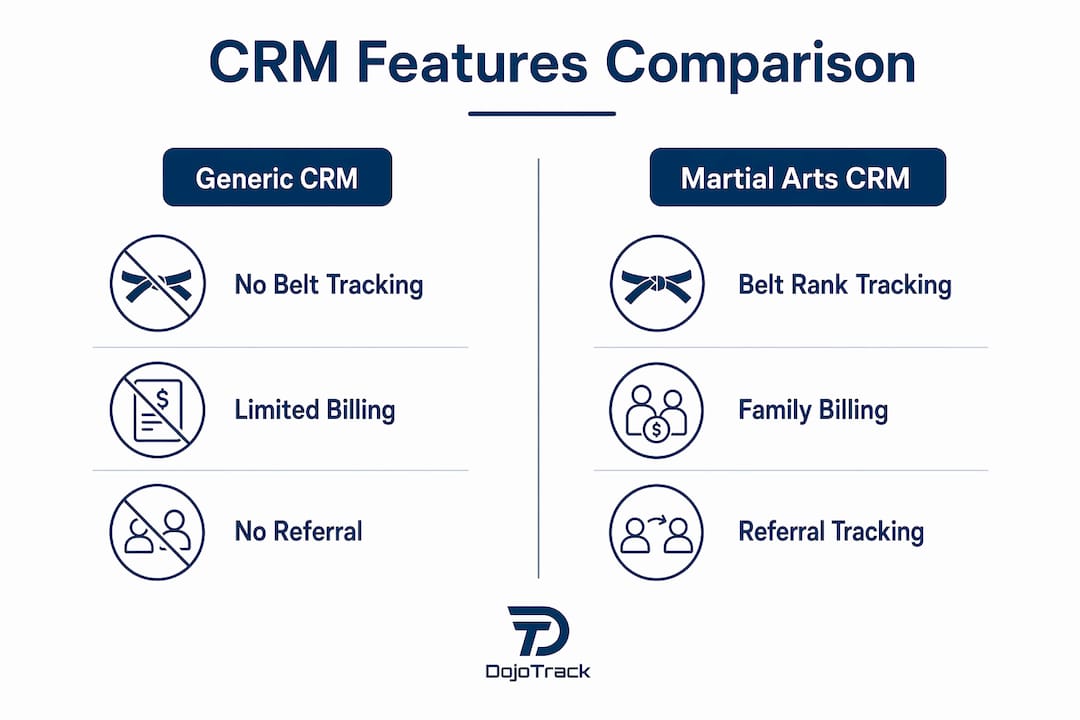
Martial arts CRM software revolves around rank tracking, family billing, and tailored retention workflows as core features, not optional add-ons. The table below shows how a purpose-built CRM compares to generic software on the features that matter most to karate studios.

| Feature | Generic CRM | Martial Arts CRM (e.g., Dojotrack) |
|---|---|---|
| Belt rank tracking | Not available | Automated progression and testing workflows |
| Family billing | Basic contact linking | Multi-student accounts with family discounts |
| Attendance tracking | Generic check-in | Class-specific martial arts attendance logs |
| Student retention alerts | Manual reporting | AI-driven at-risk student identification |
| Communication tools | Email only | SMS, email, and post-class automated follow-ups |
| Referral tracking | Not available | Source attribution tied to student LTV |
| Waiver management | Third-party integration | Built-in digital waivers |
The gap is significant. When a parent calls to ask about their child’s belt testing eligibility, a generic CRM gives you nothing. Dojotrack surfaces the student’s attendance rate, current rank, and testing history in one screen.
Referral tracking is another feature that generic tools consistently miss. Tracking referral sources through a CRM yields better student acquisition and retention outcomes compared to generic advertising. Knowing that 40% of your new students come from parent word-of-mouth tells you exactly where to invest your marketing budget.
For a detailed breakdown of how to evaluate these features, the CRM selection criteria guide from Dojotrack walks through every decision point.
How does a karate CRM improve student retention and engagement?
Student retention is the single biggest revenue lever in a karate studio. Acquiring a new student costs far more than keeping an existing one. A CRM gives you the data and automation to act before a student disappears.
Here is how a purpose-built CRM drives retention at each stage of the student lifecycle:
- Attendance trend monitoring: The system flags students whose attendance drops below a set threshold. You get an alert before they cancel, not after. That window is where you can intervene with a personal call or a check-in message.
- Automated follow-up sequences: When a student misses two consecutive classes, the CRM sends a personalized message automatically. Automated follow-ups and segmented marketing increase client engagement and retention without requiring staff to remember every at-risk student manually.
- Referral source attribution: You track where each student came from, whether that is a Google search, a Facebook ad, or a parent referral. Studios that track referral sources see lower acquisition costs and higher lifetime value from those students. The data tells you which channels produce students who stay.
- Loyalty and milestone recognition: The CRM logs belt promotions, attendance milestones, and birthdays. Automated recognition messages build the kind of community connection that keeps families enrolled for years.
- Family account visibility: When one sibling’s attendance drops, you see it in the context of the whole family account. That visibility helps you have more informed conversations with parents.
“A martial arts CRM acts as a foundational business partner that eliminates administrative friction such as missed payments and forgotten follow-ups.” — Martial Arts CRM Software: What You Need & Why It Matters
The automated SMS follow-up capability in platforms like Dojotrack is particularly effective because text messages have open rates that email cannot match. A well-timed text after a missed class often brings a student back before they mentally check out.
How to implement a CRM in your karate studio successfully
Choosing the right CRM is only half the work. Implementation determines whether the software actually changes how your studio operates or just becomes another tool nobody uses after week two.
Start with these criteria when evaluating karate studio management software:
- Martial arts specificity: Does it handle belt ranks, family accounts, and attendance natively? If you need a workaround on day one, that friction compounds over time. The comparison between generic fitness software and martial arts CRM makes this distinction clear.
- Integration with payment processing: Billing should run inside the CRM, not through a separate app. Dojotrack uses Stripe-powered recurring billing, which means payment data and student records stay connected.
- Usability for non-technical staff: Your front desk team needs to use this every day. If the interface requires training every time a new staff member joins, the system will break down.
- Scalability: A CRM that works for 50 students should also work for 300. Check whether pricing and features scale with your growth.
- Support and onboarding: Purpose-built platforms typically offer onboarding support that generic tools do not. That matters when you are migrating data from spreadsheets or a previous system.
The most common implementation mistake is treating the CRM as an optional tool rather than the operating system of the business. Staff who skip the CRM and revert to manual processes undermine the entire investment. Set a clear expectation from day one: every student interaction, payment, and communication gets logged in the system.
Pro Tip: Run a 30-day audit after launch. Pull your attendance data, check your billing failure rate, and review how many automated follow-ups fired. Those three numbers tell you whether the CRM is working or just running in the background.
For deeper guidance on getting the most out of your setup, the 5 tips for martial arts CRM success resource from Dojotrack covers the most common gaps studio owners miss after going live.
Key takeaways
A karate studio without a purpose-built CRM is leaving revenue, retention, and operational efficiency on the table every single day.
| Point | Details |
|---|---|
| CRM reduces no-shows | Automated reminders cut missed classes by 40%–50%, protecting monthly revenue. |
| Martial arts features matter | Belt tracking, family billing, and retention workflows require a purpose-built system, not a generic tool. |
| Retention starts with data | Attendance trend monitoring and automated follow-ups let you act before a student cancels. |
| Referral tracking lowers costs | Knowing your best acquisition channels reduces marketing spend and increases student lifetime value. |
| Implementation requires commitment | Staff must use the CRM daily for it to deliver results; treat it as the studio’s operating system. |
The real reason CRM tools change how studios operate
Running a martial arts school means you are a teacher, a business owner, a community builder, and an administrator all at once. Most studio owners I have spoken with did not open their school to spend hours reconciling billing spreadsheets or manually texting absent students.
What I have seen consistently is that the studios struggling most with retention are not struggling because of bad instruction. They are struggling because they have no visibility into what is happening with their students between classes. A student who misses three weeks in a row is not always quitting. Sometimes they just need someone to reach out. Without a CRM surfacing that data, nobody knows to make that call.
The other thing worth saying directly: CRM software is more than a convenience. It is the infrastructure that lets a studio grow past the point where one person can hold everything in their head. When Dojotrack was built, the goal was not to replace the instructor-student relationship. It was to protect the time and attention that relationship requires by handling everything else automatically.
The studios that treat their CRM as a growth partner, not just a billing tool, are the ones that hit 200 students and keep climbing. The ones that use it only for payments are leaving most of its value untouched.
— DojoTrack
See how Dojotrack supports your studio’s growth
If you want to understand the real financial impact of student retention, start with the Lifetime Value Calculator from Dojotrack. It shows you exactly what each enrolled student is worth over their time at your school, and what losing one student per month actually costs you annually.
Dojotrack is an AI-powered platform built specifically for martial arts schools in the United States. It combines CRM, billing, attendance tracking, belt progression, and automated communication into one system. You get the full feature set designed for karate studios, Taekwondo academies, Jiu Jitsu schools, and MMA gyms without the workarounds that generic software demands. If you are ready to run your studio on real data instead of guesswork, Dojotrack is built for exactly that.
FAQ
What does CRM stand for in a karate studio context?
CRM stands for Customer Relationship Management. In a karate studio, it refers to software that centralizes student records, billing, attendance, and communication into one platform to reduce admin work and improve retention.
Can CRM help karate studios reduce student dropouts?
Yes. CRM systems track attendance trends and trigger automated follow-ups when students go missing. Automated follow-up tools help studios re-engage at-risk students before they formally cancel.
What is the difference between generic CRM and martial arts CRM software?
Generic CRM tools lack belt rank tracking, family billing, and martial arts attendance workflows. A purpose-built platform like Dojotrack includes these as core features, not add-ons, which means faster setup and fewer operational gaps.
How does CRM improve billing in a karate studio?
A CRM automates recurring tuition charges, retries failed payments, and sends billing notifications without manual intervention. This reduces missed payments and removes the awkward task of chasing families for tuition.
How long does it take to implement a karate studio CRM?
Most purpose-built platforms can be fully operational within one to two weeks, including data migration and staff training. The key is committing to daily use from the start so the system builds accurate data from day one.