

TL;DR:
- A martial arts studio business model relies on tiered recurring memberships, capacity management, and retention policies to generate predictable revenue. Effective retention strategies, like freeze policies and tier downgrades, significantly boost long-term profitability by maintaining student engagement. Startup costs typically range from $8,000 to $30,000, with capacity management and system automation essential for scalable growth.
A martial arts studio business model is defined as a recurring membership and class instruction framework that generates predictable revenue by delivering structured training in disciplines like karate, jiu-jitsu, taekwondo, and muay thai. The US martial arts industry generates $21.0 billion in revenue as of 2025, growing at a 6.3% compound annual rate. That scale reflects a proven commercial structure, not just a passion project. Understanding what is a martial arts studio business model means understanding how tiered memberships, capacity limits, and community retention work together to create a financially stable school. This guide breaks down every layer of that structure so you can build or refine yours with confidence.
What are the typical revenue and membership structures in martial arts studios?
Recurring tuition and membership fees form the core revenue engine for any martial arts studio. The model works because students pay monthly regardless of how many classes they actually attend, which smooths out your cash flow and reduces the volatility that kills event-based businesses. Beyond base memberships, studios build layered revenue stacks that include private lessons, drop-in passes, merchandise, and event registration fees.
The most widely adopted structure is tiered recurring membership, where students choose a plan based on how many classes they want per month. AIMS Martial Arts in New York City illustrates this clearly with tiered membership pricing structured around class counts: a basic tier at 12 classes per month for $195, a premium tier at 16 classes for $225, and an unlimited tier at $240 monthly. The price gap between premium and unlimited is intentionally narrow. That gap nudges students toward the unlimited tier, which increases their commitment and reduces the likelihood they will cancel.
Here is how a standard martial arts revenue stack looks in practice:
- Base memberships: Monthly recurring fees tied to class-count tiers (basic, premium, unlimited)
- Private lessons: One-on-one instruction billed at $60 to $120 per session depending on market
- Class packs: Drop-in bundles for students not ready to commit to a full membership
- Merchandise: Uniforms, gear, branded apparel, and supplements sold through in-studio or online point-of-sale
- Testing and belt promotion fees: Charged per promotion cycle, typically $30 to $75 per student
- Seminars and events: Weekend workshops with guest instructors or competition prep sessions
| Revenue Source | Typical Frequency | Margin Profile |
|---|---|---|
| Monthly memberships | Recurring | High (predictable, low per-unit cost) |
| Private lessons | On-demand | High (instructor time only) |
| Merchandise | Sporadic | Moderate (inventory cost applies) |
| Class packs / drop-ins | Occasional | Moderate (no long-term commitment) |
| Belt testing fees | Quarterly or biannual | High (minimal overhead) |
Pro Tip: Price your unlimited tier only slightly above your premium tier. The psychological pull toward “getting more for a little extra” consistently moves students up, and unlimited members attend more often, which deepens their connection to your community and improves retention.
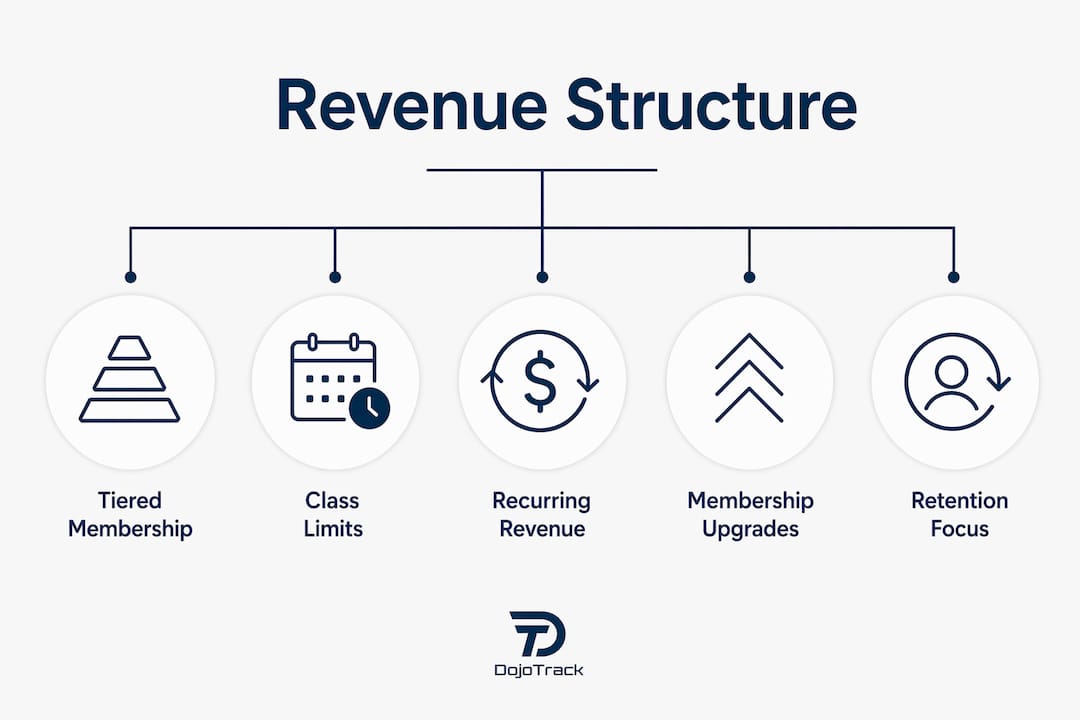
Membership tiering does more than segment pricing. It also encourages member upgrades as students grow more committed to their training. A student who joins on a basic plan and catches the bug will naturally want more mat time, and your tier structure should make upgrading feel like the obvious next step.
How do membership retention strategies impact a martial arts studio’s business model?
Retention is where most studio business models either hold together or fall apart. Acquiring a new student costs significantly more than keeping an existing one, so every policy you set around cancellations and pauses directly affects your bottom line. Flexible membership policies including freeze options and tier adjustments are retention levers that leading studios use deliberately, not as afterthoughts.

The freeze policy is one of the most underused tools in martial arts school management. Anderson’s Martial Arts Academy in New York City structures its freeze policy with a 30-day advance notice requirement, freeze durations ranging from one to four months, and a reduced fee of $25 per month during the freeze period. That $25 keeps the student financially connected to the studio while removing the pressure that would otherwise push them to cancel outright. A student who freezes almost always returns. A student who cancels rarely does.
Here are the five retention mechanics every studio business model should include:
- Freeze or suspension option: Allow members to pause for one to four months with advance notice and a nominal hold fee. This prevents cancellations driven by travel, injury, or financial stress.
- Cancellation notice window: Require 30 days written notice before cancellation. This gives you time to reach out, address concerns, and potentially retain the student.
- Tier downgrade option: Let students drop to a lower tier instead of canceling entirely. Keeping them in the ecosystem at a reduced rate beats losing them completely.
- Re-engagement outreach: Use automated SMS or email sequences to contact students who have missed two or more consecutive weeks. Early contact prevents the drift that leads to cancellation.
- Milestone recognition: Celebrate belt promotions, attendance streaks, and anniversaries publicly in class and through your student app. Recognition builds emotional investment that money cannot replicate.
Pro Tip: Track attendance weekly, not monthly. A student who misses two weeks in a row is at risk. A student who misses four weeks is likely already gone mentally. DojoTrack’s AI-driven retention system flags at-risk students automatically so you can act before the cancellation request arrives.
The connection between retention and long-term studio profitability is direct. A student retained for three years at $200 per month generates $7,200 in lifetime value. Losing that student after six months costs you $5,400 in potential revenue. Multiply that across 20 students per year and the financial case for investing in retention infrastructure becomes impossible to ignore.
What startup costs and operational factors influence the martial arts studio business model?
Knowing your cost structure before you open is the difference between a studio that survives its first year and one that closes by month eight. Startup costs for a standalone studio typically range from $8,000 to $30,000 depending on location, size, and how much buildout the space requires.
| Cost Category | Typical Range | Notes |
|---|---|---|
| Flooring (mats, tatami, spring floor) | $2,000 to $10,000 | Largest single startup expense for most studios |
| Equipment (bags, pads, mirrors, weapons racks) | $2,000 to $5,000 | Scales with discipline and class size |
| Landlord deposit and first/last month rent | $3,000 to $12,000 | Varies heavily by market and square footage |
| Legal and insurance | $500 to $2,000 | Liability insurance is non-negotiable |
| Software and technology setup | $200 to $800 | CRM, billing, scheduling, and waiver systems |
| Marketing and signage | $500 to $3,000 | Launch campaign, website, and local advertising |
Space planning directly shapes your cost structure and your revenue ceiling. Studios require 120 to 150 square feet per student on the mat at peak times, which means a 1,500 square foot studio can accommodate 10 to 12 students concurrently. Running three to five class batches per day across that space is the standard operating model. If your peak capacity is 12 students per class and you run four classes daily, your theoretical daily attendance ceiling is 48 student visits. That number, combined with your membership pricing, sets the upper bound of your daily revenue.
Legal and insurance costs are fixed obligations that new owners frequently underestimate. General liability coverage for a martial arts studio runs $500 to $1,500 annually, and some landlords require additional named-insured endorsements before you can sign a lease. Budget for these before you sign anything.
How does capacity management function as a core principle in martial arts studio business models?
The real business model of a martial arts studio is effective capacity management presented as curriculum. Your pricing reflects instructor time and space availability, not just the value of the techniques being taught. This is the insight that separates studios that scale from those that plateau.
“Tiered memberships with class-count limits allow precise forecasting of instructor time and space utilization, which stabilizes profitability despite attendance variability.” — AIMS Martial Arts NYC
Class-count caps in your membership tiers serve a specific operational function. When you know that 40 students are on basic plans capped at 12 classes per month, you can calculate the maximum number of instructor hours those students will consume. That forecast lets you schedule instructors, plan class sizes, and price your tiers accurately without guessing.
Here is how capacity management connects to every layer of your business model:
- Scheduling: Class-count limits spread attendance across time slots, preventing any single class from being overcrowded while others run empty.
- Staffing: Predictable attendance patterns let you hire and schedule instructors with confidence rather than reacting to daily fluctuations.
- Pricing: Higher-tier members pay more because they consume more instructor time and floor space, not just because they attend more often.
- Quality of instruction: Capped class sizes protect the student-to-instructor ratio that makes your teaching effective and your reputation strong.
Studios that ignore capacity management often find themselves with a full schedule, a busy floor, and shrinking margins. The fix is not raising prices across the board. It is building tier structures that accurately reflect the cost of delivering instruction at each attendance level.
What are actionable strategies for studio owners to optimize their business model and grow?
Growth in a martial arts studio does not happen by accident. It comes from deliberate decisions about pricing, timing, and the systems you use to manage operations. These four strategies have the clearest impact on revenue and student volume.
-
Offer pre-pay discounts for annual and quarterly plans. Annual and quarterly payment plans with 10 to 15% discounts improve cash flow and reduce the time you spend chasing monthly payments. A student who pays $2,160 upfront for an annual plan at a 10% discount gives you capital to invest in equipment, marketing, or staff while committing to stay for a full year.
-
Target enrollment windows strategically. Back-to-school season in August and September, New Year in January, and spring break in March are the three highest-conversion enrollment periods for martial arts studios. Run promotions, waive enrollment fees, or offer a free trial week during these windows to capture demand that already exists.
-
Build a clear upgrade path between tiers. Students who attend consistently will naturally want more classes. Make the upgrade conversation easy by training your front desk staff to mention tier benefits at the 60-day mark. A student moving from basic to unlimited adds $45 per month to your revenue with zero acquisition cost.
-
Use class management software to reduce administrative drag. Manual billing, paper waivers, and spreadsheet attendance tracking cost you hours every week. Those are hours you could spend on the mat. Platforms built for martial arts school management automate recurring billing, track attendance, and surface retention risks before they become cancellations.
Pro Tip: Run your enrollment promotions for exactly two weeks, not a full month. Scarcity drives decisions. A 30-day window gives prospects permission to wait. A 14-day window creates urgency that converts browsers into paying students.
Key takeaways
A successful martial arts studio business model is built on tiered recurring memberships, deliberate capacity management, and retention policies that keep students engaged long enough to generate meaningful lifetime value.
| Point | Details |
|---|---|
| Core revenue structure | Tiered recurring memberships with class-count limits form the financial foundation of every studio. |
| Retention is revenue | Freeze policies and tier downgrades prevent cancellations and protect long-term student lifetime value. |
| Startup costs are predictable | Budget $8,000 to $30,000 for flooring, equipment, deposits, and legal setup before opening. |
| Capacity drives pricing | Class-count limits in tiers allow accurate forecasting of instructor time and space costs. |
| Growth requires systems | Pre-pay discounts, enrollment windows, and management software accelerate revenue without adding headcount. |
The uncomfortable truth about martial arts studio business models
We have worked with studio owners across the country, and the pattern we see most often is this: technically excellent instructors running financially fragile businesses. The martial arts knowledge is deep. The business infrastructure is thin.
The most common mistake is treating membership pricing as a reflection of how good your teaching is rather than how much it costs to deliver that teaching. Your unlimited tier should not be priced at $240 because you feel that is what your instruction is worth. It should be priced at $240 because that is what covers your instructor hours, floor space, and overhead at that attendance level while leaving a margin that keeps the school alive.
The second mistake is underinvesting in retention systems until students are already leaving. By the time a student submits a cancellation request, the decision was made weeks earlier. The studios that grow consistently are the ones that catch disengagement signals early, whether through attendance tracking, automated check-ins, or AI-powered tools that flag at-risk members before the damage is done.
Flexible policies are not a sign of weakness. They are a sign of a business that understands its customers. A student who freezes for two months and returns is worth far more than a rigid policy that forces them to cancel and never come back. The student lifetime value math makes this obvious once you run the numbers.
Build the business model first. The curriculum will always be there. The cash flow will not manage itself.
— DojoTrack
How DojoTrack helps you run a stronger studio business model
DojoTrack is an AI-powered martial arts studio management platform built specifically for schools like yours. It handles recurring billing and membership management automatically through Stripe, tracks attendance in real time, and uses AI to identify students at risk of dropping out before they cancel. The platform supports tiered memberships, family discounts, digital waivers, and a student mobile app that keeps members engaged between classes. If you are currently managing billing and retention manually, migration to DojoTrack is designed to be fast and data-safe. Explore DojoTrack’s full platform to see how it fits your studio’s business model and growth goals.
FAQ
What is a martial arts studio business model?
A martial arts studio business model is a recurring membership and class instruction framework where students pay monthly fees for access to structured training in disciplines like karate, jiu-jitsu, or taekwondo. Revenue comes from tiered memberships, private lessons, merchandise, and belt testing fees.
What are typical martial arts membership pricing tiers?
Most studios offer three tiers: a basic plan with 12 classes per month around $195, a premium plan with 16 classes around $225, and an unlimited plan around $240 monthly. The narrow gap between premium and unlimited is intentional and encourages upgrades.
How much does it cost to start a martial arts studio?
Startup costs for a standalone martial arts studio typically range from $8,000 to $30,000, covering flooring ($2,000 to $10,000), equipment ($2,000 to $5,000), landlord deposits ($3,000 to $12,000), and legal and insurance costs.
How do freeze policies help with student retention?
Freeze policies allow students to pause their membership for one to four months at a reduced fee instead of canceling outright. Studios like Anderson’s Martial Arts Academy charge $25 per month during a freeze, which keeps the student financially connected and dramatically increases the chance they return.
What is the best way to grow martial arts studio revenue?
Offering annual pre-pay discounts of 10 to 15%, targeting enrollment during back-to-school and New Year windows, and building clear upgrade paths between membership tiers are the three highest-impact strategies for growing martial arts studio revenue without increasing acquisition costs.