

TL;DR:
- Automation helps small martial arts schools manage scheduling, billing, and student retention more efficiently without adding staff. It increases enrollment, improves retention, and provides consistent communication through trigger-based workflows and an AI-enabled digital front desk. Implementing targeted automation steps gradually yields measurable growth and operational benefits over time.
Automation is the operational backbone small martial arts schools need to compete, retain students, and grow without adding staff. Most small schools run on one or two instructors handling everything from teaching classes to answering phones to chasing overdue payments. That model breaks down fast. Platforms like Dojotrack and AI-powered management tools now act as a 24/7 digital front desk, handling scheduling, lead follow-up, billing reminders, and student retention triggers automatically. The result is a school that runs with fewer gaps, fewer missed opportunities, and more time on the mat where it counts.
Why small martial arts schools need automation to survive
Small schools benefit the most from automation precisely because they lack dedicated administrative staff. Every missed call is a missed enrollment. Every forgotten follow-up is a student who signed up somewhere else. Automation removes these bottlenecks by replacing manual tasks with reliable, repeatable workflows that run whether you are teaching a class or sleeping.

The core concept here is studio management automation, the industry term for using software to handle scheduling, billing, communications, and retention without manual input. This is not just about saving time. It directly affects revenue. Many small schools lose 20–40% of inbound calls due to staff limitations, and an AI phone agent can answer calls around the clock, book trial classes, and capture lead details without any human involvement.
Consider what happens when a parent calls at 7:45 PM to ask about your kids’ program. Without automation, that call goes to voicemail. With an AI phone agent, the call is answered, the parent gets information, and a trial class is booked before you finish teaching your evening session. That single workflow change can recover thousands of dollars in annual enrollment.
Automation also creates predictable enrollment growth. Systems designed around martial arts workflows produce more consistent results than ad hoc manual processes because every lead, every trial, and every renewal follows the same reliable path.
How does automation remove scheduling and front desk bottlenecks?
Scheduling is where small schools lose the most time and revenue. Manual class sign-ups, phone-tag with prospects, and fragile trial bookings all create friction that costs you students before they ever walk through the door.
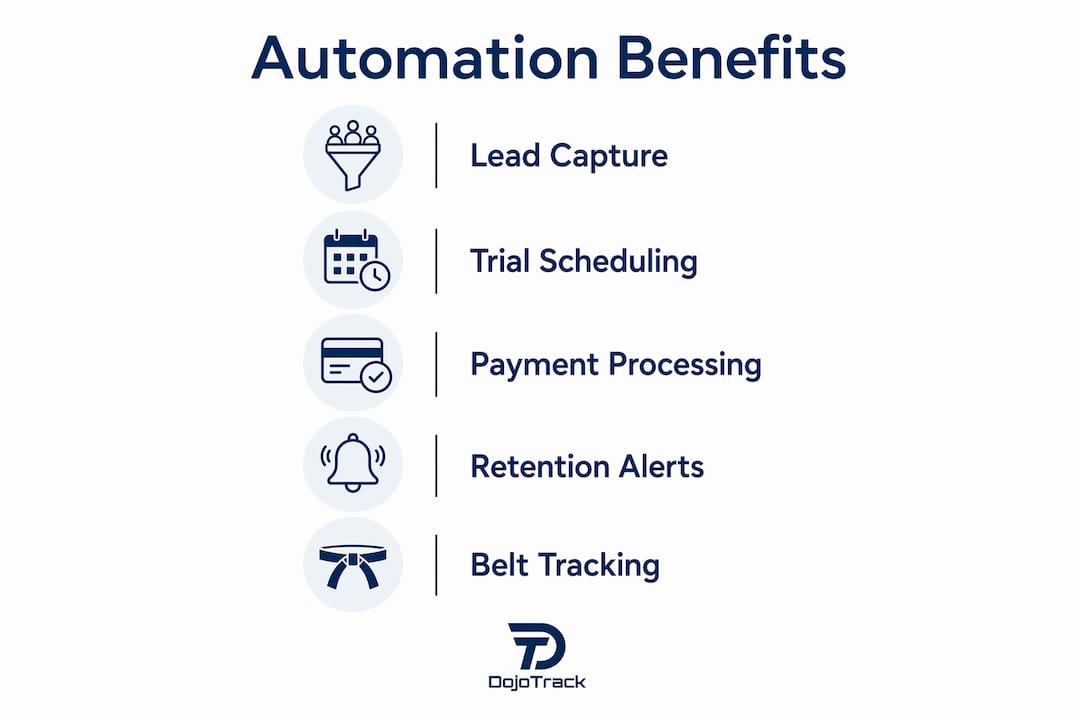
Automated scheduling tools handle the following tasks without staff involvement:
- Trial class bookings confirmed instantly via SMS or email
- Class reminders sent 24 hours and 1 hour before each session
- Waitlist management with automatic notifications when spots open
- New student intake forms and digital waivers collected before the first visit
- Missed call follow-ups triggered within minutes of a missed inquiry
Each of these tasks, done manually, takes 5–15 minutes per student. Multiply that across 50 active leads per month and you are looking at hours of administrative work that automation handles in seconds.
The 24/7 digital front desk model is the clearest way to understand the value. Your school is effectively open and responsive at all hours, even when you are on the mat. That responsiveness directly reduces no-shows and increases trial-to-member conversion rates.
Pro Tip: Start your automation rollout with just two workflows: lead response and trial class scheduling. These two alone deliver the fastest return and the clearest proof of value before you expand to billing or retention automation.
Does automation actually improve student retention?
Retention is where automation pays its biggest dividend. The difference between a school that grows and one that stagnates is almost always retention, not new enrollment. Trigger-based automation outperforms one-off campaigns because it responds to real student behavior rather than broadcasting generic messages to everyone.
The key trigger points that drive retention are:
- Missed class alerts sent within 24 hours of an absence
- Expiring membership notices sent 7 and 3 days before renewal
- At-risk engagement signals flagged when attendance drops below a threshold
- Belt promotion reminders tied to curriculum progress milestones
- Reactivation sequences for students who have gone inactive for 30 or more days
Each of these triggers fires automatically based on data your system already tracks. You do not need to remember to send a message. The system does it for you, every time, with consistent timing and personalized content.
SMS is the most effective channel for these messages. SMS open rates consistently outperform email across marketing channels. That means your retention messages are actually being read, not buried in an inbox. Pairing SMS with automated follow-up sequences creates a communication rhythm that keeps students engaged between classes and reduces the silent drop-off that kills small school revenue.
Pro Tip: Build your no-show recovery sequence as a three-step flow: a same-day check-in message, a 48-hour rebook offer, and a 7-day reactivation message. Each step should include a direct link to reschedule. Separating messages from scheduling paths cuts recovery rates significantly.
What features should small school management software include?
Choosing the right platform matters as much as deciding to automate. Disconnected tools with multiple logins and asynchronous data create their own inefficiencies. Unified platforms reduce errors and speed up decision-making compared to stitching together separate apps for billing, scheduling, and communications.
Here is how the key platforms compare on features relevant to small martial arts schools:
| Feature | Dojotrack | Generic CRM | Spreadsheet-Based |
|---|---|---|---|
| Martial arts belt tracking | Yes | No | Manual |
| Automated billing (Stripe) | Yes | Varies | No |
| AI retention alerts | Yes | No | No |
| SMS follow-up automation | Yes | Limited | No |
| Student mobile app | Yes | No | No |
| Trial booking automation | Yes | Limited | No |
| Attendance tracking | Yes | No | Manual |
| AI phone answering | Yes | No | No |
Dojotrack is purpose-built for martial arts schools, which matters more than it sounds. A generic CRM does not know what a belt promotion is. It cannot flag a student who has missed three consecutive classes as at-risk. It cannot automatically send a congratulations message when a student earns a new rank. These are martial arts-specific workflows that generic tools simply do not support.
The cost-effectiveness argument is straightforward. One recovered student per month, at an average membership value of $150, covers the cost of most small school management software. The ROI math favors automation quickly, especially when you factor in reduced administrative hours.
What are the biggest mistakes when implementing automation?
Most automation projects fail not because the technology is wrong but because the implementation is too broad or too vague. Lead response automation pays back in a median of 1.4 months. Broader back-office automation takes longer but adds real value when built in sequence rather than all at once.
The most common mistakes small schools make are:
- Starting too broad: Trying to automate everything at once leads to confusion and abandoned projects
- Skipping baseline metrics: You cannot measure improvement without knowing your starting numbers for no-show rates, lead conversion, and retention
- Using disconnected tools: Running scheduling in one app, billing in another, and communications in a third creates data gaps and manual reconciliation work
- Ignoring process design: Automation amplifies your existing process. A broken process automated at scale produces broken results faster
The right approach is sequential. Start with lead response and trial booking. Measure results for 30 days. Then add no-show recovery. Then add membership renewal reminders. Each layer builds on the last, and each one is measurable on its own.
Well-scoped automation projects can exceed 300% ROI within the first year. Top-performing schools that review their automation metrics monthly and refine their workflows have achieved over 500% ROI. Those numbers come from discipline in implementation, not from buying the most expensive software.
Pro Tip: Treat your trial booking flow as a structured funnel, not a single confirmation message. Map out every step: inquiry, booking confirmation, pre-visit reminder, post-visit follow-up, and enrollment offer. Each step should link directly to the next action. Automated linked workflows consistently outperform isolated messages.
Key takeaways
Small martial arts schools that implement targeted, sequential automation gain measurable advantages in lead conversion, student retention, and operational efficiency that manual processes cannot match.
| Point | Details |
|---|---|
| Start narrow, expand later | Begin with lead response and trial booking before adding billing or retention automation. |
| Trigger-based retention wins | Missed class alerts and expiring membership notices outperform generic broadcast campaigns. |
| Unified platforms beat disconnected tools | A single platform like Dojotrack eliminates data gaps and reduces manual reconciliation work. |
| SMS is your highest-impact channel | SMS open rates lead all marketing channels, making it the best medium for retention messages. |
| Measure before you automate | Establish baseline metrics for no-shows, conversion, and retention before launching any workflow. |
What I have learned running martial arts schools with automation
Running a martial arts school taught me that the mat time is the product, and everything else is overhead. The moment you spend your evening chasing down a parent about an overdue payment instead of coaching your advanced students, you have lost something you cannot get back.
What surprised me most about automation was not the time it saved. It was the consistency it created. Before automated workflows, student communication depended entirely on whoever was working that day. Some students got a follow-up call after missing class. Others did not. That inconsistency was silently killing retention, and I did not see it until the data made it obvious.
The schools I have seen struggle with automation share one trait: they treat it as a technology project instead of a process project. The software is not the hard part. Deciding exactly what you want to happen when a student misses two consecutive classes, and then building that sequence deliberately, is the hard part. Get the process right first. The technology just runs it reliably.
My honest advice is to start with the one workflow that costs you the most money right now. For most small schools, that is missed leads outside business hours. Fix that first. See the results. Then build from there. Automation is not a destination. It is a discipline you develop over time, one workflow at a time.
— Dojotrack
See how Dojotrack handles this for you
Dojotrack is built specifically for martial arts schools in the United States, and it handles every workflow described in this article inside one platform. From AI phone answering and automated trial bookings to belt tracking, SMS retention sequences, and Stripe-powered billing, Dojotrack replaces the manual tasks that drain your time and cost you students. Schools using Dojotrack report meaningful gains in lead conversion and retention within the first 60 days. If you want to see what your current retention gaps are actually costing you, use the free Lifetime Value Calculator to put a real number on it before you decide anything.
FAQ
Why do small martial arts schools need automation more than large ones?
Small schools typically have one or two staff members handling all administrative tasks, leaving no margin for missed calls or manual follow-ups. Automation fills that gap by running lead capture, scheduling, and retention workflows without additional headcount.
What is the fastest automation to implement for a martial arts school?
Lead response and trial class scheduling deliver the fastest return, with median payback in 1.4 months. These two workflows require minimal setup and produce measurable results within the first month.
How does automation improve student retention in martial arts schools?
Automation improves retention by sending trigger-based messages when students miss class, when memberships are about to expire, or when engagement drops. These timely, personalized touchpoints keep students connected and reduce silent drop-off.
What should I look for in small school management software?
Look for a platform that combines CRM, attendance tracking, automated billing, SMS communications, and belt promotion tracking in one place. Disconnected tools create data gaps that undermine the efficiency gains automation is supposed to deliver.
Can automation replace the personal connection in a martial arts school?
Automation handles administrative tasks so you have more time for personal connection, not less. The goal is to remove the overhead that pulls you away from teaching and mentoring, not to replace the human relationships that make martial arts schools worth attending.
Recommended
- The Ultimate Guide to Martial Arts School Automation: Everything You Need to Succeed in 2025 | DojoTrack
- Best Martial Arts Studio Software for Small Schools: Features, Benefits, and AI Advantages | DojoTrack
- Why Automate Martial Arts Administrative Tasks in 2026
- What You’re Missing Without Martial Arts Software | DojoTrack