

TL;DR:
- Stripe acts as the payment processor that handles card and bank transfers for martial arts schools. Studio management software manages billing rules and membership access, relying on Stripe’s webhook events to stay synchronized. Proper setup of the integration improves revenue, reduces payment failures, and automates recurring billing, especially through features like Smart Retries and ACH transfers.
Stripe payments in martial arts schools serve as the payment infrastructure layer that processes transactions securely while specialized studio software handles the billing logic. The role of Stripe payments in martial arts schools is not to replace your billing system. It is to power it. Stripe processes credit cards, ACH bank transfers, Apple Pay, and American Express, while your studio management platform manages membership tiers, family discounts, belt testing fees, and attendance records. Without both working together, you are either processing payments manually or leaving serious money on the table.
How Stripe payments integrate with martial arts studio management software
Stripe alone does not manage class credits, membership access, or attendance billing. That is the single most important thing to understand before you set up payment processing for your dojo. Stripe is the engine. Your martial arts software is the transmission. Neither works at full capacity without the other.
The technical connection between Stripe and your studio software runs through webhooks. Webhooks are automated messages Stripe sends to your software when something happens, such as a payment succeeding, a card declining, or an invoice coming due. Key webhook events include:
- payment_intent.succeeded: Confirms a charge went through and triggers access or enrollment updates.
- payment_failed: Signals a declined card so your software can suspend access or begin a retry sequence.
- invoice.upcoming: Fires 3–7 days before a charge, giving members time to update expired cards.
- customer.subscription.deleted: Triggers membership cancellation workflows automatically.
Configuring webhooks correctly is critical for keeping payment status and member access in sync. A misconfigured webhook means a student whose card declined still walks into class, and you find out weeks later when reconciling your books.
Martial arts billing has layers that generic payment processors cannot handle. You need software that supports attendance-linked billing (charging only when a student attends a certain number of classes), family account discounts, and rank-based fees for belt testing. Martial arts billing software built on Stripe automates invoicing for belt testing fees, family memberships, and attendance-triggered payments, eliminating missed charges and reducing admin time.

Pro Tip: Before signing up for any studio management platform, confirm it uses Stripe’s official API and supports webhook event handling. Platforms that use Stripe in a limited way often miss the retry logic and notification features that protect your revenue.
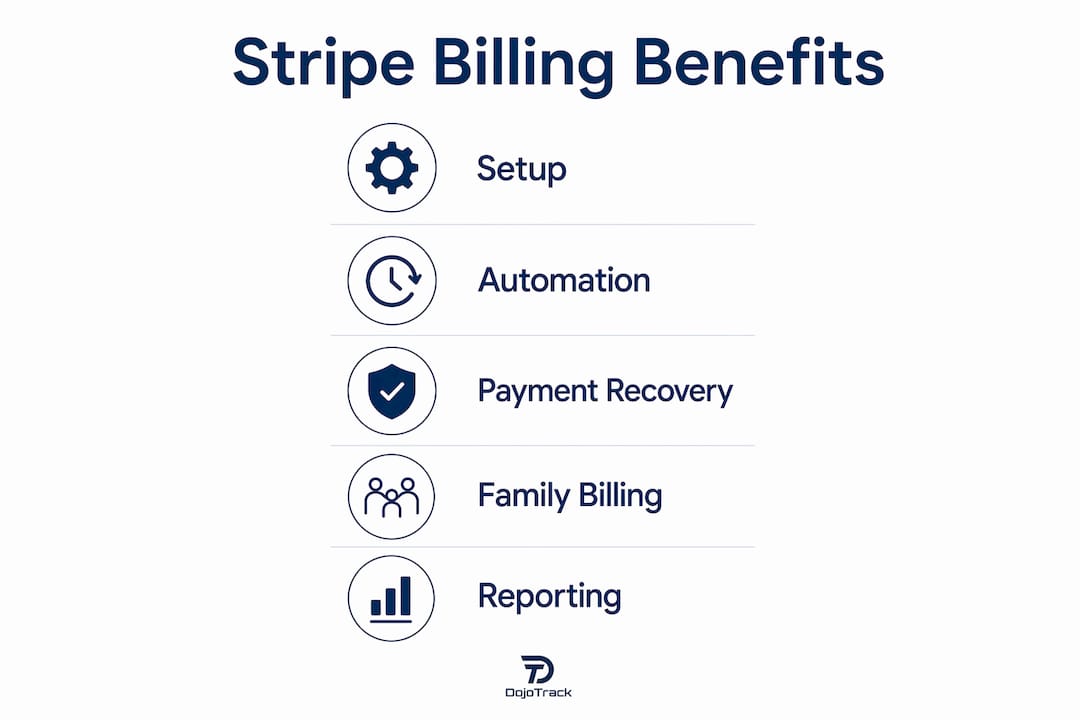
What are the key benefits of Stripe for billing automation?
Automated recurring billing is the biggest financial advantage Stripe brings to a martial arts school. Stripe’s subscriptions API manages recurring memberships with automatic renewal and retry logic, which means monthly tuition charges happen without you touching anything. That alone eliminates hours of manual invoicing every month.
The benefits go well beyond basic automation:
- Smart Retries: Stripe uses machine learning to retry failed payments at the times most likely to succeed. A card that fails on the 1st of the month might succeed on the 3rd when a paycheck clears. This recovers revenue that would otherwise disappear.
- Pre-billing notifications: Sending an automated reminder 3–7 days before a charge gives members time to update expired cards. Pre-billing notifications reduce failed payments and improve cash flow without any manual outreach from your staff.
- ACH bank transfers: ACH fees run around 0.8% capped at $5, compared to 2.9% plus $0.30 for standard credit card transactions. On a $150 monthly membership, that difference adds up to real savings across hundreds of students.
- Multiple payment methods: Stripe supports Mastercard, American Express, Apple Pay, and ACH bank transfers, reducing friction for members who prefer different payment options.
The cash flow impact of these features is direct. Fewer failed payments mean more predictable monthly revenue. Lower processing fees mean more of each dollar collected stays in your account. Better payment method coverage means fewer members drop off because their preferred option is not available.
Pro Tip: Offer ACH as a payment option at enrollment, especially for families paying multiple tuition fees. The fee savings on high-volume accounts are significant, and many members prefer bank transfers for recurring charges.
How to implement Stripe payments at your dojo
Setting up Stripe correctly from the start saves you from billing headaches later. Follow these steps to build a payment system that works without constant manual intervention.
- Create and verify your Stripe account. Complete business verification, add your bank account for payouts, and enable the payment methods relevant to your student base, including ACH if you plan to offer it.
- Connect Stripe to your studio management software. Use the platform’s native Stripe integration rather than a manual API setup. Dojotrack, for example, connects Stripe directly to its membership and billing engine so that payment status automatically updates student records.
- Configure webhook endpoints. Set up your software to receive and act on key Stripe events. Test each webhook in Stripe’s dashboard before going live to confirm your software responds correctly.
- Enable Smart Retries in your Stripe settings. This is an on/off toggle in the Stripe dashboard. Turn it on. It costs nothing extra and recovers failed payments automatically.
- Set up pre-billing notification emails and SMS. Configure your studio software to send reminders 3–7 days before each charge using the invoice.upcoming webhook. Personalize the message with the student’s name and the upcoming charge amount.
- Define grace periods and access rules. Decide how many days after a failed payment a student retains class access. Grace periods of 7–14 days are standard before access is restricted. Automate this in your software so no manual suspension is needed.
- Offer ACH at enrollment. Add ACH bank transfer as a payment option on your enrollment form. Explain the benefit to families paying for multiple students.
Setting up recurring membership payments through an integrated platform takes most of this complexity off your plate. The key is choosing software that handles the billing logic, not just the payment gateway connection.
Common challenges in martial arts billing and how Stripe addresses them
Failed payments are the most common revenue leak in martial arts schools. A card declines, the studio does not notice for days, and the student keeps attending. By the time someone follows up, the member feels awkward and sometimes quits rather than resolve the issue. Stripe’s Smart Retries and automated dunning sequences break this cycle before it starts.
The table below shows the most common billing challenges and how a Stripe-integrated system handles each one.
| Challenge | How Stripe integration solves it |
|---|---|
| Declined cards and involuntary churn | Smart Retries attempt recovery at optimized times without manual follow-up |
| Complex family membership billing | Studio software applies family discounts and bills all accounts through one Stripe customer record |
| Rank and belt testing fees | Automated invoicing triggers when a student is marked eligible for testing |
| Payment reconciliation | Stripe’s dashboard and reporting sync with studio software for accurate monthly records |
| Expired card management | Pre-billing notifications prompt members to update cards before charges fail |
Managing family memberships is where generic payment processors fall short. A family with three students needs a single billing account, individual attendance records, and a discounted rate applied automatically. Stripe-powered martial arts software handles this by linking multiple student profiles to one parent payment method and applying billing rules at the software level.
Payment reconciliation is another area where the integration pays off. Stripe generates detailed transaction records, and studio software that reads those records eliminates the manual work of matching payments to student accounts at the end of each month. You get accurate revenue reports without building spreadsheets by hand.
Using Smart Retries combined with customized dunning email sequences improves payment recovery better than default messages and manual follow-ups. Studios that automate both the retry logic and the member communication see fewer involuntary cancellations and spend less staff time chasing payments.
Key Takeaways
Stripe powers martial arts billing best when paired with studio-specific software that handles membership logic, family accounts, and automated retry workflows.
| Point | Details |
|---|---|
| Stripe needs a software partner | Stripe alone cannot manage rank fees, family discounts, or attendance billing without studio-specific software. |
| Smart Retries protect revenue | Machine learning retries failed payments at optimal times, recovering charges that would otherwise be lost. |
| ACH cuts processing costs | ACH fees of around 0.8% capped at $5 save significant money compared to standard credit card rates. |
| Pre-billing notifications reduce failures | Sending reminders 3–7 days before charges gives members time to update payment methods before cards decline. |
| Webhook configuration is non-negotiable | Correctly set webhooks keep payment status and class access in sync, preventing billing and access mismatches. |
The real cost of ignoring payment infrastructure
Running a martial arts school means you are already managing curriculum, student retention, staff schedules, and marketing. Payment infrastructure feels like a back-office detail until a billing failure costs you a long-term student or a month of revenue.
Here is what Dojotrack has seen consistently: studios that treat Stripe as a plug-and-play solution without proper software integration end up with the same problems they started with, just with a fancier payment page. The retry logic does not fire. The webhooks are not configured. Family accounts are billed manually. The front desk is still chasing declined cards by phone.
The studios that get this right do one thing differently. They choose software built specifically for martial arts billing and let it handle the complexity. ACH is a perfect example. Most studio owners know credit card fees exist, but very few actively offer ACH as an alternative at enrollment. That is leaving real money on the table every single month, especially for families paying for multiple students.
Automated payment systems also change the dynamic with members. When a card declines and the system handles it quietly through retries and a polite email, the member fixes it without embarrassment. When a staff member calls to ask for payment, the conversation gets awkward fast. The technology protects the relationship.
The investment in a properly integrated payment system is not just about efficiency. It is about building a studio that runs predictably, retains members longer, and gives you time you could spend on the mat instead of in a spreadsheet.
— Dojotrack
Dojotrack brings Stripe billing to your martial arts school
Dojotrack is built for martial arts school owners who want payment processing that actually fits how their business works. The platform connects Stripe-powered recurring billing directly to membership management, attendance tracking, family accounts, and belt testing fees. You get automated invoicing, Smart Retry support, pre-billing notifications, and ACH payment options without configuring any of it yourself. Dojotrack handles the billing logic so you are not stitching together a payment gateway and a spreadsheet. Studio owners in the United States can request a demo at dojotrack.com and see how integrated martial arts payment management works in practice.
FAQ
What is the role of Stripe payments in martial arts schools?
Stripe serves as the payment infrastructure that processes credit cards, ACH transfers, and digital wallets. Studio-specific software built on Stripe handles the billing logic for memberships, rank fees, and family accounts.
Can Stripe handle recurring membership billing on its own?
Stripe’s subscriptions API manages recurring charges and retry logic, but it requires martial arts software to apply studio-specific rules like family discounts, attendance billing, and rank-based fees.
How does Stripe reduce failed payments at a dojo?
Stripe’s Smart Retries use machine learning to retry declined cards at optimized times. Pre-billing notifications sent 3–7 days before a charge also give members time to update expired payment methods before a failure occurs.
Is ACH a good payment option for martial arts schools?
ACH bank transfers through Stripe cost around 0.8% capped at $5 per transaction, compared to 2.9% plus $0.30 for credit cards. For studios collecting high monthly tuition volumes, the fee savings are substantial.
What happens when a student’s payment fails?
A properly configured Stripe integration triggers Smart Retries automatically and sends dunning emails to the member. Grace periods of 7–14 days are standard before class access is restricted, giving members time to resolve the issue without staff intervention.