

TL;DR:
- Recurring billing in martial arts automates member charges on a set schedule, improving cash flow and reducing administrative tasks. It varies from recurring invoices and subscription models, with flexible cycles, better payment recovery, and seamless integration to enhance revenue stability and member experience. Selecting a system that supports automatic retries, secure processing, and clear communication ensures operational efficiency and stronger member relationships.
If you’ve ever spent a Friday afternoon chasing down overdue membership payments instead of preparing for class, you already understand why recurring billing for martial arts matters. Many studio owners assume billing is just “sending invoices and hoping people pay.” What is recurring billing in martial arts, really? It’s an automated system that charges members on a set schedule without you lifting a finger. Done right, it protects your cash flow, cuts your administrative workload, and gives your members a payment experience that feels professional and frictionless.
Table of Contents
- Key takeaways
- What is recurring billing in martial arts
- Benefits of recurring billing for your studio
- Recurring billing models and how studios use them
- Choosing and setting up a recurring billing system
- My honest take on recurring billing for martial arts studios
- How DojoTrack handles recurring billing for your studio
- FAQ
Key takeaways
| Point | Details |
|---|---|
| Recurring billing defined | Automated charging on a set schedule replaces manual invoicing and chasing payments. |
| Fixed vs. variable models | Studios can charge flat monthly dues or variable amounts based on usage and add-ons. |
| Cash flow stability | Predictable payment timing reduces accounts receivable complexity and revenue uncertainty. |
| Failed payment recovery | Smart retry logic recovers more revenue without frustrating your members. |
| System integration matters | Billing connected to your CRM and attendance data unlocks retention and engagement benefits. |
What is recurring billing in martial arts
Recurring billing means automatically charging members at predefined intervals for ongoing access to your classes and services. The three core mechanics are simple: you agree on a billing interval with a member, they authorize their payment method once, and the system handles every charge from that point forward. No phone calls. No reminders. No awkward “did you pay this month?” conversations.
That said, a lot of studio owners confuse three related terms, and the distinction is worth getting clear on before you shop for software.
Recurring billing both generates the invoice and collects payment automatically in one step. Recurring invoices only request payment. They send a bill, but the member still has to take action to pay it, which means you’re still exposed to delays. Studios using only recurring invoices without automatic collection lose most of the automation benefits and still deal with late payments.
Subscription billing is a broader concept. It can include proration, plan upgrades, taxes, and usage-based charges on top of automated payment collection. For most martial arts schools, the distinction between recurring billing and subscription billing is minor in practice. What matters is that your system charges automatically and handles the full payment lifecycle.
Typical billing cycles at martial arts studios include:
- Monthly (by far the most common, aligns with how members think about membership costs)
- Quarterly (works well for programs with seasonal enrollment)
- Weekly or bi-weekly (used for boot camps, short-term programs, or trial memberships)
- Custom intervals (anniversary billing, where each member is charged on their individual enrollment date)
Pro Tip: Anniversary-based billing, where each member is charged on the day they enrolled rather than the first of the month, can actually reduce your failed payment rate because charges spread across the month instead of clustering on one date.
Benefits of recurring billing for your studio
Most studio owners understand that recurring billing saves time. What they often underestimate is how much it changes the financial stability of the business.

Recurring billing charges payment at the time of billing, unlike invoice-only systems where payment timing is unpredictable. For a studio with 150 members paying $120 a month, that’s $18,000 in monthly revenue. Knowing exactly when that revenue lands makes payroll, rent, and supply decisions dramatically easier.
Here are the concrete recurring billing advantages martial arts studios consistently report:
- Predictable cash flow. You know what’s coming in and when. This changes how confidently you can invest in equipment, marketing, or a new instructor.
- Reduced administrative work. Automated billing generates invoices, collects payments, and updates your records without manual input. That’s hours back each week.
- Fewer missed payments. Autopay means members don’t have to remember to pay. A significant share of late payments in manual billing systems happen not because members refuse to pay, but because they forget.
- Better member experience. Members who pay automatically rarely think about billing at all, which means fewer billing-related complaints and a cleaner relationship between you and your students.
- Alignment with class schedules. You can tie billing cycles to program cycles so members are charged at the start of each training block, which reduces confusion and mid-cycle cancellations.
Recurring billing reduces manual processes and improves revenue predictability, which are especially important for small to mid-sized martial arts schools managing a heavy operational load. The studios that get this right stop thinking about billing entirely. It just works.
The member experience angle is underrated. When someone has to hand over a check or manually log in to pay every month, billing becomes a friction point in their relationship with your school. Autopay eliminates that friction entirely.
Recurring billing models and how studios use them
Not all recurring payments in martial arts work the same way. Understanding the models helps you choose the right setup for each membership type you offer.
| Billing model | How it works | Best use case |
|---|---|---|
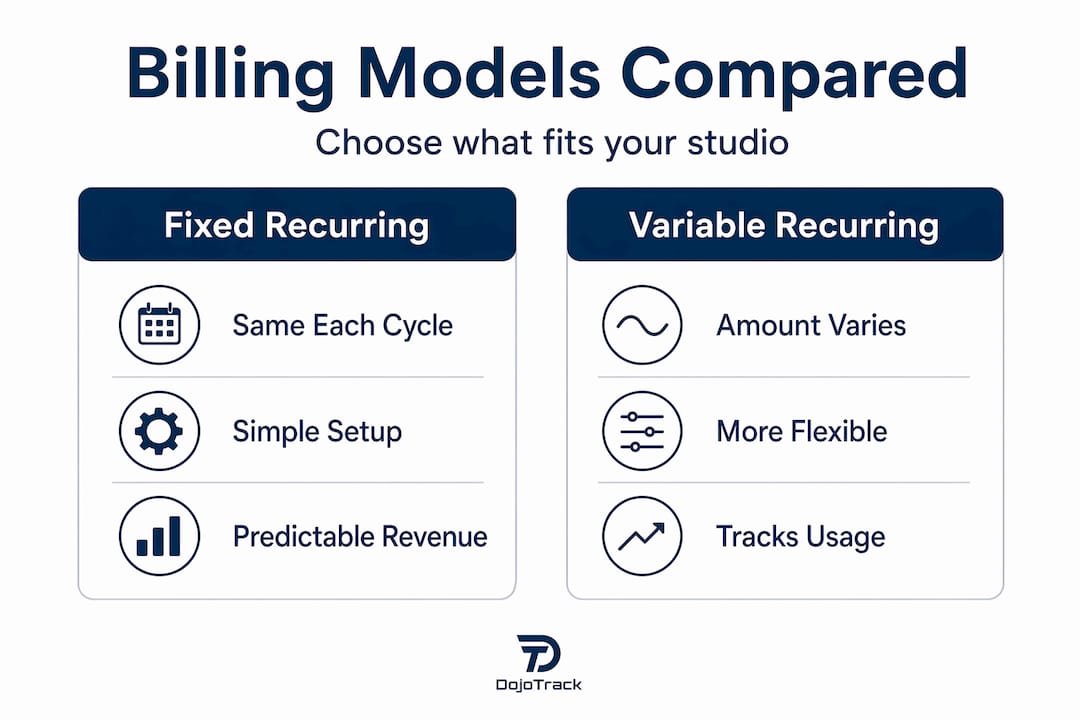
| Fixed recurring | Same amount charged every cycle | Standard monthly memberships |
| Variable recurring | Amount changes based on usage or add-ons | Drop-in passes, gear purchases, testing fees |
| Payment plan | Fixed total split into installments, ends at zero | Uniform packages, belt testing programs |
| Subscription | Indefinite recurring billing until cancelled | Ongoing monthly or annual memberships |
Fixed and variable billing models each have their place. Fixed billing is simpler to manage and easier for members to budget. Variable billing gives you flexibility to charge for extras without creating new membership tiers.
The distinction between a payment plan and a subscription matters more than most owners realize. Payment plans involve a fixed total amount divided into installments that end when the balance reaches zero. A subscription with recurring billing continues indefinitely until the member cancels. If you’re selling a six-month program for $600, that’s a payment plan charged over six months, not a subscription. Mixing these up leads to billing members longer than intended, which creates trust problems.
Failed payment handling is where many studios leave real money on the table. A card decline isn’t always a sign a member wants to quit. Cards expire, banks flag unusual charges, and people switch accounts. Strategic retry patterns, such as retrying on days 1, 3, and 7 after a failed charge, recover a meaningful percentage of those declined payments before they require any staff involvement.
Pro Tip: Send an automated text or email to members the moment a payment fails. A friendly “heads up” message asking them to update their payment info resolves most failed payments within 24 hours and avoids the awkward in-person conversation at the dojo.
Choosing and setting up a recurring billing system
Picking the right recurring payments tool for your martial arts studio isn’t about finding the most feature-rich option. It’s about finding the one that fits how your school actually operates.
Here’s what to evaluate before you commit to a system:
- Autopay and retry logic. Your system must support automatic charging and have a configurable retry schedule for failed payments. If it doesn’t handle retries automatically, you’ll be managing declines manually, which defeats the purpose.
- Invoice and receipt generation. Members expect documentation of what they’re being charged. Automated invoice generation and receipt delivery keeps your billing professional and reduces support questions.
- Integration with your class management software. Billing disconnected from attendance and membership data creates gaps. When your billing system knows a member’s enrollment status, you can pause charges automatically when they freeze a membership instead of manually adjusting records.
- Security and compliance. Your system should handle payment data through a PCI-compliant processor. Never store raw card numbers in your own systems. Stripe, which powers DojoTrack’s billing, is a good benchmark for what compliant payment processing looks like.
- Member communication tools. You need the ability to notify members of upcoming charges, billing changes, and payment failures automatically. Doing this manually at any scale is unsustainable.
When you implement a new billing system, how you communicate the change to your members is just as important as the technical setup. Give members at least two weeks’ notice before switching to autopay. Explain the benefit to them clearly: they won’t have to remember to pay, and there’s no risk of accidentally losing their spot in class.
Pro Tip: Frame the switch to recurring billing as a convenience upgrade for members, not a policy change. “We’re making it easier for you to stay enrolled” lands very differently than “We’re moving to mandatory autopay.”
Staff training is the piece most owners skip. Make sure your front desk team knows how to pull up a member’s billing status, process a manual payment when needed, and explain the retry policy if a member asks why they received a failed payment notification.
My honest take on recurring billing for martial arts studios
I’ve seen a lot of studios set up recurring billing and still struggle with cash flow. The billing itself was automated, but they hadn’t dealt with the root cause: their membership contracts were too vague, their retry logic was off, or they were manually overriding charges so often that the automation didn’t matter.
The most common mistake I see is treating recurring billing as a “set it and forget it” system from day one. The first 90 days after implementation matter. Watch your failed payment rate closely. If it’s above 5%, something is wrong, whether that’s a billing cycle misaligned with members’ paydays or a processor flagging your charges incorrectly.
What I’ve found actually works is connecting billing to your CRM data so that a failed payment triggers an automated retention check, not just a payment reminder. When a member’s card declines, there’s a real chance they’re also quietly stepping back from class. Catching both problems at once is how you protect revenue and retention simultaneously.
The automation should free you to have better conversations with your members, not replace the conversations entirely. Recurring billing is at its best when it handles the transactional stuff invisibly so you can focus on the relationships that keep people training for years.
— DojoTrack
How DojoTrack handles recurring billing for your studio
DojoTrack was built by someone who ran martial arts schools and got tired of billing being a weekly headache. The platform’s Stripe-powered recurring billing handles automatic charge collection, retry logic, invoice generation, and receipt delivery without any manual input from your team. You set up a membership plan once, and billing runs on its own from enrollment through renewal.
Beyond the mechanics, DojoTrack connects billing directly to your CRM, attendance data, and AI-driven retention alerts. When a payment fails or a member’s attendance drops, the system flags it so you can act before it becomes a cancellation. You can also use the lifetime value calculator to understand exactly what each member is worth over time, which changes how you think about retention and billing decisions.
If you’re ready to stop managing billing manually, explore everything DojoTrack’s platform offers for martial arts membership management.
FAQ
What is recurring billing in a martial arts studio?
Recurring billing is an automated system that charges members on a set schedule, such as monthly or quarterly, without requiring manual action each cycle. It handles invoice generation, payment collection, and receipt delivery automatically.
How does a martial arts billing system handle failed payments?
Most billing systems use a retry schedule, attempting the charge again on set days after the initial failure. Effective retry strategies combined with automated member notifications recover the majority of declined payments before staff involvement is needed.
What is the difference between a payment plan and a subscription in martial arts billing?
A payment plan charges a fixed total in installments and ends when the balance reaches zero, while a subscription continues charging indefinitely until the member cancels. Knowing which model applies to each program protects your members from unexpected charges.
What are the main benefits of recurring billing for martial arts studios?
The main benefits include predictable revenue, reduced administrative work, fewer missed payments through autopay, and a better member experience. Recurring billing advantages for martial arts studios also include better cash flow planning and reduced reliance on manual follow-up.
What features should I look for in a martial arts recurring billing system?
Look for autopay, configurable retry logic for failed payments, automated invoicing and receipts, integration with your membership and CRM data, and a PCI-compliant payment processor. These features together cover the full billing lifecycle without manual intervention.