

TL;DR:
- Managing multiple martial arts schools requires documented processes, centralized oversight, and purpose-built technology to ensure consistency and growth. Effective expansion depends on transitioning from owner-led operations to system design, empowering local managers, and maintaining financial discipline through strategic planning. DojoTrack offers an AI-powered platform that simplifies multi-location oversight with real-time dashboards, automated alerts, and integrated billing to support scalable growth.
Running one successful dojo is hard. Running three, five, or ten is an entirely different challenge. What is martial arts multi-location management? At its core, it is the system of strategies, structures, and tools that allow you to operate multiple martial arts schools without sacrificing quality, consistency, or your sanity. The mistake most owners make is treating expansion like a copy-paste job. You open a second location, hire an instructor, and assume the same things that worked at your first school will work everywhere. They rarely do. This guide breaks down exactly what effective multi-location management looks like and how to build it.
Table of Contents
- Key Takeaways
- What martial arts multi-location management actually means
- Technology that makes multi-location operations manageable
- Brand consistency and local marketing across schools
- Building a management structure that scales
- Financial planning and growth strategy for multiple locations
- My take on what actually works
- How DojoTrack simplifies running multiple schools
- FAQ
Key Takeaways
| Point | Details |
|---|---|
| Multi-location is a system, not a copy | Expansion requires documented processes and centralized oversight, not just replicating your first school. |
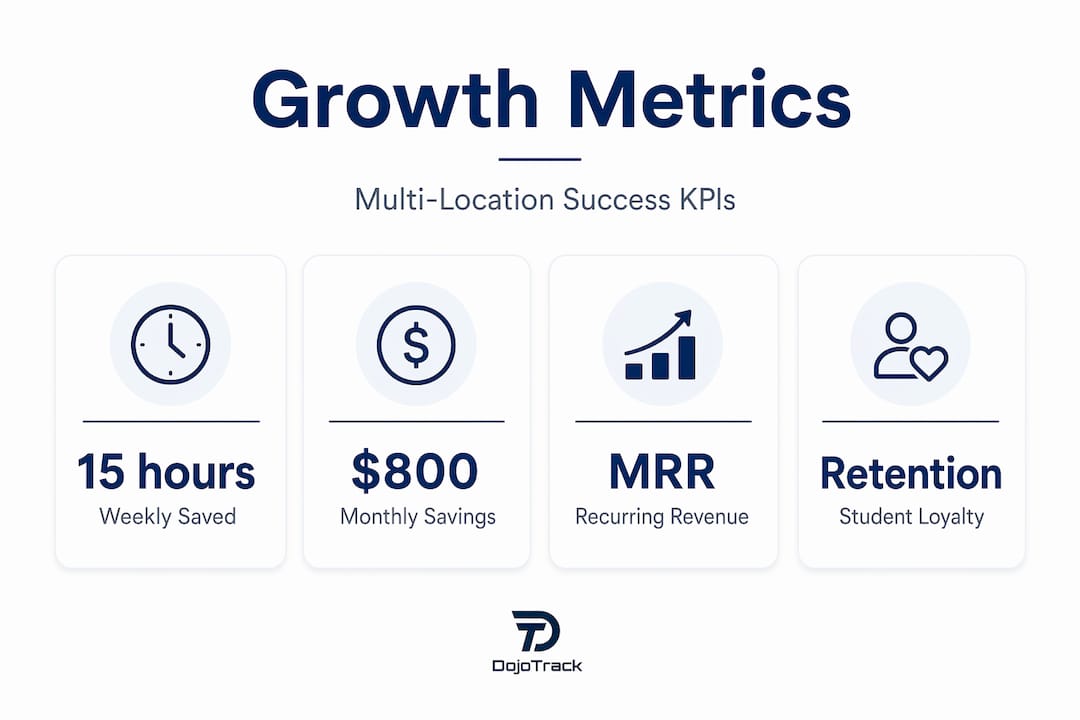
| Technology saves real time and money | Purpose-built platforms save owners an average of 15 hours weekly and $800 monthly versus managing with disconnected tools. |
| Brand consistency plus local flexibility | Centralized brand governance combined with local marketing execution is what drives growth across locations. |
| Transition your role early | Moving from hands-on operator to system designer is the single most important shift you will make as you scale. |
| Financial planning is non-negotiable | Pre-sale campaigns and understanding your ramp-up timeline protect cash flow during every new location rollout. |
What martial arts multi-location management actually means
Martial arts multi-location management is the coordinated oversight of two or more dojo locations through unified systems, shared brand standards, and distributed leadership. It covers everything from how billing is processed and classes are scheduled to how your instructors are trained and how your brand shows up on Google. The goal is operational consistency without creating a bottleneck where every decision runs through you.
There are two core tensions you have to manage at every stage. The first is centralized control versus local autonomy. You need your billing, brand, and curriculum standards to be uniform across locations. At the same time, your site managers need the authority to respond to their specific communities, adjust class times to local demand, and run marketing that resonates with their neighborhoods. Getting this balance right is what separates thriving multi-location schools from ones that quietly fracture under the pressure.
The second tension is standardization versus rigidity. Flexible localized execution within corporate policies is not optional. It is what allows your brand to feel both consistent and locally relevant. Think of it like a franchise model: the core product is identical, but the energy at each location reflects its community.
The core components of a working multi-location management system include:
- Centralized administrative control: One platform managing billing, memberships, attendance, and scheduling across all locations
- Standardized curriculum and belt progressions: Every student at every location earns their rank through the same standards
- Shared staff training and documentation: Written systems that any instructor can follow without direct supervision from the owner
- Location-specific marketing authority: Local managers empowered to post, advertise, and engage their community within defined brand guidelines
- Real-time performance visibility: Dashboards that show you revenue, attendance, and retention metrics for each location at a glance
Pro Tip: Before opening your second location, document every process at your first school as if you are handing it to a stranger. If a new manager cannot run the school from your notes alone, your systems are not ready to scale.
Technology that makes multi-location operations manageable
The operational complexity of managing multiple dojos multiplies fast. You are now coordinating class schedules across several facilities, tracking attendance for hundreds of students, processing recurring billing, managing multiple instructor payrolls, and trying to get a clear financial picture across all of it. Without the right technology, you will spend the majority of your week on administration instead of on the mat.
Purpose-built multi-site platforms save users an average of 15 hours weekly and $800 monthly by consolidating scheduling, payments, attendance, and analytics into one system with real-time dashboards. That is not a small number. Over a year, that is more than 750 hours you reclaim and nearly $10,000 saved on redundant software subscriptions alone.
The features that matter most for multi-location oversight are not always the flashiest. Here is what actually moves the needle:
| Feature | Single-Location Impact | Multi-Location Impact |
|---|---|---|
| Centralized billing | Simplifies payment collection | One system for all locations, no reconciliation across platforms |
| Attendance tracking | Monitors class participation | Flags at-risk students across every location before they quit |
| Instructor management | Tracks staff schedules | Standardizes payroll and performance review across sites |
| Reporting dashboards | Shows one school’s metrics | Compares performance, revenue, and retention across all schools |
| Automated communications | Saves front desk time | Sends location-specific messages at scale without manual work |
Multi-location software platforms allow owners to focus on strategy rather than daily administrative tasks. You stop being the person chasing down failed payments at Location 2 while also trying to plan a tournament at Location 3.
Pro Tip: When evaluating software for your schools, choose a platform built specifically for martial arts rather than a generic fitness CRM. Belt progressions, curriculum tracking, and rank-based attendance patterns are unique to martial arts. Generic tools will leave you patching gaps with spreadsheets.
Brand consistency and local marketing across schools
Marketing a single dojo is straightforward. You know your community, your competitors, and your messaging. The moment you add a second location in a different zip code, the equation changes. Successful multi-location gym strategies use a “centralized brand, local execution” model. Corporate sets the brand standards, logo usage, tone, and core messaging. Local managers handle the day-to-day social content, community engagement, and neighborhood-level advertising.

In practice, this means each location needs its own presence, including separate social media accounts, location-specific paid ads targeting within a tight radius of the school, and landing pages optimized for local search terms. Each location should have its own Google Business Profile with unique phone numbers, photos, and an active review strategy. Google treats each profile independently, which means you have an opportunity to dominate local search in multiple communities instead of competing with yourself.
Here is a comparison of what centralized versus local execution looks like in practice:
| Responsibility | Handled centrally | Handled locally |
|---|---|---|
| Brand guidelines and logo | ✓ | |
| Website and national SEO | ✓ | |
| Google Business Profiles | ✓ | |
| Weekly social media posts | ✓ | |
| Geo-targeted paid ads | ✓ | |
| Promotional offers and events | ✓ | |
| Email campaign templates | ✓ |
Local social media and local ads build community engagement while staying aligned with your broader brand. The key is giving your local managers flexible templates they can personalize, not blank canvases that result in off-brand content, and not rigid scripts that feel hollow to their specific audiences.
Building a management structure that scales
One of the most common mistakes owners make when adding locations is trying to manage everything personally. You drive between schools, sit in on classes, approve every hiring decision, and personally handle every parent complaint. That model breaks immediately at Location 2 and collapses completely at Location 3.
Scaling multi-location operations requires transitioning from hands-on operator to system designer and coach. Your job shifts from doing the work to building the systems and people who do the work without you. Here is a practical progression for building your management structure:
- Document everything at your first location first. Curriculum standards, billing procedures, front desk scripts, instructor onboarding, student communication protocols. Every process needs to be written before it can be replicated.
- Identify your first site manager early. Whether you promote from within or hire externally, this person needs to be trained and running the location largely independently before you open the next one.
- Define decision-making boundaries clearly. Site managers should be empowered to handle daily operations, scheduling adjustments, and community-level marketing. Larger decisions like pricing changes and hiring should require your approval.
- Build communication rhythms. Weekly check-ins, shared performance dashboards, and a clear escalation process so problems surface before they become crises.
- Invest in ongoing training. Documented hiring and performance standards prevent divergent cultures from developing across locations. Your brand lives in the behavior of your staff, not just your logo.
Promoting from within has a real advantage. A long-time instructor or senior student already understands your curriculum, your culture, and your students. They often need business and management training more than they need martial arts training. That gap is easier to close than rebuilding culture from scratch with an external hire.
Pro Tip: Treat your staff management systems as a living document. Review and update your training materials every time a new location exposes a gap or inconsistency.
Financial planning and growth strategy for multiple locations
Growth without financial discipline destroys more multi-location businesses than bad instructors ever will. Before you sign a lease on your second location, you need a clear-eyed view of what the financial journey looks like.
New location rollouts follow four stages: pre-opening, ramp-up, stabilization, and maturity. Each stage has distinct cash flow needs. Pre-opening costs cover deposits, build-out, equipment, and initial marketing. The ramp-up phase is the most financially stressful, as revenue is low while operating costs are already running. Stabilization begins when monthly recurring revenue covers expenses. Maturity is when the location contributes meaningfully to overall profitability.
Key financial practices for managing this well include:
- Run a pre-sale campaign before every opening. Pre-sale campaigns that secure 100 to 200 memberships before opening day shorten your ramp-up period significantly and validate demand in the new market. They also generate working capital that reduces how much you need to borrow.
- Track monthly recurring revenue (MRR) for each location separately. Blended revenue numbers hide underperforming locations. You need location-level visibility to make good decisions.
- Monitor churn by location. A retention problem at one school is easier to solve early. If you only look at totals, you will not catch it until it becomes expensive.
- Build working capital reserves before expanding. A common rule used by experienced operators is to have three to six months of operating expenses for the new location in reserve before opening.
| Financial metric | Why it matters for multi-location growth |
|---|---|
| Monthly recurring revenue (MRR) | Measures predictable income per location |
| Student churn rate | Identifies retention problems before they affect revenue |
| Cost per acquired student | Tells you whether local marketing is efficient |
| Revenue per square foot | Compares space utilization across locations |
| Lifetime value per student | Guides decisions on marketing spend and program investment |
Use a tool like DojoTrack’s lifetime value calculator to understand what each enrolled student is actually worth over their membership lifetime. That number directly informs how much you can spend to acquire a new student at each location and still grow profitably.
My take on what actually works
I have seen owners rush into their second and third locations before their first school was genuinely stable. Not just profitable on paper, but truly documented, independently operating, and running smoothly without the owner present every day. A profitable, stable first location with proven, documented systems is the only real foundation for expansion. If you skip that step, you are not building a business. You are building stress.
The thing most owners underestimate is how much of their first school’s success comes from their personal presence. Their energy, relationships, and judgment are woven into every interaction. The moment they try to duplicate that at a new location, they discover those qualities do not transfer automatically. Systems do. Culture does, if you build it intentionally. But presence does not scale.
What I have found is that embracing technology early changes everything. When you have a single dashboard showing you attendance trends, billing status, and student retention signals across all your locations, you stop being reactive. You start seeing problems two months before they become revenue losses. That shift from reactive to proactive management is where the real leverage lives.
The other insight most people learn too late is that empowering your local managers is not a risk. It is a requirement. Micromanaging site managers from a distance teaches them to wait for permission instead of solving problems. Give them clear authority within defined boundaries, give them the tools they need, and trust the systems you built. That is how you manage martial arts locations without being everywhere at once.
— DojoTrack
How DojoTrack simplifies running multiple schools
If you are serious about scaling, you need a platform built for exactly this challenge. DojoTrack is an AI-powered martial arts platform designed specifically for school owners running one location or ten. It centralizes billing, attendance, scheduling, instructor management, and student communications into one unified system so you are never toggling between disconnected tools.
With DojoTrack, you get real-time performance dashboards for each location, automated student retention alerts, and Stripe-powered recurring billing that runs without your daily involvement. The student mobile app keeps members engaged between classes, and automated SMS follow-ups mean leads do not fall through the cracks at any location.
Explore DojoTrack’s full software features or try the lifetime value calculator to start making data-driven decisions about your expansion today. No commitment required.
FAQ
What is martial arts multi-location management?
Martial arts multi-location management is the system of processes, technology, and leadership structures that allows you to operate multiple dojo locations with consistent quality, brand standards, and financial oversight. It goes well beyond simply opening a second school and hoping your first location’s model transfers.
When should I open a second martial arts location?
You are ready when your first location is profitable, fully documented, and capable of operating without your daily presence. Rushing expansion before your first school is stable significantly increases the risk of both locations underperforming.
What software features matter most for managing multiple dojos?
The highest-impact features are centralized billing, cross-location attendance tracking, unified reporting dashboards, and automated student retention alerts. Purpose-built martial arts platforms outperform generic gym software for these needs because they account for belt progressions and curriculum management.
How do I market multiple martial arts schools without losing brand consistency?
Use a centralized brand, local execution model. Set core brand guidelines, messaging, and templates at the corporate level. Give local managers authority to run their own social accounts, geo-targeted ads, and Google Business Profiles within those guidelines.
How much working capital do I need to open a new dojo location?
Experienced multi-location operators typically recommend holding three to six months of operating expenses in reserve for a new location before opening. Running a pre-sale membership campaign before launch can also reduce how much capital you need on hand by generating early recurring revenue.