
Push Notification Segmentation for Martial Arts Schools

Push notification segmentation means sending each message only to the members it matters to, not to everyone with your app installed. For a dojo, that means the adult BJJ class hears about the schedule change, the parents of your Little Dragons hear about the belt test, and the student who has not trained in ten days gets a friendly nudge instead of a seminar flyer. Start with a few opt-in topics, add behavior-based groups once your attendance data is clean, and measure outcomes (bookings, check-ins, registrations), not just opens.
TL;DR
- Segment by what members need from you: schedule changes, belt testing, seminars, billing reminders, attendance support. Do not segment by age label alone.
- Begin with explicit opt-in topics. Add behavioral segments (like “adult students absent 10+ days”) only after attendance is recorded consistently.
- Track four numbers separately: eligible audience, delivered, opened, and action completed.
- For students under 13, message through the parent or guardian account and review your vendor’s data practices under COPPA.
- Benchmarks from other industries show real lifts from segmentation, but test them in your own school before trusting them.
Table of Contents
- Why a blast to every member backfires
- What makes a good segment in a dojo
- A four-step plan for your first segmented campaign
- Measure outcomes, not just opens
- Segmenting kids’ programs: handle COPPA with care
- Our perspective: segments should follow the way a dojo actually runs
- Putting this into practice with DojoTrack
- FAQ
- Sources
Why a blast to every member backfires
Most studio owners start the same way: one announcement, sent to the whole membership. It feels efficient. The problem is that a parent of a 7-year-old does not care about the advanced no-gi seminar, and a competition-team adult does not need a reminder about the kids’ belt test. Each irrelevant buzz teaches members to ignore you, or to switch notifications off entirely.
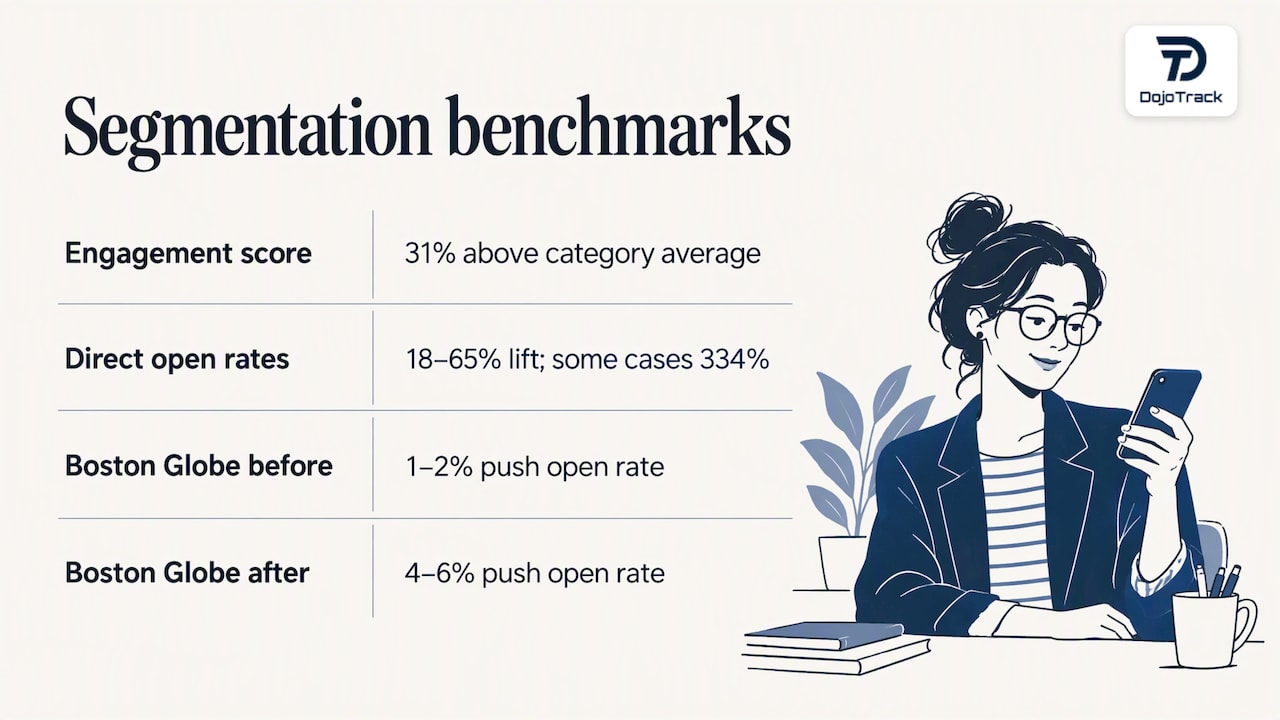
The data from other industries points the same way. Airship’s 2025 mobile-app benchmark report found that apps combining push and in-app messaging with segmentation and automation had an average Engagement Score 31% higher than their app-category average. In the examples it analyzed, segmented campaigns lifted direct open rates by 18% to 65%, with some cases reaching 334%.
Those are app-industry figures, not martial arts figures. Treat them as a reason to try segmentation, not as a promise of what your school will see.
There is a useful parallel in publishing. The Boston Globe moved from broadcasting to a preference center and interest-based targeting, and its push open rates rose from 1-2% to 4-6%. It also used opens to assign interest tags and periodically checked whether those audiences stayed engaged. The lesson for a dojo: smaller, meaningful groups beat one giant list, and the groups need maintenance.
What makes a good segment in a dojo
A segment is only useful if you can write one specific message for it and know what action you want. Pushwoosh’s analysis of 50 billion push notifications found that interest and location were among the strongest criteria, while generic demographic labels often did less. The practical takeaway from that research: “adult BJJ students who have not attended in 10 days” is more actionable than “men aged 25 to 40.”
The same research also showed that results vary. In the e-commerce subset, interest-based targeting produced a 10x higher open rate than broad segmentation, while one broad segment still produced a 3x higher open rate than blasting the whole audience. So do not assume the smallest audience always wins. Test a broad-but-relevant group (“all kids’ program parents”) against a narrow one (“parents of yellow belts testing this month”).
Segments worth building first
| Segment | How to define it | Message and goal |
|---|---|---|
| Active adult students | Adult program, 2+ visits in the last 14 days | Seminar or workshop invitation; goal is event registration |
| At-risk students | Attendance dropped well below their own usual pattern | Personal check-in, class suggestion; goal is a return visit |
| Kids’ program parents | Parent or guardian account linked to a youth student | Belt test dates, schedule changes, gear; goal is confirmation or purchase |
| Belt-stage groups | Current rank or curriculum stage | Testing eligibility, curriculum reminders; goal is test sign-up |
| Trial leads | Started a trial, not yet enrolled | Next-class reminder, offer to enroll; goal is membership |
| Event registrants | Signed up for a seminar, tournament, or camp | Logistics, time changes, what to bring; goal is attendance |
| Billing reminders | Opted in to payment notices | Upcoming or failed payment notice; goal is a resolved payment |
These groupings are our practical recommendations, not benchmarks from a study. Adjust the thresholds (14 days, 10 days) to how your school actually trains. A competition fighter who trains five days a week and a hobbyist who trains once a week need different definitions of “absent.”
Combine stated preferences with behavior
There are two kinds of data you can segment on:
- Stated preferences: what members tell you they want. Examples: “schedule changes,” “belt promotions,” “seminars,” “billing reminders.”
- Observed behavior: what members do. Examples: attendance patterns, class types, purchases, app opens.
Start with the first. It needs no complex analytics, and members who chose a topic are less likely to resent the message. Add behavioral groups after attendance and app events are being captured consistently. Segmenting on bad attendance data sends the wrong message to the wrong person, which is worse than a blast.
A four-step plan for your first segmented campaign
The mechanics are the same whether you use a studio platform or build on a messaging service. Firebase’s documentation shows the general pattern: target groups can come from Analytics audiences, imported segments, device groups or topics, and topic conditions can combine up to five topics. If you want a plain-language refresher on defining who you are trying to reach before you configure anything, this guide to identifying your target audience is a reasonable starting point.
- Define the attribute or event. Pick one clear signal: program type, belt stage, last attendance date, event registration.
- Create the group. Name it so a front-desk instructor understands it (“Adults, no visit in 10 days”), not with a code.
- Write one message with one action. “Tuesday’s 6 p.m. Fundamentals is open. Want a spot?” beats a paragraph about everything happening this month.
- Pick timing and measure. Send when members make training decisions, not when you happen to be at your desk. Then check results against the goal you set.
Keep the first campaign simple
You do not need AI to start. Offer opt-in topics for schedule changes, belt promotions, seminars, and billing reminders. Send for a month. Look at which topics members join and which they ignore. That alone tells you what your community actually wants.
Pair segmentation with other channels
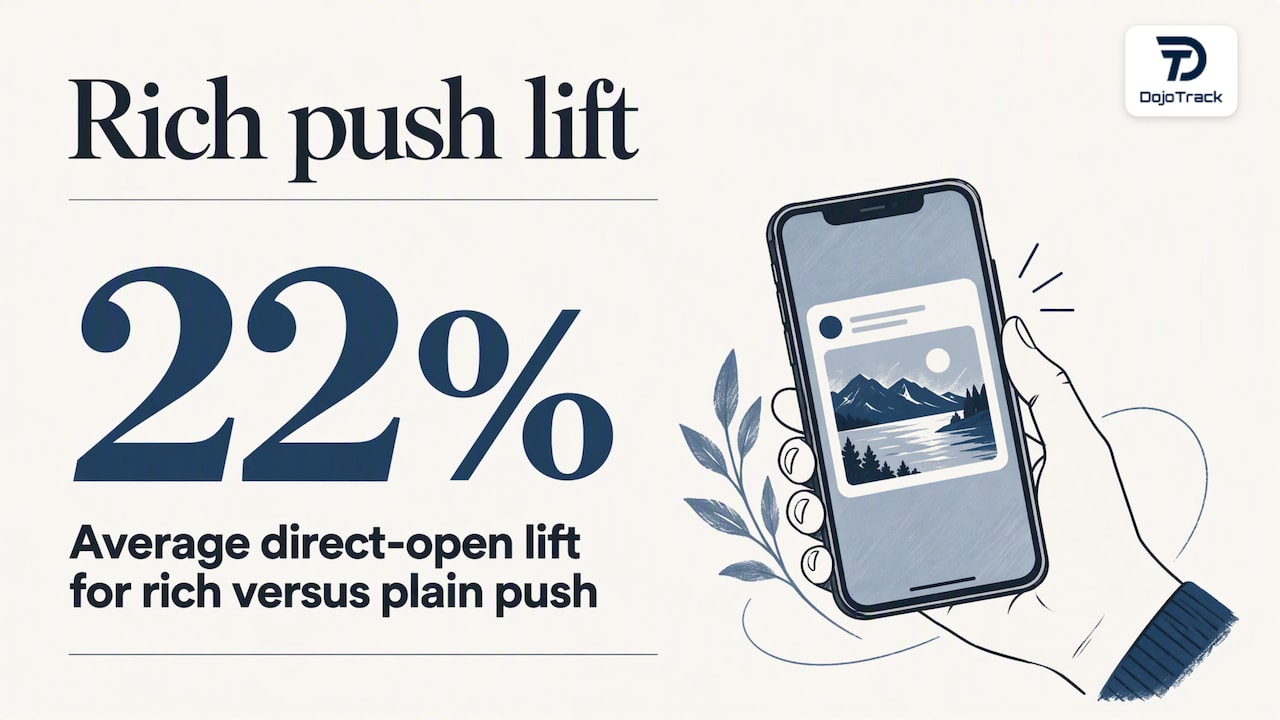
Airship’s report frames segmentation as part of an orchestration strategy rather than a one-off blast: push, in-app messaging, automation, and first-party preference data working together. Rich push, meaning a notification with an image or other media, produced a 22% average lift in direct open rates over plain notifications in the same report. In a dojo, that could be a photo of the new belt-test lineup or the seminar instructor.
Push is also not your only channel. A student who has not enabled notifications still needs an email or text. If email is part of your mix, make sure it lands in the inbox with our guide to email deliverability for gyms, and see how prospects can be followed up over several touches in our lead nurture sequences templates.
Measure outcomes, not just opens
A push notification can fail at four different points, and each one needs its own number:
- Eligible audience: how many members were in the segment and had notifications enabled.
- Delivered: how many devices actually received it.
- Opened: how many tapped it.
- Action completed: how many booked the class, registered for the seminar, or paid the invoice.
Delivery is not guaranteed attention. On Apple devices, Firebase explains that messages travel through Apple’s push service and that the installation identifier can change, so your reporting should account for token refreshes and inactive devices. In plain terms: a member who deleted the app months ago may still be counted in your audience. Clean out stale registrations from time to time, or your delivery numbers will look worse than they are.
The last number matters most. An at-risk campaign that gets 40% opens but zero return visits did not work. One that gets 10% opens and four students back on the mat did. If you want a simple way to practice calculating rates, a free engagement rate calculator can help you check your math, though your own school’s action data is the number to watch.
Review each segment every few months. Interests change, students quit, and kids age into the teen program. A segment that was accurate in January may be stale by summer.
Segmenting kids’ programs: handle COPPA with care
Many dojos run large youth programs, which raises a legal question that adult-focused businesses can skip. In the United States, the Children’s Online Privacy Protection Rule (COPPA) applies to online services directed to children under 13, and to other services that have actual knowledge they collect personal information from children under 13.
The FTC’s August 2025 business guidance on using a third party’s software in your app warns that outside SDKs can collect children’s data on your behalf, and that you can still be responsible for it. That matters for push, because notification tools often run on third-party code.
Sensible habits for a studio:
- Message the parent or guardian, not the child. Build kids’ segments on the parent’s account.
- Document consent and explain in plain language what you collect and why.
- Collect the minimum. You need a belt stage and a class schedule, not a child’s location.
- Ask your software vendor what data its notification tools collect and which third parties receive it.
- Be careful with nudges aimed at kids. The FTC has discussed proposed COPPA amendments about limits on using children’s data to encourage continued use of a service. Rules can change, so confirm current requirements with an attorney before launching child-directed engagement campaigns.
This is general information, not legal advice. If you use attendance, location, or youth-profile data for targeting, talk to your app vendor and a lawyer who handles privacy for small businesses first.
Our perspective: segments should follow the way a dojo actually runs
We built DojoTrack after running martial arts schools ourselves, so we have lived with the problem. Manual belt tracking, disconnected billing, and slow lead follow-up all trace back to the same issue: information about your students sits in different places, so you cannot act on it at the right moment.
That is why we think segmentation in a dojo works best when it is built on data you already collect: attendance, memberships, belt progress, family accounts. A segment like “adult students who have not attended in 10 days” only works if attendance is recorded every class, and a belt-test reminder only works if rank is current. The messaging layer is the easy part. The clean data underneath it is the real work.
Our advice to owners:
- Fix attendance capture first, whether through a sign-in kiosk, RFID tags, or instructor check-in. Our guide to RFID check-in shows one way to do it.
- Send fewer messages to more specific groups.
- Treat retention as a conversation. A message from a real instructor, triggered by a real absence, is worth more than a clever campaign.
- Keep family accounts at the center of kids’ communication.
— DojoTrack
Putting this into practice with DojoTrack
DojoTrack is a martial arts studio management platform that includes a student mobile app. Members can track belt curriculum progress, view class schedules, receive push notifications, and buy products from your school. The same platform handles memberships, attendance, family accounts, digital waivers, and Stripe-powered billing, and its AI retention tools flag students at risk of dropping out, so the data behind your segments lives in one place.
You can start on the free plan at $0 per month. Paid plans begin at $95 per month (Launch) and run up to $245 per month (Master), unlocking more automation, analytics, billing, SMS, and student app functionality. Texts cost $0.017 per message, and a dedicated DojoTrack number is $2 per month. See current details on the pricing page.
FAQ
What is push notification segmentation?
It is the practice of grouping app users by shared traits or behavior, such as program, belt stage, or attendance pattern, and sending each group a message relevant to it. The goal is fewer, more useful notifications. For a dojo, it replaces the all-member blast.
How many segments should a small martial arts school start with?
Three to five is plenty. Start with explicit opt-in topics like schedule changes, belt promotions, seminars, and billing reminders. Add behavioral groups, such as at-risk students, after your attendance data has been consistent for a while.
Do I need AI to segment push notifications?
No. Simple rules based on program type, rank, and last attendance date cover most needs. AI becomes useful when it spots patterns you would miss, such as students whose attendance is slipping before they cancel.
Can I send push notifications to kids?
You should send them through the parent or guardian account. COPPA applies to services directed to children under 13 or that know they collect children’s personal information, and third-party SDKs can create exposure. Document parental consent, collect minimal data, and check requirements with counsel.
Should I use push or text messages?
Use both for different jobs. Push is good for routine updates to members who have the app and have notifications on. Text reaches people who do not, and works well for urgent changes or lead follow-up.
Sources
- Airship, Mobile App Push Notification Benchmarks for 2025
- Pushwoosh, 2025 Best Mobile Segmentation Criteria for Customer Engagement
- Pugpig, The Art of the Nudge: Perfecting Push in 2025
- Firebase, Import segments
- Firebase, Get started with Firebase Cloud Messaging in Apple platform apps
- FTC, Children’s Online Privacy Protection Rule (COPPA)
- FTC, Using a third party’s software in your app? Make sure you’re (all) complying with COPPA