
PCI Compliance for Gyms and Martial Arts Schools

If your school takes a card at the front desk, drafts monthly tuition, sells uniforms or lets families sign up online, you must follow PCI DSS, the Payment Card Industry Data Security Standard. Bank of America’s merchant FAQ says the rule applies whether a business accepts five card payments or five million. The practical goal for a small studio is simple: keep card numbers out of your own systems, use a payment platform built to handle them, and file your yearly self-assessment on time.
This guide is written for studio owners, not security engineers. It explains what the standard is, which of your payments fall under it, how to find your validation form, what skipping it can cost, and a routine you can run this month.
TL;DR
- PCI DSS is a card-industry standard, not a government law. Your merchant agreement with your processor or bank is what makes it binding, according to Schellman, a PCI assessment firm.
- Every payment channel counts: front desk, phone, recurring drafts, online sign-ups, pro shop and mobile.
- Most small schools validate with a Self-Assessment Questionnaire (SAQ). Which one depends on how cards reach you.
- The best protection is not storing card data at all, according to the PCI Security Standards Council.
- The costs of ignoring it are contractual: monthly non-compliance fees and, after a breach, card-brand assessments and forensic bills.
Table of Contents
- What PCI DSS means for a martial arts school
- Which payments at your school are in scope
- The seven-day routine for a small school
- Finding the right SAQ
- What changed recently
- What non-compliance can cost
- Why the right software shortens the checklist
- Perspective
- Start with a platform that covers the whole studio
- FAQ
- Sources
What PCI DSS means for a martial arts school
PCI DSS is a set of security rules created by the major card brands: Visa, Mastercard, American Express, Discover and JCB. It covers any business that stores, processes or transmits cardholder data. The PCI Security Council’s quick reference guide also sets one hard rule: sensitive authentication data, such as the security code on the back of a card or a PIN, must never be stored after a payment is authorized.
For a school, “cardholder data” means the card number, the name on it and the expiration date. Any debit, credit or prepaid card carrying one of those brands is covered, and Bank of America notes that card numbers taken over the phone are in scope too.
A few points owners often get wrong:
- Size does not exempt you. One karate school with 40 students and one MMA chain with 20 locations both have to comply. What changes is the paperwork.
- It is not a federal or state law. Schellman explains that your acquiring bank, the bank that lets you accept cards, will likely require the assessment. That makes it an obligation in your merchant agreement, and an enforceable one.
- Using a processor does not remove the duty. The processor handles the heavy technical work. You still answer for how your staff, devices and website treat card data.
Which payments at your school are in scope
Walk through every way money reaches your school. Each path where a card number could pass through your hands, your devices or your website is part of your PCI picture.
| Payment channel | Typical example | What to ask |
|---|---|---|
| Front-desk terminal | Testing fee, private lesson, drop-in class | Is the terminal from your processor, and is it inspected? |
| Pro shop | Gis, belts, gloves, protective gear | Does retail use the same secure device as tuition? |
| Recurring tuition | Monthly memberships, family plans | Where are cards kept between drafts? |
| Online sign-up | Trial class or membership form on your site | Does the card form come from your processor or from your own page? |
| Phone or paper | Parent reads a card number to your instructor | Is it written down anywhere? |
| Mobile app or tablet | Student app purchases, events | Who runs the payment screen? |
The last two rows are where small schools get into trouble. A card number scribbled on a sign-up sheet, saved in a spreadsheet or texted to a staff member puts that data in your own systems. You then inherit the strictest questions on the questionnaire. If a parent offers to “just read you the number,” take the payment through a secure link or terminal instead. Our guide to payment links for gyms covers when that works well.
The seven-day routine for a small school
You do not need a security department. You need a short, repeatable routine.
- Map your payments. List every channel from the table above. Note which software or device handles each one.
- Find out who your acquirer is. Your processor’s statement or merchant agreement names the bank. Ask how it wants you to validate and whether it charges a PCI fee.
- Stop storing card data yourself. Delete spreadsheets, photos and notes that contain card numbers. The Council’s Guide to Safe Payments says to securely destroy card data you no longer need.
- Inventory your terminals. The same guide recommends a photographed list of every payment terminal, regular checks for tampering, and keeping devices out of customers’ reach.
- Give each person their own login. Shared front-desk passwords make it impossible to know who did what. The guide advises unique user IDs wherever possible and access only on a need-to-know basis.
- Complete and submit your SAQ. Send it to your processor or acquiring bank, then calendar it for next year.
- Train staff in one page. Never write down or text a card number, never store a security code, report a damaged or swapped terminal immediately.
The guide also recommends logging visitors who go behind the counter and keeping those logs for at least a year. In a studio, that mostly applies to the office or counter area where a terminal sits.
Finding the right SAQ
Visa sorts merchants into levels by transaction volume. The largest merchants (Level 1) need an on-site assessment report. Levels 2 to 4 validate with an SAQ and an Attestation of Compliance, a signed statement that you meet the requirements. For the smallest merchants, your acquirer can define alternative validation. Mastercard tells merchants to determine their level from the most recent 52 weeks of transactions. A typical neighborhood school will be in the smallest tier.
Which SAQ you complete depends on how cards reach you. A small-business compliance guide from Payments & Risk gives the rule of thumb: a hosted checkout page, where the card entry happens on your processor’s page, usually points to SAQ A, while handling card numbers directly points to SAQ D. SAQ D is the longest and hardest to complete.
That gap is the reason to push card entry onto your payment platform. Every card number you never touch is a question you never have to answer.
Tokens and hosted checkout
When a platform stores a card for your recurring drafts, it keeps a token, a stand-in value that is useless to a thief, while the real card number stays with the payment provider. The PCI Council’s tokenization guidance explains that tokenization does not erase your duty to comply, but it can simplify validation by shrinking the number of systems that touch card data. You still have to use the solution as intended and make sure real card numbers cannot be retrieved from the systems you consider out of scope.
The online sign-up page
Your website’s trial-class or membership form is the newest area of risk. Under PCI DSS 4.0.1, Beancount’s small-merchant guide says SAQ A is available only when you can confirm that your payment pages, including embedded forms and redirects, are not open to script attacks. Those attacks hide malicious code in a third-party script and quietly copy card data. In practice: keep the number of plug-ins and tracking scripts on any page near a payment form as low as you can, and keep your site software updated. For a broader look at why site hygiene protects customer trust, see this piece on website security and customer trust.
What changed recently
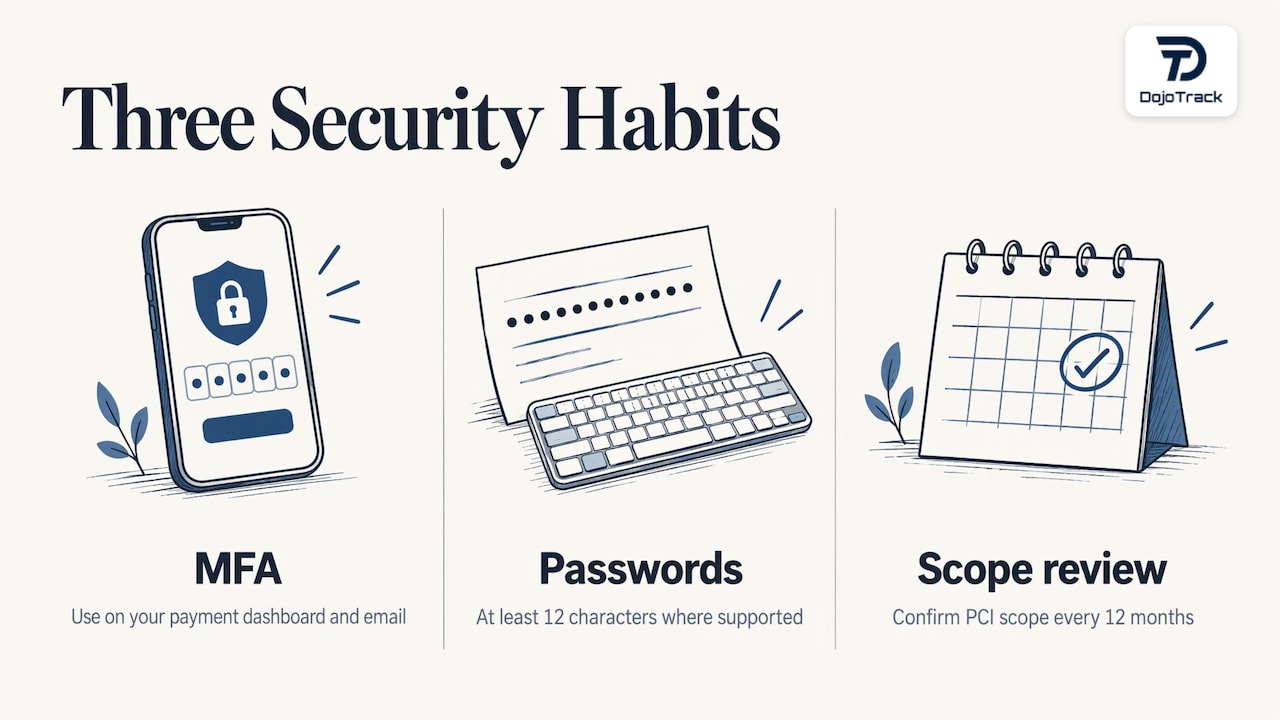
The version in force today is PCI DSS 4.0.1. According to Compyl’s compliance guide, it replaced version 4.0 on December 31, 2024, and the 51 requirements that had been phased in became mandatory on March 31, 2025. That guide lists requirements now in force, including multi-factor authentication for access to systems that handle card data, passwords of at least 12 characters where systems support it, and a documented confirmation of your scope every 12 months.
For a school that keeps no card data, most of that belongs to your payment provider. For you, it means three habits: use multi-factor authentication on your payment dashboard and email, use long unique passwords, and review your scope once a year. Your yearly SAQ is the natural moment.
What non-compliance can cost
Because PCI is contractual, the penalties come from your agreements, not a courtroom. Presencis describes it this way: card brands fine the acquiring bank, and the bank passes the cost on to the merchant. It reports escalating monthly fines in the thousands of dollars for larger merchants that stay non-compliant, with no formal appeals process.
Small studios more commonly meet the lower end first. Payments & Risk says processors may charge a monthly PCI non-compliance fee of $10 to $150. Stripe’s explanation of these fees says banks may charge a typical $25 to $50 per month at first, rising if the gap continues.
A breach is far more expensive. Presencis lists card reissuance at $3 to $10 per card, card-brand assessments of $50 to $90 per compromised card, and forensic investigations that can run into six figures. A studio with 300 member cards could face a large bill and a damaged reputation in a community that runs on trust. Prevention costs a few hours a year.
Why the right software shortens the checklist
The Council tells small merchants to consider outsourcing card processing to a PCI DSS-compliant service provider and to ask their terminal vendor or bank how to run recurring payments without storing the security code. For a school, that is the biggest decision you will make about PCI. How you collect, store and re-bill cards decides how many questions you answer.
In DojoTrack, recurring billing is Stripe-powered, and memberships, family discounts, digital waivers and point-of-sale inventory sit in one platform. That means tuition drafts, pro shop sales and sign-ups run through one system rather than a patchwork of paper forms, spreadsheets and separate card readers. Fewer places where a card number can end up means fewer things to inventory, train staff on and defend. You can also see how this fits together in our guides to online payments for small martial arts schools and payment processing for new studios, and in what a studio point-of-sale system does.
Perspective
We started DojoTrack because running a school means wearing too many hats. Jared Reed founded it in Utah after running martial arts schools himself, and the frustrations he hit were disconnected billing, manual tracking and paperwork that ate his evenings.
PCI is a good example. Most owners never meant to become card-security managers. They wanted to teach. The simplest path is one purpose-built platform for memberships, attendance, waivers, billing and retail, so you are not copying card details between tools.
That is why we built recurring billing on Stripe and kept the whole studio in one place. When your tuition, family plans and pro shop run in the same system, your payment routine is shorter and easier to explain to a new front-desk hire.
Every hour you do not spend on payment paperwork is an hour on the mat.
DojoTrack
Start with a platform that covers the whole studio
DojoTrack has a free core plan at $0 per month. Paid plans start at $95 per month for Launch, then $125 for Scale, $165 for Expand, $195 for Grow and $245 for Master. Texting is billed at $0.017 per message, and a dedicated DojoTrack number is $2 per month. Compare plans on the DojoTrack pricing page, or open the platform and set up your school.
If you are moving from another system, check how your member data is stored before you migrate. DojoTrack includes data migration tools to help with the move. Our look at membership tracking for MMA gyms shows how a single member record can support billing and retention.
FAQ
Do small martial arts schools really have to comply with PCI DSS?
Yes. Bank of America’s merchant FAQ states that compliance is required whether a business accepts five card payments or five million. What changes with size is how you validate, usually through a Self-Assessment Questionnaire.
Is PCI compliance a law?
No. Schellman notes that neither state nor federal law mandates it. It is a contractual requirement your acquiring bank is likely to enforce through your merchant agreement, with fees if you do not validate.
Which SAQ does my school need?
It depends on how cards reach you. Hosted checkout, where the card is entered on your processor’s page, usually points to SAQ A, while handling card numbers yourself points to SAQ D, according to Payments & Risk. Ask your processor which form it expects, then submit it to them each year.
Can I keep student card numbers in a spreadsheet?
No. The PCI Council’s Guide to Safe Payments says the best protection is not to store card data at all, and the security code must never be stored after authorization. Delete any existing records securely and use your payment platform’s stored-card feature.
How often do I need to validate?
Annually. Your processor or acquirer will tell you the due date, so put it on the calendar and review your scope at the same time, which version 4.0.1 expects every 12 months.
Sources
- Bank of America Merchant Services: PCI Compliance FAQ
- PCI Security Standards Council: Guide to Safe Payments
- PCI DSS v3.2.1 Quick Reference Guide
- Schellman: Payment Card Industry Compliance FAQ
- Visa: Review PCI Data Security Essentials for Small Merchants
- Mastercard: Site Data Protection Program and PCI
- Payments & Risk: Compliance Basics for SMBs
- Beancount: PCI DSS 4.0.1 small merchant guide
- Compyl: PCI DSS 4.0.1 Compliance Guide
- Presencis: Penalties under PCI DSS v4.0
- Stripe: PCI Non-Compliance Fees
- Website Security: Safeguarding Brands and Customer Trust