

The moment a student requests cancellation, stop the next billing cycle from firing or lock in the exact effective date in your studio system before anything else. Then confirm the final payment date and final access day in writing, so both sides agree on what happens and when. If the student qualifies for a save offer, trigger that retention workflow now, before the cancellation is final, not after.
TL;DR:
- Cancel the next billing cycle immediately and lock in the final payment and access dates before proceeding with any other step.
- Follow a standardized workflow where staff verify identity, confirm dates, disable autopay, update access, log reasons, and send written confirmation to avoid disputes.
- Recognize that removing a payment method only revokes authorization; a formal cancellation process remains necessary to end the contract legally.
- Use predefined retention offers based on the member’s reason for leaving, prioritizing freezes or tier downgrades over discounts for genuine life changes.
- Track core metrics like overall churn, involuntary cancellations, retention success, and failed payment recovery to improve retention strategies over time.
Table of Contents
- The Step-by-Step Studio Cancellation Workflow For Staff
- How Do You Handle Refunds And Billing Reconciliation?
- Retention Offers: When Should You Try To Save The Membership?
- What Should You Track After A Cancellation?
- Why A Repeatable Cancellation Process Protects Your Studio
- How DojoTrack Handles Cancellations Behind The Scenes
- Sources
- FAQ
The Step-by-Step Studio Cancellation Workflow For Staff
A membership cancellation process only works if every staff member follows the same sequence, in the same system, every time. Inconsistency here is exactly what turns a routine cancellation into a chargeback or a one-star review three weeks later.
Here’s the checklist that belongs in your front-desk procedures manual:
- Accept the request through an approved channel. Email, a written cancellation form, or an in-person conversation logged in the system all count. Verify the requester’s identity against the account on file before touching anything.
- Confirm the effective date. Decide whether the cancellation is immediate, effective at the end of the current billing cycle, or scheduled for a future date tied to a contract term. This single decision drives every downstream step.
- Disable recurring billing. Turn off autopay in your billing processor and remove the stored payment authorization, don’t just delete the membership record and assume billing stops on its own.
- Update the member’s status and access. Change the CRM tag, revoke class-booking permissions, and adjust any kiosk or app-based check-in access to match the agreed final access day.
- Log the cancellation reason. Attach any supporting documents, a signed form, a relocation notice, a medical note, to the account record for audit purposes.
- Send written confirmation. State the final charge date, the final day of access, and any refund or credit due, in plain language the member can reference later.
Operational guidance from membership-contract specialists backs this exact sequence: receive the request in writing, verify identity, check the contract, confirm the date, and always close with a documented written confirmation rather than a verbal promise. Platforms that already support member-facing click-to-cancel flows show the same pattern on the back end, staff dashboards that display cancellation status, effective dates, and confirmation logs side by side, the same structure worth replicating in your own system.
Pro Tip: Run a mock cancellation through your own system once a quarter. Submit a test request, walk it through every step, and check whether the confirmation email, the billing flag, and the audit log all match. Gaps show up fast, and they’re much cheaper to fix before a real dispute lands than after.
If your studio still relies on spreadsheets or a generic CRM bolted onto a payment processor, this is usually where the cracks show. A purpose-built membership tracking system keeps the billing flag, the access permission, and the CRM tag tied to one record instead of three disconnected tools.
How Do You Handle Refunds And Billing Reconciliation?
Removing a card from a payment processor is not the same thing as canceling a membership contract, and treating them as interchangeable is one of the most common billing mistakes in martial arts studio management. A member who deletes their card has revoked payment authorization. They have not necessarily ended their contractual obligation, and your system needs to flag that distinction instead of silently closing the account.
Reconciling the account after a cancellation request means:
- Calculating any prorated refund based on unused days in the current billing period.
- Applying outstanding credits or deposits against the final balance before issuing a refund.
- Confirming whether a registration fee or gear deposit is refundable under your contract terms.
- Collecting a signed cancellation form, the payment history, and any prior communication in case of a dispute.
Payment networks and regulators have been tightening rules around billing friction, which means detecting an authorization revocation early and reaching out to clarify the member’s actual intent matters more than it used to. A member who quietly removes a card without formally canceling is a strong signal you’re heading toward a dispute, not a resolved account.
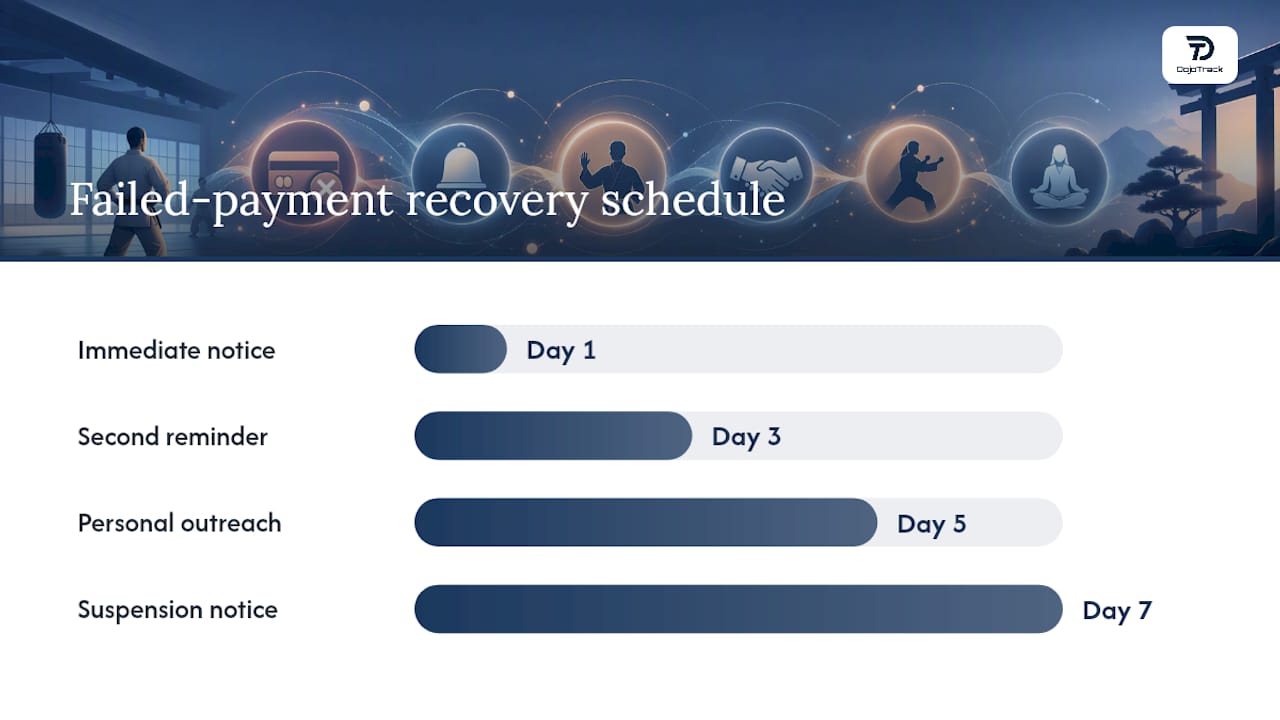
For failed payments still in the pipeline, a standard dunning schedule recovers a meaningful share of at-risk revenue: an immediate notice on the first failed charge, a second reminder around day 3, a personal outreach call near day 5, and a suspension notice by day 7 if nothing resolves.
Retention Offers: When Should You Try To Save The Membership?
Not every cancellation request deserves a save attempt, and treating them all the same way undermines both your pricing and your staff’s credibility. The decision flow matters more than the offer itself.
Start by identifying why the member is leaving:
- Low attendance or disengagement. This is the most common driver behind cancellations, not price, so a discount rarely fixes it. Offer a complimentary private lesson or a schedule change instead.
- Involuntary churn from a failed payment. This isn’t really a cancellation request at all. Route it into your dunning workflow before offering anything.
- Price objection. Consider a short rate lock or a tier downgrade rather than an open-ended discount that erodes your pricing structure.
- Relocation or a genuine life change. These rarely respond to save offers. A freeze option, typically one to three months, often serves the member better than a hard cancellation and keeps the door open for reactivation.
A short menu of predefined offers keeps staff consistent: a pause or freeze, a downgrade to a lower-frequency plan, one free month tied to a specific commitment, a 60-day rate lock, or a complimentary private training session. Anything beyond that predefined list, an extended discount, a waived fee, a custom payment plan, needs manager approval logged in the system before staff promise it to the member.
Pro Tip: Front-desk staff should never improvise a save offer on the spot. Script the opening line (“Before we process this, can I ask what’s driving the decision?”) and match the response to one of your four predefined offers. Improvised discounts are how a $150 membership quietly becomes a $90 one for a dozen students without anyone noticing.
Attendance data is often the earliest warning sign here. Instructors who track attendance closely tend to catch disengagement before the cancellation request ever reaches the front desk.
What Should You Track After A Cancellation?
Every canceled membership is a data point, and studios that ignore that data end up solving the same retention problem over and over without ever fixing the upstream cause.
Track these core metrics monthly:
- Overall churn rate, with 28 to 40% annual attrition considered typical across health and fitness clubs broadly, giving you a benchmark to measure against.
- Involuntary churn percentage, the share of cancellations driven by failed payments rather than a genuine decision to leave.
- Save rate, how many retention attempts actually kept the member enrolled.
- Dunning recovery rate, how many failed payments get resolved before hitting suspension.
Cohort analysis, grouping cancellations by signup month, referral source, or promotion, often reveals that one acquisition channel or one introductory offer is quietly producing most of your churn. A short exit survey, five to seven multiple-choice questions plus one open text field, triggered automatically the moment a cancellation is logged, surfaces far more usable detail than a single blank comment box ever will. Pair that with automated card-expiry alerts and pre-billing reminders, and you’ll catch a large share of involuntary churn before it ever becomes a cancellation conversation. Predictive tools built for martial arts schools can flag at-risk students before attendance drops far enough to trigger a request.
Why A Repeatable Cancellation Process Protects Your Studio
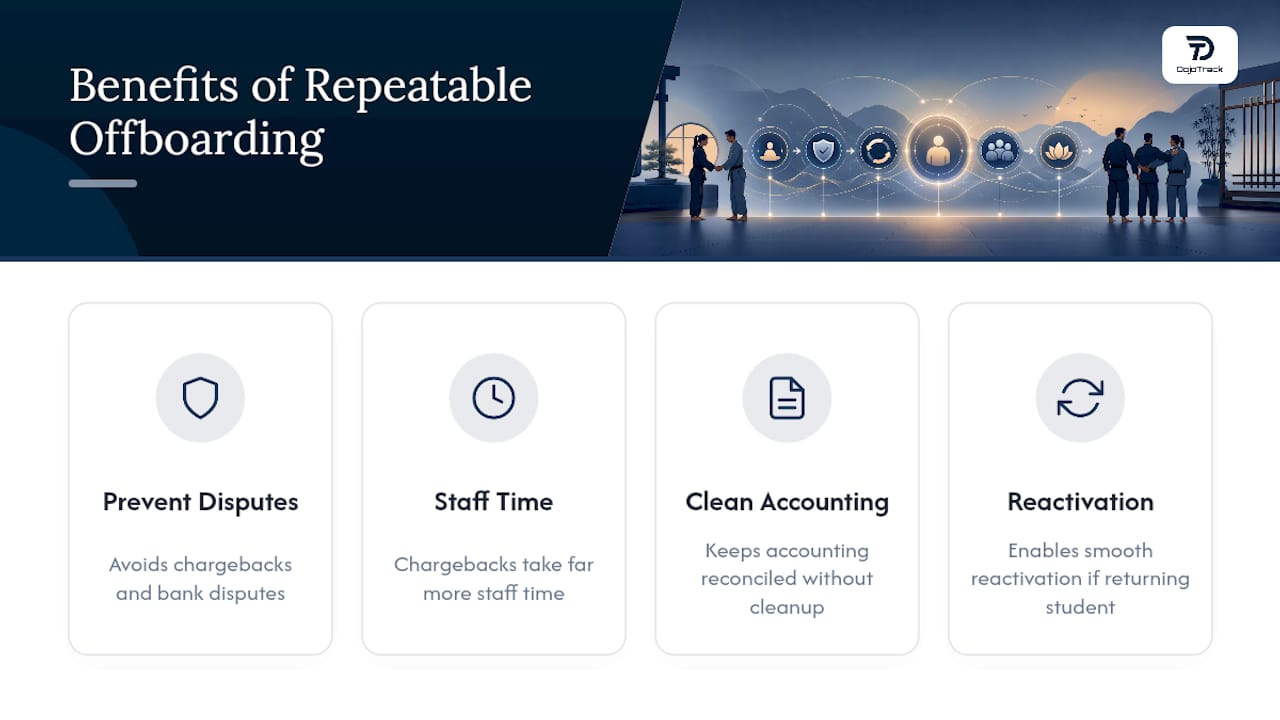
Sloppy offboarding costs more than the lost membership fee. A student who can’t get a straight answer about their final charge date is a student who disputes the charge with their bank instead of calling you, and a chargeback dispute takes far more staff time than a five-minute confirmation email would have.
The regulatory environment is pushing toward less friction, not more. The FTC’s Click-to-Cancel rule was vacated in July 2025, but the direction of travel hasn’t reversed. Payment networks and platform vendors are still building toward accessible, low-friction cancellation flows, and studios that fight that trend with manual, inconsistent processes tend to accumulate disputes rather than avoid them.
A documented exit does more than close out one account cleanly. It produces a paper trail that resolves disputes fast, keeps your accounting reconciled without manual cleanup, and leaves the door open for a smooth reactivation if the student comes back next season. That last point gets overlooked constantly, a former student who left on good terms with clear records is a far easier sale than a cold lead.
— DojoTrack
How DojoTrack Handles Cancellations Behind The Scenes
DojoTrack is built around the exact workflow described above, not a generic cancel button bolted onto a payment page. Stripe-powered recurring billing lets staff disable autopay and set a precise effective date without touching a separate processor dashboard, and every cancellation status, reason, and confirmation lives directly in the member’s profile with a full audit log attached. Retention triggers fire automatically when attendance drops or a payment fails, giving staff a save-offer prompt before the student even reaches the front desk, and push notifications through the student mobile app keep the communication trail visible to everyone involved.
The free core tier covers the basics, membership records, attendance, and billing status, so any studio can start running a clean cancellation workflow today. Studios that want the AI-driven retention triggers and automated dunning sequences can unlock those as they grow. Start with a free DojoTrack account, import your current membership list, and run one test cancellation through the system before your next real one comes in.
Sources
- Gym churn reduction framework: Identify, intervene & save members
- Club Automation introduces member click-to-cancel
- Ironclad gym membership contracts: 2026 owner’s guide
FAQ
What Is The First Step In A Membership Cancellation Process?
Stop or schedule the next billing cycle in your system immediately, then confirm the member’s final payment and access dates in writing before anything else happens.
How Do You Calculate A Prorated Refund?
Divide the membership’s monthly rate by the number of days in the billing cycle, multiply by unused days, then subtract any outstanding balance or unpaid fees before issuing the refund.
Is Removing A Payment Method The Same As Canceling A Membership?
No. Removing a card revokes payment authorization only; the underlying contract stays active until the member submits a formal cancellation request and staff process it in the system.
How Long Should A Membership Freeze Last?
Most studios cap freezes at one to three months, using a standard form to record the start date, end date, and reason before reactivating billing automatically.
What Should An Exit Survey Ask?
Five to seven multiple-choice questions covering attendance, price, and scheduling, plus one open text field, triggered automatically the moment staff log the cancellation.
Can Software Like DojoTrack Automate The Cancellation Workflow?
Yes. DojoTrack ties billing controls, cancellation status, audit logs, and retention triggers to one member profile, so staff follow the same documented process every time.