

TL;DR:
- A karate school admin workflow manages student enrollment, belt tracking, billing, scheduling, and communication. A well-designed system improves retention, accuracy, and efficiency, reducing the manual workload for dojo owners. Using specialized martial arts software streamlines these tasks, balancing automation with personal connection to build a strong community.
A karate school admin workflow is the structured sequence of administrative processes that manages student enrollment, belt rank progression, billing, scheduling, and parent communication inside a dojo. Most school owners think of administration as a necessary burden. The reality is that a well-built workflow is the engine behind student retention, accurate billing, and consistent belt progression. Club management software built specifically for martial arts handles these tasks natively, while general fitness platforms require constant workarounds. Getting your workflow right means spending more time on the mat and less time buried in spreadsheets.
What is a karate school admin workflow, and why does it matter?
A karate school admin workflow is the complete set of repeating administrative tasks that keep your dojo running from the moment a prospect walks in to the day a student earns their black belt. The industry term for this end-to-end process is the student lifecycle, and it covers every touchpoint between your school and a student. Understanding the lifecycle gives you a clear map of where time gets wasted and where errors cost you money.
The workflow matters because every broken link in the chain creates a real problem. A missed enrollment step means incomplete student records. A billing error on a testing fee damages trust with parents. A scheduling gap leaves students in the wrong class for their rank. Each failure compounds over time and quietly drives students out the door.
The core components of a karate school admin workflow include:
- Student enrollment and data management: Collecting contact details, emergency information, signed waivers, and membership agreements at intake
- Belt rank tracking: Recording current rank, promotion history, and testing eligibility for every student
- Class scheduling: Assigning students to classes that match their rank and skill level
- Testing fee billing: Charging and recording fees tied directly to each student’s rank record
- Attendance tracking: Logging class attendance and flagging students who fall behind
- Parent and student communication: Sending progress updates, billing notices, and class reminders
Each component feeds the next. Attendance data informs testing eligibility. Testing eligibility triggers fee billing. Billing records connect to rank progression. When these pieces work together, your dojo runs predictably.
How does testing fee management integrate into the karate school workflow?
Testing fees are one of the most error-prone parts of karate school administration when managed manually. Testing fees in karate schools typically range from $25 to $150 based on belt level. That range means a single testing cycle across 40 students can generate thousands of dollars in fees that must be tracked accurately.
The critical rule is that testing fees must be administered separately from monthly tuition. Failing to separate these fees leads to increased administrative errors, misapplied payments, and confused parents. When a parent sees an unexpected charge on their account with no clear label, you spend time on the phone explaining it instead of running class.
Best practices for testing fee management include:
- Trigger billing at registration: Charge the testing fee when the student registers for the test, not after the fact
- Link fees to rank records: Every payment must attach to the student’s belt progression history for accurate financial and progression tracking
- Keep a clear paper trail: Parents should receive an itemized receipt that names the specific belt test and fee amount
- Never bundle with tuition: A separate line item prevents confusion and makes refunds or disputes easier to resolve
Automating billing at the time of test registration reduces errors and cuts administrative workload significantly. Automation also ensures the fee posts to the correct student record without manual data entry.
Pro Tip: Set up your billing system to automatically flag any student who registers for a belt test without a corresponding fee payment. This one check eliminates the most common testing fee error in dojo administration.
How to effectively track and communicate student progress and attendance?
Real-time attendance tracking is the foundation of a reliable karate school management process. Without it, you cannot accurately assess testing readiness, identify at-risk students, or give parents an honest progress report. Scheduling classes based on rank ensures students attend appropriate level courses, and attendance data confirms they are actually showing up.

Effective testing cycles with on-schedule testing rates above 90% correlate strongly with improved student retention. That number tells you something important: students who test on time stay enrolled. Attendance tracking is the tool that keeps testing cycles on schedule by catching gaps before they become dropouts.
Parent communication is where many dojo owners underinvest. Parent portals showing attendance, progress, upcoming tests, and billing reduce inquiry volume and administrative burden. When parents can log in and see exactly where their child stands, they stop calling the front desk for updates.
Effective progress tracking and communication practices include:
- Log attendance at every class: Use a sign-in kiosk or mobile check-in so records are accurate and immediate
- Update rank status after each promotion: Never let a student’s record lag behind their actual belt
- Send automated reminders before tests: Give parents at least two weeks’ notice with the date, fee, and requirements
- Use a parent portal for transparency: Visible progress data builds trust and reduces billing disputes
Pro Tip: Human calls within 24 hours of a missed class are more effective than automated messages for keeping students enrolled. Reserve automated texts for reminders and billing. Pick up the phone when a student goes missing.
Physical tools like attendance cards still work well in smaller dojos. The key is that whatever system you use, the data must end up in a central record that connects to billing and rank tracking.
What scheduling practices optimize dojo operations and student retention?
Class scheduling tied to belt ranks is the most underused retention tool in karate school operations. When a white belt accidentally attends an advanced class, they feel lost and embarrassed. When a brown belt sits through a beginner session, they get bored and start looking for a new school. Rank-based scheduling prevents both problems.
A practical karate dojo workflow guide for scheduling follows this sequence:
- Define class types by rank band: Create distinct class categories such as beginner (white to yellow belt), intermediate (orange to green belt), and advanced (blue belt and above)
- Assign instructor coverage: Match instructor experience to class level so advanced students get appropriately challenging instruction
- Set enrollment rules: Block students from registering for classes above their current rank until they pass the required test
- Build in makeup options: Offer at least one makeup class per week for each rank band so missed sessions do not derail testing readiness
- Automate schedule reminders: Send class reminders 24 hours before each session to reduce no-shows
The table below shows how a typical weekly schedule maps rank bands to class types and instructor assignments.
| Rank Band | Class Type | Sessions per Week | Instructor Level |
|---|---|---|---|
| White to yellow belt | Beginner fundamentals | 2–3 | Junior instructor |
| Orange to green belt | Intermediate technique | 2–3 | Senior instructor |
| Blue to brown belt | Advanced sparring and kata | 3–4 | Head instructor |
| Black belt candidates | Pre-test intensive | 1–2 | Head instructor |
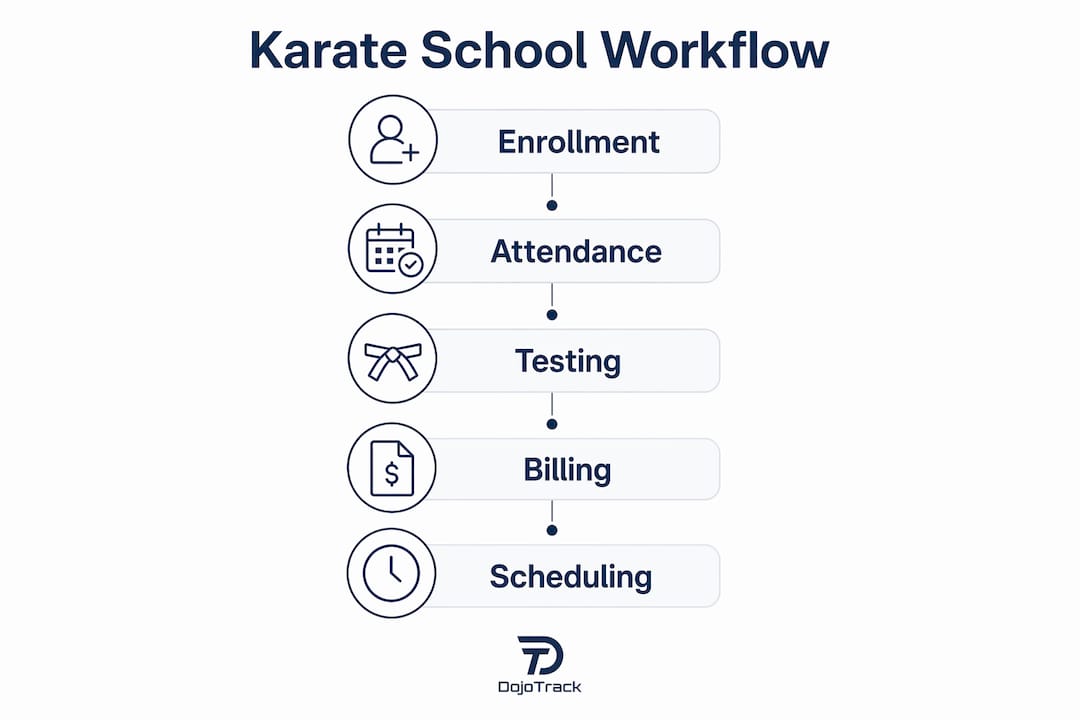
Automated reminders and tournament registration tools reduce the manual coordination burden on your front desk staff. When your scheduling system connects directly to your rank records and billing platform, the entire karate school operations overview becomes one connected process rather than a collection of separate tasks.
Key Takeaways
A karate school admin workflow succeeds when student enrollment, belt rank tracking, testing fee billing, attendance, and scheduling all connect inside one system rather than operating as separate manual tasks.
| Point | Details |
|---|---|
| Define the student lifecycle | Map every administrative touchpoint from enrollment to black belt so no step gets missed. |
| Separate testing fees from tuition | Billing test fees at registration and linking them to rank records prevents errors and parent disputes. |
| Use rank-based scheduling | Assigning students to classes by belt level improves progression, satisfaction, and retention. |
| Prioritize human follow-up | Call students within 24 hours of a missed class instead of relying solely on automated messages. |
| Centralize your data | Attendance, rank, billing, and communication records must connect in one platform to avoid errors. |
The workflow problem most dojo owners don’t see coming
Running a karate school taught me something that took years to fully appreciate: the administrative side of your dojo is a direct reflection of your teaching philosophy. If your belt records are sloppy, your students sense it. If billing is confusing, parents lose confidence. If scheduling is inconsistent, students drift away.
The biggest mistake I see school owners make is treating administration as separate from instruction. They invest deeply in curriculum and teaching technique, then patch together billing with a spreadsheet and track attendance on paper. That gap is where retention quietly bleeds out. A student whose testing date gets missed because no one flagged their attendance record does not usually complain. They just stop coming.
Martial arts-specific software solves this because it is built around the actual workflows of a dojo, not adapted from a generic gym platform. Belt tracking, testing eligibility checks, and parent portals are native features, not workarounds. The difference in daily administrative load is significant.
The best karate school admin workflows balance automation with personal connection. Automate billing, reminders, and rank updates. Keep the human touch for missed classes, parent concerns, and promotion celebrations. That combination is what builds a dojo community that stays for years.
— Dojotrack
How Dojotrack supports your dojo’s admin workflow
Dojotrack is built specifically for martial arts schools in the United States, and it handles every layer of the karate school admin workflow described in this article. The platform automates testing fee billing at registration, links payments directly to student rank records, and gives parents a portal to track attendance and upcoming tests. Belt promotions trigger automatically when eligibility criteria are met, and the AI-driven retention system flags students who are at risk of dropping out before you lose them. Dojotrack’s free core tier gives you student management, attendance tracking, scheduling, and digital waivers at no upfront cost. Schools that need advanced automation and AI insights can scale up as they grow. If you are currently running your dojo on a general fitness platform, migrating your data to a purpose-built system is simpler than most owners expect.
FAQ
What is a karate school admin workflow?
A karate school admin workflow is the structured sequence of administrative tasks that manages student enrollment, belt rank tracking, billing, scheduling, and parent communication inside a dojo. It is also called the student lifecycle, and it covers every operational touchpoint from a student’s first class to their black belt promotion.
How much do karate belt testing fees typically cost?
Testing fees in karate schools typically range from $25 to $150 depending on belt level. These fees must be billed separately from monthly tuition and linked directly to each student’s rank record for accurate tracking.
Why is rank-based class scheduling important?
Rank-based scheduling ensures students attend classes appropriate to their skill level, which improves progression, prevents frustration, and supports consistent testing readiness. Schools that enforce rank-based enrollment rules see stronger retention across all belt levels.
What is the best way to follow up on missed classes?
A personal phone call within 24 hours of a missed class is more effective than an automated message for retaining students. Automated reminders work well for billing and upcoming tests, but direct human contact is the better tool when a student goes absent.
Do I need martial arts-specific software to manage my dojo’s workflow?
General fitness software requires significant workarounds to handle belt tracking, testing eligibility, and parent portals. Software built specifically for martial arts schools includes these features natively, which reduces administrative errors and saves time across every part of the workflow.