

TL;DR:
- A martial arts referral program rewards existing students for bringing in new members through structured triggers, rewards, and reliable tracking. Success depends on scripting golden moments for asks, accurately tracking referrals, and maintaining a dynamic rewards catalog to sustain momentum. When properly implemented, these programs enhance growth and foster a strong community culture.
A martial arts referral program is a structured system that rewards current students for bringing new members into your school, making it one of the most cost-effective growth tools available to studio owners. Unlike paid advertising, referrals arrive pre-sold on your culture because a trusted person vouched for you. The industry term for this approach is a “member referral program,” and when built with clear triggers, meaningful rewards, and reliable tracking, it compounds over time. This guide covers every step you need to start martial arts referral efforts that actually stick, from the first ask to the final reward payout.
How to run a martial arts referral program that works
A working referral program requires three core components: a defined trigger event, a reward catalog, and a tracking system. Without all three, you end up with informal word-of-mouth that you cannot measure or replicate.
Here is what you need in place before you launch:
- Referral tracking system. This can be a spreadsheet, your studio management software, or a dedicated referral platform. The goal is to match every new trial student to the person who referred them, on the day they walk in.
- Reward catalog. Offer at least two options so referrers feel genuine choice. Common options include a membership discount, a private lesson, or store credit. Alliance BJJ Houston runs a refer-a-friend program where the referrer picks their reward after the new member completes 30 days of paid membership. That structure reduces fraud and churn simultaneously.
- Referral cards or unique links. Physical cards with the referring student’s name pre-printed, or digital links tied to their account, allow your front desk to credit the right person instantly. This single step prevents most tracking failures.
- Clear trigger events. Explicit trigger events tied to rewards reduce fraud and protect your program economics. The safest trigger is paid conversion, meaning the new student has paid at least one month of membership before the reward is issued.
- Front desk training. Your staff must ask every new trial student, “Who referred you?” and log the answer immediately. This is not optional. It is the backbone of your entire system.
Pro Tip: Set a qualification window of 30 days from the new student’s first paid membership before issuing any reward. This protects you from rewarding referrals who cancel after a single week, and it gives the new student enough time to genuinely commit.
Your student retention strategy and your referral program are directly connected. Students who feel invested in your school refer more often and stay longer.
How do you make the referral ask without it feeling awkward?
Social friction is the primary reason referral programs underperform. Most students are happy to refer a friend but never do because nobody asked them clearly and at the right moment.

The solution is to identify “golden moments” and script the ask in advance. A golden moment is any point where a student or parent expresses genuine satisfaction. Timing the ask right after positive feedback significantly lifts referral acceptance because you are leveraging peak goodwill.
Here is a step-by-step approach for making the ask work:
- Identify your golden moments. Belt promotions, a parent telling you their child stopped getting bullied, a student landing their first competition win, and the end of a successful trial week are all prime opportunities.
- Use a persona-focused script. Vague asks kill conversion. Instead of “Do you know anyone who might want to join?” try the “Helpful Neighbor” approach: “You mentioned your neighbor’s son has been struggling with confidence. We have a program built for exactly that. Would it be okay if I gave you a card to pass along?” This frames the referral as a favor to the recipient, not a sales pitch.
- Keep the message short. Referral messaging works best when framed as a favor to the referred person, kept under three sentences, and paired with one clear action. Hand the card over immediately so the moment does not pass.
- Train every instructor and front desk staff member. The ask should not depend on one person remembering. Build it into your post-class routine and your belt promotion ceremony process.
- Follow up within 48 hours. If a student said they would pass along a card, a brief text from your studio the next day keeps the momentum alive. Automated SMS follow-up tools can handle this without adding work to your plate.
Pro Tip: Write two or three ready-to-use scripts for your most common golden moments and post them in your staff area. When instructors have the exact words ready, they make the ask far more consistently.
How do you track, reward, and recognize referrals to keep momentum?
Operational reliability is what separates a referral program that builds trust from one that quietly dies. Students stop referring when they feel their effort went unnoticed or uncredited.
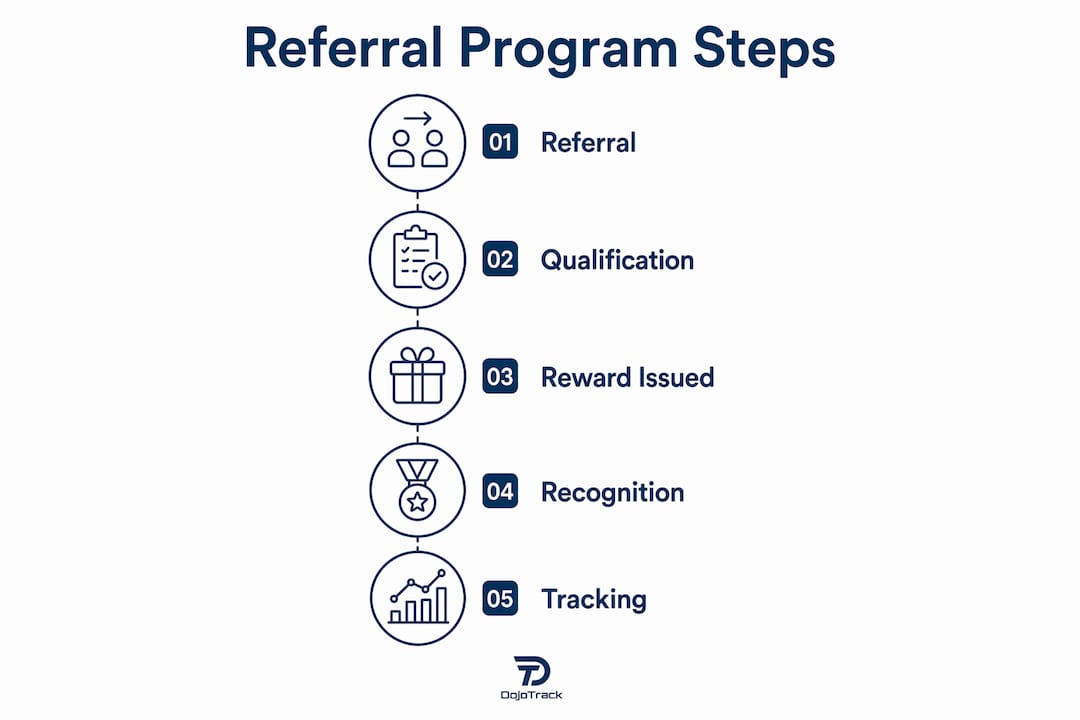
Here is the operational flow that keeps your program healthy:
- Match at arrival. When a new trial student walks in, your front desk asks who referred them and logs it immediately. Personalized referral cards or unique referral links make this matching instant and accurate.
- Set a qualification window. Issue the reward only after the new student completes 30 days as a paying member. This is the same structure Alliance BJJ Houston uses, and it protects program economics without feeling punitive to referrers.
- Issue rewards promptly. Once the new student hits the qualification window, notify the referrer the same day. Delayed payouts are one of the fastest ways to destroy trust in your program.
- Recognize publicly. Announce referrals during class. “Shoutout to Marcus for bringing in two new students this month” costs nothing and creates powerful social proof. Public acknowledgment during class strengthens the referral culture across your entire student body.
- Log everything. Track referrer name, referred student name, trial date, conversion date, and reward issued. A simple spreadsheet works at first, but studio management software makes this far less error-prone as your program scales.
The table below shows a clean referral workflow you can implement this week:
| Stage | Action | Timing |
|---|---|---|
| Trial arrival | Front desk logs referrer name | Day 1 |
| Trial completion | Confirm referral match in system | Day 7 |
| Paid conversion | Start qualification window | Day 1 of membership |
| Reward trigger | Notify referrer and issue reward | Day 30 of membership |
| Recognition | Public shoutout in class | Same week as reward |
Pro Tip: Assign one staff member as the referral program owner. That person checks the log weekly, flags any unmatched trials, and makes sure no referrer falls through the cracks. Shared responsibility usually means no responsibility.
Common mistakes that kill referral programs
Most referral programs do not fail because the idea is bad. They fail because of predictable, fixable operational errors.
- Vague asks with no script. Telling your team to “mention the referral program” produces almost nothing. A ready-to-use script tied to a specific outcome for a specific persona vastly improves results. Write the script once and train everyone on it.
- Ignoring downstream referral effects. Referred customers generate 31% to 57% more referrals themselves, increasing program ROI by 20% to 36% when downstream effects are included. If you only count first-generation referrals, you are undervaluing your program and potentially underinvesting in it.
- Delayed or unclear reward payouts. Students who wait weeks to receive a promised reward, or who never receive one because the system lost their credit, will not refer again. Worse, they will tell others. Transparent incentive rules and prompt payouts are non-negotiable.
- Referral credit leakage. This is the single biggest operational failure mode. Credit leakage happens when staff forget to ask who referred a new student at signup. Standardize the question at every trial arrival and make it part of your intake form.
- Stale reward catalogs. A reward that excited students six months ago may feel routine today. Rotating rewards quarterly and adding limited-time surprise bonuses keeps the program feeling fresh and worth participating in.
“The referral program that runs on autopilot is the one that was built with clear rules, trained staff, and a weekly check-in. Everything else is wishful thinking.”
Compliance matters too. Collecting referral data means you are handling personal information, and privacy law compliance under frameworks like CCPA applies to U.S. studios. Keep your intake forms transparent about how referral data is used.
Key takeaways
A martial arts referral program succeeds when it combines a clear trigger-credit-reward flow, scripted asks at golden moments, and meticulous tracking that prevents credit leakage.
| Point | Details |
|---|---|
| Define trigger events | Issue rewards only after 30 days of paid membership to reduce fraud and churn. |
| Script the ask | Use persona-focused scripts at golden moments like belt promotions and positive feedback. |
| Prevent credit leakage | Assign one staff member to log referrals at every trial arrival, every time. |
| Track downstream value | Referred students refer others at higher rates, boosting true ROI by 20% to 36%. |
| Refresh rewards quarterly | Rotate your reward catalog and add surprise bonuses to maintain referrer enthusiasm. |
What we’ve learned running referral programs in real dojos
At DojoTrack, we have worked with martial arts school owners across the country, and the pattern is consistent: the studios with the strongest referral programs are not the ones with the most generous rewards. They are the ones with the most reliable processes.
The ask timing insight is one that most owners underestimate. Instructors who make the referral ask during a belt promotion ceremony, right after a parent says “this program changed my kid’s life,” see dramatically better results than those who bring it up at the end of a routine class. The emotional context of the moment does more work than any reward catalog ever could.
Tracking accuracy is the other factor that separates thriving programs from stalled ones. When a referrer does not receive their credit, they do not just opt out of the program. They quietly lose trust in your school’s ability to follow through. That erosion is subtle but real, and it affects retention, not just referrals. Using your martial arts CRM to log referrals at the point of trial arrival eliminates most of this risk.
The referral contagion effect is also underappreciated. When you track your program properly and nurture referred students well, those students become your next wave of referrers. The compounding effect is real, and it means the true value of your first referral is much higher than it appears on day one.
Build the program into your school culture, not just your operations manual. Celebrate referrers publicly, thank them personally, and make the whole school feel like a community that grows together. That culture is what turns a referral program into a self-sustaining growth engine.
— DojoTrack
See how DojoTrack supports your referral program
DojoTrack gives martial arts studio owners the tools to track referrals, manage reward fulfillment, and understand the true financial impact of every new student. The platform connects your front desk intake process, membership billing, and student records so referral matching happens automatically rather than on a sticky note. Before you launch or revamp your referral system, use the DojoTrack lifetime value calculator to see exactly what each referred student is worth to your school over time. That number will change how you think about every reward you offer and every ask you make. DojoTrack is built for U.S. martial arts schools ready to grow with intention.
FAQ
What is a martial arts referral program?
A martial arts referral program is a structured system that rewards current students for introducing new members to your school. It typically includes a trigger event, a reward catalog, and a tracking process to credit the right referrer.
When should you ask students for a referral?
Ask immediately after a positive feedback moment, such as a belt promotion or a parent sharing a win. Timing the ask at peak goodwill significantly increases acceptance rates.
What are the best incentives for martial arts referrals?
Membership discounts, private lessons, and store credit are the most effective options. Offering two or three choices gives referrers genuine ownership and increases motivation to participate.
How do you prevent referral credit leakage?
Standardize the question “Who referred you?” at every trial arrival and log the answer immediately. Assigning one staff member to own the referral log weekly eliminates most tracking failures.
How do you calculate the ROI of a referral program?
Use a lifetime value calculator to estimate each student’s long-term revenue, then factor in that referred students generate 31% to 57% more referrals themselves, increasing total program ROI by 20% to 36%.