

How manual billing damages your school’s finances and operations
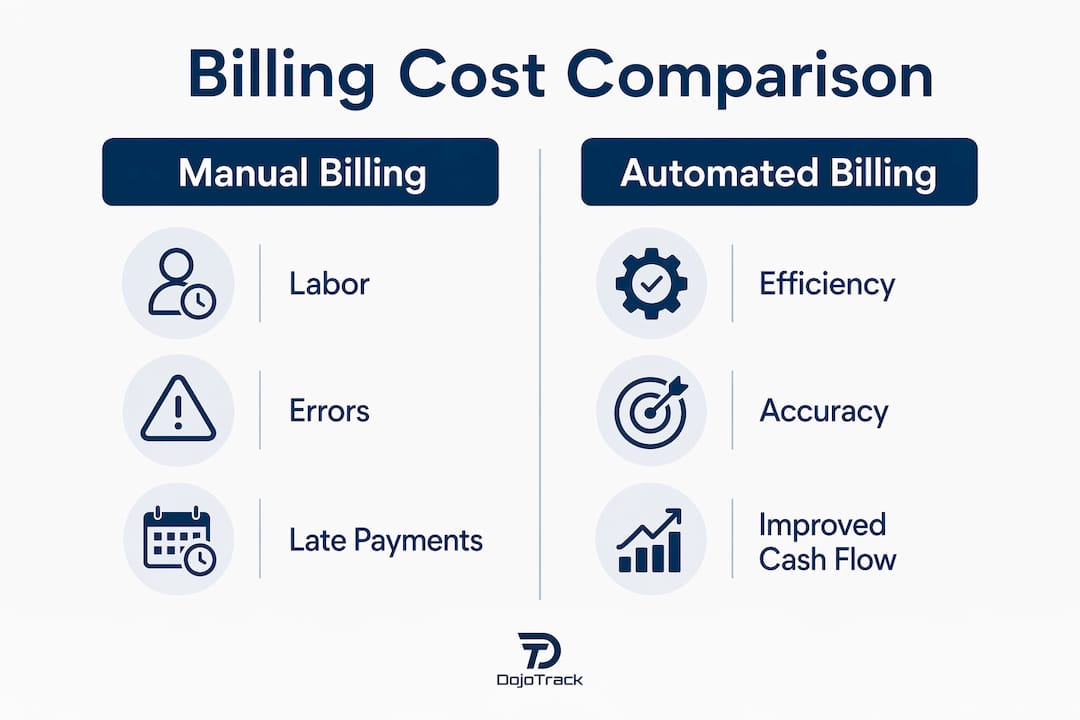
Manual billing quietly drains small martial arts schools in ways that never show up as a single line item. The real damage comes from three directions at once: time lost to repetitive admin work, revenue that slips through the cracks, and cash flow gaps that force you to fund operations from reserves while waiting on payments you’ve already earned.
Here’s what that looks like in practice:
- Time drain: 60% of administrative labor in small schools goes to automatable tasks like billing and reminders, costing over $58,000 annually for an average small school.
- Revenue leakage: Missed invoices, stale charges, and unapplied contract changes bleed annual recurring revenue in ways that never appear as line items in your financial statements.
- Cash flow disruption: Schools relying on manual billing often experience a notable portion of families paying late, creating a predictable monthly shortfall you have to cover before tuition actually arrives.
- Error compounding: Manual data entry carries a measurable error rate, which triggers disputes, corrections, and write-offs that multiply the original time cost.
- Staff burnout: Repetitive billing tasks push administrative turnover higher, adding recruiting and onboarding costs on top of the original inefficiency.
- Parent dissatisfaction: Billing errors and delayed invoices create friction with families, which directly affects re-enrollment decisions.
Every one of these problems compounds the others. A late invoice leads to a late payment, which strains cash flow, which increases stress on staff, which increases errors. Understanding where the cycle starts is the first step to breaking it.
What common billing challenges look like inside a small martial arts school
Most small martial arts school owners don’t set out to run a broken billing process. The problems creep in gradually as the student roster grows and the spreadsheet that worked for 30 students starts groaning under 120.
The most common issues fall into a predictable pattern:
- Invoicing delays: Invoices go out late because someone has to manually create each one, and busy class schedules push admin tasks to the back of the queue.
- Data entry errors: Wrong tuition amounts, outdated family contact details, and missed fee adjustments are nearly inevitable when every invoice is built by hand.
- Lost or duplicate invoices: Manual tracking across email and spreadsheets means invoices occasionally go out twice or not at all, both of which damage your credibility with parents.
- Inconsistent follow-up: Late payment reminders depend on whoever has bandwidth that week. When staff are stretched, overdue accounts sit uncontacted for weeks.
- Payment misattribution: Cash and check payments recorded manually get logged to the wrong account or missed entirely, creating reconciliation headaches at month end.
- No real-time visibility: Without a live dashboard, you can’t tell at a glance which families are current, which are 30 days out, and which need a call today.
The staffing cost alone is striking. Schools with high manual workloads experience administrative turnover at 2.3x the rate of schools using integrated platforms, with each turnover costing up to $10,000 in recruiting and onboarding. That’s a recurring expense hiding inside your payroll line.
The real financial cost of manual billing: time lost and revenue at risk

The numbers behind manual billing inefficiency are specific enough to be uncomfortable. For a 150-student school at $7,500 average annual tuition, 18% of families being chronically late by 30 or more days puts $202,500 in receivables arriving an average of 45 days after billing. Your school has already delivered the instruction. You’re just waiting on the money.

| Cost category | Manual billing | With automation |
|---|---|---|
| Administrative labor on automatable tasks | Significant amount annually | Reduced by 30–50% |
| Late payment rate | 15–20% of families | 8–11% of families |
| Delayed receivables (150-student school) | $202,500 per cycle | Significantly reduced |
| Monthly cash flow improvement | Baseline | $67,500–$101,000 per cycle |
| Staff turnover cost | Up to $10,000/year | Lower with reduced manual burden |
| Invoice error rate | 1–3% | Above 99% accuracy |
Beyond the cash flow gap, revenue leakage is the cost that most school owners never calculate because it doesn’t appear anywhere obvious. A family whose tuition rate changed but whose invoice wasn’t updated. A testing fee that was approved verbally but never invoiced. A sibling discount that was promised but never applied. Each gap is small. Across a full year and a full roster, they add up to real money.
The labor cost compounds this further. When 60% of your admin capacity is absorbed by tasks that software handles automatically, you’re paying full-time wages for work that generates no strategic value. That’s not a billing problem. It’s a business model problem.
- Cash tied up in late receivables limits your ability to invest in equipment, marketing, or instructor development.
- Manual billing doesn’t scale: each new student adds proportional admin work, so growth makes the problem worse, not better.
- Errors discovered weeks after the fact require correction cycles that cost 2–4 hours of combined staff and parent time per dispute.
How automation improves billing and overall school management
Automated billing changes the fundamental structure of how your school collects revenue. Instead of a staff member manually creating each invoice, the system generates and sends them on schedule, tracks payment status in real time, and triggers reminders automatically when a payment is approaching or overdue.
The practical benefits break down across several areas:
- Automated recurring invoices: Tuition goes out on the same date every cycle without anyone touching it.
- Automatic payment reminders: Families receive reminders before and after due dates, reducing late payments without requiring staff follow-up.
- Real-time payment tracking: You see exactly who has paid, who is overdue, and by how much, from a single dashboard.
- Integrated student records: Billing connects directly to attendance and membership data, so a new enrollment automatically triggers the correct invoice.
- Reduced DSO: Automated billing achieves invoice accuracy above 99% and reduces days sales outstanding by up to 20% through systematic payment follow-up.
- Scalability without added headcount: Automated systems handle 50 students or 500 students with the same configuration. Manual systems require proportionally more staff time as volume grows.
Pro Tip: If your billing cycle is taking longer each quarter despite no growth in your team, that’s a clear sign your manual process has hit its ceiling. The right time to automate is before the errors start compounding, not after a billing dispute costs you a family.
The parent experience improves too. Families with 24/7 access to their billing status, payment history, and upcoming charges are less likely to dispute invoices and more likely to pay on time. That’s a direct improvement in your cash flow with no extra work from your team.
What schools actually gain by switching from manual to automated billing
The shift from manual to automated billing produces gains across operations, finances, and student retention simultaneously. Schools adopting unified platforms report up to a 50% reduction in manual admin workload within the first semester, recovering six or more hours per week per administrator.
Here’s what that translates to in practice:
- Fewer errors: Automated systems eliminate the manual data entry step where most billing mistakes originate, pushing accuracy above 99%.
- Better cash flow: Reducing late payment rates from 15–20% down to 8–11% improves monthly cash flow by $67,500–$101,000 for an average small school.
- Lower staff turnover: When administrative staff spend less time on repetitive billing tasks, burnout decreases and retention improves.
- Higher parent satisfaction: Accurate, timely billing with self-service access reduces disputes and builds trust with families.
- Improved student retention: Parent satisfaction with school operations directly predicts re-enrollment. Schools in the bottom quartile for operational quality see re-enrollment rates 7–12 percentage points below top-performing schools.
- Time back on the mat: Hours recovered from billing admin go back to instruction, student development, and growing your community.
The automated billing cash flow improvement isn’t a one-time gain. It recurs every billing cycle, compounding over the course of a year into a meaningful difference in your school’s financial stability.
How fragmented manual systems create data silos that hurt your school
Manual billing rarely exists in isolation. Most small martial arts schools running manual invoicing are also managing attendance in a spreadsheet, tracking belt progress in a separate document, and communicating with families through a generic email tool. The result is a data silo problem: the same student’s information lives in multiple places, and those records drift apart every time something changes.
Disconnected tools for attendance, billing, and communication cause data to diverge and require manual synchronization, which virtually guarantees errors over time. When a family updates their contact information, it gets changed in one system and not the others. When a student earns a belt promotion, the billing system doesn’t know. When a new sibling enrolls, the discount has to be applied manually in every relevant record.
The operational consequences are concrete:
- Incorrect invoices sent to outdated contact information.
- Sibling discounts missed because billing and enrollment records aren’t connected.
- Attendance patterns that should trigger a retention conversation never surface because no one is cross-referencing the data.
- Month-end reporting requires pulling from three or four sources and reconciling manually, which takes hours and introduces its own errors.
A unified platform solves this by creating a single student record that every function reads from and writes to. One update propagates everywhere. Billing, attendance, communication, and belt tracking all reflect the same current information without anyone manually synchronizing them.
Common manual billing mistakes specific to martial arts schools
Martial arts schools have billing patterns that generic small businesses don’t face, and those patterns create specific failure points when managed manually.
Family accounts with multiple students are one of the most common sources of billing errors. Sibling discounts, split payment plans, and family membership tiers all require custom invoice logic that spreadsheets handle poorly. A discount applied to one child but not the other, or a family plan invoiced at the individual rate, creates disputes that take time to unwind.
Belt testing fees are frequently missed. Testing cycles happen a few times per year, involve a subset of students, and require a separate charge on top of regular tuition. In a manual system, someone has to identify which students are testing, calculate the fee, and add it to that cycle’s invoice. It’s easy to miss students, especially when testing lists are managed separately from billing records.
Seasonal enrollment changes create gaps. When a student pauses for summer, resumes in September, or switches from one program to another, the billing record needs to be updated immediately. Manual systems depend on someone catching the change and updating the invoice template. When that step is missed, you either charge a student who isn’t attending or fail to charge one who is.
Event and seminar fees for special workshops, tournaments, or guest instructor sessions often fall through the cracks entirely because they’re one-time charges outside the regular billing cycle.
Manual billing vs. automated billing: how error rates compare
The error rate difference between manual and automated billing is not marginal. Manual data entry produces errors at 1–3% across invoice line items. Automated billing, with validated data and configured pricing rules, achieves accuracy above 99%.
| Dimension | Manual billing | Automated billing |
|---|---|---|
| Invoice accuracy | 97–99% at low volume, degrades with scale | Above 99% consistently |
| Invoice cycle time | 1–3 days after period close | Same day or real time |
| Days sales outstanding | Dependent on staff follow-up | Up to 20% reduction |
| Revenue leakage | 1–3% of annual recurring revenue | 20–50% leakage recovery |
| Scalability | Grows linearly with student count | Scales with configuration |
The error profile also changes in a meaningful way. Manual billing generates errors through human intervention: a wrong amount entered, an outdated rate applied, a reminder that didn’t go out. Automated billing generates errors through system configuration, which are harder to introduce and easier to fix systematically when found. One bad pricing rule is corrected once and applies correctly to every future invoice. One human mistake has to be caught and corrected individually, every time it recurs.
For a school growing from 80 to 150 students, that difference compounds quickly. A 1% error rate on 150 monthly invoices means roughly 1–2 billing errors per cycle. Each one takes 2–4 hours of combined staff and parent time to resolve. That’s a recurring monthly cost with no upside.
What schools report after switching from manual to automated billing
The pattern across schools that have made the switch is consistent: the first thing owners notice is time recovered, and the second is that cash flow becomes predictable in a way it never was before.
Schools moving from fragmented manual tools to an integrated management platform typically recover six or more hours per week per administrator within the first semester. For a school paying an administrator $22 per hour, that’s nearly $6,900 per year in recaptured capacity from billing automation alone, before counting the reduction in late payments or error correction time.
The cash flow improvement is the change owners feel most directly. When automated reminders go out before due dates and failed payment notifications trigger immediately, the late payment rate drops. Families who simply forgot get a nudge before the payment is overdue. Families with failed cards get notified the same day instead of three weeks later when someone finally checks the spreadsheet.
Parent relationships improve as well. Families who receive accurate, consistent invoices with clear due dates and easy online payment options raise fewer disputes and communicate more openly about financial concerns. That trust translates into re-enrollment conversations that go more smoothly.
The transition to automated billing doesn’t require a complicated overhaul. Most schools can migrate their student roster, set up recurring billing rules, and go live within a week. The practical steps are straightforward: export your current student list, configure your tuition tiers and fee structures, set your billing dates and reminder sequences, and connect your payment processor. From that point forward, the system handles the cycle automatically.
Dojotrack gives you billing that runs without you
If you’re spending hours each month chasing late payments, correcting invoice errors, and manually updating student records across disconnected tools, Dojotrack is built to fix exactly that. It’s a purpose-built martial arts school management platform that replaces your billing spreadsheets, manual reminders, and fragmented student records with one unified system.
Dojotrack’s Stripe-powered recurring billing handles tuition automatically, sends payment reminders before due dates, and gives you a real-time view of who has paid and who hasn’t. Family accounts, sibling discounts, belt testing fees, and membership tiers are all managed in the same platform where you track attendance, belt progress, and student communication. No more updating the same information in four different places.
The free core plan gives you student management, attendance tracking, scheduling, and digital waivers with no upfront cost. Advanced billing automation, AI-powered retention alerts, and growth tools are available as your school scales. It’s designed for small schools in the United States that need a professional system without a complicated setup.
Start with Dojotrack and see how much time your school gets back in the first month.
Key Takeaways
Manual billing costs small martial arts schools far more than it saves, with hidden financial losses across labor, late receivables, errors, and staff turnover that typically exceed the cost of automation many times over.
| Point | Details |
|---|---|
| Labor cost of manual billing | 60% of admin capacity goes to automatable tasks, costing over $58,000 annually for an average small school. |
| Late payment impact | Manual billing leaves 18% of families chronically late by 30 or more days in a 150-student school, creating $202,500 in delayed receivables per cycle. Automation reduces late payment rates to 8–11%, improving monthly cash flow by $67,500–$101,000. |
| Error rate gap | Manual data entry produces 1–3% invoice errors; automated billing consistently achieves above 99% accuracy. |
| Data silo risk | Disconnected manual tools cause student and billing records to diverge, guaranteeing errors as your roster grows. |
| Dojotrack solution | Dojotrack unifies billing, attendance, and student records in one platform, with Stripe-powered recurring billing and a free core plan for U.S. schools. |
FAQ
How much does manual billing actually cost a small martial arts school?
For a 150-student school, 18% of families are chronically late by over 30 days, resulting in $202,500 in delayed receivables per cycle. Along with 60% of admin labor spent on tasks like billing and reminders (costing over $58,000 annually), and increased staff turnover, the hidden costs of manual billing add up quickly, even though they’re distributed across budget lines and never visible as a single figure.
What are the most common billing mistakes martial arts schools make?
The most frequent errors include missed belt testing fees, sibling discounts applied inconsistently, seasonal enrollment changes not reflected in invoices, and late payment reminders that go out unevenly or not at all.
Does automated billing really reduce late payments?
Yes. Schools implementing automated billing consistently reduce late payment rates from 15–20% down to 8–11%, with automated reminders reaching families before due dates rather than after accounts are already overdue.
How hard is it to switch from manual billing to automated software?
Most schools can migrate their student roster, configure billing rules, and go live within a week. The practical steps involve exporting your current student list, setting up tuition tiers and fee structures, and connecting a payment processor like Stripe.
Can Dojotrack handle billing for a small martial arts school in the United States?
Yes. Dojotrack is built specifically for U.S. martial arts schools and includes Stripe-powered recurring billing, family account management, sibling discounts, and real-time payment tracking, with a free core plan that covers essential management tools at no upfront cost.