
Discount Codes for Your Dojo: Merch, Preorders and Stock

A good dojo discount code has five parts: a clear purpose, an end date, a use limit, a defined list of eligible products, and a rule for whether it stacks with other offers. Set those five and a code becomes a controlled promotion. Skip them and it becomes a permanent markdown. This guide shows how to create codes for uniforms, gear and merch, how to pair them with preorders, and how to count stock so a promotion never sells what you don’t have.
The search results for this topic are mostly coupon pages for other companies’ products. If you own a martial arts school, you are on the other side of the counter: you are the one writing the code. That is the angle here.
TL;DR
- Every code needs a name, a value, eligible items, a minimum order, a use limit and an end date. Decide each one before you announce it.
- Pair codes with short preorder windows. Collect size and payment up front, then order exactly what was sold.
- Count your stock before and after every promotion, and review differences before you change your records.
- If you take online or phone orders, the FTC’s shipping-time rule applies to your preorders.
- Tie discounts to goals such as new-student starter kits, family bundles or belt-test gear, not blanket sales.
Table of Contents
- What a dojo discount code should include
- Writing store terms you can stand behind
- Using codes with merchandise preorders
- Count your stock around every promotion
- Our perspective
- Preorders, shipping promises and sales tax in the US
- Selling merch online without losing track
- Run it from one place
- FAQ
- Sources
What a dojo discount code should include
The mechanics are the same whichever tool you use. Platform help pages agree on the core settings. Shopify’s discount code documentation lists validity dates and time zone, a use limit, a minimum order amount, eligible products, collections or variants, and whether the code combines with other discounts. Start dates and end times follow the store’s configured time zone, so a code meant to end at midnight on Sunday actually ends then.
Translate that into a checklist for your school:
- Name and code. Use a name your staff understands in reports (“Spring Gi Sale”) and a code students can type without mistakes (“SPRINGGI”). Skip look-alike characters.
- Value. Pick a flat dollar amount or a percentage. Flat amounts are easier to protect on low-margin items such as belts. Percentages suit higher-priced uniforms.
- Eligible items. Name the products, collections or sizes. A code that quietly applies to sparring gear and tournament entries is a code you will regret.
- Minimum order. A minimum, such as a gi plus a belt, raises average order size.
- Use limit. Cap total redemptions and, where the tool allows, one use per customer.
- Duration. Give it an end date. Open-ended codes get shared and become your real price.
- Stacking rule. Decide whether the code can combine with family pricing, sale items or other offers.
Other reusable-code guidance from Strength Stage’s help pages describes merchandise-specific codes with flat-dollar, percentage or free discounts, optional minimum order totals and optional percentage caps. The pattern holds across tools: the more precisely you define the code, the less you leak.
Which discounts actually make sense
Don’t discount to feel busy. Tie each code to something you want:
- New-student starter kit. A code on a uniform, belt and bag bundle for students who sign up this month.
- Family bundle. Parents buying for two or three kids are your best repeat buyers. A modest code on the second and third uniform rewards them.
- Belt-test week. Students need a new belt or sparring gear around testing. A short code on those items lifts sales when demand already exists.
- Slow-mover clearance. Limited sizes or old patches, with a use limit that matches what is on the shelf.
- Win-back. A personal code sent to a student who has gone quiet, for example a discount on gear when they return to class.
That last one works better when you know who is drifting away. Digital attendance tracking shows who has stopped showing up, so the offer reaches the right inbox at the right time.
Keep codes out of your class fees
Keep merchandise discounts separate from tuition. A code that changes monthly dues muddies your recurring revenue and confuses families. Handle dues discounts through your billing setup, such as a family discount, and keep codes for retail items. For the billing side, see our guide to online payments for small martial arts schools.
Writing store terms you can stand behind
A code is part of a sale, and a sale needs policy. A school’s published terms can be short. J.T.F. Taekwondo’s store policy is a useful model: it states the payment methods accepted in person, requires return authorization, limits returns to 14 days and requires merchandise to be unopened and in perfect condition. It also notes that customers can discuss timeframes when ordering in person if an item is out of stock, including preorder and custom items.
Copy the habit, not the exact terms. Decide:
- Whether discounted items can be returned, and for what credit.
- How long customers have to ask.
- What condition the item must be in.
- Whether a code can be used after the item has been ordered.
Put the answers on your store page and print them on the counter. Then when a parent asks why a code didn’t work on a custom-embroidered gi, you point to the sign instead of improvising.
Using codes with merchandise preorders
Preorders and discount codes fit together because both create urgency with an end date. A preorder window is a promise to students: order by this date and we will bring it in for you. The code rewards the decision to commit early.
Set the window before you announce it
Forever Fierce’s gym preorder guide from August 2025 recommends a 5 to 7 day window with fixed opening and closing dates. Its preorder store explainer recommends seven days and says not to go past ten, and reports production of about 12 business days after submission, with transit on top. Those are one supplier’s numbers, not a universal rule, so ask your own supplier for its timeline before you publish yours.
A workable flow:
- Choose the products and the discount, and set the code to expire at the close of the window.
- Announce through class, email and text.
- Collect style, size and payment from each member before the window closes.
- After closing, total the orders by item and size, and send them to your supplier.
- When goods arrive, bag each order individually and announce a pickup day at the front desk.
The central benefit is that you stop guessing. Paid orders turn demand into sold inventory, so you buy what you know you can place.
Record more than a total
A total count isn’t enough to buy from. Black Acid Apparel’s 2026 merchandise guidance advises recording each item’s exact size, color and quantity, keeping preorder commitments separate from any allocations for staff or team members, and retaining one clear fulfillment record. For a dojo, that means a single sheet or report with these columns: student, item, size, color, quantity, code used, amount paid, picked up (yes or no). Keep your instructor demo gear and giveaway items on a separate line so they don’t hide in the preorder numbers.
If you take preorders on a school store, say plainly what you charge up front, when the window closes and when you expect to deliver. Confirm production and delivery dates with the supplier before you make promises to families.
Estimate quantities for the extras
Some schools like to order a few extra pieces for walk-ins. Base that on data. The Climbing Wall Association’s retail-planning guidance describes exporting prior sales to a spreadsheet and using the resulting size distribution as one input for preseason ordering. Your own version: pull last year’s uniform sales, see how sizes split between kids and adults, and add a small cushion in the sizes that sell out fastest. Preorder totals by size are also a good demand signal; Shopify notes that results by product variant show demand before purchase orders are final.
Count your stock around every promotion
A discount that sells your last three medium gis at a loss is a discount that should have been capped at three uses. The way to avoid it is to know your numbers.
A simple counting routine
- Before the promotion: count each item and size involved. Set the use limit near that number.
- After the promotion: count again and compare with your sales records.
- Monthly: cycle-count a few categories (belts one month, sparring gear the next) instead of closing the shop for a full inventory.
Inventory apps built for retail show how this works in practice. A stock take app listing describes barcode or manual entry, stocktakes, cycle counts, purchase orders, transfers, exports and stock adjustments. Another cycle count app listing describes counts by barcode, voice or manual entry, variance review before approval, and approved adjustments written back to inventory.
Resolve differences before you change the records
The useful principle there is to review variances first, then approve. When the shelf says 6 and your records say 9:
- Recount the item, and check nearby sizes in case something was shelved wrong.
- Check for sales rung up under the wrong size.
- Check for items given out without a sale, such as a replacement belt.
- Check preorders that arrived but were never marked received.
- Only then adjust the record, and note the reason.
Write the reason every time. Patterns show up quickly: if the same item is always short, the cause is a process problem, not bad luck.
If you run a point of sale at the front desk, read our explainer on what a dojo point-of-sale system does, and for gear you lend instead of sell, see equipment checkout tracking.
Our perspective
We built DojoTrack because we ran schools and lived the problem: billing in one tool, belt records in a notebook, uniforms in a closet nobody had counted. Discounts make that mess worse. Every code is a decision about margin, and you can only make it well when you can see your attendance, your sales and your stock in one place.
Our view is that a discount should follow behavior. A student who just earned a stripe, a family signing up a second child, a member who has missed three weeks: those are the moments a code means something. That is why we put attendance, family management, point-of-sale inventory, SMS and a student app in a single platform instead of making you stitch them together.
When your retail, your roster and your communication live together, you can run a belt-test week offer in an afternoon and know the next day what sold. That is time you get back for the mat.
DojoTrack
Preorders, shipping promises and sales tax in the US
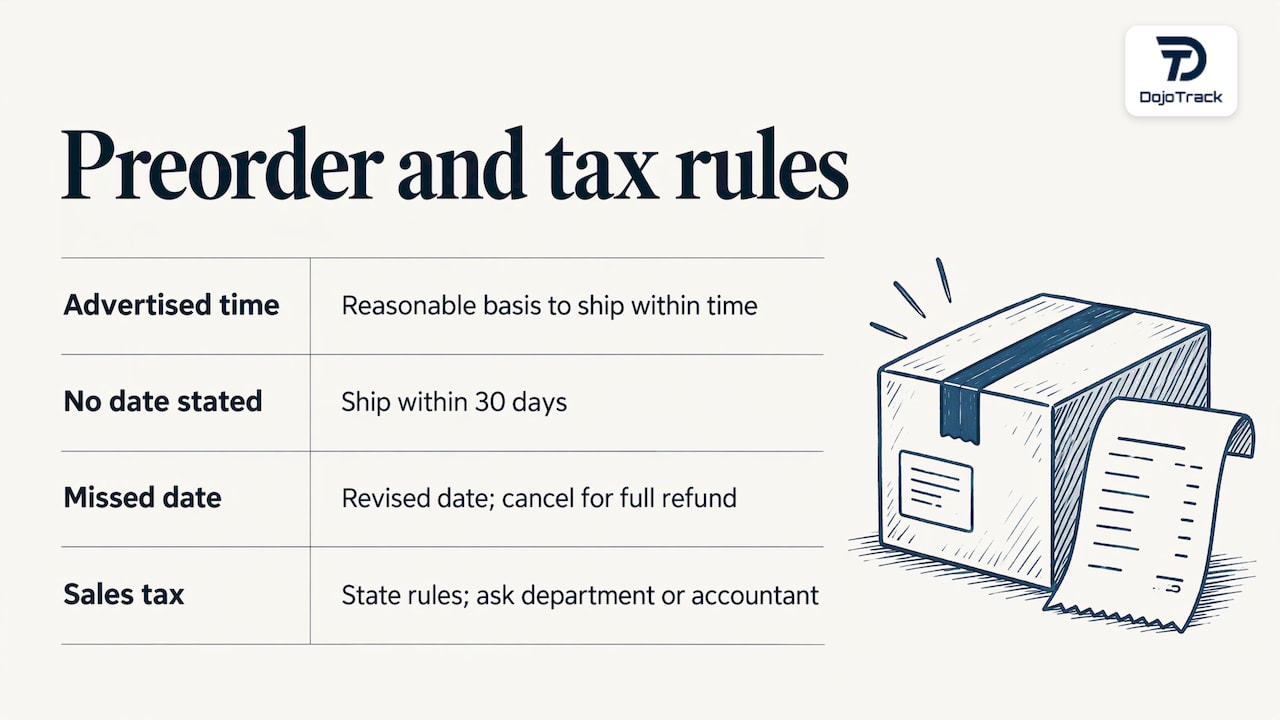
If families order online or by phone and you ship or promise delivery, a federal rule applies. The FTC’s Mail, Internet, or Telephone Order Merchandise Rule requires a reasonable basis to ship within the time you advertise or, when you state none, within 30 days. A preorder that opens in March and delivers “whenever the supplier finishes” is the situation it is meant to catch.
If you can’t meet the date, the FTC’s prompt delivery guidance says you must give a revised shipment date and explain the buyer’s right to cancel for a prompt full refund. In practice: state a delivery window you have confirmed with your supplier, build in slack, and write a delay email template now so you can send it by the original deadline if you need to.
For sales tax, the IRS points businesses to their state revenue department, because collecting sales tax is a state question. Rules differ by state, including how discounts affect the taxable amount, so ask your state department or your accountant before you design a promotion, especially if you ship to other states.
Selling merch online without losing track
Many schools now sell through an online store or the student app as well as the front desk. That raises one practical issue: the same stock sells in two places. Keep a single count and make sure a code created in one channel doesn’t conflict with the other. If you build a branded web store, loyalty program integration can connect rewards to purchases so repeat buyers earn something other than a one-off markdown.
A few habits keep things clean:
- One person owns the code list and its end dates.
- Every code gets logged with its purpose, so you can judge it afterward.
- Review results: how many redemptions, how much revenue, how many new students bought.
- Retire codes when they end. Don’t recycle the same one every month.
Run it from one place
DojoTrack is built for martial arts schools and handles memberships, attendance, family discounts, Stripe-powered recurring billing, point-of-sale inventory and a student app where members can buy from your studio. You can start on the free plan at $0 per month and move up when you need more. Paid plans are Launch at $95 per month, Scale at $125, Expand at $165, Grow at $195 and Master at $245. Texts cost $0.017 each, and renting a DojoTrack number is $2 per month. See the full plan list or open the platform to try it.
FAQ
How long should a dojo discount code last?
For a preorder, match it to the window: five to seven days is a common recommendation from gym merch suppliers. For a seasonal sale, a week or two is enough. Always set an end date and a use limit so the code doesn’t become your standard price.
Should I discount uniforms or only accessories?
Start where margin and demand allow. Bundles that include a uniform and a belt, or a second uniform for a sibling, protect your margin better than a blanket percentage off everything. Keep a record of what each code sold so you can adjust next time.
Can I combine a code with a family discount?
Only if you decide so in advance. Some tools let you set whether codes combine with other discounts, and others don’t allow stacking at all. Decide your rule, write it into your store terms and apply it the same way for every family.
Do FTC shipping rules apply to a small school?
If you take merchandise orders by internet, mail or phone, the FTC rule applies regardless of your size. You need a reasonable basis for any delivery date you promise, and a notice and refund option if you can’t meet it. Your state revenue department answers the sales tax questions.
How often should I count merchandise stock?
Count items involved in a promotion before and after it, and cycle-count a category each month. Review any difference between the shelf and your records before adjusting them, and write down the reason.
Sources
- Shopify Help Center: Discount codes
- Strength Stage Help: Create discount codes
- J.T.F. Taekwondo: Ordering, Shipping, Returns
- Forever Fierce: How to Run a Gym Merch Preorder Step-by-Step
- Forever Fierce: Gym Preorder Stores
- Black Acid Apparel: Race team merch preorders vs bulk orders
- Climbing Wall Association: Apply the Bell Curve to Predict Retail Sales
- Shopify: Preorders
- Stock Take Inventory Count app listing
- Count Comfort app listing
- FTC: Mail, Internet, or Telephone Order Merchandise Rule
- FTC: Selling on the Internet, Prompt Delivery Rules
- IRS: Starting or ending a business