

TL;DR:
- Most martial arts studios benefit from adopting three outcome-based membership tiers with the middle one as the default choice. The middle tier serves as the primary revenue driver because most students choose it when it clearly delivers a specific transformation or milestone.
The single best move for most martial arts studios is to adopt three value-based membership tiers, name them after outcomes, and position the middle tier as the default recommendation. That structure captures newcomers, converts committed students, and rewards your highest-investment members, all without leaving money on the table.
Every tier needs four things to work:
- Target buyer: Who this tier is built for (e.g., “adults new to BJJ” or “competitors training 4+ days/week”)
- Price: Monthly and annual options, with the annual rate offering roughly two months free
- Access and benefits: Exactly what the member gets, stated plainly
- 90-day outcome: The concrete transformation they can expect (a belt stripe, competition readiness, a specific skill set)
Set up your middle tier first, make it the recommended default on your pricing page, define your upgrade and grandfathering rules before launch, and publish a clear side-by-side comparison so prospects can self-select without a sales conversation.
Table of Contents
- How to create your tiered membership pricing structure in five steps
- Why three tiers work and why the middle tier is your revenue engine
- Designing value into each tier: map features to outcomes
- Pricing math and anchoring: set prices that sell
- Billing rules, proration, and grandfathering existing members
- Launch and communication plan: rolling out new tiers without losing students
- Sample tier templates for BJJ, MMA, and karate studios
- Metrics to track and a 60–90 day test window
- Common mistakes and pro tips from studio operators
- How to analyze local competitors’ membership pricing
- Legal and compliance considerations for US martial arts membership contracts
- How to segment your members to design better tiers
- Key Takeaways
- The middle tier is where most studios leave money on the mat
- Dojotrack makes tiered pricing easier to run and easier to grow
- Further reading and sources
- FAQ
How to create your tiered membership pricing structure in five steps
- Define your student segments. Group your current and prospective students into three buckets: newcomers exploring martial arts, committed students training consistently, and high-investment students pursuing competition or accelerated progress. Each bucket becomes a tier.
- Map features to outcomes. For each segment, write one sentence describing what changes in 90 days. “A newcomer learns foundational striking and earns their first stripe” is a better tier anchor than “access to beginner classes.”
- Run the pricing math and anchor the middle tier. Price the middle tier at the point where it feels like the obvious value choice next to the premium option. Offer monthly and annual billing; price the annual plan at the equivalent of ten months’ cost to boost LTV.
- Configure billing and member-management rules. Decide on proration for mid-cycle upgrades, a grandfathering policy for existing members, and how failed payments are handled before you go live.
- Launch with targeted messaging and a test window. Announce benefits, not just prices. Run a 60–90 day pilot, collect at least 50 trial signups for meaningful data, then iterate.
Why three tiers work and why the middle tier is your revenue engine
Two or three well-drawn tiers are the sweet spot for most membership communities. Fewer than two leaves money on the table; more than three creates choice paralysis that pushes prospects toward inaction.
The middle tier is your primary revenue driver. Most buyers, when presented with three options, gravitate toward the center, especially when it carries a “Most Popular” or “Best Value” badge. Design it to be the cheapest path to an outcome the entry tier simply cannot deliver, not just a version with more classes.
Naming matters more than most owners expect. Outcome-based tier names reduce confusion and help members self-select the right plan. Compare these two sets:
- Rank labels (avoid): Bronze, Silver, Gold
- Outcome labels (use): Foundations, Performance, Mastery
“Mastery” tells a student where they are going. “Gold” tells them nothing. On your pricing page, mark the middle tier with a visible badge and a one-line rationale: “Best for students training 3+ days per week.”
Designing value into each tier: map features to outcomes
Each tier should answer four questions: Who is it for? What does it cost? What do they get access to? What changes in 90 days?

The entry tier covers the basics: group classes at a set frequency, digital curriculum access, and attendance tracking. A student on this tier should be able to earn their first belt stripe within 90 days. Keep it genuinely useful; a weak entry tier drives early cancellations.
The middle tier is where you introduce access the entry tier cannot provide: unlimited group classes, small-group drilling sessions, priority scheduling, and belt-promotion eligibility on a faster cadence. The 90-day outcome is measurable progress toward the next belt rank or a specific competition skill set.
Pro Tip: Reserve the premium tier for non-scalable access only. Private coaching sessions, direct instructor feedback on recorded rounds, and limited-cohort specialty programs are the right premium perks. Adding more video content to a premium tier does not justify a higher price and burns your time.
Pricing math and anchoring: set prices that sell
Value-based pricing links price to the transformation a student receives, not the hours of mat time. A student who earns a blue belt in BJJ or competes in their first tournament has received something worth far more than the sum of their class hours.
A practical rule: price each tier well below the student’s perceived value of the outcome. If a student would pay $500 to be competition-ready in 90 days, a $149/month Performance tier is an easy yes.
| Tier | Monthly Price | Annual Price | 90-Day Outcome |
|---|---|---|---|
| Foundations (Entry) | Competitive local market rate | Ten months’ equivalent rate | First belt stripe, foundational technique |
| Performance (Core) | Competitive local market rate | Ten months’ equivalent rate | Next belt rank or competition readiness |
| Mastery (Premium) | Competitive local market rate | Ten months’ equivalent rate | Private coaching, advanced curriculum, cohort access |
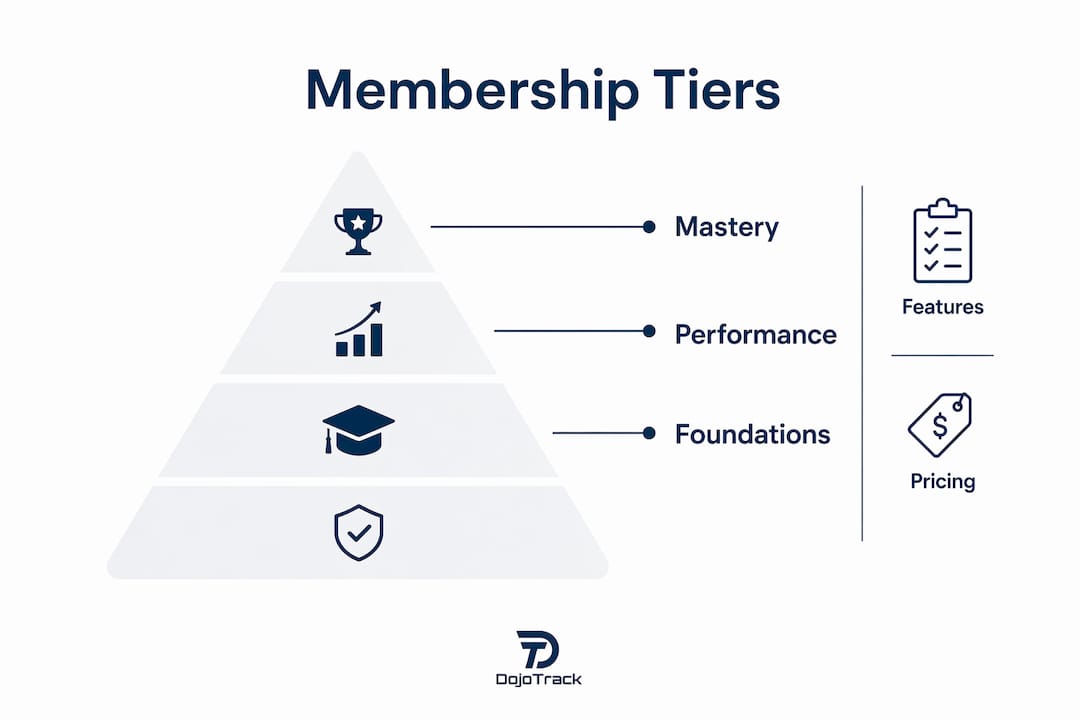
Anchor the middle tier by making the premium option visible and clearly more expensive. When a prospect sees Mastery at $229/month, Performance at $149/month feels like the smart choice. That is the anchoring effect working in your favor. Use Dojotrack’s price comparison tool to test these anchors before going public.
Billing rules, proration, and grandfathering existing members
Stripe’s subscription guidance recommends transparent features and pricing at every tier to prevent confusion and reduce churn. Apply that principle to your billing rules too.
Core billing policies to set before launch:
- Monthly vs. annual: Offer both; price the annual plan at the equivalent of ten months’ cost. Annual plans improve cash flow and LTV.
- Proration on upgrades: Charge only the difference for the remainder of the billing cycle when a student upgrades mid-month.
- Paused memberships: Allow one pause per year (up to 30 days) to reduce outright cancellations.
- Failed payment handling: Retry after 3 days, notify the student by SMS, and suspend access after 7 days of non-payment.
On grandfathering: keep existing members at their original sign-up price when you raise rates for new members. Apply new pricing only to future signups. This protects trust and retention, and it costs you almost nothing since those members are already paying.
Pro Tip: Make your member portal show the billing date, next charge amount, upgrade path, and a clear cancellation option. Hiding that information increases support tickets and erodes trust faster than a price increase ever will.
Launch and communication plan: rolling out new tiers without losing students
- Internal test first. Run your billing and proration flows with staff accounts. Confirm upgrade and downgrade paths work correctly before any student sees them.
- Pilot with a small cohort. Invite 10–20 current students to preview the new tiers. Collect feedback on perceived value and clarity of tier differences.
- Announce benefits, not just prices. Your launch message should lead with what changes for members (“You now have access to small-group drilling every Thursday”) before mentioning price.
- Highlight the recommended tier. In every communication, point to the middle tier as the best fit for most students. Use a badge, a callout box, or a direct line from your front desk staff.
- Use milestone moments for upgrade nudges. A belt promotion is the single best time to offer an upgrade. “You just earned your blue stripe. The Performance tier gets you to your next rank faster” converts well because the student’s motivation is at its peak.
Sample tier templates for BJJ, MMA, and karate studios
These templates are ready to adapt. Adjust prices to your local market after reviewing competitor rates.
| Studio Type | Entry: Foundations | Core: Performance | Premium: Mastery |
|---|---|---|---|
| BJJ Academy | — | $149/mo, unlimited group, drilling sessions, belt-promotion priority. 90-day outcome: next rank. Annual rate: equivalent to ten months. | $229/mo, all Core benefits + 2 private lessons/mo, competition prep cohort. Annual rate: equivalent to ten months. |
| MMA Gym | $99/mo, 2x/week striking or grappling. 90-day outcome: foundational combos, first sparring session. Annual rate: equivalent to ten months. | $149/mo, unlimited classes, open mat access. 90-day outcome: amateur fight readiness. Annual rate: equivalent to ten months. | $229/mo, all Core + weekly coach review of recorded rounds, limited cohort. Annual rate: equivalent to ten months. |
For the premium tier, add a scarcity signal: “Limited to 12 students.” That line alone increases perceived value and creates urgency without pressuring core members. See more karate studio membership plans for additional template language.
Metrics to track and a 60–90 day test window
After launch, watch these numbers weekly:
- Conversion rate to Core (middle tier): Your primary health metric. If fewer than half of new signups choose the middle tier, the anchoring or naming needs work.
- Upgrade rate (Entry to Core): Tracks whether your milestone nudges are working.
- Churn by tier: High churn on Entry is normal; high churn on Core signals a value gap.
- Average revenue per user (ARPU) and lifetime value (LTV): Annual plan adoption drives both.
- Retention at 30, 90, and 180 days: The 90-day mark is the most predictive for long-term retention.
Run your test window for 60–90 days and collect at least 50 trial signups before drawing conclusions. A spike in downgrade requests or support tickets about pricing is an early warning sign worth acting on immediately. Dojotrack’s membership tracking tools surface these signals in real time so you can respond before churn accelerates.
Common mistakes and pro tips from studio operators
Mistakes that cost studios revenue and trust:
- Too many tiers. Four or more tiers confuse prospects. Start with three and add only when demand clearly justifies it.
- Unclear differentiation. If a student cannot explain the difference between your Core and Premium tiers in one sentence, the tiers are not distinct enough.
- Feature bloat at the top tier. Piling on more content does not justify a higher price. Premium must offer qualitatively different access, specifically the instructor’s time and judgment.
- Frequent price changes for existing members. Every unexpected price change triggers cancellation reviews. Change prices for new members first; grandfather existing members as long as financially viable.
Pro Tip: Before full rollout, interview five to ten current students about what they would pay for specific outcomes. “Would you pay $50 more per month for two private lessons?” gives you real price-elasticity data in under an hour. Most studio owners skip this step and guess wrong.
How to analyze local competitors’ membership pricing
Pull your three closest competitors’ public pricing pages before you finalize your own. Note their tier count, price points, and what each tier includes. You are looking for two things: where they leave gaps (an outcome no one is pricing toward) and where they cluster (a price point everyone charges, which signals market tolerance).
Most US martial arts studios price group memberships in the $80–$180/month range for unlimited access. If every competitor in your area charges $99/month for unlimited classes with no differentiation, a $149/month Performance tier with a clear 90-day outcome and belt-promotion priority stands out immediately. Use Dojotrack’s martial arts pricing models guide to benchmark your rates against real-world studio data.
Legal and compliance considerations for US martial arts membership contracts
Membership contracts in the US vary by state, and several states regulate health club and fitness facility agreements directly. Key areas to address:
- Auto-renewal disclosure: Many states require clear written notice of auto-renewal terms before a member signs. Place this language prominently in your contract, not buried in fine print.
- Cancellation rights: Some states mandate a cancellation window (often 3–5 business days) after signing. Confirm your state’s specific requirement.
- Electronic signatures: Digital waivers and contracts are enforceable in all 50 states under the E-SIGN Act, provided the member actively consents.
- Billing authorization: Your payment authorization language must specify the billing amount, cadence, and how the member can cancel recurring charges.
This article is general information, not legal advice. Confirm your contract language with a licensed attorney familiar with your state’s consumer protection and health club statutes before launch.
How to segment your members to design better tiers
Segmentation turns guesswork into a pricing structure that fits your actual student population. Pull your attendance data and group current members by three variables: training frequency (sessions per week), tenure (months as a member), and stated goal (fitness, competition, self-defense).
Students training twice a week or fewer, with a fitness or self-defense goal, belong in your Foundations tier. Students training three or more times per week, with a rank or competition goal, belong in Performance. Students who ask about private lessons, compete regularly, or have been with you for two or more years are your Mastery candidates.
That segmentation also tells you how to price. If 60% of your current members fall into the Performance profile, that tier’s price point has the most revenue leverage. Dojotrack’s analytics dashboard surfaces attendance patterns and BJJ academy tier data so you can run this segmentation without a spreadsheet.
Key Takeaways
Three value-based tiers, anchored by a middle tier priced to outcomes, is the most effective membership pricing structure for US martial arts studios.
| Point | Details |
|---|---|
| Use three outcome-based tiers | Name tiers Foundations, Performance, and Mastery; avoid rank labels like Bronze or Gold. |
| Middle tier is the revenue engine | Design it as the cheapest path to an outcome the entry tier cannot deliver; badge it “Most Popular.” |
| Price to transformation, not hours | Price annual plans at the equivalent of ten months’ cost for each tier, and set prices well below the student’s perceived value of the 90-day outcome. |
| Grandfather existing members | Apply new pricing only to future signups to protect trust and reduce cancellation risk. |
| Dojotrack automates the hard parts | Use Dojotrack’s Stripe billing, proration rules, and retention analytics to run tiers without manual admin. |
The middle tier is where most studios leave money on the mat
Studios that price by the hour or the class count are solving the wrong problem. A student does not buy mat time; they buy a version of themselves that can defend a takedown, earn a belt, or step into a competition. When your pricing page reflects that, the middle tier sells itself.
The most common mistake is treating the Performance tier as “more of the same” rather than a qualitatively different path to a specific result. If your Core and Entry tiers differ only in class frequency, a student on Entry will stay there indefinitely because the upgrade does not feel urgent. Tie the middle tier to a concrete milestone, belt-promotion eligibility, competition readiness, or small-group drilling access, and the upgrade becomes obvious.
Dojotrack was built on exactly this insight. Founder Jared Reed ran martial arts schools before building the platform, and the billing, belt-tracking, and retention tools reflect what actually happens at the front desk, not what looks good in a product demo. The automated belt-promotion triggers and attendance tracking are not add-ons; they are the mechanism that makes outcome-based pricing real for students and measurable for owners.
Dojotrack makes tiered pricing easier to run and easier to grow
Running three membership tiers manually means tracking billing dates, proration calculations, upgrade requests, and retention signals across a spreadsheet or two. That is time you could spend on the mat.
Dojotrack handles the operational side of tiered pricing end to end. Stripe-powered recurring billing manages monthly and annual plans, prorates mid-cycle upgrades automatically, and retries failed payments without staff intervention. The member portal shows each student their billing date, next charge, and upgrade path, which cuts support requests significantly. Automated belt-promotion triggers and attendance tracking feed directly into the retention dashboard, so you can see which tier is churning and why before it becomes a revenue problem.
The free core platform gives you student management, attendance tracking, and scheduling from day one. Advanced billing automation, AI retention alerts, and the student mobile app unlock as you scale. Start with Dojotrack and build your tier structure on a foundation that grows with your school.
Further reading and sources
- Membership tiers: how to design and price them (Circle) — Best starting point for tier count, naming conventions, and middle-tier positioning.
- How to design your membership tiers (Behind the Scenes) — Value-based pricing framework and annual billing guidance.
- Subscription pricing models guide (Stripe) — Billing configuration, tier transparency, and proration best practices for US businesses.
- Channel memberships pricing tips (YouTube Help) — Grandfathering and price-change policies for existing members.
- Tiered pricing strategy and examples (Zuora) — Revenue optimization and tier differentiation tactics.
- Dojotrack martial arts membership pricing models — Studio-specific pricing benchmarks and real-world tier examples.
- Stripe billing for martial arts studios (Dojotrack) — Technical setup for recurring billing, proration, and failed payment flows.
- Six Love pricing and plan management — Practical examples of member-facing pricing pages and grandfathering policies from a club-management platform.
FAQ
How many membership tiers should a martial arts studio offer?
Three tiers is the right number for most studios. Two or three tiers reduce choice paralysis and let you capture distinct student segments without confusing prospects.
What is the best way to price the middle membership tier?
Price the middle tier well below the student’s perceived value of the 90-day outcome it delivers, and anchor it visually against a clearly more expensive premium option so it reads as the obvious value choice.
Should I grandfather existing members when I raise prices?
Yes. Keeping existing members at their original sign-up price and applying new rates only to future signups protects trust and reduces cancellation risk.
How long should I run a test window before changing my tier structure?
Run a 60–90 day pilot and collect at least 50 trial signups before drawing conclusions. That sample size gives you meaningful conversion and churn data to act on.
Can Dojotrack manage tiered membership billing automatically?
Yes. Dojotrack’s Stripe-powered billing handles recurring charges, mid-cycle proration, annual plan discounts, and failed payment retries, so your staff does not have to manage those workflows manually.